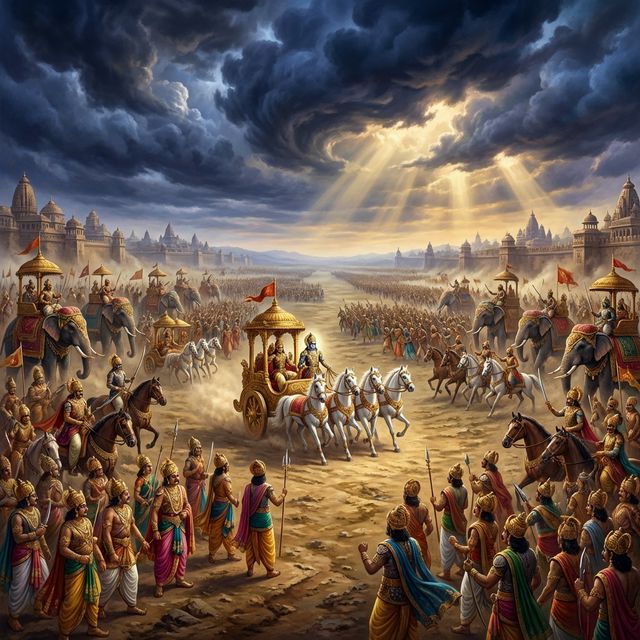
Kunti Knows Her Son
The mother who recognised Karna in the arena and stayed silent
The Assembly Divides
Vaisampayana was telling the whole of it to king Janamejaya, and he had come to the hour in the tournament at Hastinapura when the day stopped belonging to anybody.
The lists had been laid out for Drona's pupils. The princes had shot and wrestled and driven, the crowd had roared for Arjuna, and then a stranger with a natural mail on his body and ear-rings in his face had walked in like a moving cliff and done everything Arjuna had done, and the two of them now stood at either end of the arena with their bows strung, waiting for permission to kill each other.
The sky took sides before the men did. The firmament became enveloped in clouds that emitted flashes of lightning, and the coloured bow of Indra appeared over the arena, shedding its effulgent rays. Rows of white cranes went across on the wing, and the clouds seemed to laugh behind them. Indra was watching his son from up there out of affection, and the Sun, seeing it, dispersed the clouds from over his own offspring. So Phalguna stood deep in shadow, hidden under cover of cloud, and Karna stood surrounded by the rays of the Sun where everybody could see him.
On the earth the sides were plainer still. The son of Dhritarashtra placed himself beside Karna. Bharadwaja's son Drona, and Kripa, and Bhishma stationed themselves with Partha. The assembly split down the middle, and Vaisampayana notes that the women in their galleries split with it, some of them calling for the boy they had watched grow up in the palace and some for the stranger who had come in out of nowhere with the sun on him.
And knowing the state of things, Kunti the daughter of Bhoja swooned away.
She was the only person in that arena who had counted the men on the sand and got two.
Sandal-Paste and Water
It was Vidura who reached her.
He was the third of the brothers of that house, born to a waiting-woman and therefore never to be king, and the epic introduces him almost every time with the same phrase: versed in the lore of all duties. He was the man in the Kuru household who always knew what ought to be done next, and who was almost never asked. On this occasion nobody had to ask him. He came with the female attendants, and by their help he revived the insensible Kunti, sprinkling sandal-paste and water on her person until she came back.
She opened her eyes on the same arena. Nothing had been fixed while she was away from it. Both of her sons were still standing there clad in mail, and Vaisampayana sets down what happened in her with a flatness that is worse than any lament. On being restored to consciousness, Kunti, seeing her two sons clad in mail, was seized with fear, but she could do nothing.
There was one thing she could have done. She could have walked out onto that sand in front of Bhishma and Drona and the whole city and said the sentence that would have stopped the fight, and she did not say it, and she would not say it for another forty years.
What stopped it instead was procedure. Kripa, the son of Saradwat, who knew the rules that regulate duels, asked the stranger for his lineage, the names of his father and mother, and the royal line he adorned, because sons of kings never fight with men of inglorious lineage. Karna's face, at that, became like a lotus pale and torn by the pelting showers of the rainy season. And Duryodhana, rather than let the question be answered, made him a king on the spot, and Anga was given away with parched paddy and flowers and water-pots and gold while the umbrella was held over his head.
Kunti sat in the gallery and watched her eldest son crowned by her second son's enemy, and said nothing.
The Man With the Staff
Then, while the cheering was still going on, an old man came into the lists.
His sheet was hanging loosely down off him. He was perspiring and trembling, and he was supporting himself on a staff, and he was walking out across ground that had been cleared that morning for princes. This was Adhiratha, a charioteer in the service of the Kuru house, the man who had lifted a basket out of the river years before and found a child in it with armour growing on his body, and who had raised that child as his own son with his wife Radha.
He had heard what was being shouted in the streets. He had come to see it.
Karna saw him and put down his bow.
Vaisampayana is exact about the order of the movements, because the order is the whole of it. The new king of Anga left his weapon on the ground, and then, impelled by filial regard, he bowed his head. The head was still wet. The water of the inauguration was still standing in his hair.
The charioteer hurried forward. The first thing he did, before he said anything at all, was to cover his own feet with the end of his sheet, because bare feet are not brought into the presence of a crowned man, and the man being crowned was his boy. Then he addressed Karna, crowned with success, as his son. Then he embraced him, and from excess of affection he bedewed that head with tears, so that the coronation water and the father's weeping were on the same hair and could not be told apart.
In an arena that had spent the whole afternoon trying to find out who this man was, the question had just been answered in public, in the plainest possible way, by the one person who could answer it.
And the arena watched the answer with great interest.
As Befits Thy Race, Take the Whip
Bhimasena was the first to speak.
He had seen the charioteer, drawn the obvious conclusion, and found the thing funny. And he said, by way of ridicule, in a voice pitched to carry across an arena: "O son of a charioteer, thou dost not deserve death in fight at the hands of Partha. As befits thy race take thou anon the whip. And, O worst of mortals, surely thou art not worthy to sway the kingdom of Anga, even as a dog doth not deserve the butter placed before the sacrificial fire."
It is worth being clear about what is in that speech, because the poem does not soften it. The first sentence is not an insult about birth alone. It is a ruling on who is worth killing. Bhima is saying that his brother cannot be permitted to fight this man because winning would be no honour, and losing would be a disgrace beyond measure, and either way the contest is beneath the family. The second sentence hands Karna a driver's whip in front of the city. The third puts him beside a dog nosing at the butter that has been set apart for the fire, which is the worst thing that can be said of a creature in a place where the fire is the centre of everything.
Karna did not answer it.
His lips quivered slightly. He fetched a deep sigh. And then he looked up, out of the ring of faces, at the God of the day in the skies.
That is all Vaisampayana gives him, and it is enough, because the man he was looking at was his father, and neither of them said so. He had one father holding his feet covered by a sheet and weeping on his head, and one father standing overhead in the sky where the whole world could see him and nobody would believe it, and between the two of them he stood in a borrowed crown with a whip being offered to him.
The Lineage of Heroes Is Unknown
Then, as a mad elephant rises out of an assemblage of lotuses, the mighty Duryodhana rose in wrath from among his brothers.
"O Vrikodara, it behoveth thee not to speak such words. Might is the cardinal virtue of a Kshatriya, and even a Kshatriya of inferior birth deserveth to be fought with."
Then he made the argument, and it is one of the strangest speeches in the Adi Parva, because it is entirely correct and it is being made by the wrong man for the wrong reason.
"The lineage of heroes, like the sources of a lordly river, is ever unknown." Nobody can walk up a great river to the spring it came from. "The fire that covereth the whole world riseth from the waters," which is the submarine fire, the thing least like water there is, born out of the sea. "The thunder that slayeth the Danavas was made of a bone of Dadhichi," so that the weapon Indra rules heaven with came out of the skeleton of a man who agreed to die for it. "The illustrious deity Guha, who combines in his composition the portions of all the other deities, is of a lineage unknown. Some call him the offspring of Agni, some of Krittika, some of Rudra, and some of Ganga." The war-god himself has four different mothers, depending on whom you ask, and nobody thinks less of him for it.
Then he came down out of the sky and into the arena, where it stung.
"It hath been heard by us that persons born in the Kshatriya order have become Brahmanas. Vishvamitra and others have obtained the eternal Brahma. The foremost of all wielders of weapons, the preceptor Drona, hath been born in a waterpot, and Kripa of the race of Gotama hath sprung from a clump of heath."
The two men who had been running that tournament since sunrise were standing in earshot. One of them had been born into a pot. The other had been found in a patch of grass. Neither of them had a birth to boast of, and neither of them had asked Karna his until the crowd made it necessary.
Can a She-Deer Bring Forth a Tiger
Having disposed of the general question, Duryodhana turned to the particular one, and he did it by looking straight at the five brothers.
"Your own births, ye Pandava princes, are known to me."
He left it there. He did not have to go on. Everyone in that arena knew that Pandu had been under a curse that made fatherhood fatal to him, and that his sons had come to Kunti from the gods, and it was a thing spoken of as a wonder and never as a doubt. Duryodhana had just put the wonder and the doubt in the same sentence and set it down in the middle of the sand, and then he walked away from it and went back to the man in the new crown.
"Can a she-deer bring forth a tiger, of the splendour of the Sun, and endued with every auspicious mark, and born also with a natural mail and ear-rings?"
He was arguing from the body. The armour was not put on; it had grown. The ear-rings were not gifts; they were part of the face. No charioteer's household in the world had ever produced such a thing, and therefore, said Duryodhana, whatever the old man with the staff believed, this was not a charioteer's son.
He was right. He had reasoned his way to the truth from the evidence in front of him, in public, at the top of his voice, and he had no idea what he had proved, and neither did anybody else who was cheering.
"This prince among men deserveth the sovereignty of the world, not of Anga only, in consequence of the might of his arm and my swearing to obey him in everything. If there be anybody here to whom all that I have done unto Karna hath become intolerable, let him ascend his chariot and bend his bow with the help of his feet."
There was a confused murmur among the spectators, approving of the speech. Nobody got into a chariot.
And in the gallery a woman heard a boy she had never raised described by his marks, one after another, until the list was complete.
Countless Lamps
The sun went down.
He had held the clouds off his son all afternoon, and when the light went the duel went with it, because no more could be done that day. So prince Duryodhana took Karna by the hand and led him out of the arena, and the arena had been lit by then with countless lamps, and the two of them walked out through all of it together.
The Pandavas went home the other way, accompanied by Drona and Kripa and Bhishma.
The people came away arguing, as crowds do. Some named Arjuna as the victor of the day. Some named Karna. Some named Duryodhana, who had not shot a single arrow and had won more than either of them.
And Kunti walked back to the palace having recognised her son.
Vaisampayana says how she knew him: by the various auspicious marks on his person. The mail. The ear-rings. Whatever else there was on that body that a mother had looked at once, on a riverbank, before she put it in a basket and pushed it into the water. She had fainted when she saw them and she had been brought round with sandal-paste and water, and now she had seen him made a king in front of the whole city, and Vaisampayana records her feeling in one clause and does not enlarge on it. She was, from motherly affection, very pleased.
That is the last thing the section says about her, and it is the measure of what the day cost. Her eldest son had been crowned, and she was glad. Her eldest son had been called a dog at the fire in front of ten thousand people, and she had sat still. Her youngest had sworn to kill him and had been sworn to in return, and she had said nothing to either of them.
Duryodhana, having obtained Karna, banished the fear of Arjuna's archery that had been eating him for years. Karna set about gratifying his new friend with sweet speeches. Yudhishthira went to bed convinced that there was no warrior on earth like this man.
And Kunti went to her rooms and kept her mouth shut, and kept it shut through the dice and the exile and the war, until the day she came to a river to tell him herself, and by then it was too late for both of them.
Dharma Lesson
Kunti is given the one piece of knowledge that could have stopped the quarrel before it hardened, and she keeps it, and the epic does not excuse her for it. The reasons are real: a word from her would have unmade her own honour and her sons' claim, and there was no hour in that arena when speaking would have been safe. But the poem is careful to note that she was pleased when he was crowned, which means she had already begun taking the comfort of a mother without paying any of the cost. A truth withheld does not stay where it is put; it goes on gathering interest until someone has to pay it in full, and in this house the payment was made at Kurukshetra.