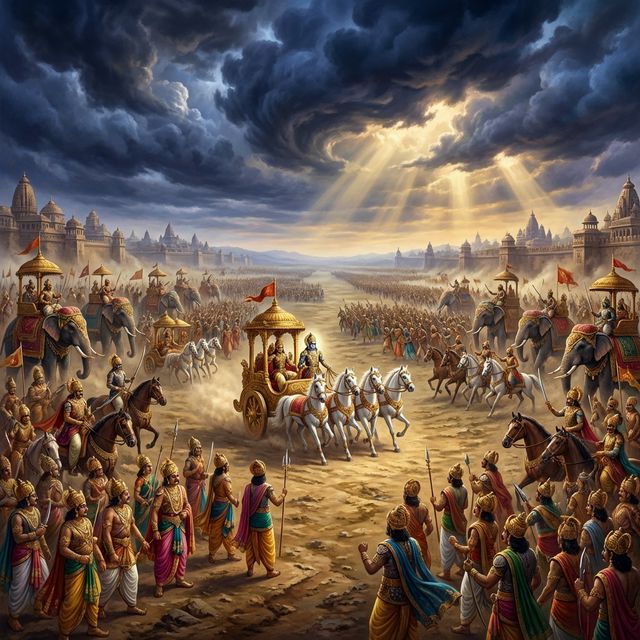
Kunti's Swayamvara
The princess no king asked for chooses Pandu in a hall of monarchs
The Daughter Nobody Asked For
Vaishampayana was telling king Janamejaya the history of his own house, working forward from the ancestors toward the generation that would fight the war, and he came to a princess in a small western kingdom who was waiting to be married and was not being married.
"The large-eyed daughter of Kuntibhoja, Pritha by name," he said, "was endued with beauty and every accomplishment. Of rigid vows, she was devoted to virtue and possessed of every good quality."
She had been born elsewhere. Her father by blood was Sura, a chief among the Yadavas and the father of Vasudeva, and Sura, who was always truthful in speech, had given his firstborn daughter away in her childhood to his childless cousin and friend Kuntibhoja, pursuant to a promise made long before she existed. So the girl who was Pritha in one house became Kunti in the other, and grew up in it looking after the duties of hospitality to Brahmanas and other guests, and did it well enough that the accomplishments Vaishampayana lists were not flattery. There is a whole girlhood behind that sentence, and one terrible guest in it, and a boon she was carrying about with her that nobody in her father's court knew she had.
Then comes the line that turns the story, and it is one of the strangest in the Adi Parva.
Though endued with beauty and youth and every womanly attribute, yet it so happened that no king asked for her hand.
Vaishampayana gives no reason for it. He does not say she was too proud, or that her adoption made her doubtful, or that some rumour ran ahead of her. He simply records that the princes of the earth, who were in the habit of sending embassies about far less promising alliances, did not send for this one, and that the years in which such offers arrive came and went in silence in the house of Kuntibhoja.
Her father was watching. And at last, seeing this, he did the thing a king does when the world will not come to his daughter.
The Invitation Sent to Every Country
He invited, O best of monarchs, the princes and kings of other countries, and desired his daughter to select her husband from among her guests.
That is a swayamvara, and it is worth being clear about what Kuntibhoja was doing, because the word is used loosely. He was not holding a contest. There was no bow to be strung, no target hung from a wheel, no test set to sort the assembly into one winner and a hall of humiliated losers, as there would be one day at Kampilya for the daughter of a king of Panchala. He was not putting her up as a prize. He was summoning every crowned head who would come, seating them in one place, and handing his daughter a garland.
The choice was hers. That is what the ceremony was for. A father who could not get an offer for his child did not have to accept that as the world's last word on her; he could reverse the direction of the whole transaction and let her do the asking, in public, with the kings of the earth sitting still and waiting to see where she walked.
It is a considerable act of faith in a girl. It also puts every risk on her. In an ordinary marriage the negotiation is done by messengers and elders, and a refusal is absorbed by intermediaries; here the daughter of a modest house was to cross an open floor in front of men who had come a long way, and to be looked at by all of them at once, and to be seen deciding.
The invitations went out to the other countries. They came for them. Kings and princes travelled to the kingdom of Kuntibhoja, with the elephants and the horses and the cars that such men travel with, and the amphitheatre filled, and every seat in it held a man who had not thought to ask for her and had come anyway now that the asking was to be done by her.
A Concourse of Crowned Heads
The intelligent Kunti entered the amphitheatre.
Vaishampayana does not describe her walk in or what she wore, which is a mercy, because he wants the reader looking where she was looking. What she came into was a concourse of crowned heads. Not a court, where there is one king and the rest are subjects, but a hall in which every man present was a king somewhere, each with his own city behind him, his own army, his own line of ancestors, his own reasons for having come.
She had grown up doing hospitality in that house. She had been the one who met arrivals at the door, saw that guests were fed, and gauged the temper of a stranger before he had finished sitting down; the household duties of an adopted daughter had trained her, without anyone intending it, in exactly the skill the moment required. She was being asked to read a room full of monarchs and pick one, once, for the rest of her life, with no way to ask a second question afterward.
So she went along the rows and looked at them.
The kings who had come are never named. Vaishampayana gives no roll of them, as he gives rolls of warriors elsewhere, and any one of them would presumably have made a marriage her father could have been satisfied with. They stay a mass of splendour, the way a field of soldiers is a mass, and out of that mass the narrator lifts one man and holds him up, and the reason he can do it in a single sentence is that everyone in the amphitheatre had already done the same thing with their own eyes.
Because there was a man there who outshone all other monarchs in splendour, and he was sitting in a hall where that was not an easy thing to do.
Another Indra in That Assemblage
She beheld Pandu, the foremost of the Bharatas, that tiger among kings.
He was the middle son of the three that Vyasa had raised up for the dead Vichitravirya, born pale, born to Ambalika, and by then the king in Hastinapura, because his elder brother Dhritarashtra had been passed over for blindness and Bhishma had put the crown where the law of a king's fitness said it must go. So the man on the bench was not a suitor of the ordinary sort. He was the Kuru throne itself, come west in person to a small kingdom to sit in a row with other men and be looked at.
Vaishampayana describes him the way the epic describes its best men, in four strokes and no adjectives of feeling. Proud as the lion. Broad-chested. Bull-eyed. Endued with great strength. And in that royal assemblage, among all those crowned men, he looked like another Indra.
That is the comparison the text reaches for, and it is not decoration. Indra is not merely the strongest of the celestials; he is the king among them, the one whose primacy the rest concede by sitting where they sit. To say that Pandu looked like Indra in that hall is to say that the ranking had already happened, silently, before anybody moved, and that every monarch on those benches knew where he stood in it.
The amiable daughter of Kuntibhoja, of faultless features, beholding Pandu in that assembly, became very much agitated.
The word is put down plainly and then left alone. She had come in composed, she had gone along the rows in the character of a woman conducting an examination, and at one bench the examination stopped and something else happened to her that she had not planned and could not conceal. The whole hall was watching her face. Whatever went across it, they saw.
Then she had to walk.
The Garland
Advancing with modesty, all the while quivering with emotion, she placed the nuptial garland about Pandu's neck.
Everything the episode is about is in that half sentence. She advanced, which is to say she crossed the floor herself, on her own feet, in front of the assembled kings of the earth, and nobody led her and nobody spoke for her. She advanced with modesty, in the manner the occasion required of her, keeping her bearing in a room where a hundred men were staring. And she was quivering the entire way, and the text says so, and does not apologise for saying so.
This is the girl no king had asked for. She had been given away once as a child, in a promise made between two men before she was old enough to know about it, and she had lived since in a house that was kind to her and was not the one she was born in. She had never yet chosen anything in her life. What she was doing now, in the sight of everyone, was choosing, and the whole apparatus of the swayamvara existed for no other purpose than to make her free to do it and to make it impossible for anyone afterward to say that she had not.
She lifted the garland and put it over his head.
The other monarchs, seeing Kunti choose Pandu for her lord, returned to their respective kingdoms on elephants, horses and cars, as they had come.
There is no protest recorded, no insult thrown, no chariot wheeled around in fury, none of the wreckage that other swayamvaras in this epic leave behind them. They looked at the garland on the neck of the Kuru king, and they got up, and they went home the way they had arrived, and the hall emptied around a woman who had just made the one decision she was ever offered and had made it, as it turned out, for the man whose life was going to be shorter than anyone in that amphitheatre could have guessed.
Like Maghavat and Paulomi
Then the bride's father caused the nuptial rites to be performed duly.
Duly is the important word. Kuntibhoja had improvised the choosing, because the ordinary route had failed him, but he did not improvise anything else. Every rite that a marriage requires was done, in its order, with nothing omitted and nothing shortened, so that when the ceremonies were over there was no clause anywhere in it that a later king or a later lawyer could put a finger on. The daughter given away as a child, whose hand no monarch had asked for, was married with the full form of the law to the head of the first house in the land.
The Kuru prince blessed with great good fortune and the daughter of Kuntibhoja formed a couple like Maghavat and Paulomi.
Maghavat is Indra, and Paulomi is Sachi his queen, and having already compared the man to the king of the celestials on his bench, Vaishampayana now extends the comparison to cover both of them together. It is the highest thing the epic knows how to say about a married pair. It is also, read from where the reader stands, an unbearable sentence, because Indra and his queen are deathless and this couple had perhaps fifteen years.
King Kuntibhoja, after the nuptials were over, presented his son-in-law with much wealth.
The adoptive father who could not get an offer for his daughter now had the Kurus for kin, and he was not going to send them away modestly provisioned. The gifts went out of his treasury in the quantity such an alliance called for, and the man who received them was the richest king in Bharatavarsha and took them anyway, because that is what the giving and taking of gifts is for between houses that have just become one house.
And then he sent him back to his capital, and the hardest thing in the whole affair was done, which was letting her go with him.
He Established His Queen Therein
The Kuru prince Pandu went home in the style of a king who has got what he came for.
He was accompanied by a large force bearing various kinds of banners and pennons, and it moved east across the country at the pace of an army, and the whole length of it was audible before it was visible. Brahmanas and great Rishis walked with the column pronouncing benedictions on the marriage, so that the noise around the new queen for the entire journey was the noise of men wishing her well in formal language, mile after mile, from the kingdom she had grown up in to the city she had never seen.
She had done this once before, as a small girl, going the other way. She had been handed from her father's house to Kuntibhoja's on the strength of a promise, and had learned in a borrowed house how to be flawless in it. Now she was travelling again, in the opposite direction, in a great deal more noise, to a third house.
They reached the capital. Hastinapura, the city named after the elephant, with Bhishma in it, and Dhritarashtra in it, and the whole weight of the Kuru succession sitting on a family that had very nearly run out of heirs two generations running and knew it.
And after arriving at his own palace, he established his queen therein.
That is where Vaishampayana leaves them, and it is the plainest possible ending to the plainest possible love scene, a king installing a wife in the apartments that are hers. Within the month Bhishma would be riding to Madra to fetch a second one, and the years after that would take the marriage apart piece by piece, a hunt in the forest, a curse, a mountain, a boon spoken over a girl by a Brahmana in a house in the west while she was still carrying jars for guests.
None of it had happened yet. What had happened was that a woman nobody asked for had walked across a floor full of kings and picked one.
Dharma Lesson
The swayamvara is usually remembered as a contest between men, but here it is a remedy for a girl the world had overlooked. Kuntibhoja could not make the kings ask for his daughter, so he gave her the power to ask instead, and the epic records without embarrassment that she was frightened while she used it. Choosing is not the same as being certain. The one decision Kunti was ever offered she made in public, quivering, and then lived out every consequence of it without once pretending she had been forced.