The Crown Passed Sideways
In the hall of white pillars at Hastinapura the elders of the Kuru house sat in council, and the question before them was as old as kingship and as sharp as a blade. Vichitravirya was ashes. Three young men had grown up in his name, and only one of them could be consecrated.
Dhritarashtra was the eldest, and he had been born without sight. Pandu, the second, had come into the world pale as a winter morning, and men murmured about the pallor, though no murmur ever touched his arm or his aim. Vidura, third and wisest of the three, was the son of a serving woman and could never wear the crown, however plainly he saw what others missed.
Bhishma rose. Grandsire of them all, the vow-bound son of Ganga, he spoke without heat and without apology. 'The eldest has every virtue but one,' he said. 'A king rides at the head of his army. He reads the faces of those who come to him with grievances and sees the lie before it is spoken. The learned do not permit a blind man to carry the rod of punishment. I say this in love, Dhritarashtra, and not in judgment, and I will say it once and never again.'
Dhritarashtra sat with his hands upon his knees and his face turned toward the sound of the voice, and said nothing at all.
'Then let Pandu be consecrated,' said Vidura, 'and let his brother be honored above every man in this kingdom save the king alone. A house split at the root bears bitter fruit for a long time.'
The council assented. Sacred water was poured over Pandu's head, the white umbrella was raised, and the drums went out over the city. That night the new king found Bhishma on the terrace above the treasury and spoke quietly. 'Grandsire, you have given me a crown and an empty vault.'
'I have given you a duty,' Bhishma said. 'Your father's long sickness ate what his fathers gathered. The kingdoms around us have stopped sending tribute because they have stopped being afraid. Go and remind them.'
The March Against Dasharna
Pandu had lately been wed twice over, to Kunti of the Yadu house and to Madri of the Madras, and the women of the palace expected a season of festivals. They got a season of armorers instead.
The king went down to the yards himself. He counted chariots and rejected a third of them. He had the elephants driven through water to see which of them balked. He asked the quartermasters not how much grain the granaries held but how many days it would carry an army marching away from them, and when the answer came back vague he sat with the ledgers until it came back exact.
'Where do we go first?' asked the commander of his horse.
'East,' said Pandu. 'Everything that has stopped paying us lies east. And the ones who watch us will judge us by the first city we take, so we will take a hard one.'
The army left Hastinapura in the cool of the year, and the dust of it hung over the road for a day after they had passed. They came into the country of the Dasharnas, and the Dasharna king met them in the open with a good force and the confidence of a man who had not been troubled by the Kurus in a generation.
The confidence lasted until the second watch of the battle. Pandu fought from the chariot the way he did everything, without display and without pause, and the pale face under the helm became a thing the enemy line began to follow with its eyes and then to move away from. By evening the Dasharna standards were down, the king was a prisoner in his own field, and the terms were read aloud to him: tribute, hostages of good family, and free passage for Kuru troops through his country forever.
'You have not even rested,' the Dasharna king said, watching the Kuru camp already breaking.
'I will rest at home,' said Pandu, 'and I am not going home yet.'
Dirgha of Magadha
Word of Dasharna ran east faster than the army could march, and it reached Girivraja, the fortress city of Magadha, cupped among its five hills like a stone held in a fist. There sat Dirgha, who had made himself hated in a very particular way. He had insulted kings. Not fought them, which is honorable, but shamed them at his own gates and sent their embassies home with their gifts thrown after them, because his walls were high and the hills were his and he believed no army would ever stand under them long enough to matter.
Pandu's council urged caution. 'Girivraja has never been taken,' said an old warrior. 'The passes between those hills are made for killing men who enter them.'
'Then we will not enter them in the order he expects,' said Pandu.
He kept the greater part of his force in plain sight before the northern gate, drawn up in ceremony, as though he intended a siege of years. Dirgha came onto the wall to watch it, pleased, and was still watching when the Kuru assault came up through the eastern gap in the dark, where the rock was bad and the guard was thin because the rock was bad.
They fought in the streets of Girivraja before the city knew the streets were the battlefield. Dirgha, who had never had to be brave at close quarters, was brave at close quarters for a very short time. Pandu killed him in his own city, among his own hills, and then did the thing that made the whole eastern country listen: he stopped the sack.
'Take the treasury,' he ordered. 'Take the arms. Touch a house or a shrine or a woman of this city and I will have you cut down by your own comrades. We came for tribute, not for ruin. A burned kingdom pays nothing next year.'
Magadha's ministers, expecting fire, brought him keys instead. The carts began to fill.
Kashi, Suhma, and the River Kings
After Magadha, the rest of it had the quality of a door swinging open. Pandu turned toward Mithila and the Videhas, and the Videhas came out to him with their submission already written. He crossed into Kashi, oldest of cities, where the ghats went down into the river and the smoke of the fires never lifted, and the Kashi king fought him once for honor's sake and then made peace with grace, because the alternative had been demonstrated at Girivraja.
'You are not what we were told,' the Kashi king said. 'They said the Kurus had grown old and quiet.'
'The Kurus grew sick,' said Pandu. 'That is a different thing, and it passes.'
He went on. The Suhmas gave way, and the Pundras after them, and the kings of the river country, whose wealth came up the water in boats and whose armies were built for the water and not for the road. One by one they weighed the season and sent out their elders with the customary gifts, and one by one Pandu received them without arrogance, seated on a plain camp seat, asking each about his harvest and his borders and his sons.
The tribute became a problem of logistics. There was gold, and there was more than gold: horses of the eastern breeds, elephants with their drivers, sandalwood, blankets of wool and silk, hides, pearls out of the southern sea, jars of honey and ghee, cloth in bales taller than a man, and coined and uncoined metal packed in chests that took four men to lift. Pandu had to send home for carts twice, and the second time he sent for oxen as well.
'How much is enough?' his commander asked him one evening, looking down the line of the baggage train, which no longer had a visible end.
Pandu did not smile often. He smiled then. 'Enough is when Bhishma tells me it is enough,' he said. 'Not before.'
The Wealth at Bhishma's Feet
Hastinapura had not seen such a return in living memory. The city came out onto the walls and the roofs to watch the column come up the northern road, and the column took the better part of two days to enter the gates. Old men wept in the street, which is the ordinary way of old men, and the young ones did what was more useful and made a great deal of noise.
Pandu did not go first to his own hall. He had the carts driven into the court where Bhishma stood with Dhritarashtra at his side and Vidura a step behind, and he had the chests opened there in the open air, and then he came down and set his forehead at the grandsire's feet.
'It is yours,' he said. 'You gave me the kingdom. I have only brought back what was owed to it.'
Bhishma raised him up and could not immediately speak, and the court saw the son of Ganga wipe his eyes, which the court did not often see.
The vault was filled and the kingdom changed with it. Dhritarashtra, in the years that followed, performed sacrifice after sacrifice out of that wealth, feeding brahmanas and guests until the sacrificial grounds outside the city were never entirely empty. Vidura's ministers repaired the roads, and merchants came back, and the tribute arrived each year without a soldier being sent to ask for it. Every measure of standing the Kuru house held from then on, every claim to a share that would one day be argued over by five brothers and a hundred, rested on those carts.
And at the height of it, Pandu came to Bhishma and said the thing no one expected.
'Keep the realm for me. Dhritarashtra is the elder and Vidura is wiser than both of us. I am going to the mountains with my queens, to live by the bow and sleep on the ground and be a man again instead of a treasury.'
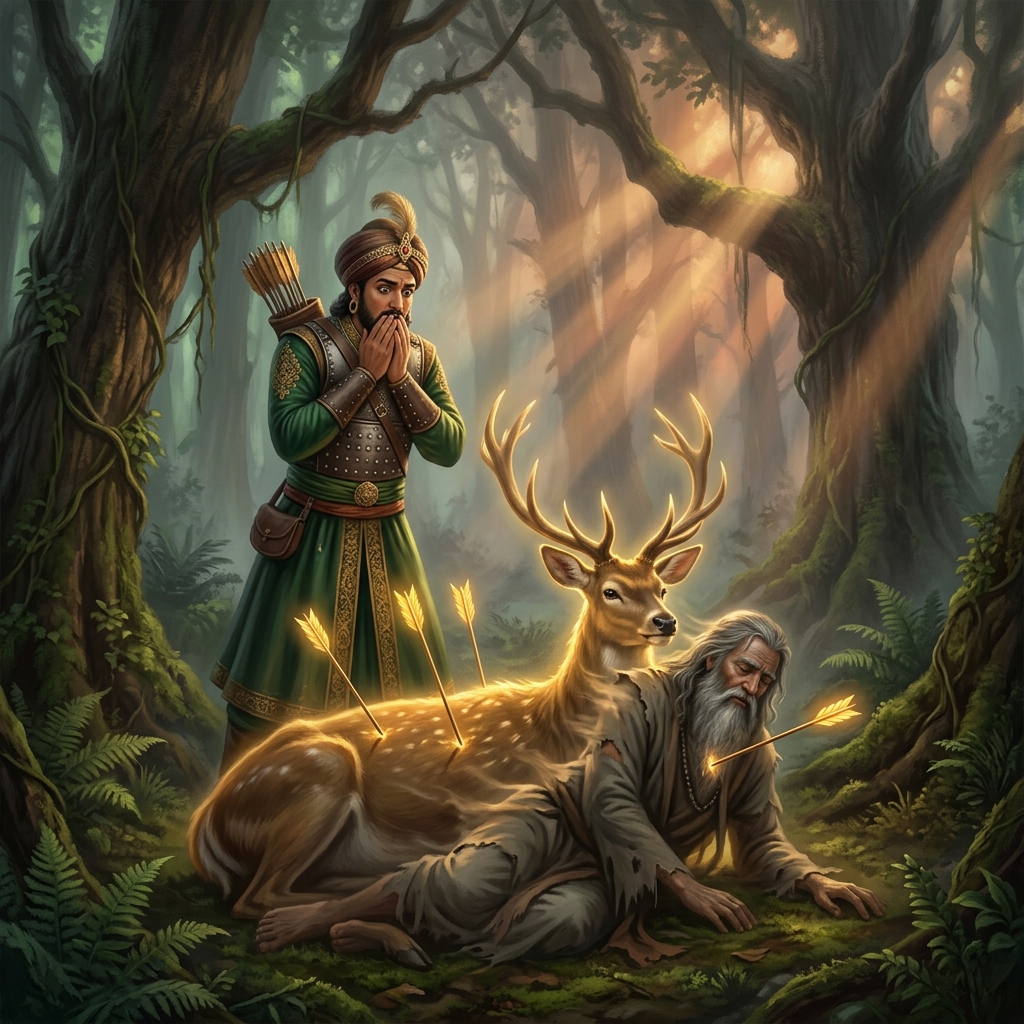
They argued. He went. Kunti and Madri put off their ornaments and went with him into the foothills, where a deer in the grass and an ascetic's dying curse were waiting to end everything.
Dharma Lesson
Pandu shows that a throne is not a reward but a debt, and that the first payment on it is made with the body. He conquered not for the pleasure of conquest but because a weak house invites ruin upon everyone it shelters, and he laid every cart of the winnings at the feet of the elder who had given him the crown. Yet the same story warns that glory is a poor resting place: the king who filled the treasury could not fill himself, and walked away from all of it to look for something the treasury did not hold.