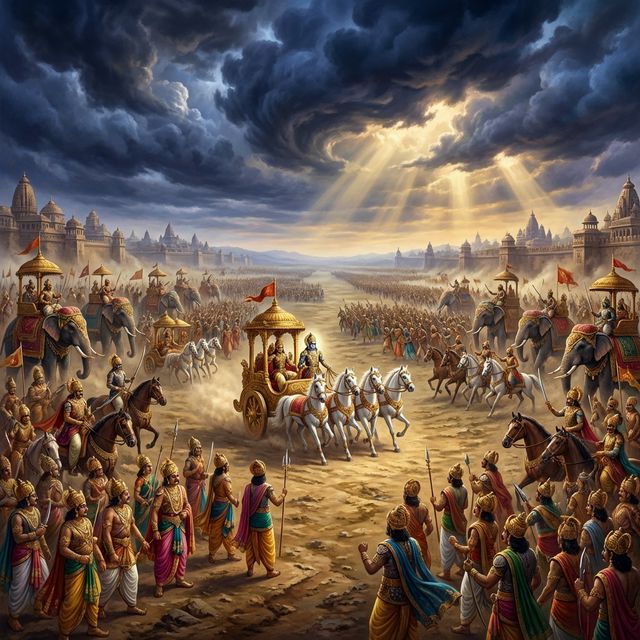
The Vow of Ten and Two Years
Krishna keeps a twelve year vow on the mountain and a fire walks out of his mouth
The Question Asked in Krishna's Hearing
The old man on the arrows had been answering questions about gifts. What kinds there are, who should receive them, what each is worth. Yudhishthira had heard the five classes named and set out, and then he changed the subject, and the way he changed it is worth noticing.
"O grandsire, thou art possessed of great wisdom," he said. "Indeed, thou art fully conversant with every branch of learning. In our great race thou art the only individual that swellest with all the sciences. I desire to hear from thee discourses that are interwoven with Religion and Profit, that lead to felicity hereafter, and that are fraught with wonder unto all creatures."
Then he gave his reason, and the reason was not curiosity.
"The time that has come is fraught with great distress. The like of it does not generally come to kinsmen and friends. Indeed, save thee, O foremost of men, we have now none else that can take the place of an instructor."
That is a king who has won a war saying, in front of everyone, that there is nobody left alive to teach him. The men who would have taught him are in the ash on the field outside. What remains is one dying man held above the ground on the points of arrows, and the days he has left are being counted.
And then Yudhishthira pointed at the person sitting nearest.
"This one is Narayana who is endued with every prosperity and is honoured by all the kings. Even he waits upon thee, showing thee every indulgence and honouring thee greatly. It behoveth thee to discourse unto me, through affection, for my benefit as also for that of my brothers, in the presence of Vasudeva himself and of all these kings."
It is an argument and a courtesy at once. If God himself sits here attending on you, said the king, then what you have to say is worth the attention of the rest of us.
Vaisampayana, telling all this long afterwards to Janamejaya, says that Bhishma, the son of the river called after Bhagiratha, was filled with joy at the words, out of affection for the monarch and his brothers, and that he answered.
Three Things Bhishma Promised to Tell
"I shall certainly recite to thee discourses that are delightful," Bhishma said, "on the subject, O king, of the puissance of this Vishnu as displayed in days of yore and as I have heard from my preceptors."
He was pointing while he said it. The puissance of this Vishnu. The man sitting at the foot of the arrow-bed with his hands folded, whom the kings all honoured and who had spent the war driving somebody else's chariot, was the subject of the discourse that was about to be delivered in his presence.
Then Bhishma named the second thing.
"Listen to me also as I describe the puissance of that great god who has a bull for his device."
And then the third, which is the strangest promise of the three.
"Listen to me as I narrate also the doubt that filled the mind of the spouse of Rudra and that of Rudra himself."
A doubt in the mind of a god. Not an error, and not ignorance of the ordinary human kind, but a question standing unanswered in the mind of the deity who destroys the worlds, and another standing in the mind of his wife. Bhishma offers this as a thing worth hearing about, and he offers it in the same breath as the powers of Vishnu and of Mahadeva, as though the three were one subject rather than three.
They are one subject. That is the whole design of what follows. The two great gods appear in this discourse not as rivals to be ranked but as two halves of a single account, and the joint of the account is a question that one of them could not answer for himself and had to be told.
Then Bhishma began, and he began not with a god on a mountain but with a man on a mountain, and the man was the one sitting in front of him.
"Once on a time," he said, "the righteous souled Krishna observed a vow extending for ten and two years."
Ten and Two Years
Twelve years, and the number is given in the old manner, ten and two, the way a man counts something he intends you to feel the length of.
A vow of that duration is not a resolution. It is a residence. It begins with Diksha, the rite of initiation, after which the man who has undertaken it is no longer at liberty to be anyone else until the term is finished. His food is fixed. His seat is fixed. His speech, his sleep, the hours at which he pours his fire, all of it is set out beforehand and then simply endured, day after day, through twelve turnings of the seasons on a mountain, and the whole apparatus is called a vow because there is nothing else to call it.
Who was doing this is the thing to hold on to. Not a forest recluse with nothing else to spend. The son of Devaki. The man who would later stand in a chariot between two armies and be asked what a soul is. He had gone up to a delightful and auspicious mountain and passed through the rite of initiation, and he was sitting out the term like any other ascetic, with the observance for his fuel.
The epic does not usually let us see him do this. We see him counselling, driving, laughing, arriving in the last moment before a disaster. Here he is doing the thing that everybody else in the epic does when they want something from heaven, and doing it the long way, for twelve years, in a place where the only witnesses would be whoever climbed up.
He wanted something. Bhishma does not say yet what it was, and the ascetics who came up the mountain did not know either. They came because a great vow was being observed and because it is proper to come and behold a man who has gone through Diksha, and they arrived expecting to sit and talk about duty, which is what they did, until the mountain caught fire.
The Guests on the Coloured Seats
For beholding him who had gone through the rite of initiation for the observance of his great vow, there came to that place Narada and Parvata.
Narada is the celestial Rishi who goes everywhere and carries what he hears, the one visitor whom no gate in the three worlds is closed against, and Parvata is his nephew and his companion on those journeys. With them came the Island-born Krishna, which is the name the epic gives to Vyasa, who was born on an island in the Yamuna and who composed the account we are reading. Dhaumya came, that foremost of silent reciters, who had been the priest of the Pandavas in the forest and who knew as much about the endurance of long hard terms as anyone alive. Devala came, and Kasyapa, and Hastikasyapa.
Other Rishis also came, endued with Diksha and self-restraint, followed by their disciples and accompanied by many Siddhas and many ascetics of great merit, so that a mountain retreat where one man was keeping a silent term filled up with the most learned assembly it is possible to convene.
The son of Devaki offered them such honours of hospitality as are deserving of the highest praise and as are offered unto the gods alone. He was the one under the vow and he was the one waiting on the guests, and the account pauses over what he sat them down on.
Those great Rishis sat themselves down upon seats some of which were green and some endued with the colour of gold and some that were fraught with the plumes of the peacock and some that were perfectly new and fresh.
Thus seated, they began to converse sweetly with one another on subjects connected with Religion and duty, and with many royal sages, and with the deities. It is the pleasantest scene in the whole of the Anushasana. Old men in a beautiful place, talking well, on the best subjects there are, in the company of a host who has nothing to do for twelve years but keep his vow and listen.
The Fire That Came Out of His Mouth
At that time the energy, in the form of fire, Narayana, rising from the fuel that consisted of the rigid observance of his vow, issued out of the mouth of Krishna of wonderful feats.
Read the clause about the fuel again, because it is the mechanism of the whole episode. Twelve years of observance had been laid on a hearth like split wood, and what came off the hearth was fire, and the fire had a name. It was Narayana. The energy that went out of him was himself.
It did not stay near him.
That fire began to consume those mountains with their trees and creepers and little plants, as also with their birds and deer and beasts of prey and reptiles. The account does not soften what that meant on the ground. Soon the summit of that mountain presented a distressing and pitiful appearance. Inhabited by animals of diverse kinds which began to utter cries of woe and pain, the summit soon became bereft of every living creature.
There is no enemy in this. Nobody had offended. No demon had come up the slope and no insult had been offered by anybody. A man had kept a vow well, and the merit of it came out of him as flame and went through the birds and the deer without any malice at all, the way a river drowns a village without hating it.
The rishis sat in the middle of it. They were men who had spent their lives subduing wrath and mastering their senses, and they had come up to a pleasant retreat to talk about duty, and the mountain they were sitting on burned to the rock while their host said nothing.
That fire of mighty flames, having consumed everything without leaving a remnant, at last came back to Vishnu and touched his feet like a docile disciple.
That is the sentence that turns the scene. The thing that had just emptied a mountain of life came in at the end and put itself at the feet of the man it had come out of, in the posture of a student reporting to his teacher, because it had been sent somewhere and had now returned.
The Benignant Look
That crusher of foes, viz., Krishna, beholding that mountain burnt, cast a benignant look upon it and thereby brought it back to its former condition.
There is no rite in it, and no mantra, and no interval. He looked at the ruin kindly and the ruin stopped being a ruin. That mountain thereupon once more became adorned with flowering trees and creepers, and once more echoed with the notes and cries of birds and deer and animals of prey and reptiles.
The list is deliberately the same list. The birds that had been named among the burned are named again among the living. Nothing has been replaced with something similar. The account is careful to walk back through the identical inventory, creepers, birds, deer, beasts of prey, reptiles, so that a reader cannot comfort himself with the idea that a new mountain has been provided in place of the old one. It is the old one, restored, down to the snakes.
Seeing that wonderful and inconceivable sight, all the ascetics became amazed. Their hairs stood on end and their vision was blurred with tears.
These are not impressionable men. They are Rishis endued with Diksha, Siddhas, ascetics of great merit, people who have seen the inside of heaven and are not easily moved by a display. What undid them was not the burning. Any sufficiently angry sage can burn a wood, and every one of them had met somebody who had done it. What undid them was watching a mountain be given back.
They wept and their hair stood up and they said nothing, and it was their host, sitting under his vow with the fire quiet at his feet, who spoke first, and what he said to them was a question, and he asked it in the sweetest voice he had.
"Why, indeed, has wonder filled the hearts of this assemblage of Rishis, these ascetics that are always free from attachment of every kind, that are divested of the idea of meum, and that are fully conversant with every sacred science?"
He was asking learned men why learning had not covered this. And he added something that ought to be impossible.
"It behoveth these Rishis possessed of wealth of penances and freed from every stain to explain to me truly this doubt that has arisen in my mind."
Thou Art Winter, Thou Art Summer
The Rishis answered him with what they knew, which was the largest thing they knew, and it did not help them.
"It is thou that createst all the worlds, and it is thou that destroyest them again," they said. "It is thou that art Winter, it is thou that art Summer, and it is thou that art the season of rains. Of all the creatures, mobile and immobile, that are found on the earth, thou art the father, thou art the mother, thou art the master, and thou art the origin!"
That is the doctrine stated correctly and completely. They were not mistaken about a single clause of it. And having stated it, they arrived exactly at their difficulty.
"Even this, O slayer of Madhu, is a matter of wonder and doubt with us. O source of all auspiciousness, it behoveth Thee to resolve to us that doubt, viz., the issue of fire from Thy mouth."
This is worth sitting with, because it is the honest position of every believing person who has ever been shown something. They could recite that he was the father and mother and origin of everything. They could not account for a flame coming out of his mouth that afternoon and burning the hill they were sitting on. Knowing what a thing is in general is no protection at all against seeing it happen in particular. The doctrine was in their mouths and their hair was still standing on end.
So they asked, and they attached an offer to the asking.
"Our fears being dispelled we shall then, O Hari, recite to thee what we have heard and seen."
They had something of their own to tell. They had come up that mountain carrying it, an account of something they had witnessed elsewhere on their travels, and they were holding it back until their host had settled them. It is a small bargain struck between the learned and the divine, and it is the hinge on which the rest of this discourse turns, though nobody in the clearing knew that yet.
The Son He Had Come to Get
"The fire that issued from my mouth and that resembles the all-consuming Yuga-fire in splendour, and by which this mountain has been crushed and scorched," Vasudeva said, "is nothing else than the energy of Vishnu."
Then he rebuked them, gently and in full.
"Ye Rishis, ye are persons that have subjugated wrath, that have brought your senses under complete control, that are endued with wealth of penances, and that are very gods in puissance. Yet ye have suffered yourselves to be agitated and distressed!"
And then he told them the thing nobody on that mountain had known, which was why he was there at all.
"It is for observing a rigid vow that I came to this delightful and auspicious mountain. The object that has brought me here is to acquire by the aid of penances a son that would be my equal in energy."
Twelve years, on a summit, under initiation, for a child. Not for a weapon, not for sovereignty, not for the destruction of an enemy. The Lord of all the worlds went up a mountain and did what a barren king does, and did it by the ordinary means, and took the ordinary length of time about it.
The rest of the explanation follows the fire on its errand.
"In consequence of my penances, the Soul existing in my body became transformed into fire and issued out of my mouth. That fire had repaired to behold the boon-giving Grandsire of all the universe."
It had gone to Brahma. The burning of the mountain was not the purpose of that flame and was not even noticed by it. The mountain was simply what lay in the path of an errand, and the errand was an answer.
"The Grandsire, ye foremost of ascetics, told my soul that half the energy of the great god having the bull for his device would take birth as my son."
Half the energy of Mahadeva. The boon was granted, and it was granted out of another god's substance, and the son who would be born to Krishna would carry in him what belonged to the deity with the bull on his banner.
"That fire returning from its mission, has come back to me and approached my feet like a disciple desirous of serving me dutifully. Indeed, casting off its fury it has come back to me to its own proper nature."
"I have thus told you, in brief, a mystery appertaining to Him who has the lotus for his origin. Ye Rishis possessed of wealth of penances, ye should not give way to fear!"
The Honey He Asked Them For
Having explained himself, he asked for his payment, and the manner of the asking is the reason this discourse exists.
"I now ask you to tell me something that is highly wonderful which you have heard of or seen on earth or in heaven. I feel an eager desire to taste the honey of that speech which will drop from your lips, the honey that will, I am sure, be as sweet as a jet of nectar itself."
He went on, and set out plainly what he could and could not get for himself.
"If I behold anything on earth or in heaven, which is highly delightful and of wonderful aspect but which is unknown to all of you, ye Rishis that look like so many gods, I say that that is in consequence of my own Supreme Nature which is incapable of being obstructed by anything. Anything wonderful whose knowledge dwelleth in me or is acquired by my own inspiration ceases to appear wonderful to me."
That is the confession of the one being in the world who can never be told anything. What he knows of himself is not news to him and cannot be. Wonder requires a gap, and he has no gap, and so the one pleasure he cannot manufacture is the pleasure of hearing something.
"Anything, however, that is recited by pious persons and that is heard from those that are good, deserves to be accepted with respect and faith. Such discourses exist on earth for a long time and are as durable as characters engraved on rocks."
God asking to be told a story, and giving as his reason that what good men say aloud outlasts the rock it is compared to.
Hearing this, all those ascetics became filled with surprise. They began to gaze at Janardana with those eyes of theirs that were as beautiful and large as the petals of the lotus. Some of them glorified him and some worshipped him with reverence, and all of them hymned the praises of the slayer of Madhu with words whose meanings were adorned with the eternal Riks.
Then they chose their speaker. They appointed Narada, that foremost of all persons conversant with speech, and they told him what to tell.
"It behoveth thee, O Narada, to describe, in full, from the beginning, unto Hrishikesa, that wonderful and inconceivable incident which occurred on the mountains of Himavat and which was witnessed by those of us that had proceeded thither in course of our pilgrimage to the sacred waters."
So the host sat down among his guests on the mountain he had burned and mended, under a vow that still had years to run, and waited to be told what had happened on Himavat when the daughter of the mountain put her hands over her husband's eyes. And the divine Narada began.
Dharma Lesson
The merit of a long observance is not a private possession. It builds up in a man like heat in dry wood, and when it comes out it goes where it was sent, through birds and deer and creepers that had nothing to do with the vow. What distinguishes Krishna here is not that the fire obeyed him but that he looked at the wreck it left and put the mountain back, bird for bird and snake for snake, before anyone had asked him to. And having done a thing no ascetic in that assembly could have done, he asked those ascetics to tell him a story, on the ground that what good men say aloud lasts longer than the rock it is carved on.