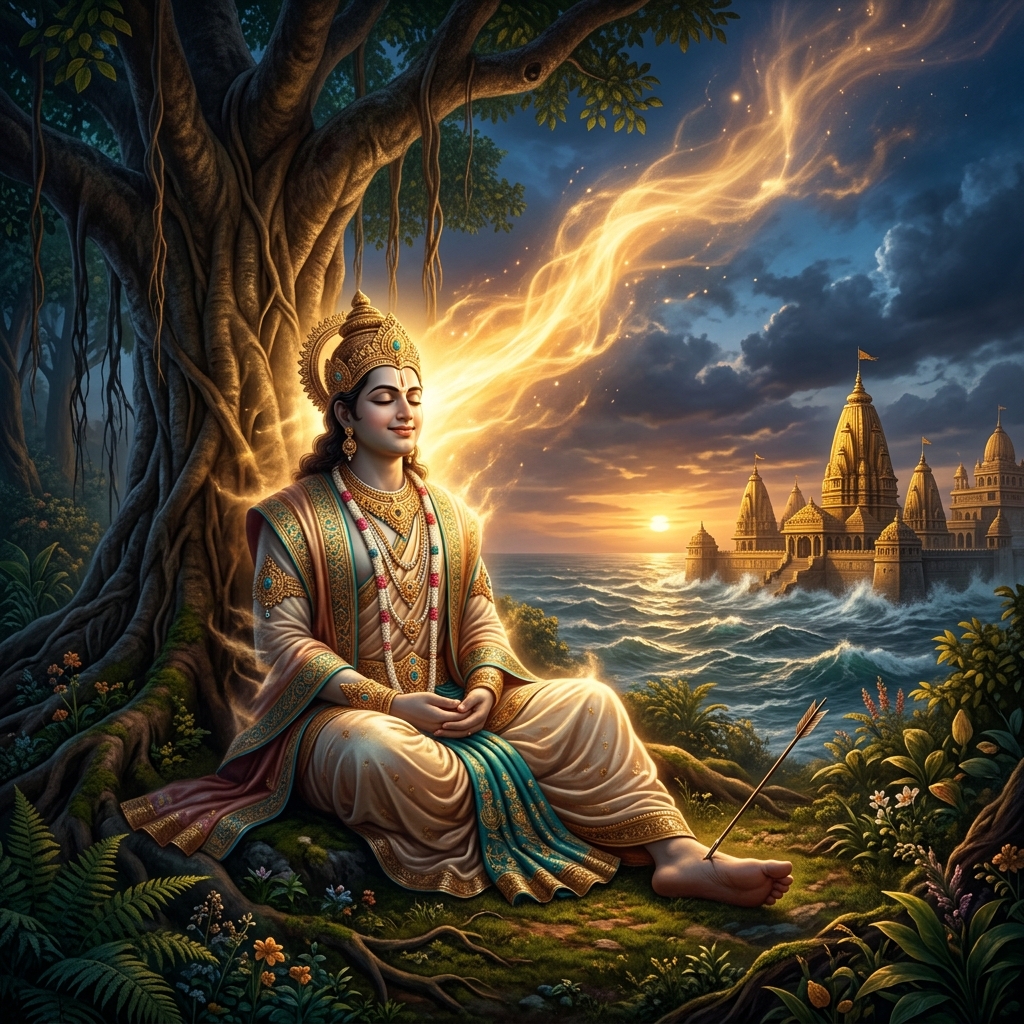
Durvasa Tests Krishna
The wrathful sage who found no anger to curse in all of Dwaraka
The Guest Who Ate for a Thousand
Krishna himself, in later years, would tell this story of his household in Dwaraka, of the day when the sage Durvasa came unannounced to the gate.
Durvasa was said to carry the wrath of ten thousand suns behind his eyes, and no king or sage dared refuse him lodging, for his curses had unmade kingdoms and his blessings had raised them. When his tall, ash-smeared form appeared at the palace of Dwaraka, Krishna went out himself to receive him, touched his feet, and asked what service he might render.
"I will stay in your house," said Durvasa, "and you and your queen will attend to my every want, exactly as I ask it, without question and without delay. If you fail me once, even in a small thing, I will burn your house of joy to ash."
Krishna bowed and welcomed him as an honored guest. Rukmini herself came forward to serve him, and from that hour the sage settled into their home like a storm that would not pass.
His first meal, he demanded, must feed a thousand men, though he alone would eat it; the kitchens labored through the night, and Durvasa devoured mountains of rice and ghee without pause, licking his fingers, while Krishna and Rukmini stood by, fanning him, refilling his plate, saying nothing. The next day he wanted nothing at all, not a grain of rice, and railed at anyone who suggested he might be hungry. He slept one night on beds of swan's down and silk, and in the morning, without warning, called for fire and set the bedding ablaze before their eyes, watching them both as the flames rose, waiting, it seemed, for a flicker of protest.
None came. Krishna only asked whether the sage required fresh bedding, and Rukmini, her hands still smelling of smoke, went to prepare it.
Not One Spark
For weeks the trial continued, each day stranger than the one before. Durvasa woke Krishna in the black of night demanding a meal cooked fresh that instant, then let it grow cold untouched at his elbow until morning, cursing the smell of it. He hurled dishes he judged too salty or too plain against the walls and ordered them scraped up and served again. He commanded that only Krishna and Rukmini, no servant, might touch his food or his robes, so that the two of them, ruler of Dwaraka and queen of the Yadavas, spent their nights grinding spices and folding linen themselves while the city slept.
Through it all, the sage's red eyes never left them. He would turn without warning and demand, "Are you angry with me, Krishna?" and Krishna would answer, smiling, that he was only glad of the sage's company. He would seize Rukmini's wrist hard enough to bruise and ask whether her arm pained her, and she would say only that it was nothing, that she hoped he had rested well.
Once he summoned the whole court at midnight merely to watch him eat curd rice, and dismissed them again before he had taken a bite, saying he had lost his appetite at the sight of their tired faces. Krishna sent the courtiers back to their beds himself, apologizing for the sage's hour, and returned to sit outside Durvasa's door until dawn, in case he was called again.
Rukmini, when Krishna at last found a moment to ask if she was well, said only, "He tests us as fire tests gold. Let him test as long as he wishes." Durvasa, listening unseen at the doorway as he often did, said nothing that night, but something in his manner had begun, very slowly, to soften, though neither of them dared to notice it aloud.
Anointed with Payasa
One morning, Durvasa's mood turned sharper than ever before. He ordered a great vessel of payasa cooked before him, sweet rice boiled in milk and sugar until it thickened, and when it was set steaming at his feet he did not eat it.
"Krishna," he said, "take this payasa, while it is still hot, and smear it over your own body, every part of it, with your own two hands."
The court attendants who had gathered to watch drew back in dismay, for the payasa was scalding and the order absurd, fit to humiliate a king before his own people. Krishna did not hesitate. He knelt, dipped both hands into the hot pudding, and began to anoint himself as he had been told, his arms, his chest, his back, his throat, his face, working the sweet paste into his skin without a wince, while Durvasa watched in silence.
Krishna covered every part of himself that his own reach could find, turning and stretching to be certain nothing was missed. Only one place escaped him: the soles of his own feet, which no man, however supple, can anoint with his own hands unaided, and which no servant had been permitted to touch. When he had finished, sticky and gleaming from head to foot, he stood before the sage and asked whether he had done as commanded.
Durvasa circled him once, inspecting the work with a strange new light in his eyes, no longer the light of testing but something nearer to wonder. He said nothing yet of what he had seen, only nodded and told Krishna to wash and dress, for there was one trial left before this house of Dwaraka would be free of him.
The Chariot of Rukmini
"Bring your chariot to the courtyard," Durvasa said, "and yoke your queen to it in place of your horses. I wish to ride out into the city, and I wish her to draw me."
Even the guards at the gate, who had grown used to strange commands, looked to Krishna for some word of refusal. He gave none. He had the chariot brought, and Rukmini, without being asked twice, stepped between the shafts and let the harness be fitted to her shoulders as though it were the most natural burden in the world.
Krishna himself took the driver's place behind her, holding the reins loosely, and Durvasa climbed up onto the chariot's floor behind them both. "Faster," the sage said, and when the pace did not please him he leaned down and struck at Rukmini's back with the goad meant for horses, calling her slow, calling her a poor mount for a sage of his standing, shouting insults that echoed down the streets of Dwaraka as the people of the city stopped in the roadway to stare.
Rukmini bent into the harness and pulled, her breath coming hard, sweat mixing with the sweetness still clinging to her lord's skin beside her, but she did not slow her step nor let a sound of pain escape her. Krishna drove at the pace the sage demanded, calling out no word of protest on her behalf, watching her only from the corner of his eye, trusting her as she trusted him, that this too would pass.
They circled the city once in this manner, queen yoked like a beast, king driving like a servant, sage riding like an emperor, while all Dwaraka watched and wondered what test this could possibly be, and whether their king and queen had lost their senses to bow so low. Not once, through the whole circuit, did either of them speak a word of complaint, and it was this silence, more than anything eaten or burned or endured before it, that Durvasa had truly come to Dwaraka to hear.
The Sage's Blessing
When the chariot came to rest again in the palace courtyard, Durvasa stepped down and, to the astonishment of everyone watching, took Krishna's sticky, payasa-smeared hands in his own and embraced him.
"In all my wandering," he said, "I have tested kings and sages and found rage hiding under every courtesy they showed me. I have burned their beds and starved their kitchens and struck their queens with the goad, and always, somewhere, I have found the spark I came looking for. In you and in Rukmini I have found none. Not one flicker, not one word held back in anger. You have served me as though service itself were joy."
He told Krishna then what he had truly done that morning with the payasa. "Wherever that paste touched your skin, no weapon forged by god or man will ever wound you, no illness will take hold, no death will find purchase there. Your body is sealed against harm, from your crown to your ankles, everywhere your own hands could reach."
He paused, and something passed over his face that was almost sorrow. "But the soles of your feet, Krishna, you could not anoint yourself, and no other hand was permitted to help you. There the payasa never touched you, and there alone you remain as any mortal remains, open to the world's ordinary harm."
He blessed Rukmini as well, praising her endurance in the harness, and then, as suddenly as he had come, Durvasa gathered his staff and his waterpot and walked out through the gates of Dwaraka and was gone, leaving behind only the smell of scorched bedding and sweet rice.
Krishna, they say, only smiled at the sage's parting words, as a man smiles at news he has always somehow known. Years later, in a quiet forest at the end of his earthly life, it would be exactly there, at the sole of his foot, that a hunter's arrow, meant for a deer, would find him.
Dharma Lesson
True devotion is service without complaint, given even under absurd and painful demands. Krishna's calm before Durvasa's rage shows that dharma is proved not in comfort but in how one bears an unreasonable trial. Yet even divine protection has its gap - the one place a man cannot reach with his own hand - a reminder that no boon, however great, erases fate entirely.