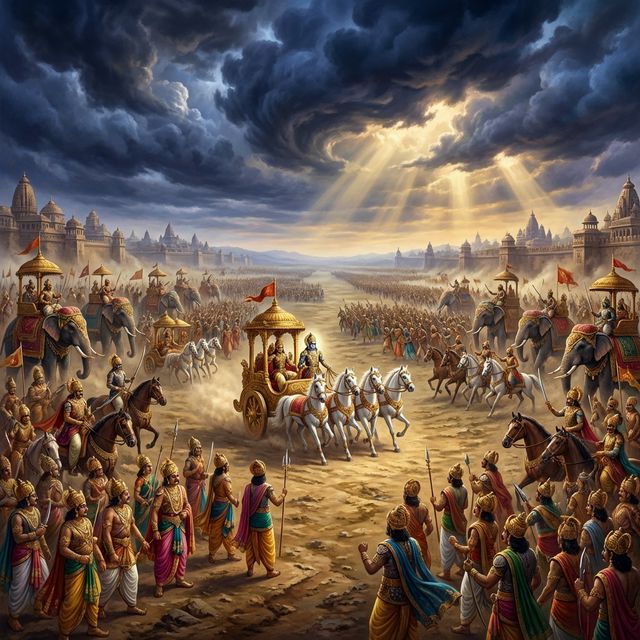
The Three Sages Who Saved the Gods
Agastya burns the Danavas, Vashishtha brings down the Sarayu, and Atri becomes the moon and the sun
The King Who Kept Saying Nothing
Bhishma was still on the arrows, and the argument he was reporting had happened long before any of the men listening to him were born.
Kartavirya of the Haihayas, lord of Mahishmati, thousand-armed, had ridden out and asked aloud who on earth was his equal, and the god of wind had answered him out of the empty sky. That answer had turned into a catalogue. Every time the king opened his mouth to claim something, Vayu named a brahmana who had done more, and then told the whole of that brahmana's feat, and then asked the same question at the end of it.
He had already told him about Kashyapa, who saw the Earth herself preparing to leave the world and entered her body by yoga to hold her in place for thirty thousand celestial years. He had already told him about Utathya of the race of Angiras, whose wife Varuna stole out of the Yamuna, and who solidified the waters and drank them off, and dried the six hundred thousand lakes of Varuna's palace into sterile ground, and got her back.
"Tell me the name of the Kshatriya who can be held superior to Utathya," the wind had said.
"Thus addressed," Bhishma said, "king Arjuna remained silent."
That sentence is the hinge of the whole conversation, and it comes back after every story like a drumbeat. The king was not being shouted down. He was being told, in order, the things that men with no armies and no chariots had done for the world, and each time he was invited to produce a warrior who had done as much, and each time he found he had nothing to say.
So the god of wind went on.
"Listen now, O king," he said, "to the story of the greatness of the Brahmana Agastya."
The Gods Who Wandered the Earth
There was a time when the Asuras beat the gods outright, and the wind described the defeat by what it cost rather than by the battle.
The sacrifices of the deities were seized. The Swadha of the Pitris, the offering that goes to the fathers, was misappropriated, so that the dead were being robbed along with the living. And all the religious acts and observances of human beings were suspended by the Danavas, which means that the whole traffic between earth and heaven had been shut down at both ends. Nothing went up. Nothing came back.
Divested of their prosperity, the gods wandered over the earth.
That is the picture to hold. Not gods besieged in a fortress of heaven, but gods walking about on the ground with nowhere to go, having lost the thing that made them gods, which was that men fed them.
One day, in the course of that wandering, they came upon Agastya.
He was a brahmana of high vows, endued with great energy, and the splendour about him was as blazing as the sun's, and he was sitting in the middle of the ruined world doing what he had always done. The gods saluted him duly. They made the usual enquiries of politeness, which is a detail worth noticing: beaten, homeless and hunted, they still went through the greetings in order, because that is what one does on meeting a rishi.
Then they said what they had come to say.
"We have been defeated by the Danavas in battle," they said, "and have therefore fallen off from affluence and prosperity. Do thou, O foremost of ascetics, rescue us from this situation of great fear."
They did not ask him to pray for them. They did not ask him to intercede with a greater power. They asked a man sitting on the ground with nothing to do what an army had failed to do.
Thousands Dropping Out of the Sky
Informed of the plight to which the deities had been reduced, Agastya became highly incensed.
There is no weapon in what follows and no mantra either. Possessed of great energy, he at once blazed forth like the all-consuming fire at the time of the universal dissolution, and that was the whole of his attack. He did not aim it. He simply stopped holding it in.
With the blazing rays that emanated from the rishi, the Danavas began to be burnt. Thousands of them began to drop down from the sky. Burning with the energy of Agastya, they abandoned both heaven and earth together and fled towards the southern direction, and that is how the gods got their sacrifices back.
Some survived, and the reason they survived is recorded exactly. At that time the Danava king Vali was performing a Horse-sacrifice in the nether regions, and those great Asuras who were with him below, or who were dwelling in the bowels of the earth, were not burnt. They were not saved by their strength. They were saved by being underground on the day it happened.
The deities went back to their own regions with their fears entirely dispelled. Then, encouraged by what had been done for them, they came back to the rishi with one more request. Destroy the rest of them, they said. Finish the ones who took refuge under the earth.
Agastya answered them plainly.
"Yes, I am fully competent to consume those Asuras that are dwelling underneath the earth," he said. "But if I achieve such a feat, my penances will suffer a diminution. Hence, I shall not exert my power."
He had burned an enemy off the face of two worlds, and he stopped because the second burning would have cost him something and the first one had already bought what the gods actually needed. The power was real, and the accounting on it was exact, and he was the one keeping the books.
"Even so was Agastya as described by me," the wind said. "Shall I continue? Or will you say anything in reply? Is there any Kshatriya who is greater than Agastya?"
Thus addressed, king Arjuna remained silent.
The Lake That Gave the Dead Back
"Hear, O king," the god of wind said, "one of the great feats of the illustrious Vashishtha."
The gods were performing a sacrifice on the shores of the lake Vaikhanasa. Knowing his puissance, they thought of Vashishtha and made him their priest in imagination, which is to say they installed him at that altar without sending for him and without his knowing, because his name was enough to make the rite correct.
The Diksha they were undergoing, the long consecration that a sacrifice requires, had left them reduced and emaciated. Men and gods under that vow eat little and sleep less, and a race of Danavas called the Khalins, of statures as gigantic as mountains, saw the condition they were in and decided that this was the moment to kill them.
The Khalins could not be killed back. That was the difficulty. Those among them who were disabled or slain in the fight were plunged into the waters of the Manasa lake, and in consequence of a boon of the Grandsire they instantly came back to vigour and life. Every corpse the gods made was returned to them the same day, standing up, armed.
And they fought with the landscape. They took up huge and terrible mountain summits, and maces, and trees, and they agitated the waters of the lake with them until the water swelled up to the height of a hundred yojanas. Then they ran against the deities, who numbered ten thousand.
Afflicted, the gods sought the protection of their chief. Vasava was their answer to everything, and Vasava was soon afflicted himself, hammered by mountain-sized enemies who could not be made to stay dead. In his distress Indra sought the protection of Vashishtha.
So the rishi who had been made priest of that sacrifice in imagination was now being sent for in earnest, by the king of the gods, in the middle of a battle he had no part in.
The River That Came Through the Water
The holy rishi Vashishtha assured the deities and dispelled their fears, and the text gives his reason before it gives his act. Understanding that the gods had become exceedingly cheerless, the ascetic did this through compassion. Not through anger, as with Agastya. He looked at how frightened they were and could not leave them in it.
Then he put forth his energy and burnt, without any exertion, those Danavas called the Khalins.
Without any exertion. They had heaved mountain peaks into a lake and raised the water a hundred yojanas and come back from death as often as they were killed, on a boon from Brahman himself, and the man who ended them did it the way another man closes a door.
What he did next is the part that stayed on the map.
Possessed of wealth of penances, the rishi brought the River Ganga, who had gone to Kailasa, to that spot. She came, and she appeared by piercing through the waters of the lake, one water rising through another. The lake was penetrated by that river. And as that celestial stream came up through the lake and out the other side, it flowed on under a different name, and the name was Sarayu.
The place whereon those Danavas fell came to be called after them.
So two things were left standing in the world when it was over, and both of them are geography. There is a river in the east that anyone may go and look at, which began as Ganga and became Sarayu at the moment she came up through a lake to a rishi's summons. And there is a stretch of ground that carries the name of the giants who died on it, given to them by the people who came after, who did not know what they were saying.
"It was thus that those Danavas, who had received boons from Brahman, were slain by that high-souled rishi," the wind said. "Shall I go on? Or will you say anything? Was there a Kshatriya who could be said to surpass the Brahmana Vashishtha?"
Thus addressed, Arjuna remained silent.
Rahu's Arrows in the Dark
"Hear me, O foremost one of the Haihayas," the god of wind said, "as I narrate to thee the achievement of the high-souled Atri."
The gods and the Danavas were fighting each other in the dark. That is where the story starts, and it is worth stopping on, because a night battle in this epic is already the worst thing that can happen to an army even when the sky is behaving normally.
The sky was not behaving normally. Rahu pierced both Surya and Soma with his arrows.
The sun and the moon were not eclipsed in the ordinary way, passing behind something and coming out again on a schedule. They were shot. The two lights of the world were wounded and darkened where they hung, and there was nothing left overhead to fight by.
The gods, overwhelmed by darkness, began to fall before the mighty Danavas. Repeatedly struck by enemies they could not see, the denizens of heaven began to lose their strength, which is what happens to any army that is being killed from a direction it cannot identify.
Then they beheld Atri.
He was a learned brahmana, endued with wealth of penances, and he was sitting in the observance of austerities in the middle of all this. He had conquered all his senses. In him, wrath had been extinguished, which is said of very few men in this book and is never said carelessly. Agastya had saved the gods by being angry. Atri had nothing of that kind left in him to use.
"Behold, O rishi, these two, Soma and Surya, who have both been pierced by the Asuras with their arrows," they said. "In consequence of this, darkness has overtaken us, and we are being struck down by the foe. We do not see the end of our troubles. Do thou, O lord of great puissance, rescue us from this great fear."
The rishi asked them one question, and it is the most practical question in the whole of Vayu's long argument.
"How, indeed, shall I protect you?"
Become the Moon, Become the Sun
They told him exactly what they wanted, and what they wanted was not help.
"Do thou thyself become Chandramas," they said. "Do thou also become the sun, and do thou begin to slay these robbers."
They were asking a man sitting on the ground in deerskins to take over the two offices that hold up the day and the night, because the officeholders had been shot and were bleeding light out of the sky.
Thus solicited, Atri assumed the form of the darkness-destroying Soma. In consequence of his agreeable disposition he began to look as handsome and delightful as Soma himself, and the text puts the reason in the temperament rather than in the power, as though the moon were a manner before it is a body.
Then, beholding that the real Soma and the real Surya had both been darkened by the shafts of the foe, he assumed the forms of those luminaries and began to shine forth over the field of battle, aided by the puissance of his penances. Verily Atri made the universe blaze forth in light, dispelling all its darkness.
And having lit the field, he fought on it. By putting forth his puissance he subjugated the vast multitudes of those enemies of the deities, and the gods, protected by Atri's energy and able at last to see what they were swinging at, began to despatch them quickly. He burnt the great Asuras and they finished them.
The wind ends the account with an inventory of the man who did it, and every item in it is a poverty.
He was aided by his sacred fire. He was a silent reciter of mantras. He was clad in deerskins. He subsisted upon fruits only.
"Behold, O royal sage, that act achieved by that rishi," the god of wind said. "Putting forth his prowess and mastering all his energy, it was even in this way that Atri illumined the god of day, rescued the deities, and slew the Asuras. Shall I go on? Or will you say anything? Is there a Kshatriya that is superior to this regenerate rishi?"
Thus addressed, Arjuna remained silent.
Three times now. A man with a thousand arms, who had gone out that morning to be told he had no equal, stood in his chariot outside Mahishmati listening to a voice with no body in it, and could not name one of his own kind who had ever done what a hungry man in a deerskin had done for the world.
Dharma Lesson
Each of these three rescues is made out of something the rescuer had no intention of spending. Agastya spends anger and then stops, because he can measure to the grain what the next act would take out of his penances and what it would buy for anyone else. Vashishtha spends nothing at all, in the sense that the text says he burnt mountain-sized enemies without any exertion, and names compassion rather than power as the reason he bothered. Atri, in whom wrath had been extinguished, has no weapon left and so becomes the light itself, which is the only help a man can give who has stopped wanting to strike anybody. The king with a thousand arms had no answer to any of it, and his silence is the argument.