The Rishi Born From a Word
Vyasa tells his disciples who he was before he was Vyasa
A King Asks About the Systems
"Regenerate Rishi," said Janamejaya, "the Sankhya system, the Pancharatra scriptures, the Aranyaka Vedas: these different bodies of knowledge are all current in the world. Do they all preach the same course of duties, or are the courses of duty that they preach different from one another? I have asked you. Discourse to me now on Pravritti, in due order."
Vaishampayana did not begin with the systems. He began where he always began.
"I bow," he said, "to that great Rishi who is the dispeller of darkness, whom Satyavati bore to Parasara in the middle of an island. The learned say of him that he is the origin of the Grandsire Brahma; that he is the sixth form of Narayana; that he is the foremost of Rishis and endued with the puissance of Yoga; that being the only son of his parents he is an incarnate portion of Narayana; and that, born under extraordinary circumstances upon an island, he is the inexhaustible receptacle of the Vedas. In the Krita age, Narayana of great puissance and mighty energy created him as his son. Truly the high-souled Vyasa is unborn and ancient, and the inexhaustible receptacle of the Vedas."
The king had been listening to this man for a long time and had learned to catch the places where the account did not sit flat.
Two Fathers for One Man
"Best of regenerate persons," said Janamejaya, "it was you that said before this that the Rishi Vashishtha had a son of the name of Saktri, and that Saktri had a son of the name of Parasara, and that Parasara begot a son named the Island-born Krishna, endued with great ascetic merit. Now you tell me that Vyasa is the son of Narayana. I ask you: was it in some former birth that Vyasa of immeasurable energy had sprung from Narayana? You are of great intelligence. Tell me of that birth of Vyasa which was due to Narayana."
It is a fair question, and the answer is not a genealogy. A man has one father in the world and may have another behind the world, and the second one is harder to speak of, because the only person who can testify to it is the man himself.
Vaishampayana had that testimony. He had not got it out of a book and he had not reasoned it out from the Srutis. He had been sitting on a mountain with four others when the man in question opened his mouth and told them what he had been before he was anybody, and he had never forgotten a word of it, partly because of what was in it and partly because of the flat and unhurried way it was said.
So he did not answer the king's objection with an argument. He told him where they had been sitting, and who was sitting there, and in what condition their teacher had been when he began.
The Tired Man on the Himavat
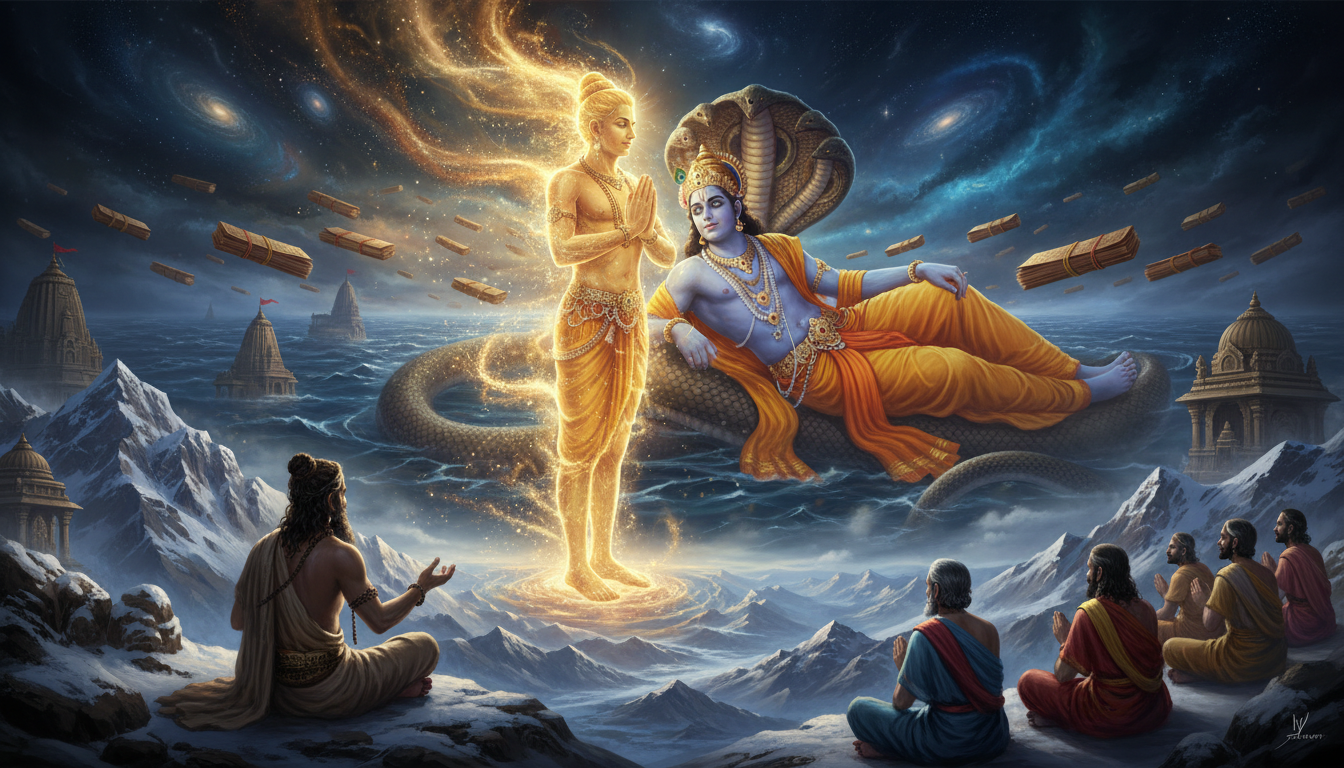
"Desirous of understanding the meaning of the Srutis," said Vaishampayana, "my preceptor, that ocean of penances, exceedingly devoted to the observance of all scriptural duties and to the acquisition of knowledge, dwelt for some time in a particular region of the Himavat mountains. Endued as he was with great intelligence, he had become fatigued with his penances, in consequence of the great strain upon his energies occasioned by the composition of the Mahabharata.
"At that time Sumanta and Jaimini and Paila of firm vows, and myself making the fourth, and Suka his own son, attended upon him. Seeing the fatigue our preceptor felt, all of us waited dutifully upon him and were engaged in doing whatever was necessary for dispelling that fatigue of his. Surrounded by these disciples, Vyasa shone in beauty on the breast of the Himavat like Mahadeva, the lord of all the ghostly beings, in the midst of those attendants of his.
"We had recapitulated the Vedas with all their branches, and the meanings of all the verses in the Mahabharata besides. One day, with rapt attention, all of us approached our preceptor, who had controlled his senses and was at that time wrapped in thought. Availing ourselves of an interval in the conversation, we asked that foremost of regenerate persons to expound to us the meanings of the Srutis and of the verses in the Mahabharata, and to narrate to us the incidents of his own birth from Narayana.
"Conversant as he was with all topics of enquiry, he first discoursed to us upon the interpretation of the Srutis and of the Mahabharata. Then he set himself to narrate the following, and it is the only occasion on which I ever heard him speak of himself."
The Task Brahma Could Not Take
"Listen, my disciples," said Vyasa, "to this foremost of narratives, this best of histories, which relates in its turn to the birth of a Rishi. It appertains to the Krita age and it has become known to me through my penances.
"On the occasion of the seventh creation, that which was due to the primeval Lotus, Narayana, endued with the austerest penances, transcending both good and ill, possessed of unrivalled splendour, first created Brahma from his navel. After Brahma had started into birth, Narayana addressed him: 'You have sprung from my navel. Endued with puissance in respect of creation, set yourself to create diverse kinds of creatures, rational and irrational.'
"Thus addressed by the author of his being, Brahma felt the difficulty of the task, and his mind was penetrated with anxiety, and he became unwilling to do what he had been commanded to do. Bowing his head to the boon-giving Hari, the Lord of the universe, he said, 'I bow to you, Lord of the deities. But I ask, what puissance have I to create diverse creatures? I have no wisdom. Ordain what should be ordained in view of this.'
"Thus addressed by Brahma, the Lord of the universe disappeared there and then from Brahma's sight, and began to think. Then the Goddess of Intelligence made her appearance before him. Himself transcending all Yoga, Narayana by dint of Yoga applied her properly, and addressing that goddess who was endued with activity and goodness and all the puissance of Yoga, he said, 'For the accomplishment of the task of creating all the worlds, do you enter into Brahma.'
"Commanded thus, Intelligence forthwith entered Brahma. And when Hari beheld that Brahma had become united with Intelligence, he addressed him once more, saying, 'Now create diverse kinds of creatures.' Replying to Narayana by uttering the word 'Yes,' Brahma reverently accepted the command of his progenitor. Then Narayana disappeared from his presence and in a moment repaired to his own place, which is known by the name of Deva, and returning to his own disposition of unmanifestness, remained in that state of oneness."
The Weight the Earth Was Given
"After the task of creation had been accomplished by Brahma, however, another thought arose in the mind of Narayana, and he reflected in this strain.
"'Brahma, otherwise called Parameshthi, has created all these creatures, Daityas and Danavas and Gandharvas and Rakshasas. The helpless Earth has become burdened with the weight of them. Many among the Daityas and the Danavas and the Rakshasas will become endued with great strength. Possessed of penances, they will at diverse times succeed in acquiring many excellent boons, and swelling with pride and might in consequence of those boons, they will oppress and afflict the deities and the Rishis. It is therefore meet that I should now and then lighten the burden of the Earth, by assuming diverse forms one after another as the occasion requires. I shall achieve this task by chastising the wicked and upholding the righteous. Looked after by me in this manner, the Earth, which is the embodiment of Truth, will be able to bear her load of creatures. Assuming the form of a mighty snake, I myself have to uphold the Earth in empty space; and upheld by me, she will uphold the entire creation, mobile and immobile. Incarnated upon the Earth in different forms, I shall have to rescue her at such times from peril.'
"Having reflected in this way, the slayer of Madhu created in his mind the diverse forms in which he would appear from time to time to accomplish the task he had in view. 'Assuming the form of a Boar, of a Man-lion, of a Dwarf, and of human beings, I shall quell or slay such enemies of the deities as become wicked and ungovernable.'"
The disciples heard this sitting on a mountain in the middle of the age in which the last of those forms was walking about on the plains below them, driving a chariot for a friend. Not one of them interrupted to say so. Their teacher was describing a decision taken before there was anybody to see it taken, and describing it in the manner of a man who had been standing in the room at the time; and Suka, who sat nearest, had been told once already in his life that his father was more than his father, and had gone away and come back and asked nothing further about it.
The Rishi Born From a Syllable
"After this," said Vyasa, "the original Creator of the universe uttered the syllable Bho, causing the atmosphere to resound with it. And from that syllable of speech there arose a Rishi of the name of Saraswat. The son thus born of the Speech of Narayana came to be called also by the name of Apantaratamas. Endued with great puissance, he was fully conversant with the past, the present, and the future. Firm in the observance of his vows, he was truthful in speech.
"That Rishi, after his birth, bowed his head to Narayana, and Narayana, the original Creator of all the deities, whose nature is immutable, said these words to him: 'You should devote your attention to the distribution of the Vedas, foremost of all persons endued with intelligence. Accomplish, ascetic, what I command you.'
"In obedience to that command of the Supreme Lord from whose Speech he had sprung into existence, Apantaratamas, in the Kalpa named after the Self-born Manu, distributed and arranged the Vedas. And for that act of his, and for his well performed penances, and his vows and observances, and his restraint of the senses, the illustrious Hari became gratified with him and said, 'At each Manwantara, my son, you will act in this way with respect to the Vedas. In consequence of this act of yours you shall be immutable, and incapable of being transcended by any one.'"
That was the whole of the reward: to be told that he would do the same work again at the beginning of every world-age, for as long as there were world-ages, and that nobody would ever get past him. There is no release in that and no rest in it. The Vedas come apart in the mouths of men as an age wears out, and somebody has to gather them and set them in order again, and the one who did it first was told at his birth that he would still be doing it when the Sun had been put out and lit again a hundred times over. Vyasa reported all of this without any complaint in his voice, in the manner of a man stating the terms of his employment. Then he told them the rest of what the Lord had said, which was longer, and which was about a life he had not yet begun to live.
The Life He Was Told in Advance
"'When the Kali age sets in,' said Narayana, 'certain princes of Bharata's line, to be called by the name of Kauravas, will take their birth from you. They will be celebrated over the Earth as high-souled princes ruling over powerful kingdoms. Born of you, dissensions will break out among them, ending in their destruction at one another's hands, excepting yourself.
"'In that age also, endued with austere penances, you will distribute the Vedas into diverse classes. In that dark age your complexion will become dark. You shall cause diverse kinds of duties to flow, and diverse kinds of knowledge also. And although you will be endued with austere penances, yet you shall never be able to free yourself from desire and from attachment to the world. Your son, however, will be freed from every attachment, like the Supreme Soul, through the grace of Madhava. It will not be otherwise.'"
Suka was sitting with the others while his father repeated that sentence, and neither of them said anything about it.
"'He whom learned Brahmanas call the mind-born son of the Grandsire, Vashishtha of great intelligence, like an ocean of penances, whose splendour transcends the Sun's, will be the progenitor of a race in which a great Rishi of the name of Parasara, possessed of mighty energy and prowess, will take his birth. That foremost of persons, that ocean of the Vedas, that abode of penances, will become your sire when you take birth in the Kali age. You shall take your birth as the son of a maiden residing in the house of her sire, through an act of congress with the great Rishi Parasara.'"
Doubts You Will Have None
"'Doubts you will have none,' said Narayana, 'with respect to the imports of things past, present, and future. Endued with penances and instructed by me, you will behold the incidents of thousands upon thousands of ages long past away, and you will see through thousands upon thousands of ages in the future also. In that birth, ascetic, you shall behold me, who am without birth and without death, incarnated upon Earth, armed with the discus. All this will happen to you through the merit that will be yours in consequence of your ceaseless devotion to me. These words of mine will never be otherwise.
"'You shall be one of the foremost of creatures, and great shall be your fame. Surya's son Sani will, in a future Kalpa, take birth as the great Manu of that period, and during that Manwantara, my son, you shall in respect of merits be superior even to the Manus of the several periods. You shall be so through my grace, without doubt. Whatever exists in the world is the result of my exertion. The thoughts of others may not correspond with their acts; as regards myself, however, I always ordain what I think, without the least impediment.'
"Having said these words to the Rishi Apantaratamas, otherwise called by the name of Saraswat, the Supreme Lord dismissed him, saying, 'Go.'
"I am he that was born as Apantaratamas through the command of Hari. Once more have I taken birth as the celebrated Krishna-Dwaipayana, a delighter of the race of Vashishtha. I have thus told you, my dear disciples, the circumstances of my own former birth, which was due to the grace of Narayana in so much that I was a very portion of Narayana himself. In days of yore I underwent the austerest penances, with the aid of the highest abstraction of the mind. Moved by my great affection for you who are devoted to me with reverence, I have told you everything relating to what you wished to know: my first birth in remote antiquity, and that other birth which came after it."
The Man Who Walked Into It
"I have thus narrated to you, monarch," said Vaishampayana, "the circumstances connected with the former birth of our revered preceptor, Vyasa of unstained mind, as you asked. Listen to me once again.
"There are diverse kinds of cults that go by diverse names: Sankhya, Yoga, the Pancharatra, the Vedas, and Pasupati. The promulgator of the Sankhya cult is said to be the great Rishi Kapila. The primeval Hiranyagarbha, and none else, is the promulgator of the Yoga system. The Rishi Apantaratamas is said to be the preceptor of the Vedas, and some call that Rishi by the name of Prachina-garbha. The cult known by the name of Pasupata was promulgated by the Lord of Uma, the master of all creatures, the cheerful Siva. The illustrious Narayana is himself the promulgator of the cult contained in the Pancharatra scriptures in its entirety. In all these cults, foremost of kings, it is seen that Narayana is the one sole object of exposition. The Sankhya and the Yoga systems are eternal, and all the Vedas are eternal. The Rishis, in all these systems of cult, have declared that this universe, existing from ancient times, is Narayana's self."
That was the answer to what Janamejaya had asked at the beginning, and it had taken the whole of a life to give it.
For consider what was in that life. A rishi comes out of a spoken syllable, bows, and is set to sort the Vedas, and is told he will do it again in every age. Then he is told, before he has done anything at all, that in the dark age his skin will be dark, that his father will be Parasara and his mother a girl still living in her father's house, that princes will be born of him who will destroy one another to the last, that he will not be able to let go of the world however much he burns himself, and that his one son will let go of it entirely and be gone.
He was given the list and he said nothing against it. He was born as Krishna-Dwaipayana, and he made the divisions of the Veda, and he fathered those princes, and he stood in the tent at Kurukshetra afterwards among the women, and he watched Suka go north like the wind and not come back. A man may be told the whole of his life in advance, including its griefs, and still have to get up and walk into it, one day at a time, exactly as if he had not been told.
Dharma Lesson
A man may be told the whole of his life in advance, its work, its griefs and its losses, and still have to get up and walk into it one day at a time. Apantaratamas was promised the same labour of dividing the Vedas in every world-age and no release from it, and said nothing against the terms. Knowing the end changes nothing about having to go there.