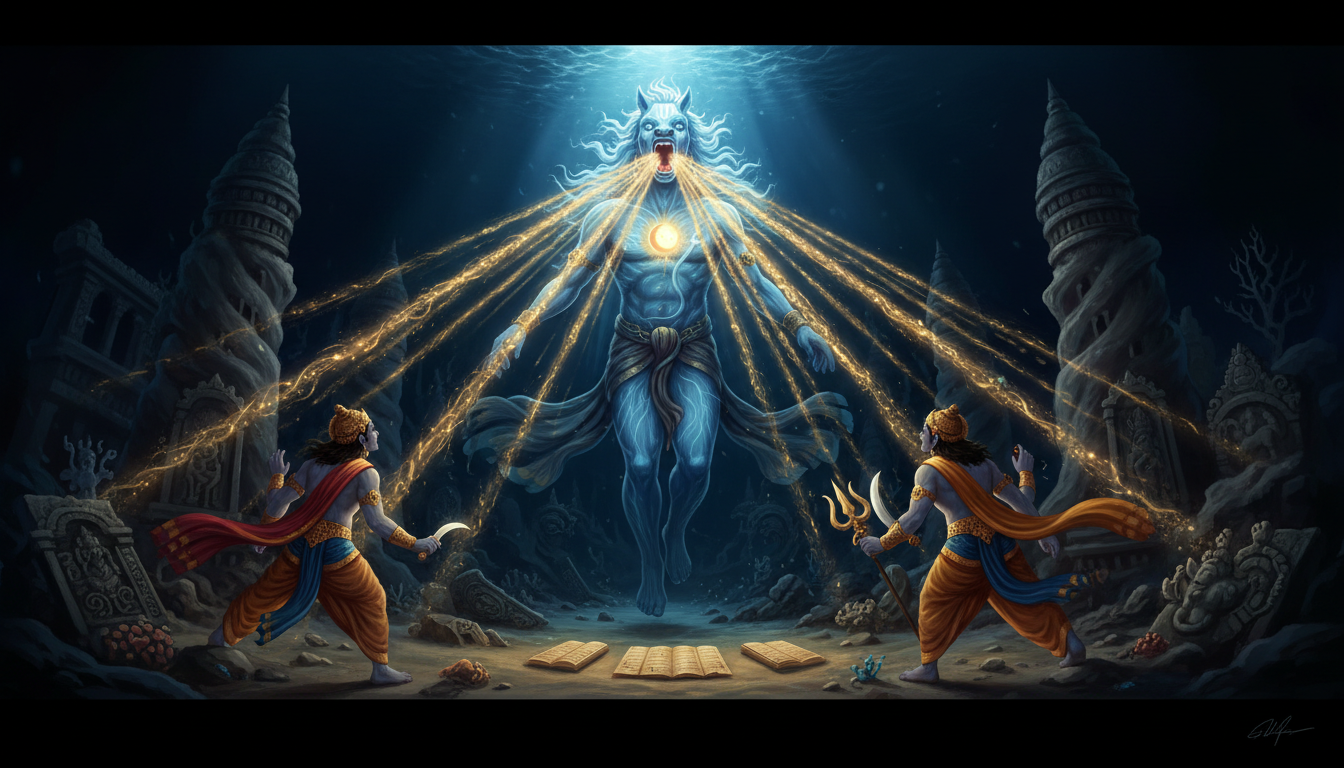
The Horse-Headed Voice in the Deep
How the Vedas were sung back out of the hands of thieves
A Doubt About a Horse's Head
The fires of the snake sacrifice had been burning for a long while, and the king had heard a great deal.
"I have heard from you the glory of the divine and Supreme Soul," Janamejaya said. "I have heard of the birth of the Supreme Deity in the house of Dharma, in the form of Nara and Narayana. I have heard the origin of the Pinda from the mighty Boar that lifted the submerged Earth. You have told us which deities and rishis were ordained for the religion of Pravritti and which for the religion of Nivritti, and much else besides, and I am grateful for all of it.
"But there is one thing you said in passing, regenerate one, and then went on, and it has stuck in me like a splinter. You spoke of a vast form of Vishnu with the head of a horse. You said it appeared in the great ocean, in the North-East, and that the illustrious Brahman, who is otherwise called Parameshthi, beheld it there."
"I did say that," Vaishampayana agreed.
"Then tell me the rest. What were the exact features of that form? What was its energy, the like of which among all great objects had never appeared before? What did the Grandsire do, having seen that foremost of deities whose likeness had never been seen, him of immeasurable energy, him with the equine head, him who was Sacredness itself? For what reason did the supreme Deity assume that shape and display himself in it to Brahman? This doubt has arisen in our minds about an ancient matter, and you have sanctified us with so many holy subjects that I am emboldened to ask for one more."
Vaishampayana was quiet for a moment. "It is an old story," he said, "and perfectly consistent with the Vedas, which is fortunate, since the Vedas are in it. Sit, king. It begins with the world being put away."
The Sleeper on the Water
"Everything that exists," said Vaishampayana, "is a combination of the five primal elements, and the combining is done by the intelligence of the Supreme Lord. Narayana is that Lord, endued with infinity, the inner Soul of all things and the giver of boons; divested of attributes, and then again possessed of them. Hear now how the Destruction of all things is brought about, for you cannot understand the theft unless you know what the world is made of and what it comes back to.
"First the element of Earth becomes merged in Water, and then nothing is seen anywhere but one vast expanse of water. Water merges into Heat. Heat merges into Wind. Wind merges into Space, and Space in its turn into Mind. Mind merges into the Manifest, which is also called Consciousness. The Manifest merges into the Unmanifest, which is Prakriti. Prakriti merges into Purusha, and Purusha merges into the Supreme Soul.
"Then Darkness spreads over the face of the universe, and nothing whatever can be perceived. And out of that primal Darkness, which is primeval and fraught with immortality, arises Brahma endued with the principle of Creation."
He developed, by his own potency, into the idea of the universe, and took the form of Purusha, and that Purusha is called Aniruddha. Divested of sex, he is called Pradhana. He exists with Knowledge alone for his companion, and he is otherwise called Viswaksena, and Hari.
Yielding to Yoga-sleep, he laid himself down upon the waters.
And while he slept he thought about making a universe of diversified phenomena, and in the course of thinking about it he recollected his own high attributes, and from that recollection sprang the four-faced Brahma, who is the Consciousness of Aniruddha. Endued with eyes like lotus petals, the illustrious Hiranyagarbha, Grandsire of all the worlds, took birth within the Lotus that springs from the navel of the sleeper.
Seated on that Lotus, wonderful of aspect, he looked around him and saw that the waters were on all sides. So he adopted the attribute of Sattwa and commenced to create.
Two Drops in the Primeval Lotus
In that primeval Lotus, which was endued with the effulgence of the sun, two drops of water had been cast by Narayana, and they were fraught with great merit. The illustrious Narayana, who is without beginning and without end and transcends destruction, cast his eyes upon those two drops of water.
One of them was of very beautiful and bright form, and looked like a drop of honey. From that drop, at the command of Narayana, there sprang a Daitya of the name of Madhu, and he was made up of the attribute of Tamas, which is dullness.
The other drop within the Lotus was very hard. From it sprang the Daitya Kaitabha, and he was made up of the attribute of Rajas, which is passion.
"Consider what they were," Vaishampayana said. "They were not intruders from outside the creation. They were made of two drops of water that the Lord himself had put into his own flower and then looked at. Everything that happened afterwards, the theft and the darkness and the horse and the long descent into the deep, happened inside a lotus, among the family."
Endued thus with dullness and passion, the two Daityas were possessed of great might, and each of them was armed with a mace, and immediately after their birth they began to rove about within that vast primeval Lotus, going up and down the petals of it as men go about a country, looking for something to do.
And in the middle of it they came upon Brahma of immeasurable effulgence, sitting at his work.
Taken in the Sight of Their Maker
He was engaged in creating the four Vedas, and each of them was endued with the most delightful form.
That is what the two Asuras saw: not four books, but four beings, newly made and beautiful, standing beside the Creator on the petal while he finished them. They were the first things anyone had ever made, and they had come out well, and Brahma was looking at them the way a maker looks at work that has gone right.
Those two foremost of Asuras, possessed of bodies and armed with maces, beheld the four Vedas, and suddenly seized them.
They did it in the very sight of their Creator. Not by stealth, not at night, not while he was turned away; they took hold of the four Vedas while the eyes of Brahma were upon them, which is a thing worth noticing about a certain kind of thief, that the being seen is part of what he is after.
Then the two mighty Danavas, having seized the eternal Vedas, went at once to the edge of the Lotus and dived into the ocean of waters that they saw below, and swam down and down and proceeded to its very bottom, and there they stopped, in a place where no light had ever gone, holding all the knowledge there was.
And Brahma sat on his flower above the water and could not follow them.
The Creator Goes Blind
Seeing the Vedas forcibly taken away from him, Brahma was filled with grief, and the grief in him was not of the ordinary kind, because a great deal more than his feelings had gone down into the water.
"The Vedas are my great eyes," he said aloud, to the water and to nobody. "The Vedas are my great strength. The Vedas are my great refuge. The Vedas are my high Brahman. And all of them have been forcibly taken away from me by two Danavas.
"Deprived of the Vedas, the worlds that I have created have become enveloped in darkness. Without the Vedas beside me, how shall I succeed in causing my excellent Creation to start into existence? Alas, great is the grief I suffer for the loss of them, and by such agency. My heart is very much pained. It has become the abode of a great sorrow.
"Who is there that will rescue me from this ocean of grief in which I am sunk? Who is there that will bring me the Vedas I have lost? Who is there that will take compassion upon me?"
"He was not being poetical," Vaishampayana said. "When he says the Vedas are his eyes, he means that he cannot see. Creation had gone as far as four books and stopped, and everything he had already made was standing in the dark waiting to be told what it was, and he had no way to tell it. A creator without the Vedas is a blind man in a house he built himself and can no longer find his way about."
And while Brahma was uttering these words, best of kings, a resolution suddenly arose in his mind: to praise. He joined his hands in reverence, and took hold of the feet of his progenitor, who lay asleep upon the water below him, and sang the highest of hymns.
Give Me Back My Eyes
"I bow to you, O heart of Brahman," sang Brahma. "I bow to you that were born before me. You are the origin of the universe and the foremost of all abodes. You are the ocean of Yoga with all its branches. You are the Creator of what is Manifest and of what is Unmanifest. You tread along a path whose auspiciousness is of inconceivable extent. You are the consumer of the universe. You are the Inner Soul of all creatures. You are without any origin, and for origin you have none that is not yourself.
"As for me, I have sprung through your grace, and from you I derived my birth. My first birth from you, which all regenerate persons hold sacred, was by a fiat of your Mind. My second birth, in days of yore, was from your eyes. Through your grace my third birth was from your speech. My fourth birth, O puissant Lord, was from your ears. My fifth, excellent in all respects, was from your nose. My sixth birth was, through you, from an egg.
"This is my seventh. It has occurred within this Lotus, and it is meant to stimulate the intellect and the desires of all beings. At each Creation I take birth from you as your son, and as your eldest son, made up of Sattwa, the foremost of the three attributes.
"The Vedas are my eyes. By them I transcend Time itself. Those Vedas which constitute my eyes have been taken away from me, and I have therefore become blind.
"Do you awake from this Yoga-sleep. Give me back my eyes. I am dear to you, and you are dear to me."
"It is not a bargain and it is not a complaint," Vaishampayana said. "He counts up seven births to establish who is speaking, and then he asks for the one thing, twice, in the plainest words in the hymn. Give me back my eyes."
And thus praised by Brahma, the illustrious Purusha, with his face turned toward every side, shook off his slumber.
The Form With the Equine Head
He resolved to recover the Vedas from the Daityas who had snatched them, and he did not go down in the body he was lying in. Applying his Yoga-puissance, he assumed a second form.
That body, equipped with an excellent nose, became as bright as the Moon. Upon it he set an equine head of great effulgence, and that head was the abode of the Vedas.
And then, said Vaishampayana, he was made out of the world. The firmament with all its luminaries and constellations became the crown of his head. His locks of hair were long and flowing and had the splendour of the rays of the sun. The regions above and the regions below became his two ears. The Earth became his forehead. The two rivers Ganga and Saraswati became his two hips. The two oceans became his two eyebrows. The Sun and the Moon became his two eyes. The twilight became his nose. The syllable Om became his memory and his intelligence. The lightning became his tongue. The Pitris who drink the Soma became, it is said, his teeth. The two regions of felicity, Goloka and Brahmaloka, became his upper and his lower lip. And the terrible night that succeeds universal destruction, which transcends the three attributes, became his neck.
"You asked me what its features were," Vaishampayana said to the king. "There they are. He did not put on a disguise to go and fetch the Vedas. He put on the universe, and he put a horse's head on top of it, because the head was to be the house of the Vedas and the mouth was to be the instrument."
Having assumed that form, with those diverse things for its diverse limbs, the Lord of the universe disappeared from that place and proceeded to the nether regions.
The Chanting at the Bottom of the World
Having reached those regions, he did not hunt for the thieves. He set himself to high Yoga, and adopting a voice regulated by the rules of the science called Siksha, he began to utter Vedic Mantras aloud.
His pronunciation was distinct. Every syllable stood where it belonged, with its proper measure and its proper pitch, as Siksha lays down; and the sound reverberated through the air and was sweet in every respect. It filled the nether region from one end to the other. Being endued with the properties of all the elements, it was productive of great benefits wherever it went, though there was nobody down there to benefit but two demons and four stolen books.
Madhu and Kaitabha, lying on the floor of the ocean with the Vedas beside them, lifted their heads.
"Consider what they did next," said Vaishampayana, "because in it is the whole of their nature and the whole of the Lord's stratagem. They did not abandon their loot. They were careful. The two Asuras made an appointment with the Vedas concerning the time at which they would come back and take them up again, and having settled that, they laid them down there in the nether region.
"And then they ran. They ran toward the place the sound seemed to come from, with their maces in their hands and their prize left lying behind them, because a beautiful noise was being made somewhere in the dark and they could not bear not to know what it was."
"They were made of dullness and passion," Janamejaya said.
"They were," said Vaishampayana. "And neither dullness nor passion has ever been able to sit still while somebody sings."
The Books Go Home
Meanwhile the Supreme Lord with the equine head, who was himself in the nether region, went to the place where they had been and took up all the Vedas.
He carried them up out of the water and returned to where Brahma was staying and gave them into his hands, and the eyes of the Creator were restored to him, and the worlds standing in the dark were given their names at last.
Having restored the Vedas, the Supreme Lord once more returned to his own nature. But he did not simply put the horse-headed body away, as a man puts off a garment he has finished with. He established that form in the North-Eastern region of the great ocean, and left it standing there; and having in this way established him who was the abode of the Vedas, he once more became the equine-headed form that he was.
"That is the answer to the first half of your question," Vaishampayana said. "You asked why the Grandsire beheld a vast form with a horse's head in the north-east of the ocean, and why it was there to be beheld at all. It is there because it was never taken down. The shape that was made for one errand was left standing where the errand ended, at the corner of the world, with the sound of correct recitation still in its mouth."
Janamejaya said, "And the thieves came back for their appointment."
"They came back," said Vaishampayana.
Whose Is He? Who Is He?
Not finding the person from whom those sounds proceeded, the two Danavas quickly came back to the spot where they had left their prize. They cast their eyes around, and beheld that the place on which they had thrown the Vedas was empty.
Those two foremost of mighty Beings then adopted great speed of motion and rose out of the nether region, and returned to where the primeval Lotus was that had given them birth. And there they saw the puissant Being, the original Creator, staying in the form of Aniruddha, of fair complexion, with a splendour like that of the Moon. He was under the influence of Yoga-sleep, his body stretched upon the waters and occupying a space as vast as itself, lying upon the excellent hood of a snake that seemed to emit flames of fire.
Beholding him lying there, the two foremost of Danavas roared out a loud laugh.
"This is that Being of white complexion," they said. "He is now lying asleep. Without doubt this one has brought the Vedas away from the nether region. Whose is he? Whose is he? Who is he? Why is he thus asleep on the hood of a snake?"
Uttering these words, they awakened Hari out of his Yoga-slumber; and the foremost of Beings, thus awakened, understood that they intended an encounter with him, and set his mind to gratify that desire of theirs. So the battle came, one against two, and Narayana slew Madhu and Kaitabha for the gratification of Brahma, and from that day he has been called Madhusudana.
Then, aided by Hari and assisted by the Vedas, Brahma created all the worlds with their mobile and immobile creatures; and Hari, having granted to the Grandsire intelligence of the foremost order relating to Creation, disappeared, and went to the place he had come from.
"That is the old story of Hayasiras," Vaishampayana said, "consistent with the Vedas, about which you asked me. Of all his forms endued with puissance, this one is celebrated as the most ancient. The man who frequently listens to it, or recites it mentally, will never forget his Vedic or his other lore. It was by adoring the deity with the equine head with the austerest penances that the rishi Panchala, whom men also call Galava, acquired the science of Krama."
The king sat looking at the fire.
"They put the Vedas down of their own accord," he said, "and ran toward a voice."
"They did," said Vaishampayana. "What was taken by force was not taken back by force. It was sung out of their hands."
Dharma Lesson
What is stolen by force can be recovered by beauty; the thief will always leave his loot to go and listen. The Lord did not hunt Madhu and Kaitabha through the dark water. He recited correctly, and dullness and passion, which can seize anything but cannot sit still while somebody sings, put down what they had taken and went to find the voice.