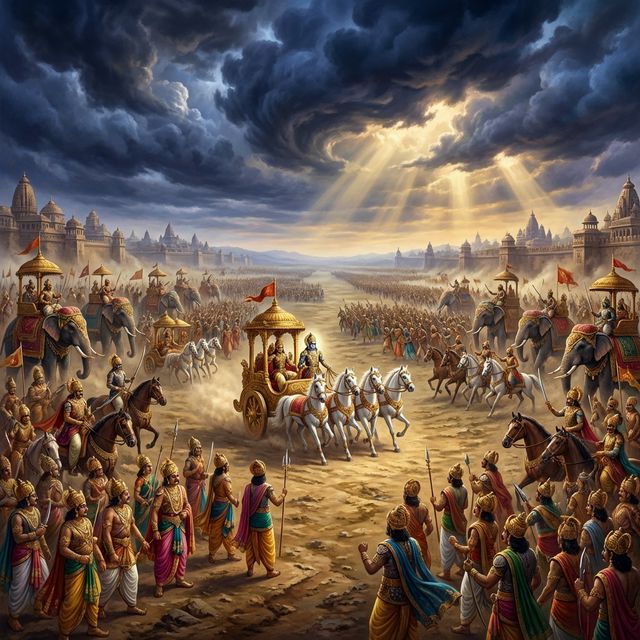
The Sins That Need Expiation
Vyasa reads Yudhishthira the whole catalogue of acts that make a man liable, and then the exceptions
The Question After the Consolation
Vaishampayana said that when the Island-born Rishi had finished speaking of Time, the king was quiet for a while.
Vyasa had just told him the largest thing that could be told him. That the Kshatriyas who lay out on the plain had fallen in the observance of their own duties, that it was Time and not Yudhishthira who had taken their life-breaths, and that a man born in a noble race who is forced by the faults of others into an act he did not want, and who then repents of it, is not the same creature as the man who sins deliberately and feels no shame. For such a one there is no expiation and his sins know no diminution. For Yudhishthira the Horse-sacrifice had been indicated, and the sage had told him to make preparations for it and to go and rule.
None of that was refused. The king simply asked the next question, and it was the question of a man who has been told that he may be cleansed and who wants to know how the accounting is actually kept.
"After doing what acts does a man become liable to perform expiation?" Yudhishthira said. "And what are those acts which he must do for being freed from sin? Tell me this, O grandsire."
It is worth noticing what he did not ask. He did not ask whether he in particular was guilty, which is what he had been asking for days. He asked for the list. He wanted the whole schedule of transgressions laid out, the small ones with the great ones, so that he could find his own place in it and stop guessing.
Vyasa gave him the list.
He gave it the way such things are given in the scriptures, without ranking the items by how they would sound to a grieving man, so that the slaughter of a Brahmana stands in the same recital as black teeth and a nail gone rotten, and a king who has emptied the earth of its lions has to hear his own case read out in the middle of a catalogue of household faults.
"Having omitted to do those acts that have been ordained," the sage began, "and done those that have been interdicted, and having behaved deceitfully, a man becomes liable to perform expiation."
That was the whole principle, in one line, before a single example was named. Omission. Commission. Deceit.
The Man Who Sleeps Past Sunrise
The catalogue began where nobody expects a catalogue of sins to begin, which is in the morning.
The person in the observance of the Brahmacharya vow who rises from bed after the sun has risen, said Vyasa, or who goes to bed while the sun is still setting, becomes liable to perform expiation. One who has a rotten nail. One whose teeth are black.
A modern reader wants to protest at once that these are not sins at all, and the protest is the useful part. What the list is describing is a student under a vow, and a vow is not a feeling. It is a set of hours and a set of observances kept in the body. A man whose nails have gone rotten and whose teeth are black has not committed a crime against anyone. He has stopped keeping himself, and the keeping was the vow. The scripture treats that slackening as a real thing with a real remedy, and puts it on the same page as the great offences rather than in a footnote for the fastidious.
There is an argument buried in the arrangement. If the only entries on the list were murder and blasphemy, then almost everyone alive could read it in comfort, and the whole apparatus of expiation would be a thing built for other people. Beginning at sunrise makes it a list that includes the reader.
Then the sage went from the student's body to the household, and the tone did not change at all.
One whose younger brother weds first. One who weds before his elder brother is wedded. One who weds a younger sister before the elder sister has been wedded. One who weds an elder sister after having wedded a younger one.
Four entries, and all four are the same offence looked at from the four corners of a marriage. In a house where sons and daughters are given in order, the one who goes ahead of the elder has not injured a stranger. He has taken a place that was not his and left an elder standing unmarried in a village that counts such things, and the elder wears the shame of it without having done anything at all.
Yudhishthira, who had spent his life being the eldest, would have heard that clause differently from most men.
Brahmana-Slaying, Set Among the Rest
In the middle of the household faults, without any change of voice, came the greatest of the sins.
One who has been guilty of the slaughter of a Brahmana. One who slays any one of the regenerate classes. One who slays his preceptor, or a woman.
There is no pause around them in the recital. They are named between the marriage clauses and the clauses about the Vedas, in the same measured order, and the effect is not to make the killing of a Brahmana small. It is to say that the ordinance is a single fabric, and that a man does not get to choose which threads of it apply to him.
Beside those, the offences of the tongue and the will. One who speaks ill of others. One who falls away from a vow. One who lives by deceit. One who acts in opposition to his preceptor. One who has violated a compact.
The last of those carried its own weight on that field. A compact is a thing agreed between men who then act on the strength of it, and eighteen days of war had been fought inside a hedge of compacts, some kept and some broken, and both sides had a list. Vyasa did not point at anything. He recited.
Then the clauses that concern the Vedas themselves, and these come in pairs, because the fault can be made in either direction. One who imparts a knowledge of the Vedas to a person unworthy of it. One who does not impart a knowledge thereof to a person that is worthy of it. One who sells a knowledge of the Vedas.
Teaching the wrong man, refusing the right man, and taking money for either. The learning is treated as a thing held in trust, and the trustee can betray it by generosity as easily as by meanness, and can betray it most completely by pricing it.
And beside those, one who has abandoned his sacred fire, which is a household's whole religion gone cold on the hearth while the man of the house is elsewhere.
Flesh, Fire, and Many Lives
The end of the first catalogue is a group of men who make their living out of harm, and the sage named their trades.
One who takes many lives. One who sells flesh. One who slays an animal wilfully. One who sets fire to a dwelling house. One born in a sinful family.
Each of those had a face on the plain outside. Men had taken many lives that month, in the tens of thousands, and one of the people listening had ordered it done. The tents of the sleeping had burned in the night. Yudhishthira was hearing a description of the last eighteen days read out as a list of the acts for which the scriptures require expiation, and he had asked for it, and Vyasa did not soften a syllable on his account.
Nor did the sage stop to say that the king's case was different. He had said it before the list began, and he would say it again after the list ended, and in between the list was simply the list.
"These all are guilty of sins requiring expiation," Vyasa said, and closed it.
Then he opened a second catalogue, and marked the difference between them.
"I shall now mention other acts that men should not do, viz., acts that are interdicted by both the world and the Vedas. Listen to me with concentrated attention."
That is a distinct category and the distinction matters. The first list was of things that make a man liable to a rite. The second is of things that the scripture and the ordinary judgement of people agree a man should simply not do, so that one who does them cannot take shelter in the excuse that the books are obscure and he was doing his best. The village and the Veda have both told him.
The sage began that second recital with the thing a man is likeliest to do while believing himself pious.
The rejection of one's own creed. The practice of other people's creed.
What the World and the Vedas Both Forbid
Then the sage went down the second list, and it turns out to be a list about other people.
Assisting at the sacrifice or the religious rites of one that is not worthy of such assistance. Eating of food that is forbidden. Deserting one that craves protection. Neglect in maintaining servants and dependants. Selling salt and treacle and similar other substances. Killing of birds and animals. Refusal, though competent, to procreate upon a soliciting woman. Omission to present the daily gifts, the handfuls of grass to the kine and the like. Omission to present the dakshina. Humiliating a Brahmana.
Set the ritual clauses aside for a moment and look at what is left. A man came to you for shelter and you sent him away. The people in your house who work for you were not fed and clothed, and you did not think about it. The cattle were not given their handful. The priest who did the work of your sacrifice was not paid his fee. A Brahmana was made small in front of others by a man with the power to do it.
None of those is a dramatic crime. Every one of them is a failure to give what was owed to somebody who was standing in front of you at the time, and the second list is made almost entirely of such failures. The Vedas forbid them and so does the world, because the world can see them happening.
"These all have been pronounced by persons conversant with duty to be acts that no one should do," said Vyasa.
Three more he added, and put them at the end where they would be remembered, because all three are offences committed inside a family, against the people who made you or taught you or married you.
"The son that quarrels with the father, the person that violates the bed of his preceptor, one that neglects to produce offspring in one's wedded wife, are all sinful, O tiger among men!"
Then he closed the whole account.
"I have now declared to thee, in brief as also in detail, those acts and omissions by which a man becomes liable to perform expiation."
And then, having spent the morning building a wall of prohibitions in front of a man who was already convinced of his own damnation, the sage began to take part of it down again.
"Listen now to the circumstances under which men, by even committing these acts, do not become stained with sin."
Wrath Against Wrath
He began the exceptions with the heaviest item on the whole list, which was not an accident.
"If a Brahmana well acquainted with the Vedas takes up arms and rushes against thee in battle for killing thee," Vyasa said, "thou mayst proceed against him for taking his life. By such an act the slayer does not become guilty of the slaughter of a Brahmana."
He did not leave it as his own opinion. There is a mantra in the Vedas that lays this down, he said, and I declare unto thee only those practices that are sanctioned by the authority of the Vedas. One who slays a Brahmana that has fallen away from his own duties and that advances, weapon in hand, with intent to slaughter, does not truly become the slayer of a Brahmana.
Then the line that explains the whole exception in a dozen words.
"In such a case it is the wrath of the slayer that proceeds against the wrath of the slain."
The protection belongs to the office, and a Brahmana who has picked up a weapon and is running at a man with it has stepped out of the office for as long as he is running. What meets your anger is his anger and not his birth. There was a preceptor lying dead on that plain who had spent the war shooting arrows, and a son of his still alive somewhere, and every man listening knew it without being told.
The sage went on to the other cases where the act is done and the stain is not incurred.
A person who drinks alcoholic stimulants in ignorance, or upon the advice of a virtuous physician when his life is at peril, should have the regenerating ceremonies performed once more in his case, and that is the end of the matter. All that has been said about the eating of interdicted food may be cleansed by such expiatory rites.
Connection with the preceptor's wife at the preceptor's command does not stain the pupil, and here the sage cited a case instead of arguing: the sage Uddalaka caused his son Swetaketu to be begotten by a disciple.
A person who commits theft for the sake of his preceptor in a season of distress is not stained. One, however, that takes to thieving for procuring enjoyments for himself becomes stained. And even in the first case the conditions hold. One is not stained by stealing from other than Brahmanas, and only one that steals under such circumstances without himself appropriating any portion thereof is untouched by sin.
The Falsehood That May Be Spoken
Then came the exception that unsettles people most, and Vyasa stated it without apology.
A falsehood may be spoken for saving one's own life or that of another, or for the sake of one's preceptor, or for gratifying a woman, or for bringing about a marriage.
Four occasions, and none of them vague. The words are permitted where a life hangs on them, where a teacher's need requires them, where a woman is to be pleased, and where a marriage is to be made. Everywhere else the ordinance about truth stands where it stood. The list of licences is short and closed, and a man who wants to lie for his own advantage will not find his case in it.
The remaining exceptions came quickly, each of them lifting an entry off the catalogue the king had just heard.
One's vow of Brahmacharya is not broken by having wet dreams, and the expiation laid down in such cases consists only in the pouring of libations of clarified butter on the blazing fire. If the elder brother be fallen or has renounced the world, the younger brother does not incur sin by marrying. Solicited by a woman, connection with her is not destructive of virtue. By making a gift in ignorance to an undeserving Brahmana one does not incur sin, and the omission through ignorance to behave with liberality towards a deserving person does not lead to sin either. By casting off an adulterous wife one does not incur sin, and by such treatment the woman herself may be purged while the husband may avoid sin. One who knows the true use of the Soma juice does not incur sin by selling it. By dismissing a servant who is incompetent to render service one is not touched by sin.
Only one clause in the whole set of exceptions was tightened rather than loosened.
"One should not slay or cause to be slain an animal except in a sacrifice. Animals have become sacred, fit for sacrifice, through the kindness manifested towards them by the Creator himself in the ordinance laid down by him."
Then the sage stopped, and told the king exactly where they had got to.
"I have now said unto thee those acts by doing which one does not incur sin. I shall now speak to thee of expiation in detail."
Yudhishthira had asked two questions in one breath that morning: what makes a man liable, and what he must then do. He had been given the first answer entire, with his own war standing in the middle of it and a door left open on the far side, and he sat among his brothers and waited for the second.
Dharma Lesson
Yudhishthira wanted to know whether he in particular was guilty, and what he got instead was the whole schedule, with black teeth and broken vows standing in the same recital as the slaughter of a Brahmana. The list humbles because it includes everybody. The exceptions steady, because they show a tradition that weighs circumstance and intent rather than counting acts: what is forbidden to a man seeking advantage may be permitted to a man saving a life, and the tongue that must not lie for gain may lie to keep someone alive. Between a wall of prohibitions and a door left open on the far side, a king is being taught that guilt is a thing to be measured and discharged, not a thing to drown in.