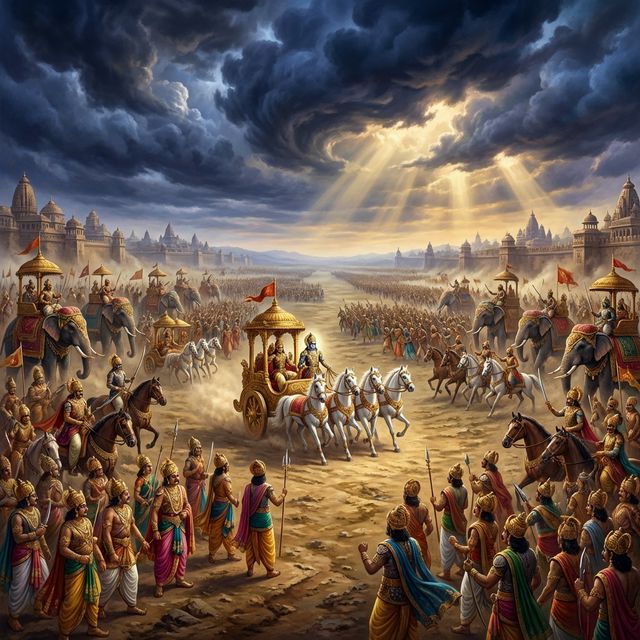
The Night Janaka Opened the Sky
Before the battle with Pratardana, the king of Mithila shows his army heaven and hell
The Question Behind the Question
Yudhishthira had just been told what happens to the man who dies facing forward.
Bhishma had given him Amvarisha and Indra on the sacrifice of battle, the whole terrible liturgy of it, elephants for priests and blood for the liquid offering and the open ground between two armies for the altar, and at the end of it the plain sentence that the king could not stop hearing. The inglorious warrior who, turning away from the fight in fear, is slain by foes, sinks into hell. There is no doubt in this.
He was a man who had spent eighteen days sending other men into that sacrifice. He knew what his own army had looked like at dawn on the days when it was going to hold, and what it had looked like on the days when it was not, and he knew that the difference had very little to do with the numbers.
So the next thing Bhishma said to him was not a doctrine. It was a story about a king who had worked out how to tell his soldiers this before the fighting rather than after.
"In this connection," said Bhishma, from the bed of arrows, "is cited the old story of the battle between Pratardana and the ruler of Mithila."
He did not stop to explain Pratardana, and the epic does not either. He was a king who came against Mithila with an army, and for the purposes of this story that is the whole of him. He is the weather. The story is about the other man.
"The ruler of Mithila," Bhishma said, "viz., Janaka, after installation in the sacrifice of battle, gladdened all his troops on the eve of fight. Listen to me, O Yudhishthira, as I recite the story."
Installation is the word used of a man who has been consecrated for a rite and may not now walk away from it. Janaka had been installed. The enemy was on his border, the fire was lit, and what he did next, on the last evening before it began, was the thing Bhishma wanted his own king to hear.
The King Who Knew the Truth of Everything
Janaka of Mithila is not, in most of the places he appears, a man one expects to find on a battlefield.
He is the king the sages come to argue with. He is the one who sits on a throne in Videha with a kingdom running smoothly around him and holds his own against renunciates who have given up everything, and the standing scandal of him is that he seems to be free while still being a king. Bhishma had already used him more than once in these long days on the arrows, and would use him again.
Here he is a war leader with a hostile army coming, and the epithet the text gives him is the same one it always gives him. Janaka, the high souled king of Mithila, conversant with the truth of everything.
That phrase is doing the work of the entire story. It is not decoration. It is the reason the thing that follows is possible at all, because what Janaka did on the eve of that fight was not give a speech.
He showed both heaven and hell unto his own warriors.
The text does not say he described them. It does not say he preached about them or promised them or held them out as a hope for after. It says he showed them, and it says it in one flat clause and then moves straight on to what he said while they were looking, in the manner of a book that assumes a man conversant with the truth of everything can open that particular curtain if he judges the occasion worth it.
So picture the occasion. An army camped at the edge of its own country on the last night before a battle, men who have been issued armour and have eaten and are now sitting in the dark doing the arithmetic every soldier does, and the king walks out among them, and the sky above the camp is not the sky any more.
Behold, These Are the Regions
"Behold," said Janaka. "These are the regions, endued with great splendour, for those that fight fearlessly."
He was pointing. That is what makes this different from every recruiting speech ever made. A commander who says that heaven awaits the brave is making a claim his men must take on trust from him, and men on the eve of a battle are very good at estimating exactly how much their commander's trust is worth. Janaka took the estimate out of their hands. He put the thing itself in front of them and told them to look at it.
And he described what they were looking at in three strokes, no more.
Full of Gandharva girls. Eternal. Capable of granting every wish.
It is worth noticing how little the epic spends here, because it can be extravagant when it wants to be, and a few sections earlier it had spent a hundred lines on the imagery of the sacrifice of battle without drawing breath. Here it gives three clauses. The regions are beautiful, they do not end, and there is nothing a man could want in them that he would not have.
A soldier does not need a fourth clause. Those three answer the only three questions he has been asking himself since sundown, which are whether the thing on the other side is good, whether it lasts, and whether he will still be wanting anything when he gets there.
What the men of Mithila were being offered was not a reward for winning. Janaka never says that. He says the regions belong to those that fight fearlessly, which is a description of conduct and not of outcome, and every man in that camp understood the distinction, because it meant that the dead who fought well were going to the same place as the living who fought well, and that the only way to be excluded was to be excluded by something you did yourself.
Then the king turned, and told them to look the other way.
The Other Side
"There, on the other side, are the regions of hell, intended for those that fly away from battle."
He had shown them the reward first and the punishment second, which is the order a man uses when he wants to be understood rather than obeyed, and the sentence he gave for the second was shorter than the sentence he gave for the first.
They would have to rot there for eternity in everlasting ingloriousness.
There is no torture in it. No hooks, no fire, no officers of Yama with instruments, none of the apparatus the epic knows perfectly well how to describe and elsewhere describes at length. The whole punishment is contained in two words that are almost the same word said twice. Eternity. Everlasting. And the quality of the place is given as ingloriousness, which is to say that nothing whatever happens there, and that nothing is ever said about you again.
For the men standing in that camp, this was the more precisely aimed of the two visions. Every one of them could imagine dying. Not one of them had any trouble imagining the other thing, the walk home, the fields, the years, the particular silence of a village that knows.
Then Janaka stopped showing and started asking, and the ask was put as plainly as a man can put it.
"Resolved upon casting away your very lives, do ye conquer your foes. Do not fall into inglorious hell."
And then the line that the rest of the section exists to hold up.
"The laying down of life in battle constitutes, in respect of heroes, their happy door of heaven."
A door. Not a price, not a loss, not even a sacrifice, though the whole discourse around it is built on the language of sacrifice. A door, and the adjective attached to it is happy. Janaka had walked his army up to the one thing it was afraid of and told the men that it was the way in, and he had arranged matters so that when he said it they could see over his shoulder that he was right.
How the Army of Mithila Went In
Thus addressed by their king, O subjugator of hostile towns, the warriors of Mithila, gladdening their rulers, vanquished their foes in battle.
That is the whole account of the war. One sentence, and the sentence is mostly about the mood of the men rather than the manoeuvres of the armies, and Pratardana, who had presumably marched a long way with a great deal of equipment, is disposed of in two words. Their foes.
Bhishma did not linger over the fighting because the fighting was never the point. The point was the evening before it, and having made it he turned at once to the practical instruction that the story had been carrying all along, and gave Yudhishthira the arrangement of an army.
They that are of firm souls should take their stand in the van of battle.
The car-warriors should be placed in the midst of elephants.
Behind the car-warriors should stand the horsemen.
Behind the last should be placed the foot-soldiers, all accoutred in mail.
"That king who forms his array in this manner always succeeds in vanquishing his foes," said Bhishma. "Therefore, O Yudhishthira, the array of battle should always be thus formed."
It reads at first like a change of subject, a page of drill inserted into a page of theology, and it is not. Look at what stands in the front rank. Not the strongest, not the best armed, not the highest born. Those that are of firm souls. The order of the whole army is being set by the quality Janaka had spent the previous night manufacturing in his camp, and everything behind the first rank is arranged around it, elephants around cars, horse behind cars, mailed infantry at the back holding the shape.
An array is a machine for keeping frightened men in a line. Janaka's night was the same machine, built out of sight instead of steel, and Bhishma set the two side by side in the same breath because to him they were one subject.
Do Not Chase Them Far
"Filled with rage, heroes desire to win blessedness in heaven by fighting fairly," Bhishma went on. "Like Makaras agitating the ocean, they agitate the ranks of the foe."
The Makara is the great sea-beast, and the image is exact about what a determined body of men does to a line: not cut it, not break it, stir it, until the water that was one thing is churning and cannot be told from itself.
Then, immediately after the sea-beasts, this. Assuring one another, they should gladden those amongst them that are cheerless.
That is the same verb the text used of Janaka on the eve of the fight. He gladdened all his troops. Now it has been handed down from the king to the men themselves, and it has become a standing duty owed sideways, soldier to soldier, in the middle of the fighting. Somebody in the rank is cheerless. Attend to him. It is listed here as a manoeuvre, between the arrangement of cavalry and the conduct of a pursuit, and it is treated as no less technical than either.
And then, on the far side of victory, the restraint.
The victor should protect the land newly conquered. He should not cause his troops to pursue too much the routed foe.
Bhishma gave two reasons, and they belong to two different orders of thinking. The first is simply true. The onset is irresistible of persons that rally after the rout and that, despairing of safety, assail their pursuers. A man with nothing left to lose is the most dangerous thing on the field, and an army strung out chasing him is no longer an army.
The second reason is not prudential at all.
Warriors of courage do not wish to strike them that run away with speed. That is another reason why the routed foe should not be pursued hotly.
The hero does not want to. Janaka had just spent a night teaching his men what happens to the man who runs, and the same teaching, arriving from the other end, forbids them to enjoy it when they see it.
The World Rests on the Arms of Heroes
Then Bhishma closed it, and he closed it with a short catalogue that starts in the natural world and arrives, without any change of tone, at the man who runs away.
Things that are immobile are devoured by those that are mobile.
Creatures that are toothless are devoured by those that have teeth.
Water is drunk by the thirsty.
Cowards are devoured by heroes.
Four clauses, and the fourth is stated in exactly the same voice as the first three, as a fact about how the world is put together rather than as a threat or a moral. The plant is eaten by the animal. The soft-mouthed thing is eaten by the thing with teeth. Water goes where there is thirst. This is not presented as justice. It is presented as appetite, and the last line of it says what a coward is for.
And then the observation that gives the whole section its edge.
Cowards sustain defeat though they have, like the victors, similar backs and stomachs and arms and legs.
That is the anatomy of two men laid side by side and found identical. Nothing in the body accounts for the difference. The same shoulders, the same legs, the same everything a quartermaster could measure, and one of them is standing in the front rank and the other is face down in the dust of the road home, and the entire distance between them was opened up somewhere that no inspection would ever find.
They that are afflicted with fear bend their heads and joining their hands stay before those that are possessed of courage.
This world rests on the arms of heroes like a son on those of his sire.
He, therefore, that is a hero deserves respect under every circumstance.
There is nothing higher in the three worlds than heroism.
The hero protects and cherishes all, and all things depend upon the hero.
The image in the middle of it is the one to carry away, because it is not an image of conquest. It is a man holding a child. Everything that is soft and unarmed and asleep in the world is lying in somebody's arms, and the arms belong to people who have been out at the edge of it where Janaka's soldiers stood, and who did not turn round.
Dharma Lesson
Janaka does not tell his men that heaven is waiting; he takes the question out of the realm of trust and lets them see for themselves, and what they see is that the door is opened by their own conduct rather than by the result of the battle. The regions belong to those who fight fearlessly, not to those who win, and the hell belongs to no enemy's sword but only to a man's own turning away. Bhishma sets this beside the drill of the array and the mercy owed a fleeing foe because to him they are one subject: courage is a thing a commander builds in his people before it is ever a thing they spend. The line that closes it is not about conquest at all, but about who is carrying whom, since the world rests on the arms of heroes as a son rests on the arms of his father.