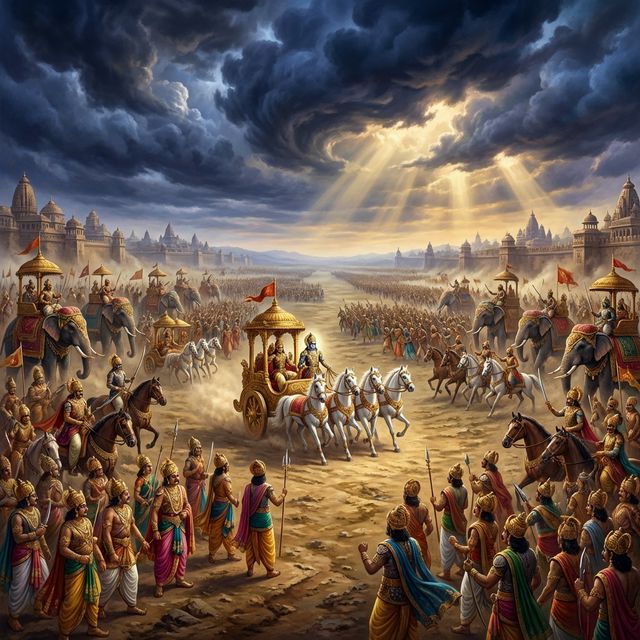
What Is Owed to Mother, Father and Teacher
Asked which duty matters most of all, Bhishma names three people and calls them the three sacred fires
The Path Is Long and Has Many Branches
By this point in the questioning, Yudhishthira had been given nearly everything a king is supposed to know.
Bhishma had gone through the duties of Brahmanas and Kshatriyas and Vaisyas and Sudras, and the means of livelihood proper to each. He had gone through the treasury and how it is filled, the marks of a good minister, the six limbs of a kingdom, the qualities of armies, the way to tell a wicked man from a good one, and the handling of the great families whose combination holds a realm together and whose quarrels take it apart. It had all been sound and it had all been long, and the king lying awake at the end of each day had begun to feel that the list had no bottom to it.
So the question he brought the old man on the arrows that morning was not another item for the list. It was a question about the list itself.
"The path of duty is long," said Yudhishthira. "It has also, O Bharata, many branches. What, however, according to thee, are those duties that most deserve to be practised? What acts, according to thee, are the most important among all duties, by the practice of which I may earn the highest merit both here and hereafter?"
He was asking to be told what he could not afford to leave undone. A man may hear the whole of dharma recited to him from a bed of arrows and still not know which part of it would ruin him if he neglected it. Yudhishthira wanted the short road. He had spent his life being told that everything mattered, and he wanted to know what mattered most.
Bhishma did not send him to a sacrifice, or to a conquest, or to a rite that needed priests and a season and a herd of cattle.
"The worship of mother, father, and preceptor is most important according to me," he said. "The man who attends to that duty here succeeds in acquiring great fame and many regions of felicity."
Three people. Not one of them far away, not one of them difficult to find, and every one of them already known to the man who was asking.
The Three Fires
Bhishma did not leave the three standing as three ordinary people. He set them in a series of triads, each one larger than the last, until the household had been made the size of the universe.
"They are the three worlds," he said. "They are the three modes of life. They are the three Vedas. They are the three sacred fires."
Then he assigned the fires, one to each, and this is the part a listener of that time would have felt in his body, because the fires were not a figure of speech. A householder kept them alight in his own courtyard and fed them with his own hands every day of his married life.
"The father is said to be the Garhapatya fire," said Bhishma. That is the household fire, the one lit at a man's wedding and kept burning to the end, the fire from which all the others are taken. "The mother, the Dakshina fire." That is the fire set toward the south, the quarter of the ancestors and the dead. "And the preceptor is that fire upon which libations are poured." That is the fire that carries the offering out of the world and up to the gods.
"These three fires are, of course, the most eminent. If thou attendest with heedfulness to these three fires, thou wilt succeed in conquering the three worlds."
Then he divided the reward between them, and the division is exact.
"By serving the father with regularity, one may cross this world. By serving the mother in the same way, one may attain to regions of felicity in the next. By serving the preceptor with regularity one may obtain the region of Brahma."
The father gets a man through the life he is living. The mother gets him through the one after it. The teacher gets him past both, to the region from which nobody comes back down.
"Behave properly towards these three, O Bharata, and thou shalt obtain great fame in the three worlds. Blessed be thou. Great will be thy merit and reward."
There is no altar in any of it. The whole apparatus of the sacrifice has been folded up and put into three chairs at the edge of a room.
Never Eat Before They Eat
Having made them fires, Bhishma brought them back down to the house and said what the service actually consists of, and it is small, daily and unglamorous.
"Never transgress them in any act. Never eat before they eat, nor eat anything that is better than what they eat. Never impute any fault to them. One should always serve them with humility. That is an act of high merit."
Not a vow, not a pilgrimage. Sitting down after them at meals. Not helping yourself to the better dish. Not saying, even once, even accurately, that they are in the wrong.
And with it he laid down a clause that is hard to hear and that the text does not soften.
"Worshipped with respect by thee, whatever they will command thee, be it consistent with righteousness or inconsistent with it, should be done unhesitatingly, O Yudhishthira. One should never do what they forbid. Without doubt, that which they command should always be done."
Then the other side of the ledger, stated as flatly as the first.
"He who honours these three is honoured in all the worlds. He, on the other hand, who disregards these three, fails to obtain any merit from any of his acts. Such a man acquires merit neither in this world nor in the next. He who always disregards these three seniors never obtains fame either here or hereafter."
That is a severe accounting. It says that a man may perform every rite in the books and be building on nothing, because the ground the rites stand on is at home and he has let it rot.
And then Bhishma, who was not in the habit of citing himself, cited himself.
"All that I have given away in honour of those three has become a hundredfold or a thousandfold of its actual measure. It is in consequence of that merit that even now, O Yudhishthira, the three worlds are clearly before my eyes."
The three he meant were a river for a mother, a king of Hastinapura for a father whose desire had cost him a throne and a marriage, and Rama of Bhrigu's line for a preceptor, whom he had afterwards fought for twenty-three days on the Saraswati and could not defeat. He had honoured all three and lost heavily by two of them. He was telling a king, from the arrows, that the account had come back multiplied.
One Is Worth Ten
Then Bhishma did something unexpected. Having set the three side by side, he began to rank them against one another, and he did it by tens, like a man counting out weights.
"One Acharya is superior to ten Brahmanas learned in the Vedas. One Upadhyaya is again superior to ten Acharyas. The father, again, is superior to ten Upadhyayas. The mother, again, is superior to ten fathers, or perhaps, the whole world, in importance."
The Acharya and the Upadhyaya are two grades of teacher, one giving a portion of the Veda and one the whole of it, and the ladder climbs from the learned man to the first, from the first to the second, from the second to the father. Then it takes a step that is not a step at all but a leap off the scale. Ten fathers, or perhaps the whole world. The arithmetic has been going up by tens and at the last rung it stops counting.
"There is no one that deserves such reverence as the mother."
That could have been the end of the discourse, and if it had been, this would be a teaching about mothers. It is not the end. Bhishma had one more thing to say, and he marked it as his own judgment rather than a quotation.
"In my opinion, however, the preceptor is worthy of greater reverence than the father or even the mother."
Then he gave the reason, and the reason is the whole argument of the section compressed into four sentences.
"The father and the mother are authors of one's being. The father and the mother, O Bharata, only create the body. The life, on the other hand, that one obtains from one's preceptor, is heavenly. That life is subject to no decay and is immortal."
The word only is doing a great deal of work there, and it is doing it against a woman he had just called worth the whole world. Parents make the thing that dies. A teacher makes the thing that does not. On that scale, and on no other, the man who taught you outranks the woman who bore you.
"For this reason, the preceptor is worthy of greater reverence than either the father or the mother."
He said it twice, in case the king had thought he misheard.
The Two Who May Not Be Struck
Yudhishthira was a king, and a king carries the rod. Bhishma had spent whole days teaching him when to use it. So he now closed off two people against it by name.
"The father and the mother, however much they may offend, should never be slain. By not punishing a father and a mother, even if they deserve punishment, one does not incur sin. Indeed, such reverend persons, by enjoying impunity, do not stain the king."
That is a deliberate hole cut in the law of chastisement, and it is cut for the sovereign's own parents and for everyone else's. The king who lets his father go unpunished has not failed in his office. He is not marked by it.
"The gods and the Rishis do not withhold their favours from such persons as strive to cherish even their sinful fathers with reverence."
Even their sinful fathers. The text does not pretend that the three seniors are good. It assumes some of them are not, and says the duty is unchanged.
Then Bhishma widened the word father until it took in men who had never been anyone's father.
"He who favours a person by imparting to him true instruction, by communicating the Vedas, and giving knowledge which is immortal, should be regarded as both a father and a mother. The disciple, in grateful recognition of what the instructor has done, should never do anything that would injure the latter."
And the traffic runs both ways. "Preceptors always show great affection for their disciples. The latter should, therefore, show their preceptors commensurate reverence. He that wishes to earn that high merit which has existed from ancient days should worship and adore his preceptors and cheerfully share with them every object of enjoyment."
Then, last, he named who is on the other end of each of the three services, and the three names are not small ones.
"With him who pleases his father is pleased Prajapati himself. He who pleases his mother gratifies the earth herself. He who pleases his preceptor gratifies Brahma by his act. If preceptors are worshipped, the very Rishis, and the gods, together with the Pitris, are all pleased."
Wait on your father and you have waited on the lord of creatures. Care for your mother and the ground under the whole world is content with you.
The Four Who Are Never Cleansed
Bhishma finished with the failures, and he weighed them all against the same thing.
"They that do not reverence their preceptors after receiving instruction from them, by obeying them dutifully in thought and deed, incur the sin of killing a foetus. There is no sinner in this world like them."
He said it of the ungrateful disciple. He said it again of anyone who injures a preceptor or a father or a mother in thought and deed, and he said the second time that there is no sinner in the world equal to them. Then he said it a third time, and the third case is the one a listener recognises fastest, because it happens in ordinary families every year and nobody calls it a crime.
"That son of the sire's loins and the mother's womb, who, being brought up by them and when he comes to age, does not support them in his turn, incurs the sin of killing a foetus. There is no sinner in the world like unto him."
The measure is chosen with care. The sin of killing a foetus is the destruction of a life that has not been lived yet. That is what the old man puts opposite the son who was carried and raised and fed and who, when his turn came, did not feed back.
Then he named four men, and this list is different from the others because it has no remedy attached to it.
"We have never heard that these four, viz., he who injures a friend, he who is ungrateful, he who slays a woman, and he who slays a preceptor, ever succeed in cleansing themselves."
Not that their penance is heavy. That it has never been heard of. Every other sin in the Shanti Parva comes with a rite that ends it, and these four stand outside that whole machinery. The ungrateful man is in the middle of them, between the betrayer of a friend and the killer of a woman, and he is there for one reason, which is that all three of them have taken something from a person who could not defend himself against them.
Then the old man on the arrows stopped.
"I have now told thee generally all that a person should do in this world. Besides those duties that I have indicated, there is nothing productive of greater felicity. Thinking of all duties, I have told thee their essence."
The king had asked for the shortest road out of a subject with no bottom to it, and he had been handed three people and sent home.
Dharma Lesson
Yudhishthira asked for the one duty he could not afford to neglect, and was pointed back at the people he had been living with all his life. The teaching moves the whole apparatus of the sacrifice indoors: the fires a man tends are his parents and his teacher, and the offerings are sitting down to eat after them and not finding fault. It is also uncomfortable, and honestly so, since it asks obedience even where the command is not righteous and forbids the rod even where a parent deserves it. What holds it together is the ranking at its centre, that the mother outweighs the world because she gave the body, and the teacher outweighs her because what he gave does not die.