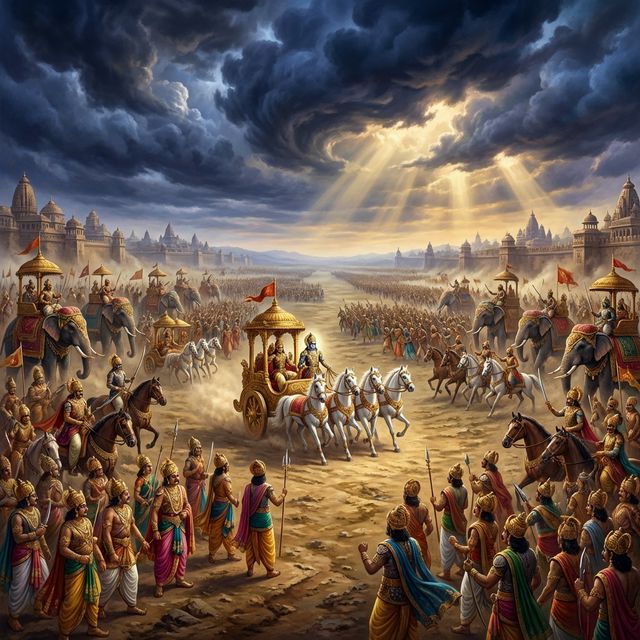
The Night After Drona
The sleepless camp, four men in a tent, and the thread tied round Karna's wrists
The Word Jaya
"Om! Having bowed down unto Narayana, and unto that most exalted of male beings, Nara, and unto the goddess Sarasvati also, must the word Jaya be uttered."
That is how the eighth book opens, and the invocation is not ornament. Jaya means victory, and Jaya is also the oldest name of the poem itself, and the book that begins with the word is the book in which the Kaurava cause finally runs out of men.
The speaker is Vaishampayana, the pupil of Vyasa, reciting the whole history to king Janamejaya, who is the great-grandson of Arjuna and who has asked to hear what his ancestors did. Everything in this story reaches us at that distance: an old brahmana telling a young king about a night in his family's past that nobody in the family survived well.
"After Drona had been slain, O monarch," Vaishampayana said, "the royal warriors of the Kaurava army headed by Duryodhana, with hearts filled with great anxiety, all repaired to Drona's son."
It was the evening of the fifteenth day of the war. That morning Drona had been alive and in command, arresting the sky with his weapons, the third and greatest of the teachers the Kauravas had put at the head of their army after Bhishma fell. By afternoon he had heard a word about his son that was true in its letter and false in everything else, had laid down his bow on the terrace of his car, and had sat down in yoga; and Dhrishtadyumna, who had been born out of a fire for exactly this, had taken him by the hair and cut off his head in front of the whole field.
The army had broken and run. It had been rallied, more or less. And then the light went, and the fighting stopped, and the kings of the Kaurava side found themselves standing in the dusk with no commander and no plan and nothing to do with their hands.
There was one place to go. They went to the son of the man who was dead.
The Circle Around Sharadvat's Grandson
The text does not call him Ashwatthama in this passage, and it does not call him Drona's son twice in a row either. It says they sat around the son of Sharadvata's daughter.
That is a way of naming him through his mother. Kripi was the daughter of the rishi Sharadvat and the sister of Kripa, and Drona married her, and Ashwatthama is their only child. On the night his father was killed the poem reaches past the father and identifies the young man by the other half of his blood, as though it were being careful, just for a moment, not to say the word Drona in his hearing.
They sat around him afflicted with grief. Lamenting the loss of Drona, and deprived of energy in consequence of their cheerlessness, the kings of the earth came and lowered themselves onto the ground beside a man in his twenties whose father had been beheaded that afternoon, and stayed there.
It is worth noticing what this gathering was not. It was not a council of war. Nobody appointed a commander that evening. Nobody drew up an array for the morning or counted what was left of the elephants. The men who had a war to run came together and did nothing but sit, which is the most honest thing they do in the whole of this section.
"Comforted for a little while by considerations founded upon the scriptures," Vaishampayana said, "when night came, those rulers of Earth proceeded to their respective tents."
Considerations founded upon the scriptures. Everyone in that circle knew the arguments by heart. That the kshatriya slain with his face to the enemy goes upward at once. That Destiny is unconquerable and no man's purpose is his own. That grief has never yet fetched anybody back. They are good arguments. They have consoled a great many people. They are also the same arguments Sanjaya will offer Dhritarashtra later, and Krishna offered Arjuna at the start, and they work here exactly as far as the poem says they work.
For a little while. Then it got dark, and they went to bed.
No Happiness in Their Abodes
"Those lords of Earth, however, O thou of Kuru's race, could feel no happiness in their abodes. Thinking of that immense slaughter, they could not also sleep."
The line is short and it covers an entire camp. Every tent in it had a king or a great car-warrior lying awake inside, and the poem does not go into any of them. It states the fact for all of them at once and moves on, and the effect is of a lamp carried past a long row of doorways with the same thing happening behind each one.
Thinking of that immense slaughter. Not of tomorrow. The Kaurava lords lay in the dark that night doing arithmetic backwards, and the numbers were these. Fifteen days gone. Bhishma taken down on the tenth and still alive out there on his bed of arrows, waiting for the sun to turn north before he would consent to die. Abhimanyu killed inside a formation by six men at once. Jayadratha beheaded before a false sunset. Ghatotkacha burned out of the sky by the dart that had been kept back for Arjuna, which is why the dart was not available today or any day after. Drona dead this afternoon, by a lie, with his son alive the whole time.
And the tents themselves were the same tents. That is the part the sentence leaves for the reader. A camp does not shrink when the men in it are killed. The lanes between the pavilions ran the same distances they had run on the first morning, when the two armies drew up eleven divisions against seven and the conches went off together, and a man walking back to his own quarters that night passed the standards of the dead in the ordinary order in which they had always stood.
They had inflicted most of that slaughter themselves, and they had asked for the war, and they were winning nothing by it. So they lay in their beds among the empty pavilions of their friends and could feel no happiness in their abodes, which is a mild phrase for what the poem is describing, and the poem knows it.
Four Men Who Did Not Sleep
Out of the whole camp the poem then picks four.
"The Suta's son, and king Suyodhana and Duhshasana and Shakuni, in special, could not compose themselves to sleep. Those four passed that night together in Duryodhana's tent."
Take the names one at a time, because the list is not casual.
The Suta's son is Karna, called here by the fact about him that the whole war has turned on: that he was raised by Adhiratha the charioteer, that the assembly at Hastinapura and the field at Kurukshetra have both thrown his birth in his face, and that Kunti has since come to him alone at the water and told him whose son he actually is. Suyodhana is Duryodhana. The name means the good fighter, and it is the name his parents gave him and the one the poem uses when it is standing inside his own point of view rather than outside it. Dushasana is his brother, the one whose hands did the work in the assembly hall. Shakuni is their uncle from Gandhara, who is in this history for one reason and had already accomplished it years before the first arrow was shot.
Those four. Not Ashwatthama, whom they had all just been sitting with. Not Kripa, not Kritavarma, not Shalya, none of the men whose advice you would want on the night you had lost your commander. The four who could not sleep were the four who had been in the room at the dice.
They did not summon each other, so far as the text says. It simply reports that when the night became unbearable in four separate tents, the four of them ended up in one, which is what happens to people who share a thing they cannot discuss with anybody else.
And having gathered, they did not talk about Karna's promotion, or the Pandava line, or how to hold the field for one more day.
As If It Were Really a Hundred Years
"Reflecting upon the woes they had inflicted upon the high-souled Pandavas," Vaishampayana said. "Formerly they had brought Draupadi, plunged into woe on account of the match at dice, into the assembly. Recollecting it they experienced great regret, their hearts being filled with anxiety."
That is what they talked about. Not the war they were losing. One afternoon, years earlier, in a hall.
Consider everything available to those four men to be sorry about, and how little of it they chose. The house of lac. The thirteen years. The refusal of five villages when Krishna came to ask for five villages. Abhimanyu. Any of it. What came up out of the dark instead was the queen of the Pandavas being brought into the assembly in one garment, and the epic is precise about her condition when they brought her: plunged into woe on account of the match at dice. She had not lost anything at that game. She had not played. She was staked by a man who had already lost himself, and she asked the hall the legal question about that, and the hall could not answer her.
Each of the four had held a different part of it. Shakuni had thrown the dice. Duryodhana had given the order and shown her his thigh. Dushasana had gone to the inner apartments and taken her by the hair. Karna, who was neither a Kuru nor the king nor a blood relation, had said the words in front of everybody, which were the worst thing said in that hall by anyone.
And now they were sitting in a tent with the army half dead outside, four grown men going over it again in the dark.
"Thinking of those sufferings inflicted upon the Pandavas in consequence of the gambling match, they passed that night in sorrow, O king, as if it were really a hundred years."
The poem gives them their regret. It is real regret, and it is stated plainly, and it is worth a great deal to know that they felt it. It also arrives on the fifteenth night of an eighteen-day war, when there is nothing left to do with it, and it changes not one thing about the morning.
The Thread Round His Wrists
"Then when morning came, observing the dictates of the ordinance, all of them duly went through the customary rites."
That is the sentence that ends the night, and the recovery in it is entirely mechanical. Nobody has an idea. Nobody says anything wise. The sun comes up, and the ordinance says what a king does when the sun comes up, and they do it, and the doing of it works: "Having gone through these customary rites, and comforted to some extent, O Bharata, they ordered their troops to be arrayed, and then came out for battle."
Comforted to some extent. The scriptures had comforted them for a little while the evening before and had not lasted the night. The morning ritual, which asks nothing of a man except that he perform it in order, got them as far as giving orders.
Then the ceremony that this whole night has been leading to. They made Karna their generalissimo by tying the auspicious thread round his wrists.
That is the whole of the installation as the text gives it. No speech. No account of the choice, no debate, no rival candidate named. A thread on the wrists of the man who had waited longer for this than any of them, who had been kept out of the field for ten days by Bhishma's refusal to fight beside him, who had already given away his armour and his earrings, and who by his own word to Kunti would not lift a hand against four of the five men he was now marching out to destroy.
And around the thread, everything money could arrange. Foremost of brahmanas caused, by presents of vessels of curds, clarified butter, akshatas, coins of gold, kine, jewels and gems and costly robes, to pray for their victory. Heralds and musicians and panegyrists adoring them with hymns about victory.
Across the field the other camp did the same thing without the noise. "The Pandavas also, O king, having gone through their morning rites, issued from their camp, resolved on battle."
"Then commenced a fierce battle, making the hair to stand on end, between the Kurus and the Pandavas, each desirous of vanquishing the other."
Two Days, and a Question
Then Vaishampayana, having got his army out of the tent and onto the field, gave away the ending before he told any of it.
"During the commandership of Karna, the battle that took place between the Kuru and the Pandava troops was exceedingly fierce and lasted for two days. Then Vrisha, having made an immense slaughter of his enemies in battle, was at last slain in the sight of the Dhartarashtras, by Arjuna. Then Sanjaya, repairing to Hastinapura, told Dhritarashtra all that had happened at Kurujangala."
Two days. That is the length of the command that the thread was tied for, and Vrisha is Karna's own name for himself, the bull, and the sons of Dhritarashtra were watching when he went down.
And the young king listening to all this stopped the recitation, because something in it did not make sense to him.
"Having heard of the fall of Bhishma and that other mighty car-warrior, Drona," Janamejaya said, "the old king Dhritarashtra had been afflicted with great grief. How, O foremost of brahmanas, could he, plunged into grief, support his life having heard of the death of Karna, that well-wisher of Duryodhana? How indeed could that descendant of Kuru support his life when he, upon whom that monarch had rested the hope of his sons' victory, had fallen?"
It is not a rhetorical question. Janamejaya has been counting, and he cannot make the total come out.
"When the king did not lay down his life even after hearing of Karna's death, I think that it is very difficult for men to yield up life even under circumstances of great grief! O brahmana, when the king did not yield up his life after hearing of the fall of the venerable son of Shantanu, of Bahlika and Drona and Somadatta and Bhurishrava, as also other friends and his sons and grandsons, I think, O regenerate one, that the act of yielding up one's life is exceedingly difficult!"
That is the discovery a young man makes reading his family's history: that grief does not kill people, and that a man can be told everything and go on living, and be given the whole account of it afterwards by a servant who was there.
"Tell me all these in detail and as they actually happened! I am not satiated with hearing the high achievements of my ancestors!"
Dharma Lesson
Remorse is not the same thing as repentance. These four men felt real regret that night, and the poem gives them credit for it, naming the exact wrong they could not stop seeing. But it came fifteen days into a war they had chosen, when the only thing left to do with it was carry it out of the tent in the morning and array the troops. Regret that arrives after the last moment when it could have changed anything is still worth having, and it costs the sufferer everything and the wronged nothing.