The First Duels of the Sixteenth Day
Bhima kills a king off an elephant, Satyaki kills two brothers, and Draupadi's sons kill two more
The Two Hosts Strike
Sanjaya had a habit, telling the war to a blind man in a hall, of beginning each day with the noise of it.
"Then those two vast armies," he said, "teeming with rejoicing men and steeds and elephants, resembling in splendour the celestial and the Asura hosts, meeting together, began to strike each other."
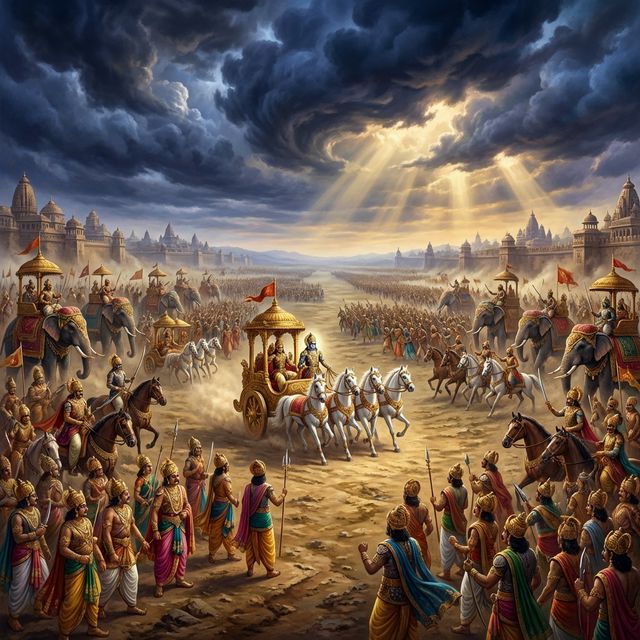
It was the sixteenth morning. Karna had the command now, and his makara array had come out against the half moon Arjuna had drawn up to meet it, and by the time the sun was properly up there was nothing on that field to look at but the work.
Lion-like men strewed the earth with the heads of lion-like men, each head resembling the full moon or the sun in splendour and the lotus in fragrance. Arms of long and massive make, cut off by men of long and massive arms, fell on the ground still wearing their bracelets, and the earth with those writhing arms on it, red at the fingers and the palms, looked as though it had been strewn with fierce five-headed snakes killed by Garuda. Brave men dropped off elephants and cars and horses the way the denizens of heaven drop out of their celestial cars when their merit is used up. Cars were crushed by cars. Infuriate elephants were crushed by infuriate elephants. Horsemen went down under foot-soldiers and foot-soldiers under horsemen, and everything on that field was being destroyed by everything else.
Into that, said Sanjaya, the Parthas came headed by Vrikodara: Dhrishtadyumna and Shikhandi, the five sons of Draupadi and the Prabhadrakas, Satyaki and Chekitana with the Dravida forces, the Pandyas and the Cholas and the Keralas. Behind Satyaki marched the infantry files of the Andhras, broad-chested men of tall stature and large eyes, red-toothed, smeared with powdered scents, armed with swords and nooses, men who could hold a maddened elephant and who had agreed among themselves to die together rather than desert one another.
And in the middle of that force came Bhima, riding on the neck of an elephant.
The beast was equipped for war and looked like a stone mansion on the summit of the Udaya mountain with the risen sun on top of it. Its iron armour, studded with costly gems, was as bright as the autumn sky with all its stars out. Bhima sat above it with a lance in his outstretched arm and a beautiful diadem on his head, splendid as the noon sun of autumn, and he began to burn his enemies.
Somebody on the Kaurava side saw him coming from a long way off, and was glad.
Two Hills Topped With Trees
The man who saw him was Kshemadhurti, the king of the Kulutas, a hill country in the north whose ruler had brought his levies down to fight for Duryodhana. He was on an elephant himself. He shouted his challenge and came on cheerfully, and Sanjaya, who was fair about such things, noted that Bhima was more cheerful still.
So the two beasts met, and it was like two huge hills topped with trees walking into each other, each fighting as it pleased.
The men on their necks struck first with lances, weapons with the brightness of solar rays in them, and roared while they did it. Then they separated and careered in circles, wheeling their elephants wide of one another, and each took up a bow and began to shoot. They gladdened the people around them, the ones close enough to watch, with their roars and the slaps they gave their own armpits and the whizz of the arrows, and they went on shouting like lions the whole time. Both were strong men and both were accomplished in weapons, and their elephants turned and answered under them with trunks curled upward and banners floating from their backs on the wind.
Each cut the other's bow. Then, having nothing left to shoot with, they roared again and began to rain darts and lances across the gap between them like two masses of cloud in the rainy season pouring down torrents.
Kshemadhurti hit first and hit well. A lance of great impetuosity went into the centre of Bhima's chest, and then six more went in after it, and the king of the Kulutas gave a loud shout over the work.
Bhima sat there with the shafts standing out of his body and his form blazing with wrath, and he looked, said Sanjaya, like the sun with a cloud drawn over it and the rays coming out through the gaps in the canopy.
Then he took careful aim and hurled a lance of his own, bright as the rays of the sun, made entirely of iron, and it went perfectly straight.
The ruler of the Kulutas drew his bow and cut it out of the air with ten shafts, and then, before it had finished falling, put sixty more into the son of Pandu.
The Mace and the Fallen Beast
Bhima picked up another bow, one whose twang was like the roar of clouds, and gave a shout, and then he did the thing that decided the duel: he stopped shooting at the man and began shooting at the animal.
He afflicted Kshemadhurti's elephant deeply with his shafts. The beast was pulled at and spoken to and would not stay. It went off the field like a wind-blown cloud, carrying its king away from the fight against his will, and Bhima's own fierce prince of elephants went after it the way one mass of cloud driven by a tempest goes after another.
Kshemadhurti, hauling his mount around under him, turned in the middle of that flight and shot at the elephant behind him. Then he chose a razor-headed arrow, perfectly straight, and cut Bhima's bow off at the grip, and went back to work on the animal. Filled with wrath now, he pierced Bhima and struck the elephant with many long shafts in every vital part.
The huge beast under Bhima began to go down.
Bhima did not go down with it. He jumped clear and was standing on the earth on his own two feet before the animal had finished falling, and he had his mace with him, and the first thing he did on the ground was crush Kshemadhurti's elephant with it.
So the king of the Kulutas came down too, off the ruin of his own mount, and came at Bhima on foot with his weapon raised. There was nothing subtle about the end of it. Bhima struck him as he came. Kshemadhurti fell lifeless beside his elephant with the sword still in his arm, looking, Sanjaya said, like a lion struck down by thunder beside a thunder-riven hill.
The two of them lay there together, the beast and the man, and the Kaurava troops who had been watching the duel saw that the celebrated king of the Kulutas was dead.
They were exceedingly distressed, and they fled.
Karna Sets the Pairs
That was one corner of the field. Elsewhere the new commander was proving what the Kauravas had said about him when they made him commander.
Karna began to smite the Pandava army with his straight shafts, cloth-yard arrows bright as the rays of the sun and polished by the hands of the smith, and the Pandava great car-warriors filled with wrath and smote Duryodhana's army back in Karna's very sight. The elephants took the worst of it. Struck by Karna's shafts they cried out, lost their strength, went faint, and wandered about the field with nobody able to hold them.
While the army was being destroyed that way, the duels formed, one after another, the way they do when a battle stops being a battle and becomes a hundred private quarrels.
Nakula went at Karna himself, at speed. Bhima, up from the wreck of his elephant, went against Drona's son, who was engaged that morning in the accomplishment of the most difficult feats. Satyaki checked the Kaikeya princes Vinda and Anuvinda. King Chitrasena, who ruled the Abhisaras and had been posted with his brother Chitra in the tail of Karna's makara array, rushed against Srutakarman as he advanced, and Prativindhya went against Chitra, who owned a beautiful standard and a beautiful bow. Duryodhana rushed against Yudhishthira the son of Dharma. Dhananjaya rushed against the angry throngs of the samsaptakas, who had sworn again to kill him or die. In that slaughter of great heroes Dhrishtadyumna proceeded against Kripa, and the invincible Shikhandi closed with Kritavarma, and Srutakirti encountered Shalya, and Madri's son, the valiant Sahadeva, encountered Dushasana.
Srutakarman and Prativindhya and Srutakirti were the sons of Draupadi, one born to each of the elder brothers, boys who had been children when their mothers' husbands went into the forest and were now grown men with cars of their own. Dhritarashtra's own grandsons, Sanjaya called them, because that was what they were.
The first of those pairs to come to anything was Satyaki's.
The two Kaikeya brothers shrouded him with a shower of blazing arrows, and the grandson of Sini shrouded the two of them in return.
The Head With the Earrings
Vinda and Anuvinda fought as brothers who had trained together fight. They struck Satyaki deep in the chest, both at once, like two elephants in a forest putting their tusks into a rival, and they did it with their own vitals already pierced by his shafts and no sign of caring.
Satyaki covered all the points of the compass with arrows and smiled while he did it, and checked them. So the brothers came in closer and shrouded his car. He cut off both their beautiful bows. They took up two others, and a number of powerful shafts with them, and began to career about him with great activity and skill, and the arrows they shot, equipped with the feathers of the Kanka and the peacock and decked with gold, went across that ground illumining every quarter as they fell.
Then so many were in the air at once that they made a darkness there. Sanjaya said it plainly, as a fact about the light: in that dreadful battle between them the arrows they shot caused a darkness.
Out of it, all three of those car-warriors cut each other's bows.
Satyaki was invincible that morning and knew it. Filled with rage, the Satwata took up another bow, strung it where he stood, and chose a keen razor-headed shaft, and with that one arrow he cut off Anuvinda's head.
The head was decked with earrings. It went up and over and came down, said Sanjaya, like the head of Samvara falling in the great battle of old, and it reached the earth in no time at all, and it filled all the Kaikayas with grief.
Vinda saw his brother's head on the ground.
He strung another bow and began to resist the grandson of Sini from every side at once, and he pierced him with sixty arrows winged with gold and whetted on stone, and shouted at him across the noise.
"Wait, Wait!"
Swords on the Open Ground
Then the mighty car-warrior of the Kaikeyas struck Satyaki with many thousands of shafts in the arms and the chest, and Satyaki, whose prowess could not be baffled, stood up in the middle of that with every limb of him wounded and looked, said Sanjaya, like a Kinsuka tree in flower.
He answered with twenty-five arrows, and with the greatest ease.
After that the fight came apart into pieces. Each cut the other's handsome bow. Each killed the other's driver. Each killed the other's horses. So the two of them stepped down off two useless cars onto the open ground and came at each other on foot with swords.
Both were men of massive arms. Each took up a shield decked with a hundred moons and an excellent sword, and on that wide arena, with the war going on all around them and nobody near enough to interfere, they looked like Jambha and Sakra in the old battle between the gods and the Asuras.
They began to career in circles. Then they closed, each coming near, each making great efforts for the destruction of the other. The Satwata cut the shield of the Kaikeya in two. The Kaikeya cut the shield of Satyaki in two, and having sheared away that covering of a hundred stars he began to move in circles again, advancing and receding, watching for the opening.
Satyaki did not wait for it. Endued with great activity, he took the prince of the Kaikeyas as he came round, with a sidestroke, and cut him in half through his armour.
That great bowman fell down like a hill riven with thunder, and lay near his brother.
Satyaki had no car and no horses left. He climbed onto the car of Yudhamanyu, the Pancala prince who was one of the two guards of Arjuna's wheels, and rode there until a properly equipped car could be brought to him, and then he mounted that one and turned on the Kaikeya host itself and began to kill it with his shafts.
The vast army of the Kaikeyas, slaughtered in that fashion, left the enemy where he stood and fled away on all sides.
The Head With the Head-Gear
Srutakarman, the son Bhima had by Draupadi, filled with wrath and struck Chitrasena, that lord of earth, with fifty shafts.
The ruler of the Abhisaras struck back with nine straight arrows and put five more into the young man's driver. Srutakarman, in a rage now, chose a keen arrow and sent it into a vital part of Chitrasena at the head of his own troops, and the pain of it was so great that the king swooned away in the sight of his men. In that interval Srutakarman covered his insensible antagonist with ninety arrows.
Chitrasena came to. He cut Srutakarman's bow with a broad-headed arrow and put seven shafts through him.
Srutakarman took up another bow, decked with gold and capable of striking hard, and made the king assume a wonderful appearance. He raised such waves of arrows that the youthful Chitrasena, wearing his beautiful garlands and adorned all over with the shafts standing in him, looked like a well-dressed young man in the middle of an assembly.
The king was still able to fight. He pierced Srutakarman in the centre of the chest with an arrow and called out to him, "Wait, Wait!"
That arrow made Srutakarman bleed. He shed blood as a mountain sheds streams of liquid red chalk, and being bathed and dyed in it he shone in the battle like a Kinsuka in flower, and being shot in that manner made him angry.
He cut the foe-resisting bow of Chitrasena in two. Then, with the man disarmed in front of him, he covered him completely with three hundred arrows equipped with goodly wings, and then he took one more, broad-headed, sharp-edged and keen-pointed, and cut off his head with the head-gear still on it.
The blazing head of Chitrasena fell to the ground like the moon loosened from the firmament and dropping to the earth at will.
Seeing their king dead, his troops rushed impetuously at the man who had killed him. Srutakarman went into them shooting, like Yama filled with fury against all creatures at the time of the universal dissolution, and they broke and ran on every side like elephants scorched by a forest fire, and he pursued them with his keen arrows and looked, on his car, exceedingly resplendent.
The Lance That Went Into the Earth
Prativindhya was the eldest of those five cousins, Yudhishthira's son by Draupadi, and his opponent Chitra was the brother of the king Srutakarman had just beheaded.
He opened carefully: five arrows into Chitra, three into his driver, one into his standard. Chitra answered with nine broad-headed shafts winged with gold, keen-pointed, plumed with Kanka and peacock feathers, and put them into Prativindhya's arms and chest. Prativindhya cut off his bow and struck him deeply with five keen arrows.
So Chitra, having no bow, began to throw things, and each thing was worse than the last.
First a dart adorned with golden bells, terrible and irresistible, that came on like a flame of fire. Prativindhya cut it into three fragments as it flew, with the greatest ease, and the pieces fell like the thunderbolt that fills every creature with fear at the end of the Yuga.
Then a huge mace decked with a net-work of gold. That one arrived. It killed Prativindhya's horses and his driver, crushed his car under it, and drove into the ground with great force.
Prativindhya, having got down off the wreck, hurled at Chitra a dart of his own, well-adorned, with a golden staff.
Chitra caught it in the air as it came at him, and threw it straight back. It struck Prativindhya, went through his right arm, and fell to the earth, and lit up the whole region as it fell like a flash of lightning.
With that arm hanging, and filled with rage, and wanting nothing now but the destruction of Chitra, Prativindhya sped at him a lance decked with gold. It went through the king's armour and through his chest and out and into the earth behind him like a great snake going into its hole. Chitra fell where he stood, stretching out his two long massive arms that were like a pair of iron clubs.
The Kaurava warriors saw the king go down and rushed at Prativindhya from all sides, shooting shafts of every kind and shataghnis hung with rows of bells until they covered him the way masses of cloud cover the sun. He consumed those assailants with his arrowy showers and routed the army the way thunder-wielding Sakra routs the host of the Asuras, and Dhritarashtra's troops, slaughtered on every side, scattered in all directions like gathered clouds pulled apart by the wind.
One man came the other way through that rout. Out of the whole fleeing army, Drona's son alone turned and rode at speed against Bhimasena, and the two of them met like Vritra and Vasava, and the sixteenth day went on.
Dharma Lesson
The great names of the war are not on this page. Kshemadhurti of the Kulutas, Vinda and Anuvinda, Chitrasena and Chitra brought their levies because a king they were bound to asked them, and each of them fought well enough that Sanjaya remembered how he died. A war is not won by its famous duels. It is won by mornings like this one, in which a dozen brave men whose names nobody afterwards repeats are used up in an hour to move a line a little way.