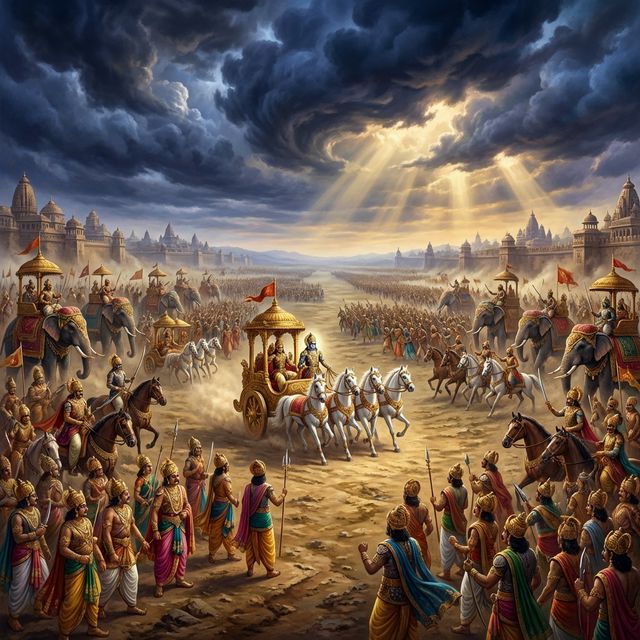
Dandadhara of Magadha
Two brothers on elephants, and the field Krishna made Arjuna look at
The Uproar in the North
Sanjaya was telling the blind king about the sixteenth day, which was Karna's first day in command of his army, and he had just finished the account of Arjuna's long duel with the son of Drona.
Ashwatthama had been carried off the field by his own horses with Arjuna's shafts in his arms and his chest, and had gone away into the ranks of Karna with his quivers nearly empty and his hope of the day gone. Krishna had turned the car. The two of them were going back toward the samsaptakas, the sworn men who had taken an oath to kill Arjuna or die, and who had been calling him out of the main battle every morning for days, and the wheels made a noise like clouds and the banner stood out on the wind.
Then, said Sanjaya, out of the northern part of the Pandava army there came a loud uproar.
It was the particular sound an army makes when it is not fighting but being destroyed: cars and elephants and horses and foot-soldiers all crying out at once, and the cries moving, because whatever was doing it was moving. Somewhere up there a single man had got in among the Pandava divisions and was walking them down.
Krishna heard it and turned the course of the car toward it without slowing the horses, which were as fleet as Garuda or the wind.
That is worth stopping on for a moment. Arjuna had a task in front of him and a promise behind him and an enemy waiting on the other side of the field whose death was the whole point of the day. Krishna heard a noise from a direction that had nothing to do with any of it, and changed course, and did not explain until the car was already moving.
Then he explained.
Not Inferior to Bhagadatta
"The chief of the Magadhas, with his elephant, is unrivalled in prowess," Krishna said. "In training and might he is not inferior to Bhagadatta himself. Having slain him first, thou wilt then slay the samsaptakas."
Arjuna knew exactly what that meant, and so did everyone in the army who had been alive four days earlier.
Bhagadatta was the old king of Pragjyotisha, a friend of Arjuna's father, who had come to the war on an elephant named Supratika and had very nearly ended the Pandava cause single-handed. He had driven that beast through Bhima's division and through Satyaki's, and had thrown a weapon at Arjuna which Krishna had taken on his own chest to save him, and it had cost the whole strength of an afternoon and one arrow in the temple of the elephant to bring him down. The name was a shorthand on that field for the one thing an army has no good answer to: a great elephant handled by a man who has spent his life learning how.
And Krishna's word for the king of the Magadhas was not lesser. It was equal.
The Magadhas were the men of Girivraja in the east, the country of Jarasandha before the Pandavas killed him, and their chief that day was called Dandadhara, which means the bearer of the rod, the staff of punishment that a king carries. His brother Danda rode beside him on a second elephant. They were not famous men. They get their names in the record for the length of one section and then they do not appear again.
At the conclusion of his words, Keshava bore Partha into the presence of Dandadhara.
Sanjaya, who was watching from wherever a bard watches, said that the chief of the Magadhas was peerless in the handling of the elephant hook as the headless planet Ketu is peerless among the planets, and that he was destroying the hostile army the way a fierce comet destroys the whole earth.
The Wheel of Death
The elephant is described before the man, because on that part of the field the elephant was the argument.
It was a foe-slaying beast, well equipped, and it looked, Sanjaya said, like a danava with an elephantine face and form, and when it roared the sound was a mass of clouds roaring together. From its neck Dandadhara was shooting, and his shafts were going into cars and horses and elephants and men by the thousand, so that the count of what he had already killed could not be given as a number, only as a kind of weather.
Under him the animal did its own work. It trod on cars with its feet and pressed them into the ground, and the men and horses and drivers went into the ground with them. Other elephants came against it and it crushed them and killed them with its two forefeet and its trunk. Sanjaya said the beast moved like the wheel of Death, which is not a figure about speed. A wheel does not chase anything. It comes round.
Men in steel coats of mail, with their horses and the foot-soldiers who stood by them, were pressed down into the earth by that foremost of elephants like thick reeds pressed down, and the sound they made going down, said Sanjaya, was a crackling.
Into that, through a host teeming with thousands of cars and horses and elephants, loud with cymbals and drums and conchs, with the clatter of wheels and the twang of bowstrings and the clapping of palms all going at once, Arjuna drove.
He came at the prince of elephants directly. There was no manoeuvre in it and no attempt to draw the man off. Krishna had told him what this was, and where it stood in the order of the day's work, and Arjuna went to it the way a man goes at a thing he intends to finish before noon.
Dandadhara saw him coming and did not give ground either.
The Laugh on the Elephant's Neck
He shot first, and he shot well.
A dozen foremost of shafts went into Arjuna. Sixteen went into Janardana, who was driving and had no weapon in his hands. Three apiece went into each of the four horses. Then the chief of the Magadhas uttered a loud shout from the neck of his elephant, and laughed, and went on laughing.
Men had laughed at Arjuna on that field before. Very few of them had done it with his blood already on their arrows.
Partha answered with broad-headed shafts, and he did not answer at the man. He answered at everything the man was using. The bow went first, cut through with its string and with the arrow already fixed on it, so that the whole apparatus of the shot came apart in Dandadhara's hands at the instant he was drawing. Then the well-decked standard, which is how an elephant-rider is found by his own troops. Then the guides of the beast, the men who sat behind and at the flanks and told the animal what the king wanted. Then the footmen who walked at its legs and kept spearmen from coming in underneath.
In the time it takes to say it, the king of the Magadhas had been reduced from a command to a man sitting on an animal.
At this, said Sanjaya, the lord of Girivraja became filled with rage.
He had lances left, and he had the elephant, whose temples had split and were running with the fluid of its excitement, which is the state in which such a beast is most dangerous and least governable, and which looked like a mass of clouds and had the speed of the wind. He wanted Krishna. That was his aim in the last thing he did: to agitate Janardana with the tusker, to break the car and the driver and take Arjuna's footing out from under him.
So he drove the animal in, and struck Dhananjaya with many lances as he came.
Three Razor-Headed Arrows
The son of Pandu took three razor-headed arrows.
With them he cut off, almost at the same instant of time, the two arms of Dandadhara, each of which Sanjaya says looked like the trunk of an elephant, and then the head, which he says resembled the full moon.
Three arrows, one instant, and the bearer of the rod was finished. There is no speech from him and none from Arjuna. The whole of that killing takes one sentence in the account, and the sentence is arranged so that the arms go before the head, which is the order in which a man on an elephant would actually come apart under fire from below.
Then Arjuna turned on the animal, and this took longer.
He struck it with hundreds of arrows. Covered all over with the gold-decked shafts of Partha, that elephant in its golden armour looked, said Sanjaya, as resplendent as a mountain at night with its herbs and its trees burning in a forest fire, which is one of the images in this war that seems to be praise until you look at it a second time.
Afflicted with the pain, roaring like a mass of clouds, weakened past the point where its own weight would serve it, the beast began to cry out, and to wander, and to run with steps that would not hold. It went down at last with the guide still on its neck, and Sanjaya, who has by now used the mountain three times in three different ways, uses it once more and says the thing fell like a mountain summit riven by thunder.
Whatever the king of the Magadhas had been in his own country, he had brought his best thing to Kurukshetra and put it against Arjuna, and it lay in the dirt with a dead man on it.
His brother had been watching from a little way off.
The Brother on the White Elephant
Danda came forward as soon as his brother fell.
His elephant was white as snow and decked with gold, and it looked, said Sanjaya, like a summit of the Himalaya, and against the dust and the burning of that field a white elephant coming on must have been visible to the whole northern half of the army. He was riding at Indra's younger brother and at Dhananjaya together, meaning to kill them both.
He had three whetted lances for Janardana, bright as the rays of the sun, and five for Arjuna, and he threw them all and shouted.
The son of Pandu shouted back. That detail is in the text and it is easy to pass over. Arjuna answered the noise before he answered the weapons, and then he cut off Danda's two arms.
They came down off the elephant's back at the same instant, both of them, smeared with sandal-paste, wearing the angadas that a prince wears on his upper arm, with the lances still gripped in the hands, and Sanjaya says they looked like a couple of large and beautiful snakes falling from a mountain summit.
Then a crescent-shaped arrow from the diadem-decked Partha took the head, and it fell from the elephant's back to the earth, and covered with blood it looked resplendent, he says, as it lay there, like the sun dropped from the Asta mountain toward the western quarter.
That is the second time in a few minutes that a man's head has been compared to a heavenly body while it is coming off his shoulders, and the moon was used for the elder brother and the sun for the younger, and neither image is offered as consolation. Sanjaya is describing to a father what happens to sons on a battlefield, and he does it in the language of the sky, and the blind king had to take it.
Then Arjuna pierced the white elephant with many excellent arrows bright as the rays of the sun, and it fell with a noise like a Himalayan summit riven with thunder.
What the Army Said to Him
There were other elephants of that kind, huge beasts capable of winning a battle by themselves, and Savyasaci cut them down as he had cut down the two.
At this, said Sanjaya, the vast hostile force broke.
The description of what breaking looks like is worth having, because armies in this war are usually said to fly or to be routed and left at that. Here the elephants and the cars and the horses and the men, in dense throngs, clashed against one another and fell down on the field. They were tottering already. They struck each other violently in the press and went down and were dead where they went down, and nobody had shot at them.
Then the men Arjuna had come to save came and stood around him.
They encompassed him, Sanjaya says, as the celestials encompass Purandara, and they said this:
"O hero, that foe of whom we had been frightened like creatures at the sight of Death himself hath by good luck been slain by thee. If thou hadst not protected from that fear those people that were so deeply afflicted by mighty foes, then by this time our foes would have felt that delight which we now feel at their death, O slayer of enemies."
It is a soldier's speech and it says two honest things. The first is that they had been afraid, and they say so out loud in front of the man who came, which men in the middle of a war do not usually do. The second is the arithmetic underneath: the delight is a fixed quantity that day and somebody was always going to have it, and the only question that had been open an hour ago was which side would be standing over the other one saying this.
Arjuna, with a cheerful heart, listened to these and other words from his friends and allies, and worshipped those men, each according to his deserts.
Then he went back to the samsaptakas, because they were still waiting, and the day was not half done.
The Bridge Over the Raftless Ocean
Wheeling round like the planet Mercury in the curve of its orbit, Jishnu once more slew large numbers of the samsaptakas.
The sworn men came on the way they had sworn to come. Sanjaya says that brave warriors by hundreds and by thousands closed upon Arjuna like bulls fighting a bull for the sake of a cow in season, and that the battle between them and him made the hair stand on end.
One of them is named. The son of Ugrayudha pierced Partha with three shafts like three venomous snakes, and Partha cut his head from his trunk, and that is his entire history.
The rest are given as a list of parts. Yokes and drivers and standards, bows and shafts, hands and the weapons gripped in them, arms, heads: all of it cut off with arrows that were broad-headed, or razor-faced, or crescent-shaped, or furnished with heads like a calf's tooth. He cut the trivenus of the cars, the poles, and the traces and the axles and the cords, and the bottoms and the yokes, and knocked the quivers out of their places, and the cars stood smashed in the field looking, said Sanjaya, like the luxurious mansions of the rich after fire and wind and rain have been at them.
Horses went down with their riders, tongues out, bathed in blood. Elephants with their vitals opened fell like houses on a hilltop struck by lightning.
And of the men, Sanjaya said a thing he does not say often: that those of them who were of righteous deeds and noble birth and great knowledge went to heaven on the strength of what they had done, and that only the bodies stayed on the earth.
Then the chiefs of many realms rushed at him together with their followers, and the weapons came down on him like a shower out of congregated clouds, and Arjuna destroyed the shower in the air.
People saw him then, said Sanjaya, crossing an ocean that had no raft: an ocean made of horses and foot-soldiers and elephants and cars, with mighty weapons for its waves. He crossed it on a bridge, and the bridge was built out of his own weapons.
Behold, Partha
"Why, O sinless one, dost thou sport in this way?" Vasudeva said. "Grinding these samsaptakas, haste thyself for Karna's slaughter."
"So be it," said Arjuna, and finished the remnant of them like Indra destroying the daityas, and after that, said Sanjaya, no man however closely he watched could mark when Arjuna took out a shaft, when he aimed it, and when he let it go. Govinda himself regarded it as wonderful, and Govinda had been standing in front of him all day. The arrows went into the hostile force white and active, like swans diving into a lake.
Then Krishna looked at the field, and reined in, and made Arjuna look at it with him.
"Here, O Partha, for the sake of Duryodhana alone, occurreth this great and terrible destruction of the Bharatas and other kings of Earth."
And then he began to name the things lying on the ground, and he went on naming them for a long time.
Bows with golden backs. Girdles and quivers loosened from bodies. Straight shafts with wings of gold, and long arrows washed with oil, lying like snakes that have come out of their sloughs. Lances decked with gold. Coats of mail with gold on them, fallen off the men they had been made for. Spears and darts embellished with gold, maces twined round with golden thread and cords of hemp, swords and axes and battle-axes with gold-decked handles, spiked clubs, short arrows, bhusundis, kanapas, iron kuntas, heavy mushalas.
"These victory-longing warriors endued with great activity and armed with diverse weapons, though dead, still seem to be quick with life. Behold those thousands of warriors, their limbs crushed with maces, and heads split with mushalas or smashed and trod by elephants and steeds and cars."
He named the hooks with handles set with lapis lazuli that had dropped from the hands of elephant-riders. The bells broken to pieces under the beasts that had been wearing them. The single-piece blankets for the backs of the huge animals, and the torn variegated ones. The breastplates of horses set with diamonds, the cloths tied to the ends of the horsemen's standards, the ranku skins inlaid with gold that had been under the saddles. The great diamonds out of the head-gear of kings. Necklaces of gold. Umbrellas displaced from over the heads they had shaded, and yak-tails, and fans.
Arjuna had made most of it. He was being asked to look at it item by item, in the voice of a man reading an inventory, by the friend who had told him where to drive.
A Lake of Lilies and Lotuses
Then Krishna came to the faces.
"Behold the earth strewn with faces adorned with earrings bright as the moon or stars, and embellished with well-cut beards, and each looking like the full moon. The earth, strewn with those faces looking like lilies and lotuses, resembles a lake adorned with a dense assemblage of lilies and lotuses."
He was not being cruel and he was not being ironic. He said the field was beautiful, and he said it twice, and then a third time: that the earth having the effulgence of the bright moon and diversified as if with myriads of stars looked like the autumnal firmament bespangled with stellar lights.
Severed hands with their fingers still in their leather fences and their rings still on. Thighs lopped off, lying like the trunks of elephants. Arms smeared with sandal-paste, wearing angadas and keyuras, marked with the auspicious lines that a man's mother once had read for his fortune. Cars with golden bells broken in every way a car can break. Horses bathed in blood. Elephants with their tongues lolling, lying on the field like hills, still carrying their triumphal banners, with their dead riders beside them.
"O Arjuna, these feats that have been achieved by thee in great battle today are, indeed, worthy of thee or of the chief of the celestials himself in heaven."
Even thus, said Sanjaya, did Krishna show the field of battle unto Arjuna.
Then they turned the car for the camp, and while they were going they heard a noise out of Duryodhana's army: conchs and cymbals and drums and patahas, wheels, horses neighing, elephants grunting, and weapons striking weapons.
Krishna took the car into that force with those wind-swift horses to see what it was, and Sanjaya says that he was filled with wonder at what he found. Somebody was grinding the Kaurava host the way Yama grinds creatures whose time has run out, piercing elephants and horses and men with sharp shafts and cutting out of the air every weapon that was thrown at him, and killing his enemies as Sakra kills the danavas.
It was Pandya, whom the blind king would ask about next.
Dharma Lesson
Krishna changes course for a noise in a direction that has nothing to do with the day's purpose, because a man who is killing the helpless is a task that cannot wait for a more convenient hour. And when the killing is done he does not let Arjuna ride past it. He stops the car and reads out the field like an inventory, gold by gold and face by face, so that the man who made it has to see what a good day of war leaves on the ground. Skill is praised in the same breath as the wreckage it produced, and both are true at once.