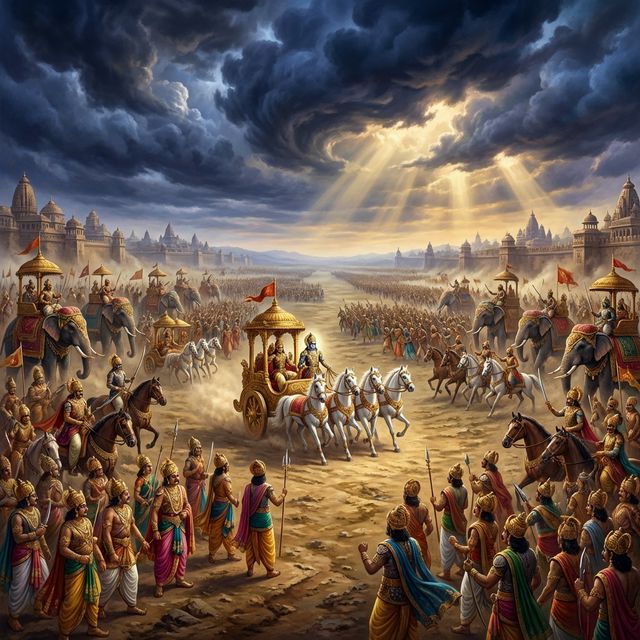
The Kings of the East Fall
Satyaki, Sahadeva and Nakula break the elephant corps of the eastern kings
The Elephants Sent at Prishata's Son
It was the sixteenth day of the war, and Karna had the command.
Sanjaya, who sat in the hall at Hastinapura and told a blind king what was being done to his army, had just finished the account of Pandya's fall and of Arjuna turning back into the press to save his brother. Now he came to a stretch of that afternoon in which the Kaurava host tried something other than arrows.
"Many elephant-warriors riding on their beasts," Sanjaya said, "urged by thy son, proceeded against Dhrishtadyumna, filled with rage and desirous of compassing his destruction."
Dhrishtadyumna was the son of Drupada of the Pancalas, called Prishata's son after his grandfather, the man born out of a sacrificial fire to kill Drona and who had killed him the day before. Duryodhana wanted him dead, and he sent the elephants to do it.
They were not Kuru elephants. They came out of the east and the south, from every country where men are bred to that kind of fighting: Easterners and Southerners, the Angas, the Vangas, the Pundras, the Magadhas, the Tamraliptakas, the Mekalas, the Koshalas, the Madras, the Dasharnas, the Nishadas, and with them the Kalingas. Their riders were the foremost combatants in the world at elephant-fight, and they came on showering shafts and lances and arrows like pouring clouds, and drenched the Pancala force with them.
Dhrishtadyumna did not go back. He covered the beasts with his arrows as they were urged forward by their riders with heels and toes and hooks, and each of those animals, huge as hills, he pierced with ten whetted shafts, or eight, or six, taking them as they came.
It was not enough. There were too many of them. From a distance the Pandava line could see the prince of the Pancalas being shut in, hidden by the moving bulk of the elephants the way the sun is hidden by clouds, and they could see that he was still shooting inside it.
So the Pandus and the Pancalas turned and went for him, roaring, with sharp weapons in their hands.
The Dance of Heroes
What the rescue looked like, Sanjaya said, was a dance.
The warriors poured their weapons up into those elephants from every side, and as they shot they began to dance the dance of heroes, aided by the music of their own bow-strings and the sound of their palms, and urged on by heroes beating the time. There is no other way he found to describe it. Men were being killed all round them and they were keeping time.
Nakula and Sahadeva came into it, the twin sons of Madri, the youngest of the five brothers and the two who are usually named last. With them came the sons of Draupadi, and the Prabhadrakas of the Pancala levies, and Satyaki, and Shikhandi, and Chekitana of great energy, and all of them together drenched those elephants from every side with their weapons, like clouds drenching the hills with rain.
The elephants answered in their own way, which was worse than arrows.
They were furious beasts urged on by mleccha warriors, men from beyond the pale of the Vedic countries who had been handling elephants all their lives, and the animals came into the Pandava ranks dragging down men and steeds and cars with their trunks and crushing them under their feet. Some men they pierced with the points of their tusks. Some they raised aloft and dashed on the ground. Others were taken up on the tusks of those huge beasts and carried there, and when those fell the spectators who watched them fall were filled with fear.
That was the state of the field when the fighting narrowed, as it does, from an army against an army into a series of single men looking at each other across a short distance.
One of the elephants that had come through the Pandava shafts was standing in front of Satyaki. On its neck sat the king of the Vangas.
The King of the Vangas
Satyaki was the grandson of Sini, a Vrishni of Krishna's own clan and Arjuna's pupil in the bow. Two days earlier he had cut his way alone through the whole Kaurava army to reach Arjuna, and the men who had tried to stop him were still being counted. He had spent the war being underestimated by kings.
The Vangas held the country at the mouths of the Ganga, wet delta land east of everything the Kurus thought of as the world, and their king had brought his elephants across half of India to stand in Duryodhana's line.
Satyaki took a long shaft endued with great impetuosity and shot the animal first.
He put it into the vitals of the beast, and it went down where it stood on the field with the king still on its back. That is the order the account keeps, and it is worth noticing: the elephant was the weapon, and the elephant was killed first, and the man on top of it became at that instant a man standing on a falling mountain.
The rider had been out of Satyaki's reach the whole time. He had been up above the arrows behind the housings and the great head, a target Satyaki could not touch while the animal lived. Now the animal was dying under him, and he gathered himself to jump clear of it.
Satyaki was waiting for exactly that. He had a second long shaft on the string, and he took the king of the Vangas in the chest in the moment the man left the elephant's back, before his feet had found anything, and he came down on the earth beside his beast.
Thus struck by the Satwata, he fell.
Sanjaya gives him no last speech and no lament. He had come a very long way to die in the sixteenth afternoon of somebody else's war, and the fighting went on over him without a pause.
Three Shafts for the Elephant of Pundra
Meanwhile, a little way along the same line, Sahadeva was watching another mountain come at him.
The elephant of the king of Pundra advanced against him like a moving hill. Pundra was another of the eastern countries, north of the Vangas, in the old rice lands between the rivers, and its beasts were of the same breeding as the ones that had shut in Dhrishtadyumna.
Sahadeva was the youngest of the five brothers and the quietest of them, a man who knew more than he was permitted to say, and he was reckoned by his own family a good swordsman and by nearly everybody else an afterthought. He shot three arrows.
Sanjaya is careful about those three. They were shot with great care, and between them they deprived that elephant of its standard, its driver, its armour and its life, in that order, one thing at a time, as though the animal were being taken apart by a man who had thought about how it was assembled. The banner came down. The mahout came off. The plates of its housing were split. Then the beast itself.
Having thus cut off that elephant, Sahadeva did not stop to look at it. He turned his car and went for the chief of the Angas, who was fighting a short way off in the same crowd of tuskers.
Anga is the country on the Ganga near Champa, and its name was one that nobody in that army could hear without thinking of the commander. It was the kingdom Duryodhana had given Karna on the day of the tournament, the gift that made a charioteer's son a king so that he could be permitted to fight Arjuna. The man who had brought the Anga elephants to Kurukshetra was a mleccha prince, well skilled in elephant-lore, and he was about to be the last of the three eastern kings to fall that afternoon.
Sahadeva was closing on him when his brother cut across in front of him.
The Head of the Anga King
Nakula caused Sahadeva to desist.
That is the whole of the explanation given, and the twins would not have needed more of one. They had been born together, exiled together, spent the hidden year in Virata's kingdom together among the horses and the cattle, and fought the whole war within sight of each other. Nakula wanted this one. Sahadeva let him have it and turned his bow elsewhere.
Then Nakula afflicted the ruler of the Angas with three long shafts, each resembling the rod of Yama, and covered his elephant with a hundred arrows.
The Anga king answered with the weapon of his own country. He hurled at Nakula eight hundred lances, bright as the rays of the sun, thrown from the back of a moving elephant by a man who had been trained to it since he could lift one, and the air between the two of them filled with falling light.
Nakula cut every one of the eight hundred into three fragments.
Sanjaya says it in a single line and passes on, and it is the reason Nakula's brothers never worried about him. He was the beautiful one, the brother people described by his face, and he stood on his car in the middle of that shower and reduced it to sticks.
Then the son of Pandu took a crescent-shaped arrow and cut off his antagonist's head.
At that the mleccha king, deprived of life, fell down together with the animal he rode, the two of them coming apart in the air and landing separately, and the last of the kings of the east was finished within a few minutes of the other two.
Behind him his own elephant-men saw it happen. They had followed that man out of the delta country to the Kuru plain, their banners were still waving over their heads, and their beasts still wore the golden housings he had paid for.
They turned, all of them, and came for Nakula.
The Hills Struck Down by Rain
They came on elephants decked with banners that waved in the air, beasts possessing excellent mouths, adorned with housings of gold, looking like blazing mountains, and their one purpose was to crush Nakula to pieces. With them came Mekalas and Utkalas and Kalingas and Nishadas and Tamraliptakas, showering their shafts and lances, all of them wanting the man who had beheaded their king.
For the second time that afternoon a Pandava was shrouded like the sun by clouds, and for the second time the army came for him. The Pandus and the Pancalas and the Somakas rushed to the rescue with speed, filled with rage, and what followed was a fierce battle of one kind of warrior against another: car-warriors below shooting arrows and shafts upward, elephant-men above throwing their lances down by the thousand.
The frontal globes of the elephants were split. Their limbs and their tusks and their ornaments, exceedingly pierced with shafts, were mangled.
Sahadeva shot four and sixty impetuous arrows and eight of those huge beasts came down with their riders still on them. Nakula, bending his excellent bow with great vigour, killed many more with straight shafts, working along the line he had drawn upon himself. The Pancala prince and the grandson of Sini and the sons of Draupadi and the Prabhadrakas and Shikhandi drenched what was left of them with showers of arrows from every side.
And then Sanjaya gave his king the image, because he knew what it would do to him.
The Pandava warriors were rain-charged clouds. The elephants of the Kaurava host were hills. And those hills fell, struck down by torrents of rain in the form of numberless shafts, the way real mountains are struck down in a thunder-storm.
The leaders of the Pandava car-warriors, having killed those elephants, lifted their eyes to the army in front of them, and it was running. It resembled, Sanjaya said, a river whose two banks have been washed away.
Having agitated that host once, they agitated it once more. Then they turned their cars together and went looking for Karna.
Dharma Lesson
The kings of the Vangas, the Pundras and the Angas are named once each, killed within minutes of one another, and never mentioned again. They had brought their elephants across half of India for a quarrel that was not theirs, on the word of a man who needed their numbers, and the epic records their skill honestly and their deaths without ceremony. It is the twins, the two brothers the poem almost always counts last, who do most of the killing here, and nobody in the hall remarks on it. A great deal of the work of a war is done by the people the story has already decided are minor.