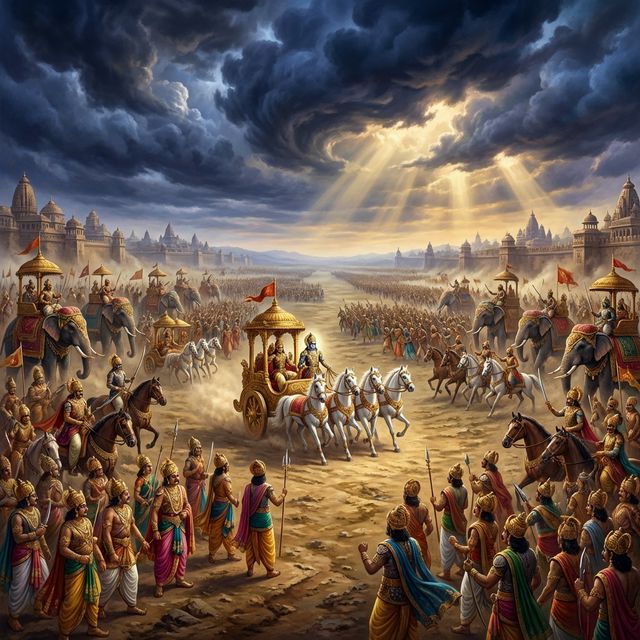
The Lords of the Waters and the Treasures
Balarama walks the Sarasvati past the fords where Varuna, Kubera, Indra and Surya won what they hold
The Question After the War God
Janamejaya had just heard how the gods anointed Skanda their generalissimo, and he was not ready to let the narrator move on.
"This history, O regenerate one, that I have heard from thee is exceedingly wonderful," he said, "this narration, in detail, of the installation, according to due rites, of Skanda. I deem myself cleansed by having listened to this account. My hair stands on end and my mind hath become cheerful. I feel a curiosity, however, in respect of another matter. How was the Lord of the waters installed by the celestials in that tirtha in days of yore? Tell me that, for thou art possessed of great wisdom and art skilled in narration."
Vaishampayana was answering him, and the thing he was answering out of was a journey. While the Kurus and the Pandavas were killing each other at Kurukshetra, Balarama, the elder brother of Krishna, the wielder of the plough, had refused to lift a weapon for either side and had gone up the Sarasvati instead. He walked her banks from ford to ford with brahmanas beside him, bathing at each, giving away gold and cloth and cattle at each, and at every one of them the ascetics who lived there told him whose tirtha it was and what had been won on that spot.
That is the whole shape of these sections. A river, a man in white unguents with a garland of wild flowers, and at every bend of the water an older story about somebody who had been given an office, or had bought one with penance, or had paid for one with a sacrifice.
He had come from the tirtha of Skanda. The next ford was called Taijasa, and it was the place where Varuna had been made lord of all waters.
"Listen, O king," said Vaishampayana, "to this wonderful history of what transpired truly in a former Kalpa."
As Shakra Protects the Gods
In days of yore, in the Krita age, all the celestials duly approached Varuna and said these words to him.
"As Shakra, the Lord of the celestials, always protects us from every fear, similarly be thou the Lord of all the rivers. Thou always residest, O god, in the Ocean, that home of makaras. This Ocean, the lord of rivers, will then be under thy dominion. Thou shalt then wax and wane with Soma."
It is worth reading the offer slowly, because it is an argument as much as a request. They did not tell him that he deserved the office or that he was the strongest of them. They told him where he already lived. He was in the sea already, among the makaras, in the water that every river runs down into, and the gods were proposing only that the fact be made into a title. And they attached a condition to it that was not a burden but a tether: he would rise and fall with Soma, the moon, so that the lord of the waters would never be a law to himself but would move with something outside him.
Varuna answered them, saying, "Let it be so."
That is the entire negotiation. All the celestials then assembled together and made Varuna, having his abode in the ocean, the Lord of all the waters, according to the rites laid down in the scriptures. Having installed him as lord of all aquatic creatures, and having worshipped him duly, they went back to their own abodes and left him to it.
And he did it. Installed by the celestials, the illustrious Varuna began to duly protect seas and lakes and rivers and other reservoirs of water, exactly as Shakra protects the gods. The clause in their petition became his working description.
Bathing in that tirtha also, and giving away diverse kinds of gifts, Baladeva, the slayer of Pralamba, then walked on to the ford called Agnitirtha, where the eater of clarified butter had once hidden himself inside a piece of wood.
The God Inside the Sami Wood
Agnitirtha is the spot where Agni, disappearing from view, became concealed within the entrails of the Sami wood, and the account of what that cost the world is given in the gods' own words.
When the light of all the worlds had gone out, the celestials repaired to the Grandsire of the universe and said, "The adorable Agni has disappeared. We do not know the reason. Let not all creatures be destroyed. Create fire, O puissant Lord."
Notice what they ask Brahma for. Not to find the missing god. To make another one. They had lost the fire and they were prepared to have a new fire manufactured rather than live one more day without it, which is the measure of what Agni is to a world that must cook and must sacrifice.
"For what reason did Agni, the Creator of all the worlds, disappear?" Janamejaya asked. "How also was he discovered by the gods? Tell me all this in detail."
Agni of great energy, said Vaishampayana, had become very much frightened at the curse of Bhrigu. That was all. The carrier of every offering, the mouth by which the gods eat, had been cursed by a rishi and was afraid, and he went and got inside the entrails of the Sami wood and stayed there.
Upon his disappearance, all the gods with Vasava at their head, in great affliction, searched for the missing god, and they found him. They saw him lying within the entrails of the Sami wood. The celestials, with Brihaspati at their head, having succeeded in finding him out, became very glad, and then they returned to the places they had come from.
They did not lift the curse. Nobody could. Agni, from Bhrigu's curse, became an eater of everything, precisely as Bhrigu, that utterer of Brahma, had said he would. He came out of hiding and went back to work as a god who would thereafter consume anything at all, clean or unclean, without distinction.
The Sami wood keeps the mark of it. That is the wood the fire is still churned out of.
Everything Came to Him of Its Own Accord
From there the intelligent Balarama went to Brahmayoni, where the adorable Grandsire of all the worlds had exercised his functions of creation, and where in days of yore the Lord Brahman along with all the gods had bathed according to due rites. He bathed, he gave away gifts of many kinds, and he went on to a tirtha called Kauvera.
That is the ford where Ailavila, the son of Visrava, whom the world calls Kubera, chief of the yakshas, sat down and practised the severest austerities and obtained the Lordship over all treasures.
The manner of it is the point. While he dwelt there engaged in his penances, all kinds of wealth and all the precious gems came to him of their own accord. He did not go and take them. He did not conquer a region and empty its vaults. He sat still in one place on the bank of a river doing something extremely difficult, and the wealth of the world walked in and presented itself, which is how the epic distinguishes a treasury that is earned from a treasury that is seized.
What he asked for, and got, was a list. The lordship of all treasures. The friendship of Rudra, possessed of immeasurable energy. The status of a god, which he had not been born with. The regency over one particular point of the compass, the north. And a son named Nalakuvera.
The Maruts, those wind-gods who go in troops, came there and installed him duly in his sovereignty, and he obtained for a vehicle a well-equipped celestial car, fleet as thought, together with all the affluence of a god.
Rama beheld at that spot the excellent woods of Kubera, still standing round the place where the penance had been done. He bathed in the tirtha, gave much wealth to the brahmanas, and, using white unguents, proceeded quickly to another ford, one populous with all kinds of creatures, where the fruits of every season are always to be found and flowers and fruits of every kind are always abundant.
Its name was Vadarapachana, the place where the jujubes were cooked.
The Ford of the Jujubes
Ascetics and Siddhas lived there in numbers, and the tirtha had its name from a pot of five jujubes.
Sruchavati, the daughter of Bharadwaja, had kept the vows of a brahmacharini at that spot for many years, unrivalled on earth for beauty, wanting the Lord of the celestials for a husband. Indra came to test her in the shape of the rishi Vashishtha, told her that everything is attainable by penances and that penances are the root of great happiness, set her to boil five jujubes, and went off to recite mantras at a ford nearby so that the jujubes would not soften. Her fuel ran out with the fruit still hard. She fed her own feet into the fire, and did not change her face while they burned, and Agni himself consumed her limbs while she went on cooking because a rishi had told her to cook.
Indra showed himself, gave her heaven and his own company, and gave the place her boon: that this hermitage should become the foremost of tirthas in the world, capable of cleansing from every sin, and should be known by the name Vadarapachana.
It had already held one such contest. In that same spot the seven rishis once left Arundhati behind when they went to Himavat for fruits and roots, and a drought of twelve years fell. Mahadeva came to her as a brahmana and asked for alms, and she had nothing but jujubes, and he told her to cook them, and she cooked and listened to his discourses and fasted, and the twelve years went past her like a single day. He told the seven rishis to their faces that her merit was greater than theirs, and he granted her the boon that a man who fasts here and stays three nights shall gain the fruit of a twelve years' fast. Indra afterwards bettered even that for Sruchavati's sake: one night here, and a bath with the soul fixed, and regions of blessedness difficult of acquisition by any other means.
The girl herself had been born out of a leaf cup. Bharadwaja's seed had fallen at the sight of the apsara Ghritachi, and he held it in his hand and kept it in a cup made of the leaves of a tree, and named the child who was born in it Sruchavati.
Balarama bathed there, gave away much wealth to the foremost of brahmanas, and went with his soul well fixed on meditation to the tirtha of Sakta, and from there to the ford that carries Indra's own name.
A Hundred Horses and a New Name
The mighty chief of the Yadus, having proceeded to Indra's tirtha, bathed there according to due rites and gave away wealth and gems to the brahmanas. Then they told him what the ford was for.
There the chief of the celestials had performed a hundred horse sacrifices.
That is a sentence the epic uses often and rarely explains, so it is worth unfolding once. The horse sacrifice is the rite of a king who claims to have no equal; the animal wanders for a year with an army behind it, and every ruler whose ground it crosses must either let it pass or fight. To perform one is a career. Indra performed a hundred of them on that one spot, and gave away enormous wealth to Brihaspati, the preceptor of the gods, who conducted them.
Through the assistance of brahmanas conversant with the Vedas, Shakra performed all those sacrifices there according to the rites ordained in the scriptures, and those sacrifices were such that everything in them was unstinted. Steeds of all kinds were brought there. The gifts to brahmanas were profuse. Nothing in them was done narrowly or cheaply or in the hope that some part of the cost might be avoided.
Having duly completed those hundred sacrifices, Shakra of great splendour came to be called by the name of Satakratu, which is to say, He of the Hundred Rites.
It is the name he carries through the rest of the epic, and it is worth knowing where it came from. Indra is called many things for what he destroyed. He is the slayer of Vala, the chastiser of Paka, the wielder of the thunderbolt. This one title, the one that gets used most often of all, he did not get by killing anybody. He got it by paying for a hundred fires and giving the fee away.
That auspicious and sacred tirtha, capable of cleansing from every sin, thereupon came to be called after his name as Indra-tirtha. Having duly bathed there, Balarama worshipped the brahmanas with presents of excellent food and robes, and then proceeded to that other foremost of tirthas which is called after the name of Rama.
The Whole Earth as a Fee
The Rama in question was not the son of Dasaratha. It was Rama of Bhrigu's race, the axe-bearer, the son of Jamadagni, and the tirtha remembers what he did after the killing was over.
The highly blessed Rama, endued with great ascetic merit, repeatedly subjugated the Earth and slew all the foremost of the kshatriyas. Repeatedly is the word the text uses, and it is the whole indictment: he did not do it once in a rage, he did it again and again, going round the world and coming back to find that the order he had emptied had filled up again.
Then he came to this ford and performed a Vajapeya sacrifice and a hundred horse sacrifices, through the assistance of his preceptor Kashyapa, that best of munis.
Read that against the ford he had just come from. Indra performed a hundred horse sacrifices and became Satakratu and kept his heaven. Parashurama performed as many, and the fee he paid at the end of them was the whole earth with her oceans, given to Kashyapa. He had taken the earth from the kshatriyas by force and he handed it entire to a brahmana as a sacrificial present, and after that he had no ground of his own to stand on. That is the arrangement under which the kshatriyas got the world back.
He was not finished giving. Having duly bathed there, he made presents to the brahmanas and worshipped them, and made diverse presents consisting of diverse kinds of gems, and cattle, and elephants, and female slaves, and sheep, and goats. And then, with nothing left that a man could be envied for, he retired into the woods.
Balarama bathed in that sacred and foremost of tirthas, which is the resort of gods and regenerate rishis, duly worshipped the ascetics living there, and proceeded to the tirtha called Yamuna, where an older sacrifice had ended very differently.
The Rajasuya That Started a War
Endued with great effulgence, Varuna, the highly blessed son of Aditi, had in days of yore performed the Rajasuya sacrifice in that tirtha.
This is the same Varuna the celestials had installed in the first of these fords, and by the time of this rite he was no longer a god who had been handed an office by his colleagues. The Rajasuya is the sacrifice of a paramount sovereign, and it cannot be performed by anyone who has not made everybody else acknowledge him first. Varuna had done that the hard way. Having in battle subjugated both men and celestials and gandharvas and rakshasas, that slayer of hostile heroes performed his grand sacrifice on the bank of that river.
Two battles hang off it, one at each end.
Upon the commencement of that foremost of sacrifices, a battle ensued between the gods and the danavas, inspiring the three worlds with terror. The rite had not been finished. It had only been begun, and the beginning of it was enough to set the two halves of heaven at each other.
And after the completion of that foremost of sacrifices, the Rajasuya of Varuna, a terrible battle ensued amongst the kshatriyas.
The text says it in one line and leaves it there, and the man walking the riverbank was in a position to hear it properly. Balarama had left Kurukshetra precisely because both the men fighting there were his pupils and he would not choose between them. He was being told, at a ford on the Sarasvati, that a sacrifice of paramountcy had once been completed in good order, with every rite performed correctly and every fee paid, and that what came out of the far end of it was kshatriyas killing kshatriyas. Yudhishthira had performed the Rajasuya too, at Indraprastha, and the dice game had followed it, and then this.
The ever-liberal and puissant Baladeva, having worshipped the rishis there, made many presents to those that desired them. Filled with joy and praised by the great rishis, that hero, ever decked with garlands of wild flowers and possessed of eyes like lotus leaves, then proceeded to the tirtha called Aditya.
The Ford Where the Sun Was Made Lord
There, in the last of these fords, the adorable Surya of great splendour, having performed a sacrifice, obtained the sovereignty of all luminous bodies in the universe, and acquired also his great energy.
Every other office on this stretch of the river had been granted by somebody. The gods went to Varuna and asked him to hold the waters. The Maruts installed Kubera in his lordship of treasures. Indra bought a name with a hundred fires and Rama of Bhrigu's race bought his peace with the earth itself. The sun's case is the plainest of all: he sacrificed, and he came out of it lord of everything in the sky that shines, and the light he is known by was part of what he was given. What burns overhead is not simply his by nature. It was won at a spot on a riverbank that a man could still walk up to and bathe in.
The crowd that lives at that ford is the proof of what it is worth. In that tirtha situated on the bank of that river, all the gods with Vasava at their head, the Viswedevas, the Maruts, the gandharvas, the apsaras, the Island-born Vyasa, Suka his son, Krishna the slayer of Madhu, the yakshas, the rakshasas and the pisachas, and diverse others numbering by thousands, all crowned with ascetic success, always reside.
In that same auspicious and sacred tirtha of the Sarasvati, Vishnu himself, having in days of yore slain the asuras Madhu and Kaitabha, had performed his ablutions. The Island-born, of virtuous soul, having bathed there, obtained great Yoga powers and attained to high success. The rishi Asita-Devala, endued with great ascetic merit, having bathed in that very water with his soul rapt in high Yoga meditation, obtained great Yoga powers likewise.
And Balarama, who could have been at Kurukshetra taking one side or the other, stood in the same water with his plough laid by, giving away what he had brought to give, at the ford where the sun had once had to earn the right to shine.
Dharma Lesson
Every office on this stretch of the river was received rather than seized. Varuna was asked, and tied to the moon so that he would never be a law to himself. Kubera sat still and the wealth of the world walked in. Indra earned his most-used name not by killing anything but by paying for a hundred fires and giving the fee away, and Parashurama, who had taken the earth by force, could only be quit of it by handing it over entire. Set against them is Varuna's flawless Rajasuya, which broke into war at both ends: a rite performed perfectly can still leave men fighting, and Balarama, walking away from a battlefield where both commanders were his pupils, was in the right place to hear it.