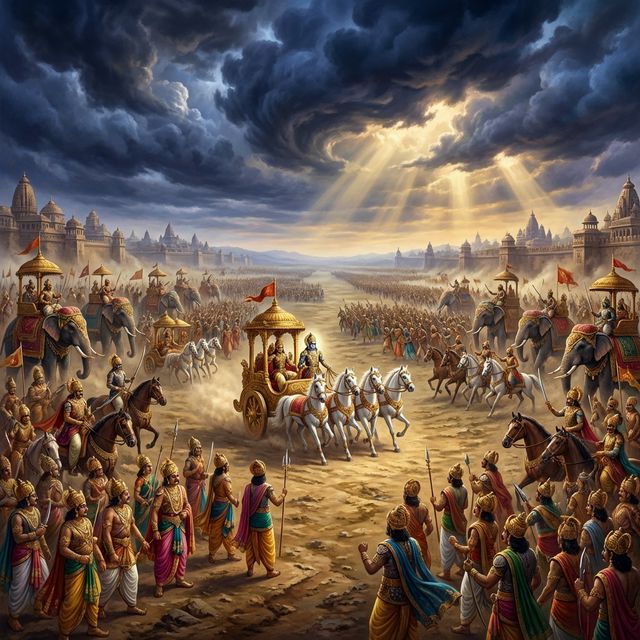
The Plunder of the Kaurava Camp
The victors ride into Duryodhana's empty tents, and Arjuna's chariot turns to ash
The Kings Turn the Wrong Way
Sanjaya had watched the whole of the eighteenth day from the field, and he was telling it to a blind king in a hall at Hastinapura, and he had got as far as the evening.
Duryodhana was down at Samantapanchaka with his thighs broken. Krishna had said that it was late, that they had been crowned with success, and that they had better depart to their tents and take rest with their steeds and elephants and cars. So the kings mounted, all of them men whose arms were like spiked bludgeons, and they went, blowing their conchs the whole way, filled with joy.
"The Pandavas also, O monarch," Sanjaya said, "proceeded towards our encampment."
That is the sentence, and it is worth stopping on. The victorious army did not ride back to its own lines. It rode to the enemy's. Five brothers who had been sleeping for seventeen nights across the field from the Kuru camp now turned their horses toward it, because there was nobody left in it to stop them.
They did not go alone. The great bowman Yuyutsu followed them, and of all the men on that road he was the strangest: a son of Dhritarashtra by a vaisya woman, Duryodhana's own half brother, who had walked out of the Kaurava host on the first morning of the war when Yudhishthira asked whether anyone wished to change sides, and who was now riding back into his father's camp behind the men who had emptied it.
Satyaki came, of the Vrishni race, Krishna's kinsman and Arjuna's pupil. Dhrishtadyumna came, who had been born out of a fire to kill Drona and had done it. Shikhandi came, on whose account Bhishma had laid down his bow. And the five sons of Draupadi came, boys who had a father each among the brothers and a mother who had been waiting thirteen years for exactly this evening.
The other great bowmen followed after them, and the whole of that column rode in through the gates of a camp that nobody was defending.
A Lake Without Its Elephant
The Parthas then entered the tent of Duryodhana.
Sanjaya gave his master three pictures of it, one after another, and did not comment on any of them. It was shorn of its splendours and reft of its lord. It looked like an arena of amusement after the spectators have gone home. It looked like a city with the festival over, or a lake without its elephant.
Those are not the images a man reaches for when he wants to describe a plundered place. They are the images for a place that is merely empty. What Sanjaya saw in that pavilion was not ruin. It was the particular silence of a hall that was built to be full and has been left standing after everyone has walked out of it.
It was not quite empty. It swarmed, he said, with women and with eunuchs and with certain aged counsellors, which is to say that everything in the tent that could not fight or flee was still in it. The king's household had been left behind by an army that had run in the night, and it was sitting there in the half dark when the men who had killed the king came through the door.
And Sanjaya, who was speaking to Duryodhana's father, took one moment for the old men.
Duryodhana and the other heroes, he said, attired in robes dyed in yellow, formerly used to wait reverentially on those old counsellors, with joined hands.
Formerly. That is the whole of the memory, and it is placed there without a word of judgement on it. The prince who had refused Vidura and Drona and Kripa and Sanjaya himself when they told him to make peace had once been a young man in a yellow robe who stood before these same grey heads with his palms together, waiting to be spoken to. The counsellors had outlived him. They were still sitting in his tent, and there was nobody left to wait on them, and the Pandavas were dismounting outside.
Get Down First
Arrived at the pavilion of the Kuru king, the Pandavas, those foremost of car-warriors, dismounted from their cars.
All of them except one, because Krishna would not let him.
Keshava was always engaged in the good of his friend, and he had been driving Arjuna's chariot since the first morning, holding the reins of four white horses through eighteen days of it. Now he turned round on the driver's bench and gave an order to the man behind him as though they were still under fire.
"Take down thy gandiva," he said, "as also the two inexhaustible quivers. I shall dismount after thee, O best of the Bharatas. Get thee down, for this is for thy good, O sinless one."
Gandiva was the bow, the great bow that Arjuna had carried out of the Khandava forest and had strung on every day of the war. The two quivers were the ones that had never yet run dry. The order was to unload them from the car and set them on the ground, and then to step down himself, and to do it before Krishna moved.
There is no reason given for it. Nothing is burning. The battle is over, the field is behind them, the enemy is a household of women and old men. A charioteer is telling a man who has just won a war in what order to get off a chariot, and the only justification offered is the one clause: this is for thy good.
Pandu's brave son Dhananjaya did as he was directed. He lifted down the bow and the quivers and stepped off the car onto the earth of the Kaurava camp.
Then the intelligent Krishna abandoned the reins of the steeds and dismounted after him, and the Lord of all creatures took his weight off that vehicle for the last time.
And the moment he did, the celestial Ape that had topped the mantle of Arjuna's car disappeared, there and then, without a sound.
The Car That Was Already Ashes
The ape had been on that banner since before the fighting started. Men on both sides had learned to find Arjuna in the dust by looking for it, and it had roared from the flagstaff in a voice that turned Kaurava troops cold. It went out like a lamp.
Then the car itself blazed forth to ashes.
There was no visible fire in sight. Sanjaya was careful about that, twice over. The top of the vehicle, which had been burnt long before by Drona and by Karna with their celestial weapons, went up first, and then the whole of it: the quick pairs of steeds, the yoke, the shaft. It fell down where it stood, reduced to ashes, on the ground of the camp it had ridden into.
The sons of Pandu stood round the heap of it and were filled with wonder. Arjuna saluted Krishna and bowed to him, and joined his hands, and asked in an affectionate voice.
"O Govinda, O divine one, for what reason hath this car been consumed by fire? What is this highly wonderful incident that has happened before our eyes? O thou of mighty arms, if thou thinkest that I can listen to it without harm, then tell me everything."
"That car, O Arjuna, had before been consumed by diverse kinds of weapons," Vasudeva said. "It was because I had sat upon it during battle that it did not fall into pieces, O scorcher of foes. Previously consumed by the energy of brahmastra, it has been reduced to ashes upon my abandoning it after attainment by thee of thy objects."
The chariot had been dead for days. It had been killed by the brahmastras of the teacher and of the Suta's son, and it had gone on rolling and turning and carrying a bowman through the thickest of the fighting for the single reason that Krishna was sitting on the front of it. Every wheeling manoeuvre Arjuna had made since then had been made on a thing that was already burnt.
Now the purpose was accomplished, and the driver had stepped down, and the ash fell where it had been standing all along.
The Promise Made at Upaplavya
Then Keshava embraced Yudhishthira, and Sanjaya noted that he did it with a little pride, which is not often said of him.
"By good luck, thou hast won the victory, O son of Kunti. By good luck, thy foes have been vanquished. By good luck, the wielder of gandiva, Bhimasena the son of Pandu, thyself, O king, and the two sons of Madri have escaped with life from this battle so destructive of heroes, and have escaped after having slain all your foes. Quickly do that, O Bharata, which should now be done by thee."
The two sons of Madri were Nakula and Sahadeva, Pandu's sons by his second wife. Krishna was counting them off, all five, alive, out of a war that had left almost nobody alive.
Then he reminded Yudhishthira of a debt, in the exact words in which it had been contracted.
"After I had arrived at Upaplavya, thyself, approaching me, with the wielder of gandiva in thy company, gavest me honey and the customary ingredients, and saidst these words, O Lord: This Dhananjaya, O Krishna, is thy brother and friend. He should, therefore, be protected by thee in all dangers. After thou didst say these words, I answered thee, saying, So be it.
"That Savyasaci hath been protected by me. Victory also hath been thine, O king. With his brothers, O king of kings, that hero of true prowess hath come out of this dreadful battle, so destructive of heroes, with life."
Upaplavya was the town in Virata's country where the Pandavas had gathered before the war, when the whole thing could still have been stopped. A host had poured honey for a guest there and asked him for one thing, and the guest had said, So be it. He was now, in a dead man's camp, reporting that the errand was discharged.
Yudhishthira heard it with the hair standing up on his body.
"Who else save thee, O grinder of foes, not excepting the thunder-wielding Purandara himself, could have withstood the brahmastras hurled by Drona and Karna? It was through thy grace that the samsaptakas were vanquished. It was through thy grace that Partha had never to turn back from even the fiercest of encounters. At Upaplavya, the great rishi Krishna-Dvaipayana told me that thither is Krishna where righteousness is, and thither is victory where Krishna is."
The samsaptakas were the sworn men of Trigarta, who had taken an oath to kill Arjuna or die, and who had spent day after day dragging him to the far end of the field. The rishi was Vyasa. Yudhishthira quoted the old saying standing in that plundered tent as a man quotes something he has finally seen proved.
The Military Chest
After this conversation, those heroes entered the encampment and took it apart.
Sanjaya listed what they found for the man who had owned it, and he made the list long on purpose. They obtained the military chest, which was the war treasury of the Kuru house, the fund out of which eleven armies had been paid and fed and armed for eighteen days. They obtained many jewels and much wealth. They obtained silver and gold, and gems and pearls, and many costly ornaments. They obtained blankets and skins. They obtained innumerable slaves, male and female. They obtained, Sanjaya said, many other things necessary for sovereignty.
That last phrase is the point of the whole inventory. This was not loot in the ordinary sense. It was the working equipment of a kingdom, the movable half of the thing the war had been fought over, and it had been sitting in tents at Kurukshetra because Duryodhana had brought it out with him and had never intended to go home without a crown on.
"Having obtained that inexhaustible wealth belonging to thee, O bull of Bharata's race," Sanjaya said to Dhritarashtra, and did not soften it.
Then those highly blessed ones, whose foe had been slain, uttered loud cries of exultation.
It is the second time that day they had shouted. The first had been over Duryodhana's body, and Krishna had stopped it, telling them it was not proper to slay a slain foe over and over with cruel speeches, and that a man who has become a piece of wood is not worth spending bitter breath on. Nobody stopped this one. There was nothing wrong with it. Five men who had been sent into a forest for twelve years and into hiding for one more, on the strength of a rigged game of dice, were standing in the middle of everything they had been cheated of, and they made the noise that men make.
Then they unyoked the animals.
Horses that had been in harness since the morning were led off the poles, and elephants were brought in, and the Pandavas and Satyaki remained there awhile to rest themselves in the tents of the men they had killed.
One Night Outside the Walls
They did not sleep there.
Vasudeva of great renown, resting among that wealth with the rest of them, said one sentence and undid the whole arrangement.
"We should, as an initiatory act of blessedness, remain out of the camp for this night."
It was not a warning. He gave no reason and named no danger. He called it an initiatory act, the sort of observance a man performs at the beginning of a rite, before the thing itself is undertaken. A king about to be consecrated does not spend the first night in the house he has just taken.
"So be it," said the Pandavas, and they got up and left the treasure where it lay. Satyaki went with them, and Krishna went with them, and they walked out through the gate of the camp for the sake of doing that which was regarded as auspicious.
They came to the banks of the Oghavati, a sacred stream running near the field, and there, reft of foes at last, they took up their quarters for the night: five brothers and one Yadava and one charioteer, camped in the open beside running water, with the wealth of the Kurus lying unguarded half a mile away.
Everyone who reads it afterwards knows what that sentence saved them from, and none of the men on the riverbank knew it that evening.
There was one thing still to be done before they slept. They despatched Keshava to Hastinapura.
Daruka got the car ready, and yoked Shaibya and Sugriva and the others to it, and Krishna mounted, and the brothers stood at the horses' heads with their instruction. It was not about the kingdom, or the surrender of the city, or the terms. Gandhari had lost a hundred sons in eighteen days, and the last of them had died that afternoon with his thighs broken, and she was a woman whose austerities were said to be enough to burn the world.
"Comfort the helpless Gandhari," they said, "who hath lost all her sons."
Thus addressed by the Pandavas, that chief of the Satvatas proceeded towards Hastinapura, and came into the presence of a mother who did not yet know.
Dharma Lesson
The chariot had been dead for days and nobody knew it, because the one who was holding the reins had not yet stepped down. Much of what we take for our own strength is only something that has not been withdrawn from us yet, and it stands until its purpose is accomplished and not one moment longer. Notice too what the victors did with the treasure they had spent eighteen years wanting: they took it, shouted over it, and then walked out and slept beside a river because they were told the first night was not theirs to spend indoors. Winning is one act; knowing when not to sit down in what you have won is a different one.