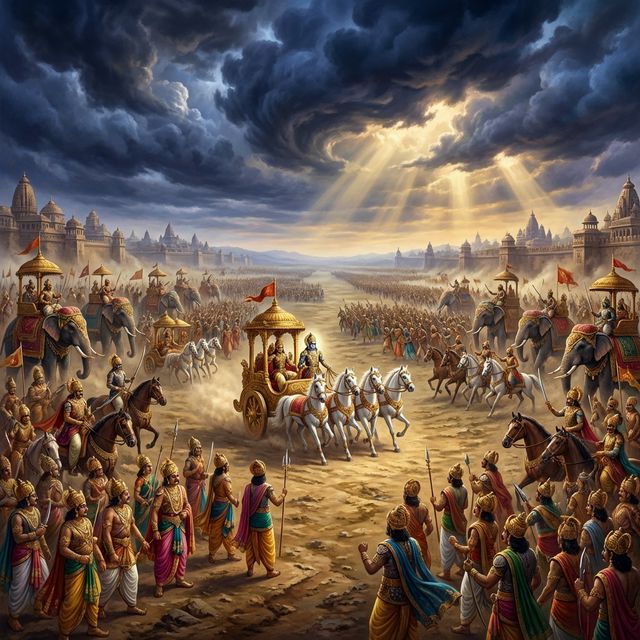
The Muster of the Eighteenth Day
An oath never to fight alone, and the count of what was left of both armies
Arm, You Mighty Car-Warriors
The night that had just gone by was the one after Karna fell, and it was the last night either army would sleep soundly.
Sanjaya, who had been given sight of the whole field and who carried it back every evening to a blind king sitting in a hall at Hastinapura, began the eighteenth morning without any ornament at all.
"After that night had passed away, king Duryodhana then, addressing all thy soldiers, said, Arm, you mighty car-warriors."
Three commanders of that host were already dead. Bhishma had led it ten days, Drona five, Karna two. The fourth had been anointed only the evening before, water poured on his head in the midst of the troops according to the rites ordained in the scriptures: Shalya, ruler of the Madras, who was the maternal uncle of Nakula and Sahadeva and who had come to this field to fight against them.
Hearing the command of the king, the warriors began to put on their armour.
Sanjaya then describes what a camp looks like while it is doing that. Some began to yoke their steeds to their cars quickly. Others ran hither and thither. The elephants began to be equipped. The foot-soldiers began to arm. And others, numbering thousands, began to spread carpets on the terraces of the cars.
That last is the detail worth holding, because it is the one nobody would think to invent. On the morning of the eighteenth day of a war that had already consumed three generals and the better part of two nations, thousands of men were still walking the lines laying cloth on the platforms of the chariots, so that the great car-warriors should ride out sitting on something fit for them. The forms were kept up to the end.
The noise of musical instruments arose there, for enhancing the martial enthusiasm of the soldiers.
Then all the troops, placed in their proper posts, were seen to stand, clad in mail. Sanjaya gives them one phrase, and it is the phrase that governs everything that follows.
They were resolved to make death their goal.
The Undertaking They Made Among Themselves
Having made the ruler of the Madras their leader, the great car-warriors of the Kauravas distributed their troops and stood in divisions. And then, before a single chariot moved, the survivors held a conference among themselves.
Sanjaya names who was left to attend it. Kripa, whom the text calls Gautama, the old preceptor who had taught both sets of princes their first lessons in arms and who had already outlived every man he taught with. Kritavarma of the Bhojas, who had brought a division of Vrishni troops to this side of the field while Krishna went unarmed to the other. Drona's son Ashwatthama, who had watched his father put down his weapons on a car and be killed for a rumour. Shalya. Subala's son Shakuni of Gandhara, uncle to the king, who had thrown the dice that began all of it. And the other kings that were yet alive, which by the eighteenth day was not a long list.
They met Duryodhana, and they arrived at an understanding.
The understanding was that none of them would individually and alone fight with the Pandavas.
They then put a sanction on it, in their own words, and the sanction is heavier than anything they had sworn before. "He amongst us that will fight, alone and unsupported, with the Pandavas, or he that will abandon a comrade engaged in fight, will be stained with the five grave sins and all the minor sins."
The text does not stop to list the five grave sins, because it does not need to. They are the offences at the top of the scale, the ones for which the books provide no convenient expiation, and men do not invoke them lightly. These men were staking their next world on staying in formation.
"All of us, united together, will fight with the foe."
For seventeen days that army had been a collection of famous single champions, each of whom expected to decide the war by himself, and each of whom had gone down in his turn with the others watching. On the eighteenth morning the ones who remained bound themselves by an oath never to be alone again.
Then those great car-warriors, having made such an understanding with one another, placed the ruler of the Madras at their head and quickly proceeded against their foes. On the other side the Pandavas arrayed their troops and came out to meet them on every side, and that host, whose noise resembled that of the agitated ocean, presented the aspect of the vast deep swelling with its surges.
Tell Me Now of the Fall of Shalya
At that point the blind king interrupted his charioteer, as he had done all through the war, and what he asked for this time was not a battle but an ending.
"I have heard of the fall of Drona, of Bhishma and of the son of Radha," Dhritarashtra said. "Tell me now of the fall of Shalya and of my son. How, indeed, O Sanjaya, was Shalya slain by king Yudhishthira the just? And how was my son Duryodhana slain by Bhimasena of great might?"
He has stopped asking who had the better of a passage of arms. He names the two deaths that are still owed to him, and he names the men who will deal them, and he is asking only for the manner of it. Somewhere in the seventeen days behind him the question changed from what will happen to how did it happen, and the old king does not seem to have noticed the moment when it turned.
"Hear, O king, with patience," Sanjaya said, "of the destruction of human bodies and the loss of elephants and steeds, as I describe to thee the battle."
That is the whole of the promise he makes. Not victory, not glory, not the deeds of heroes. Destruction of bodies, loss of animals, described patiently.
Then he explains what the Kaurava camp was feeling while it armed. The hope became strong in the breasts of Dhritarashtra's sons that, after Drona and Bhishma and the Suta's son had been overthrown, Shalya would slay all the Parthas in battle. Cherishing that hope in his heart and drawing comfort from it, Duryodhana, relying in battle upon that mighty car-warrior, the ruler of the Madras, regarded himself as possessed of a protector.
And Sanjaya says plainly why a protector was wanted. When, after Karna's fall, the Parthas had uttered their leonine roars, a great fear had possessed the hearts of the Dhartarashtras.
They had heard that sound come across the field in the dark. It was the fourth time in eighteen days that this army had put the whole of its hope on the shoulders of one man, and every man who had carried it so far was dead.
The Bow and the Horses of the Sindhu Breed
Shalya assured them duly. That is the word Sanjaya uses, and it is a commander's word rather than a hero's: he went among frightened men and settled them.
Then the valiant king of the Madras formed a grand array whose arrangements were auspicious in every respect, and proceeded against the Parthas in battle.
Auspicious in every respect is not decoration. An array was drawn up with attention to the quarter it faced, the hour, the omens, and the rites proper to the beginning of a day's fighting, and a commander who neglected any of that was held to have thrown away an advantage before a shaft was loosed. Shalya had promised Duryodhana the night before that he would form an array their enemies would not be able to overmaster. This was him keeping the first half of the promise, in front of everyone, with the whole camp watching to see whether the new man knew his work.
He proceeded shaking his beautiful and exceedingly strong bow, a bow capable of imparting a great velocity to the shafts sped from it.
He was mounted upon the foremost of vehicles, with horses of the Sindhu breed yoked to it, the best animals money and empire could put in front of a chariot. Riding upon that car, his driver made the vehicle look resplendent. Protected by it, that hero, that brave crusher of foes, stood dispelling the fears of Dhritarashtra's sons.
There is a hard irony in the picture that the text does not point out and does not need to. Two days earlier this same man had sat in the driver's niche of another car, holding the reins for Karna and pouring contempt on him between shots. Now the reins are in somebody else's hands, the driver is making his car look splendid, and the fear he is dispelling is the fear caused by the death of the man he drove.
The king of the Madras, clad in mail, proceeded at the head of the array. With him went the brave Madrakas, his own countrymen, and the invincible sons of Karna, who had lost their father the previous evening and who rode out that morning in the van beside his charioteer.
The Order of the Line
Sanjaya sets out the array the way a man sets out a board, and it is worth taking in position by position, because it is the last complete order of battle the Kauravas ever formed.
At the head, Shalya, with the Madrakas and the sons of Karna.
On the left, Kritavarma, surrounded by the Trigartas. The Trigartas were Susharman's people, the sworn men from the hill country west of the Kuru lands who had taken an oath to kill Arjuna or die, and who had been spending themselves against him a division at a time since the thirteenth day.
On the right, Gautama, which is to say Kripa, with the Sakas and the Yavanas. These are the foreign contingents, horsemen and bowmen from beyond the north-western passes, the outer edge of the alliance that Hastinapura had spent a generation of gifts and marriages assembling.
In the rear, Ashwatthama, surrounded by the Kambojas, another people of the far north-west, famous for their horses.
In the centre, Duryodhana, protected by the foremost of the Kuru warriors.
And moving with the rest, surrounded by a large force of cavalry and other troops, Subala's son Shakuni, and with him the mighty car-warrior Uluka, who was Shakuni's son and who had carried his father's insults from tent to tent on the eve of the war as Duryodhana's messenger.
Look at what the shape says. The new commander is in front, where a commander who has just promised to surpass Bhishma and Drona and the Suta's son has to be. The king is in the middle, walled in by the best of his own house. The wings and the rear are held by the three men who will still be alive when the sun goes down, and the outer edges of the formation are made up almost entirely of allies from countries that will never hear how the day ended.
It is a careful array. Every division has a name and a protector, nothing is left hanging, and it is drawn up around a centre that must not be touched. It is also, read from front to back, an inventory of everything the Kuru cause had left in the world, and there is not a great deal of it.
Three Bodies
The mighty bowmen amongst the Pandavas, those chastisers of foes, divided themselves into three bodies and rushed against the Kaurava troops. Sanjaya then names, pairing by pairing, who went at whom.
Dhrishtadyumna and Shikhandi and the mighty car-warrior Satyaki proceeded with great speed against the army of Shalya. Dhrishtadyumna was Drupada's son, born out of a sacrificial fire for the destruction of Drona, and he had done that work on the fifteenth day. Shikhandi was his sibling, at the sight of whom Bhishma had refused to lift a weapon, and the whole of the tenth day had turned on that refusal. Satyaki was the Vrishni, Krishna's own kinsman and Arjuna's pupil. Between the three of them they had accounted for a good part of the reason the Kaurava army was now as small as it was.
Then king Yudhishthira, accompanied by his troops, rushed against Shalya alone, from desire of slaughtering him.
That was not improvisation. Krishna had told him the evening before, in front of everyone, that he found no match for the ruler of the Madras in either heaven or earth save Yudhishthira himself, that there was no room here for compassion on the ground that this was his own maternal uncle, and that he should keep the duties of a Kshatriya before him and kill the man. The eldest Pandava, who had been the last of the brothers anyone expected to be given such a task, went straight down the field at the head of the enemy array.
Arjuna, that slayer of large bands of foes, rushed with great speed against the great bowman Kritavarma and the Samsaptakas, the sworn warriors who had contracted never to retreat from him.
Bhimasena and the great car-warriors among the Somakas rushed against Kripa, desirous of slaughtering their foes in battle.
The two sons of Madri, Nakula and Sahadeva, accompanied by their troops, proceeded against Shakuni and the mighty car-warrior Uluka at the head of their forces. The twins had been given the dice-player and his son, and everybody on that field knew why.
And similarly, thousands upon thousands of warriors of the Kaurava army, armed with diverse weapons and filled with rage, proceeded against the Pandavas in that battle.
The Count at Dawn
Before Sanjaya would let the two hosts touch, the blind king stopped him once more, and asked the question that this section exists to answer.
"After the fall of the mighty bowmen Bhishma and Drona and the great car-warrior Karna," Dhritarashtra said, "and after both the Kurus and the Pandavas had been reduced in numbers, and when, indeed, the Parthas, possessed of great prowess, became once more angry in battle, what, O Sanjaya, was the strength of each of the armies?"
"Hear, O king, how we and the enemy both stood for battle on that occasion," Sanjaya said, "and what was then the strength of the two armies."
On the Kaurava side: eleven thousand cars, ten thousand seven hundred elephants, a full two hundred thousand horses, and three millions of foot.
On the Pandava side: six thousand cars, six thousand elephants, ten thousand horses, and one million of foot. That was all that composed the remnant of the Pandava force in the battle.
Sit with those two columns, because they are the strangest thing in this part of the epic. The side that has lost its grandsire, its preceptor and its greatest bowman, the side whose survivors have just sworn an oath never to fight alone, is still the larger army by every measure on the list. Nearly two to one in chariots. Twenty to one in horse. Three to one in foot. Eighteen days of war had begun with eleven divisions against seven, and eighteen days of war had not overturned the arithmetic. It had only made both numbers smaller.
And yet the fear was all on that side, and the leonine roars in the dark had come from the other. Whatever was deciding this war, the count was not it. Sanjaya gives the figures to a man who wants to know why his son is going to lose, and the figures do not tell him.
Having distributed their forces in this way, Sanjaya said, ourselves, excited with wrath and inspired with desire of victory, proceeded against the Pandavas, having placed ourselves under the command of the ruler of the Madras. Similarly the brave Pandavas, those tigers among men, desirous of victory, and the Pancalas possessed of great fame, came to battle.
Even thus, at dawn of day, all those tigers among men encountered one another. Then commenced a fierce and terrible battle between the two hosts, the combatants being all engaged in striking and slaughtering one another.
Dharma Lesson
An army that spent seventeen days sending out one famous champion at a time only learns to stand together on the morning when there is almost nobody left to stand with. The oath the survivors swear, binding themselves by the five grave sins never to fight alone or desert a comrade, is a good rule arrived at too late, and it is sworn in the service of a cause that no rule can now repair. Sanjaya's count says the rest: the side about to be destroyed is still the bigger army in every column, which means the war was never being decided by what could be counted.