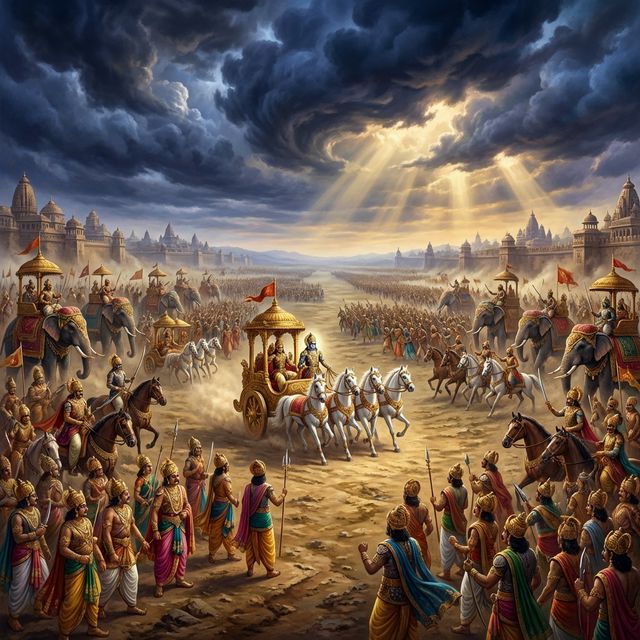
The Flight of the Royal Ladies
The last of the eleven armies dies, Duryodhana walks into a lake, and the Kaurava camp runs for Hastinapura
The Last Charge of the Gandharas
Sanjaya was telling it to a blind man in a hall, and he had reached the last hour of the eighteenth day.
Shakuni's head had been struck from his shoulders a moment before by Sahadeva, and the followers of Subala's son went out of their minds. They were prepared to lay down their lives in that dreadful battle. They came back with darts and swords and lances, resolved upon one thing only, that the son of Madri who had done it should not outlive their master.
Arjuna received them. So did Bhimasena, possessed of great energy, who by that hour of the day resembled an angry snake of virulent poison in aspect, and the two of them put themselves in front of their younger brother the way men stand in front of something they have decided will not be touched.
With his Gandiva, Dhananjaya baffled the purpose of those warriors. Vibhatsu, with his broad-headed arrows, cut off the steeds, the heads, and the arms with the weapons still gripped in them of the men rushing at him. The horses of those heroes, endued with great activity, struck by Savyasachi, fell down on the earth deprived of their lives, and the riders came down after them.
It was the last charge the horsemen of Gandhara ever made, and it lasted about as long as it takes to say so.
Sanjaya was in a position to describe all of it. He was Dhritarashtra's charioteer and reporter, a suta of the court, and Vyasa had given him a sight that reached across the whole field. On the eighteenth day that gift had become nearly superfluous. There was not much field left to see. The army he had been sent out to watch had been reduced to a strip of churned ground with a few hundred cars standing in it, and the dust of it was still moving.
King Duryodhana, beholding that carnage of his own troops, became filled with rage.
Slay Them Quickly and Turn Back
He assembled together the remnant of his cars, which still numbered many hundreds, and with them what elephants and horse and foot he could find still standing, and he gave the last order he would ever give to an army.
"Encountering all the Pandavas with their friends and allies in this battle, and the prince of Pancala also with his own troops, and slaying them quickly, turn back from the fight!"
Respectfully accepting that command of his, those warriors, difficult of defeat in battle, proceeded once more against the Parthas.
It should be read as it stands, because it is the order of a man who has stopped calculating. He was not asking them to hold a line or to cover a withdrawal. He was asking them to kill five brothers, a Pancala prince, and every ally either of them had, and then to come back and report. And they accepted it respectfully, which is the last courtesy anyone paid him on that field.
The Pandavas covered them with arrows resembling snakes of virulent poison. That army, as it came to battle, was in a moment exterminated by those high-souled warriors, and Sanjaya gave the reason for the speed of it in one clause: for it failed to obtain a protector. There was nobody at its head. Bhishma was on his arrows, Drona was ashes, Karna was two days dead, Shalya had fallen that morning, Shakuni that hour. Men who had spent eighteen days being told where to stand were sent forward with nobody in front of them, and the thing came apart the way a wall comes apart when the last course is pulled out.
The loose horses ran hither and thither, and the dust they raised was thick enough that the cardinal and the subsidiary points of the compass could not be distinguished.
Eleven Akshauhinis had been assembled for the king's son. All of them, said Sanjaya, were slain by the Pandus and the Srinjayas.
Among those thousands upon thousands of high-souled kings, only Duryodhana was now seen to be alive, exceedingly wounded, casting his eyes on all sides and seeing the earth empty, while the Pandavas roared aloud in the accomplishment of all their objects. He could not endure the whiz of their shafts. He became stupefied. Destitute of troops and animals, he set his heart on retreat from the field.
The Blind King Asks for a Number
The old man in the hall interrupted him there.
"When my troops were slain and our camp made entirely empty," Dhritarashtra said, "what was the strength, O Suta, of the troops that still remained to the Pandavas? I desire to know this. Therefore tell me, O Sanjaya, for thou art skilled in narration. Tell me also that which was done by my son, the wicked Duryodhana, that lord of the earth, the sole survivor of so many men, when he saw his army exterminated."
It is worth noticing what the question is. Everything the king loves is already dead, and what he asks for first is a count of the enemy. He had been asking for counts for eighteen days. He wanted to know the arithmetic of the disaster before he could bear the shape of it, and he wanted, perhaps, to hear that the other side had paid something too.
Sanjaya gave him the figure without softening it.
Two thousand cars. Seven hundred elephants. Five thousand horse. Ten thousand foot. That was the remnant of the mighty host of the Pandavas, and taking care of that force, Dhrishtadyumna waited in the battle.
So the Pancala prince who had been born out of a fire to kill Drona spent the last minutes of the war doing the ordinary work of a commander, keeping seventeen thousand tired men together in one place while his allies finished. It is a small detail and it answers the king's question completely. The Pandavas still had an army. It was a wreck of an army, a fifth of what had come to the field, but it had a head on it and it was standing in formation.
Against it, on the other side of that dust, king Duryodhana, that foremost of car-warriors, looked for a single warrior on his own side and did not see one.
He was the lord of eleven Akshauhinis, and he was standing in the middle of the field of Kurukshetra by himself.
Eastward, On Foot, With the Mace
Beholding his enemies roaring aloud, and witnessing the extermination of his own army, that lord of the earth abandoned his slain steed and fled from the field with his face turned eastwards.
The horse was dead under him. He left it where it lay, took up his mace, and went away on foot toward a lake.
Before he had proceeded far, the king recalled the words of the intelligent and virtuous Vidura.
Sanjaya does not quote them. He does not have to. Everyone in that hall had heard Vidura say it, in that room, more than once, over the course of years: that this policy would end in the destruction of the Kshatriya order and of their own house, that the sons of Pandu would not be cheated forever, that the man who takes what is not his loses what is. Without doubt, said Sanjaya, this had been foreseen by Vidura of great wisdom, this great carnage of Kshatriyas and of ourselves in battle.
Reflecting on this, with his heart burning in grief at having witnessed the extermination of his army, the king desired to penetrate into the depths of that lake.
Behind him the field was being cleared. The Pandavas, with Dhrishtadyumna at their head, filled with rage, rushed against the small remnant that was left. With his Gandiva, Dhananjaya baffled the purpose of the troops who, armed with darts and swords and lances, were still uttering loud roars, and having slain them with his sharp shafts along with their allies and their kinsmen, Arjuna stood on his car with the white steeds yoked to it and looked exceedingly beautiful.
That is the image Sanjaya chose for the end of the war, and he was not on Arjuna's side. A man standing in a chariot in the evening light with nothing left in front of him.
Upon the fall of Subala's son along with horse and cars and elephants, the army of the Kurus looked like a large forest laid low by the wind.
In Duryodhana's host, which had numbered many hundred thousands of warriors, not another great car-warrior was seen to be alive: only the heroic son of Drona, and Kritavarma, and Kripa the son of Gotama, and the king himself, walking east with a club on his shoulder.
Nothing Will Be Gained by Keeping Him Alive
There was one more man of the Kaurava party standing on that field, and he was not a warrior.
Dhrishtadyumna saw him. Sanjaya, who had spent eighteen days riding through the fighting with no armour worth the name and no business there except to look, was taken, and the Pancala prince laughed when he looked at what he had caught.
He addressed Satyaki, and what he said about the prisoner he said in the prisoner's hearing.
"What is the use of seizing this one? Nothing will be gained by keeping him alive."
Hearing those words, the grandson of Sini, that great car-warrior, uplifted his sharp sword and prepared to slay him.
Sanjaya reports his own execution in the same flat voice he uses for everything else. He does not say that he begged, and he does not say that he was afraid, though he tells us a few sentences later that when he finally walked off the field his limbs were bathed in blood. He was a suta. He had carried messages between these men for thirty years, he had told Duryodhana to his face in open court that his policy was ruin, he had sat at Dhritarashtra's knee describing the deaths of the man's sons one by one, and at the end of it a Pancala prince decided he was not worth a rope and a Vrishni hero raised a sword over him.
Just at that juncture the Island-born Krishna of great wisdom came there.
Vyasa had made this war in the sense that he had fathered the fathers of both houses, and had spent the whole of it appearing at the edges of it and saying short things. He said one now.
"Let Sanjaya be dismissed alive! By no means should he be slain!"
Hearing the words of the Island-born, the grandson of Sini joined his hands. He set the man free. Then he said, "Peace to thee, O Sanjaya, thou mayest go hence!"
Permitted by him, Sanjaya put off his armour and made over his weapons, and set out in the evening on the road that led to the city.
The Man Standing Alone on the Road
After he had come about two miles, he saw Duryodhana.
The king was standing by himself, mace in hand, exceedingly mangled. His eyes were so full of tears that he could not see, and Sanjaya stood cheerlessly in front of him, and he looked at Sanjaya without recognising him.
Beholding him standing alone on the field and indulging in grief, Sanjaya says, I also, overwhelmed with sorrow, succeeded not for a little while to speak a single word.
Then he told him about his own capture, and about his release through the grace of the Island-born.
Having reflected for a moment, and regained his senses, the king enquired about his brothers and his troops. Sanjaya had seen everything with his own eyes, and therefore he told him everything: that his brothers had all been slain, and that all his troops had been exterminated. He told him that there were three car-warriors left alive on their side, because Vyasa had said so to him as he set out.
Drawing deep breaths and looking repeatedly at him, the king reached out and touched him with his hand.
"Except thee, O Sanjaya, there is none else that liveth amongst those engaged in this battle! I do not see another on my side, while the Pandavas have their allies living! Say, O Sanjaya, unto that lord, the blind king Dhritarashtra, that his son Duryodhana hath entered the depths of a lake! Destitute of friends such as those I lately had, deprived of sons and brothers, and seeing his kingdom taken by the Pandavas, who is there like me that would desire to live? Say all this unto the king, and tell him further that I have escaped with life from that dreadful battle, and that, alive, though exceedingly wounded, I shall rest within the depths of this lake."
Having said these words, the king entered that lake.
That ruler of men, by his power of illusion, charmed the waters, making a space for himself within them. The surface closed and held, and the last of eleven armies lay down under it, armed, awake, and out of the world.
The King Knows Not That We Are Alive
After he had entered that lake, Sanjaya stood on the bank with nobody on his side, and saw three car-warriors coming toward that spot with their animals tired under them.
They were Kripa, the son of Saradwat, who had taught both sets of princes their weapons when they were boys; Ashwatthama, the son of Drona, who had been Duryodhana's friend since before either of them had a beard; and Kritavarma of the Bhoja race, who had brought a Vrishni army to this side while Krishna went to the other. Mangled with shafts, all of them came together to that place.
Beholding him, they urged their steeds to greater speed, and coming up to him they said, "By good luck, O Sanjaya, thou livest yet!"
Then all of them enquired after the king. "Is our king Duryodhana still alive, O Sanjaya?"
He told them that the king was well in body. He told them everything Duryodhana had said to him. And he pointed out to them the lake that the king had entered.
Ashwatthama, having heard those words, cast his eyes on that extensive water and began to wail in grief.
"Alas, alas, the king knows not that we are still alive! With him amongst us, we are still quite able to fight with our foes!"
That cry is the hinge of everything that follows, and it is worth stopping on. Ashwatthama was not grieving because the war was lost. He was grieving because his friend had gone under the water believing himself the last man, when three men who would have died for him were standing on the bank. Everything he does over the next night, and it is the worst thing anybody does in the poem, comes out of the sentence he shouted at a lake.
Those mighty car-warriors, having wept there for a long time, fled away at the sight of the sons of Pandu.
The three of them took Sanjaya up on the well-adorned car of Kripa and proceeded to the Kuru camp. The sun had set a little before.
The Women Who Had Never Been Seen by the Sun
The troops forming the outposts of the camp, learning that all the king's sons had been slain, wept aloud.
Then the old men who had been appointed to look after the ladies of the royal household proceeded towards the city, taking the princesses after them.
What follows is the passage the whole section is remembered for, and Sanjaya sets it down in short sentences without commentary, which is the only way it can be borne.
Loud were the wails uttered by those weeping women when they heard of the destruction of the whole army. Crying ceaselessly, they caused the earth to resound with their voices like a flight of she-ospreys. They tore their bodies with their nails. They struck their heads with their hands. They untied their braids, indulging all the while in loud cries. Filling the air with sounds such as "Oh!" and "Alas!" and beating their breasts, they cried aloud and wept and uttered loud shrieks.
Then the friends of Duryodhana, deeply afflicted and made voiceless by their tears, set out for the city, taking the ladies of the royal household with them.
Around that procession the camp emptied itself. The camp-guards fled towards the city, taking with them many white beds overlaid with costly coverlets, because in a rout men carry away whatever their hands close on. Others placed their wives on cars drawn by mules and went. And the one sentence that says more about what had happened to that house than any count of the dead:
Those ladies, who while in their houses could not be seen by the very sun, were now, as they proceeded towards the city, exposed to the gaze of the common people.
They were queens of the Kuru house. Every arrangement of their lives had been built to keep them out of sight, and the whole apparatus of screens and inner apartments and appointed old men that had done it for a hundred years was gone in an afternoon, and they went up the road to Hastinapura in the dark with their hair down and their faces bare, in front of anybody who cared to look. Women who were very delicate now proceeded with speed, having lost their near ones and their kinsmen.
Behind them came the cowherds and the shepherds and the common men of the camp, filled with panic, afflicted with the fear of Bhimasena. Even these were filled with a great fear of the Parthas. Looking at one another, all of them fled towards the city.
The Son Nobody Counted
During the progress of that general flight there was one man on the field who stopped to think about it.
Yuyutsu was a son of Dhritarashtra by a Vaisya woman, the only one of that hundred and one who had walked across to the Pandava side on the first morning of the war, and who had therefore spent eighteen days watching his brothers die from the other bank. Deprived of his senses by grief, he thought upon what should be done.
"Duryodhana hath been vanquished in battle by the Pandavas of terrible prowess! He had eleven Akshauhinis of troops under him! All his brothers have been slain! All the Kauravas, headed by Bhishma and Drona, have perished! Through the influence of Destiny, only I have been saved! All those that were in the Kuru camp have fled! Alas, they are flying on all sides, deprived of energy and destitute of protectors! Such a sight had never been seen before! Afflicted with sorrow, with eyes anxious in fear, they are flying away on all sides like a herd of deer, looking at one another! Those amongst the counsellors of Duryodhana that are yet alive have fled towards the city, taking with them the ladies of the royal household! I think that the time hath come when I also should enter the city with them, after taking the permission of Yudhishthira and Vasudeva!"
For this purpose that mighty-armed prince presented himself before both those heroes. King Yudhishthira, who is always compassionate, became highly pleased with him. He embraced that child of a Vaisya mother and dismissed him affectionately.
Riding upon his own car, Yuyutsu urged his steeds to great speed and supervised the removal of the ladies to the city. The sun was setting. With those women he entered Hastinapura, with tearful eyes and with his voice choked in grief.
The Sole Staff of the Blind King
There he found Vidura sitting with tearful eyes, who had come away from Dhritarashtra with his heart afflicted. Yuyutsu bowed down and stood before him.
"By good luck, O son, thou livest amid this general destruction of the Kurus! Why, however, hast thou come without king Duryodhana in thy company? Tell me in detail the cause of this!"
Yuyutsu told him: that after the fall of Shakuni the king had abandoned the steed he rode and fled in fear towards the east, that the encampment had emptied behind him, that the protectors of the ladies had put the wives of the king and of his brothers on vehicles and gone, and that he had obtained the permission of Yudhishthira and Keshava and come to Hastinapura for the protection of the people who were flying away.
Vidura, conversant with every usage and feeling that was proper at that hour, applauded him.
"Thou hast acted properly, having regard for what has come. Thou hast also, from compassion, maintained the honour of thy race! By good luck we behold thee come back with life from this terrible battle that is so destructive of heroes, like creatures beholding the sun possessed of blazing glory! Thou, O son, art now in every way the sole staff of the blind monarch, bereft of foresight, afflicted with calamity, struck by Destiny, and who, though repeatedly dissuaded, could not abstain from pursuing his evil policy. Take rest here for this day! Tomorrow thou mayst return to Yudhishthira!"
Then Vidura, with tearful eyes, took leave of him and entered the abode of the king, which resounded with cries of "Oh!" and "Alas!" uttered by citizens and villagers afflicted with woe. The cheerless mansion seemed to have lost all its beauty. Comfort and happiness seemed to have deserted it. It was all empty and pervaded by disorder, and Vidura's grief, already full, increased at the sight, and he went in drawing deep breaths.
Yuyutsu passed that night in his own house. People greeted him with panegyrics, because he was alive and he was the king's son and somebody had to be praised, and he failed to obtain any joy from it. He passed the time thinking of the terrible destruction of the Bharatas at one another's hands.
Dharma Lesson
An army is not only the men in it, and a war is not only the men who fight it. The poem spends its longest and steadiest passage here not on the death of eleven Akshauhinis but on what happened in the hour afterwards to women who had never in their lives been looked at by a stranger, and it insists on the small indignities: the untied hair, the mule-carts, the stolen bedding, the common people standing along the road. Duryodhana chose this for them thirteen years before, in a hall, when he chose it for another man's wife. The only figure who comes out of the evening with credit is the son nobody counted, who asked permission, took nothing, and rode back to protect the people who were running.