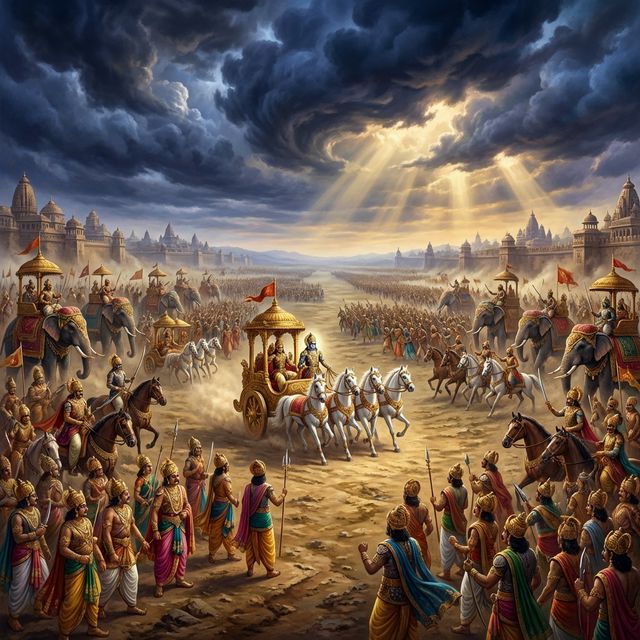
Satyaki Unhorses Shakuni
The seventeenth day breaks into single combats, and the gambler of Gandhara is carried off the field by his son
What the Kauravas Did
The blind king had been listening to a rout.
"When Bhima and Pandu's son Yudhishthira were engaged in battle," Dhritarashtra said, "when my troops were being slaughtered by the Pandus and the Srinjayas, when, indeed, my vast army being broken and routed repeatedly became cheerless, tell me, O Sanjaya, what the Kauravas did."
It was the seventeenth day, and Karna had been commander of the Kuru host since the morning after Drona fell. Sanjaya, who had the eye that saw the whole field, answered the question exactly as it was asked. He did not describe a victory. He described a man walking back into a stampede.
"Beholding the mighty-armed Bhima," Sanjaya said, "the Suta's son of great valour, with eyes red in wrath, O king, rushed towards him. Seeing thy army fly away from Bhimasena, the mighty Karna rallied it with great efforts."
That is the whole of what the Kauravas did, and it was enough. Karna got the running men turned around and moving forward again, and then took them himself against the Pandavas, those heroes difficult of defeat in battle. The great car-warriors on the other side shook their bows and shot their shafts and came out to meet him: Bhimasena, and Satyaki the grandson of Sini, and Shikhandi, and Janamejaya of the Pancalas, and Dhrishtadyumna of great strength, and all the Prabhadrakas, and behind them those tigers among men, the Pancalas, filled with rage and inspired with the desire of victory, rushing in from every side.
The Kuru car-warriors came on just as quickly, wanting the same thing. Teeming with cars and elephants and horses, abounding in foot-soldiers and standards, the two armies at that moment assumed a wonderful aspect, which is Sanjaya's way of saying that for a little while the whole immense machine was in order again, and every man in it knew where he was going.
Then the field broke into pairs, and the seventeenth day stopped being an army against an army and became a hundred private quarrels fought at once.
Three Arrows in the Forehead
Sanjaya named the pairings the way a herald names them, and the list is a map of every grudge left alive in that war.
Shikhandi went against Karna. Dhrishtadyumna went against Dushasana, with a large force behind him. Nakula took Vrishasena, and Yudhishthira took Citrasena. Sahadeva went against Uluka, the son of Shakuni, who had carried his father's message of insult to the Pandavas in the woods. Satyaki went against Shakuni himself. The sons of Draupadi took the remaining Kauravas, and Ashwatthama, with great care, went against Arjuna. Sharadvata's son Kripa proceeded against the bowman Yudhamanyu, and Kritavarma against Uttamauja, the two Pancala princes who guarded Arjuna's chariot wheels. And Bhimasena, alone and unsupported, took the rest: all the Kurus and all the sons of Dhritarashtra at the head of their division.
The first of those duels went to the man who had killed Bhishma.
Shikhandi, born a woman and made a man, who had stood in front of the grandsire's bow on the tenth day and been let live because of what he had been born, now put himself in front of Karna's bow and resisted him with winged arrows, careering fearlessly. Karna was checked, and his lips trembled with rage, and he answered by putting three arrows into the middle of Shikhandi's eyebrows.
They stuck there and stood out from his forehead, and Sanjaya, watching from a distance, said that with those three shafts in him Shikhandi looked highly beautiful, like a silver mountain with three elevated crests.
Deeply pierced, the mighty bowman shot back ninety keen shafts. Karna killed his four horses, killed his driver with three arrows, and cut off his standard with a razor-faced arrow. Shikhandi jumped down from the wrecked car and hurled a dart at him, and Karna cut the dart into pieces in the air with three shafts and put nine more arrows into the man who had thrown it.
So Shikhandi, exceedingly mangled, avoided the shafts coming off Karna's bow and retreated speedily from that spot. And Karna began to scatter the troops of the Pandavas like a mighty wind scattering a heap of cotton.
The Elephant and the Lion
Dhrishtadyumna was the commander of the Pandava army and the son of Drupada, born out of a sacrificial fire for one purpose, which he had accomplished two days earlier when he took Drona's head. Dushasana was the second son of Dhritarashtra, the man who had dragged Draupadi into the assembly hall by the hair, and Bhima had sworn thirteen years ago to drink his blood. Neither of them had any business fighting anybody else that afternoon, and the war put them opposite each other anyway.
Dushasana struck first and drew blood, and Dhrishtadyumna answered with three arrows into the centre of his chest. Then Dushasana put a broad-headed shaft, sharp and straight and winged with gold, clean through his enemy's left arm.
Pierced in the arm, filled with wrath and the desire to retaliate, Dhrishtadyumna sped a terrible shaft at him. It never arrived. Dushasana cut that impetuous arrow out of the air with three shafts of his own while it was still coursing towards him, then closed the distance and struck the Pancala prince in the arms and the chest with seventeen broad-headed arrows adorned with gold.
Prishata's grandson, in a rage now, cut Dushasana's bow apart with a single sharp razor-headed arrow, and the Pandava troops all round them uttered a loud shout at the sight.
Dushasana took up another bow, and Sanjaya says he did it as if smiling, and from that moment he had the better of it. He held the commander of the whole Pandava army in check with showers of arrows from every side, and would not let him move. The combatants watching, and the siddhas and the apsaras watching from above, were all filled with wonder at the prowess of that son of Dhritarashtra, and men who had spent the war despising him had to stand in the dust and admire him.
"We then saw the mighty Dhrishtadyumna," Sanjaya said, "thus assailed by Dushasana, to resemble a huge elephant held in check by a lion."
Then the Pancala car-warriors and elephants and horses came in to rescue their commander and closed round Dushasana, and the battle that began there presented as frightful a sight as the destruction of all creatures at the end of the Yuga.
The Son Who Guarded the Wheel
Vrishasena was Karna's eldest son, and all that day he fought where his father could see him. Staying by the side of his father, he pierced Nakula with five arrows made wholly of iron, and then with three more. Nakula, as if smiling, put a cloth-yard shaft of great keenness deep into the young man's chest. Vrishasena answered with twenty arrows and took five in return, and then the two of them shrouded each other with arrows by the thousand until the divisions supporting them broke apart and left them alone in the middle of it.
What ended that duel was not either of them. It was Karna. His own troops had begun to fly again, and Sanjaya says he followed them and began forcibly to stop them, and once he had gone off on that errand Nakula left Vrishasena and went against the Kauravas at large.
Vrishasena avoided him and did not pursue. He went quickly instead to where his father was, to protect his car-wheel.
Hold that detail. On the seventeenth day of the war, Karna's son left a duel he was not losing in order to stand by his father's wheel, and no reader of this story needs to be told what would happen to that wheel before the sun went down.
Elsewhere on the field, Uluka was fighting Sahadeva. He was Shakuni's son, and he was the man who had been sent as an envoy to the Pandava camp on the eve of the war to repeat his uncle Duryodhana's insults to every one of the brothers in turn, and to Krishna, and he had done it thoroughly.
The angry Uluka was held in check. Sahadeva killed his four steeds and despatched his driver to the abode of Yama, and Uluka, that delighter of his father, jumped down from the ruined car and went quickly away on foot and got in among the division of the Trigartas, where no one could reach him.
He would be needed again within the hour, and he was closer to his father than he knew.
The Standard of Subala's Son
Shakuni, son of Subala, king of Gandhara, had spent eighteen years on the dice and three days short of eighteen days on the field, and he was still alive and still in a chariot. Satyaki, the grandson of Sini, was the Vrishni who had crossed the entire Kaurava army by himself on the fourteenth day to reach Arjuna. Of the two of them, only one had ever built his reputation on standing where he was.
Satyaki opened by piercing Shakuni with twenty keen arrows and then, with one broad-headed shaft, easily cutting off the standard of Subala's son. In that war a standard was how your own men found you in the dust. Cutting it down was the polite half of killing a man.
The valiant son of Subala, filled with rage, was not slow. He pierced Satyaki's armour, and then he cut off Satyaki's golden standard, so that the two of them faced each other in the noise with nothing flying over either car.
Then Satyaki finished it, piece by piece, in the order the manuals prescribe. He pierced Shakuni in return with many keen arrows. He struck his driver with three. And then, with great speed, with other shafts, he despatched the steeds of Shakuni to Yama's abode.
The man who had won an empire by knowing exactly when to stop rolling now had a chariot that could not move, and he did the only thing left to him. Speedily alighting from his car, Shakuni, that mighty car-warrior, quickly ascended the car of Uluka.
His son took the reins and drove, and bore his father away with great speed out of the reach of Sini's grandson, that warrior skilled in battle. Uluka had lost his own horses to Sahadeva a little while before and had run into the Trigartas on foot, and had found another car, and now that car had his father on it. The gambler of Gandhara went off the field of his last great duel standing behind his son.
Then Satyaki turned and rushed against the Kuru army with great impetuosity, and that army broke. Shrouded with the arrows of Sini's grandson, the host fled away on all sides with great speed, and fell down deprived of life.
Carless, Driverless, Standardless
While that was happening, Duryodhana himself came out to resist Bhimasena.
It lasted, in Sanjaya's telling, exactly one sentence. In a trice Bhima made that ruler of men steedless and driverless and carless and standardless, and the Pandava troops became highly glad at the sight, and Duryodhana went away from Bhimasena's presence.
He was the king of the whole world that morning, and Bhima did not even trouble to kill him, because Bhima had a vow about how Duryodhana was going to die and it did not involve arrows. The whole Kuru army rushed in at Bhimasena then, and tremendous became the din made by combatants all inspired with the desire of slaying that one man.
Two more duels were settled while they came.
Yudhamanyu, one of the two Pancala princes who guarded Arjuna's wheels, pierced Kripa and quickly cut off his bow. Kripa was Ashwatthama's uncle, the teacher who had taught the Pandavas and the Kauravas together when they were boys, and he was foremost of all wielders of weapons. He took up another bow and felled Yudhamanyu's standard, and his driver, and his umbrella, and put all three on the earth, and the mighty car-warrior Yudhamanyu retreated on his car, driving it himself, because there was no one left on it to do it for him.
Uttamauja, the other guardian of the wheels, covered Kritavarma of the Bhoja house with a thick shower of arrows, like a cloud pouring torrents of rain on a mountain. The battle between those two became so awful, Sanjaya said, that he had never seen its like before, which is a considerable statement from a man who had watched every day of that war. Then Kritavarma, in that encounter, suddenly pierced Uttamauja in the chest, and the prince sat down on the terrace of his car, and his driver bore that foremost of car-warriors away.
Both of Arjuna's wheel-guards were off the field within a few minutes of each other, and neither of them had been killed.
And then the whole Kuru army rushed at Bhimasena, as it had been trying to do since the morning.
Elephants Against Elephants
They did not come at him with cars. Dushasana and Subala's son, who had both just been driven off by other men, encompassed the son of Pandu with a large elephant force and began to strike him with small arrows from behind it.
Bhima answered by causing the wrathful Duryodhana to turn his back on the field with hundreds of arrows, and then he rushed at the elephants.
Beholding that force advance impetuously against him, Vrikodara was filled with great rage and invoked his celestial weapons, and he began to strike elephants with elephants, as Indra strikes the Asuras. While he was slaughtering them he covered the welkin with his shafts like myriads of insects covering a fire. Like the wind scattering masses of clouds, Bhima scattered and destroyed crowds of elephants gathered together in thousands.
They were beautiful animals. Covered all over with networks of gold and with many gems, they looked in that battle like clouds charged with lightning, and then they began to fly away, and some of them with their hearts pierced fell down on the earth. With those fallen and failing elephants adorned with gold the ground looked as if it were strewn with broken mountains, and with the fallen elephant-warriors of blazing resplendence and adorned with gems, it looked as if it were strewn with planets whose merit had run out.
Elephants with their temples and frontal globes and trunks deeply pierced fled in hundreds, afflicted with the shafts of Bhimasena. Some of them, huge as hills, sick with fear and vomiting blood, ran away with their limbs mangled by arrows, and looked on that account like mountains with liquid metals running down their sides.
People stopped and watched his arms. They saw the two arms of Bhima, resembling two mighty snakes, smeared with sandal-paste and other pounded unguents, continually employed in drawing the bow. And hearing the sound of his bow-string and his palms, which resembled the peal of thunder, those elephants ejected urine and excreta and ran away in fear.
The feats of the single-handed Bhima of great intelligence, on that occasion, shone like those of Rudra himself while engaged in destroying all creatures.
That was the state of the field, said Sanjaya to the blind king, when Arjuna's white horses came round the flank and the day began again.
Dharma Lesson
Every man in this stretch of the battle is measured not by whether he wins but by what he does when the car under him is gone. Shikhandi jumps down and throws a dart, Yudhamanyu drives himself away, Uluka runs into the Trigartas on foot and comes back with a chariot for his father. Shakuni, who spent his whole life arranging for other people to take the risks, ends his last real duel being carried to safety by the son he had sent to do his talking. The war has stopped rewarding cleverness, and it has begun asking each of them the simplest question it has: what are you worth on your feet.