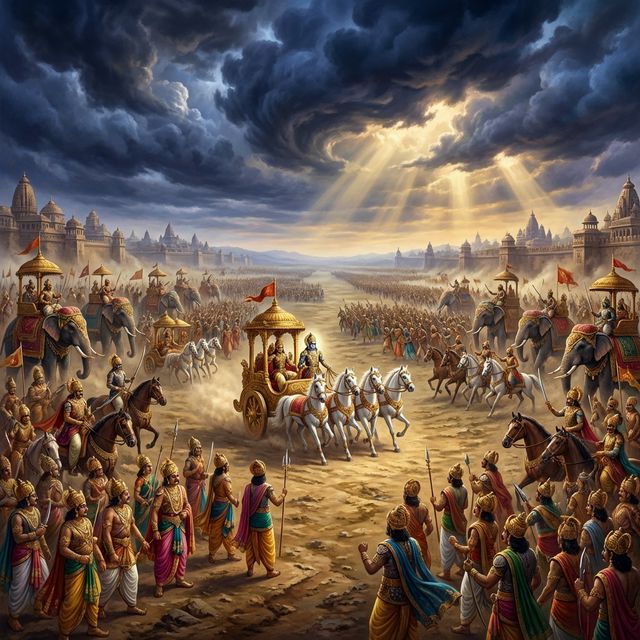
The Gates of Heaven Stand Open
Duryodhana tells his kings that dying well is winning, and Krishna drives Arjuna through what that costs
The Third Part of the Day
It was the seventeenth day, and Sanjaya, telling it afterwards to a blind king in a hall in Hastinapur, kept coming back to the same accounting. Arjuna was breaking the samsaptakas. Bhima was breaking the Kurus. Karna was breaking the Pancalas. Three men, three armies, and the field between them emptying out.
Yudhishthira had already gone back about two miles with his wounds to sit down and breathe. Duryodhana had been unhorsed by Dhrishtadyumna and carried off by one of his brothers with his standard cut and his weapons cut and no car under him. The elephant device worked in jewels, the golden Angadas on the flagstaff, all of it lay in the dust where the prince of the Pancalas had put it.
He came back. That is the thing about Duryodhana that the epic never lets you forget. He came back, and he went looking not for a physician but for Karna.
He found him with Shalya, the ruler of the Madras, who was holding Karna's reins that day and holding his temper with them, and with the other lords of Earth who had come to Kurukshetra on the Kaurava side and were still alive at noon on the seventeenth day. Kings of countries that would have no kings by tomorrow evening. Men who had brought elephants and drummers and their own poets.
Sanjaya says he addressed them. Not commanded, not pleaded. Addressed, the way a host addresses guests when the thing he has invited them to has finally arrived.
The sun stood a little past the meridian. A third part of the day still remained. The Earth along the track of Karna's car was strewn with fallen elephants and steeds and men, and the wind coming across it carried what such a wind carries.
Duryodhana looked at that field, and what he saw there was not a defeat.
Without Seeking Hath This Occasion Arrived
"Without seeking hath this occasion arrived," Duryodhana said, "when the gates of heaven have become wide open."
That is how he began. Not with the kingdom, not with the insult at the dice, not with Draupadi or the thirteen years or any of the grievances he had been feeding for half his life. He began with a door.
"Happy are those Kshatriyas, O Karna, that obtain such a battle."
Understand what he was saying to men standing in that particular place at that particular hour. The whole apparatus of a kshatriya's life, the training from boyhood, the bow, the vow, the horses bred for it, exists for an encounter that most warriors never actually get. Skirmishes, cattle raids, the punishment of some minor chief. What the books promise is a meeting with an enemy of equal weight, and the books are honest that such a meeting is rare.
"Brave heroes fighting in battle with brave Kshatriyas equal to them in might and prowess obtain great good, O son of Radha. The occasion that hath come is even such."
Then he set out the two outcomes, and he set them out as though they were both prizes.
"Either let these brave Kshatriyas, slaying the Pandavas in battle, obtain the broad Earth. Or let them, slain in battle by the foe, win the blessed region reserved for heroes."
There is no third clause. He does not say, and if we survive without winning. He does not say, and if the war goes on another month. Earth or heaven, and no other door out of the afternoon, and he offered it to them as good news.
It was good news, by the reckoning of the order he belonged to. That is what makes the speech terrible rather than merely mad. Every man listening had been raised on the same arithmetic. Duryodhana was not lying to them. He was reminding them of what they had all agreed was true, at the one moment when believing it would cost them everything.
And the bulls among kshatriyas, hearing him, cheerfully uttered loud shouts.
The Instruments Answer
They beat and blew their musical instruments. Conches, drums, the whole noise a host makes when it has decided something, rolling out over a field covered with the men who had decided it yesterday.
Sanjaya, who was standing where he could see it, does not describe the joy as foolish. He says the force became filled with joy, and he leaves it there, and lets the blind king in Hastinapur do with that what he can.
Into that joy stepped Drona's son.
Ashwatthama had a reason to speak and a reason to be heard. He was the son of the preceptor who had taught both armies, the man who had made Arjuna what Arjuna was, and Drona had died on the fifteenth day sitting in yoga on the terrace of his car with his weapons laid aside, having been told a lie about his son and having believed it. Dhrishtadyumna had taken him by the hair and cut his head off while he sat there unarmed. Every man on that field knew it. Ashwatthama had been away at the far end of the line when it happened.
"In the very sight of all the troops," he said, "and before the eyes of you all, my father, after he had laid aside his weapons, was slain by Dhrishtadyumna."
He did not shout it. He gladdened them, Sanjaya says, which is a strange verb for what follows.
"By that wrath which such an act might kindle, and for the sake also of my friend, ye kings, I swear truly before you all. Listen then to that oath of mine. Without slaying Dhrishtadyumna I shall not doff my armour. If this vow of mine be not fulfilled, let me not go to heaven."
Then he widened it, in case anyone thought there was a way to protect the Pancala prince.
"Be it Arjuna, be it Bhimasena, or be it anybody else, whoever will come against me I will crush him, or all of them. There is no doubt in this."
Duryodhana had opened the gates of heaven for his army. Ashwatthama, standing next to him, had just wagered his own place on the other side of them against one man's life.
The Gods Come Down to Watch
After Ashwatthama had spoken, the entire Bharata army, united together, rushed against the Pandavas, and the Pandavas rushed against them.
The collision of the leaders of the car divisions was awful. A destruction of life set in at the van of the Kurus and the Srinjayas that resembled, Sanjaya says, what takes place at the last great universal dissolution, when the worlds are folded up and nothing is kept.
And it was at that moment, with the two hosts going into each other, that the sky filled with spectators.
Various superior beings came, with the gods among them, and they brought the Apsaras with them, for the purpose of beholding those foremost of men. They had come for the sight. There is no other reason given.
Filled with joy, the Apsaras began to cover the warriors with celestial garlands, and with diverse kinds of celestial perfumes, and with diverse species of gems. Flowers came down on men who were killing each other. Soft winds bore those excellent odours to the nostrils of the foremost of the warriors, and the warriors, having smelt those perfumes carried to them on the wind, engaged in battle once more, and striking one another, began to fall down on the Earth.
Read that sequence carefully, because the order of it is the whole of it. The perfume arrives. The men breathe it. The men fight harder. The men fall.
Strewn with celestial flowers, and with beautiful shafts equipped with wings of gold, and with many of the foremost of warriors, the Earth looked beautiful, Sanjaya says, like the firmament bespangled with myriads of stars.
That is the image the epic chooses for a killing field at midafternoon on the seventeenth day. Not a slaughterhouse. A night sky. The bodies are the stars.
Then, in consequence of the cheers coming from the welkin and the noise of the musical instruments, the passage at arms became exceedingly fierce, with the twang of bows in it and the clatter of car wheels and the shouts of men, and above it the applause of the gods, who could not be hurt by any of it and had come a long way to see.
Arjuna Cannot Find His Brother
Across the field, Arjuna had just finished with Ashwatthama.
He had cut the son of Drona's bow and standard and umbrella and banners and car and dart and mace, and put calf toothed arrows deep into his shoulder, and Ashwatthama had gone down in a swoon against his own flagstaff and been carried off insensible by his driver. Before that Arjuna had exterminated the wing and the further wing of the samsaptakas, ten thousand kshatriyas and then the Kambojas and the Yavanas and the Sakas after them.
He had won everything in front of him, and he looked around and could not see his brother.
"Behold, O Krishna of mighty arms," he said, "the Pandava army is flying away. Behold, Karna is slaying our great car warriors in this battle."
Then the thing that was actually frightening him.
"I do not see king Yudhishthira the just. Nor is the standard of Dharma's son, foremost of warriors, visible."
A standard is how a man is found on a field of that size. It is carried high for exactly this reason. Yudhishthira's was not there, and Arjuna did not know that his eldest brother had gone two miles to the rear with his wounds, and the arithmetic he could do from where he stood had only bad answers in it.
"The third part of the day still remaineth, Janardana. No one amongst the Dhartarashtras cometh against me for fight."
He had beaten everyone who would face him, and it had bought him nothing he wanted.
"For doing, therefore, what is agreeable to me, proceed to the spot where Yudhishthira is. Beholding Dharma's son safe and sound with his younger brothers in battle, I will again fight with the foe, O thou of Vrishni's race."
He was asking to be taken to see that his brother was alive, and he was promising, like a man bargaining with himself, that he would go straight back to work afterwards.
Krishna turned the white horses and went, toward the place where Yudhishthira and the Srinjaya car warriors were fighting with the enemy, making death their goal.
Behold the Weapons
They had to cross the field to get there, and while they crossed it Krishna began to talk.
He did not comfort Arjuna and he did not hurry him. He pointed at things.
"Behold, O Partha, how great and awful is this carnage, O Bharata, of Kshatriyas on Earth for the sake of Duryodhana."
That is the sentence the rest hangs from. For the sake of Duryodhana. Then, having named the cause, Govinda spent the whole ride naming the effects, one by one, and he began with the weapons, because the weapons were what these men had loved.
"Behold the gold backed bows of slain warriors, as also their costly quivers displaced from their shoulders. Behold those straight shafts equipped with wings of gold, and those clothyard arrows washed with oil and looking like snakes freed from their sloughs."
Washed with oil. Someone had prepared them the night before, in a tent, with care.
"Behold those scimitars, decked with gold and having ivory handles, and those displaced shields embossed with gold. Behold those lances decked with gold, those darts having golden ornaments, and those huge maces twined round with gold. Behold those swords adorned with gold, those axes with golden ornaments, and the heads of those battle axes fallen off from their golden handles."
The gold keeps coming back. Every line of the catalogue has gold in it, because everything a kshatriya carried was made beautiful before it was made deadly, and none of that beauty is doing anybody any good now.
"Behold those iron Kuntas, those short clubs exceedingly heavy, those beautiful rockets, those huge bludgeons with spiked heads, those discs displaced from the arms of their wielders, and those spears used in this dreadful battle."
And then the line that turns an inventory into a horror.
"Endued while living with great activity, warriors that came to battle having taken up diverse weapons are lying, though deprived of life, as if still alive."
Every man on that ground still had his hand where he had put it. Nothing had been let go of.
An Altar Strewn With Extinguished Fires
Then Krishna moved from the weapons to the men, and did not soften the transition.
"Behold thousands of warriors lying on the field, with limbs crushed by means of maces, or heads broken by means of heavy clubs, or torn and mangled by elephants and steeds and cars."
The field, he said, was covered with shafts and darts and swords and axes and scimitars and spiked maces and lances and iron Kuntas and battle axes, and with the bodies of men and steeds and elephants, hacked with many wounds, covered with streams of blood, deprived of life.
And then, in the middle of that, he used a word that stops the passage cold.
"The Earth looks beautiful, O Bharata, with arms smeared with sandal, decked with Angadas of gold and with Keyuras, and having their ends cased in leathern fences."
Beautiful. He says it deliberately and he says it again. Arms that had been perfumed with sandalwood paste that morning, still wearing their armlets, still wearing the leather guard against the bowstring, lying by themselves on the ground.
"With hands cased in leathern fences, with displaced ornaments, with severed thighs looking like elephants' trunks of many active warriors, with fallen heads decked with costly gems and earrings, of heroes having large expansive eyes, the Earth looks exceedingly beautiful."
Krishna is not being cruel here and he is not being ironic. He is showing Arjuna the exact thing that men fight for, which is splendour, and showing it to him in pieces, still splendid, with nobody inside it.
"With headless trunks smeared all over with blood, with severed limbs and heads and hips, the Earth looks, O best of the Bharatas, like an altar strewn with extinguished fires."
That is the sentence to carry away. An altar. The place where offerings are made, after the rite is finished and the flames have gone out and there is nothing left on the stone but ash and the smell of what was burned.
The war had been called a sacrifice by both sides since before it started. Krishna, driving through the middle of it, agreed with them, and finished the metaphor for them.
The Furniture of Kings
He went on, and the catalogue widened out from the men to everything the men had brought with them.
"Behold those beautiful cars with rows of golden bells, broken in diverse ways, and those slain steeds lying scattered on the field, with arrows yet sticking to their bodies. Behold those bottoms of cars, those quivers, those banners, those diverse kinds of standards, those gigantic conchs of car warriors, white in hue and scattered all over the field."
Every one of those conches had a name and a history and a man who blew it at the start of the day.
"Behold those elephants, huge as hills, lying on the Earth with tongues lolling out, and those other elephants and steeds deprived of life and decked with triumphal banners."
Decked with triumphal banners. Somebody had dressed those animals for a victory before leading them out.
"Behold those housings of elephants, and those skins and blankets, and those other beautiful and variegated and torn blankets. Behold those rows of bells torn and broken in diverse ways in consequence of falling elephants of gigantic size, and those beautiful goads set with stones of lapis lazuli, and those hooks falling upon the ground. Behold those whips adorned with gold and variegated with gems, still in the grasp of slain horsemen, and those blankets and skins of the Ranku deer falling on the ground, which had served for seats on horseback."
Still in the grasp. Krishna keeps noticing the hands.
"Behold those gems for adorning the diadems of kings, and those beautiful necklaces of gold, and those displaced umbrellas and yak tails for fanning."
The umbrella and the yak tail whisk are not weapons. They are the marks of sovereignty. A king does not carry them himself, he has men to hold them over him, and they were on the ground now with nobody underneath.
"Behold the Earth, miry with blood, strewn with the faces of heroes, decked with beautiful earrings and well cut beards, and possessed of the splendour of the moon and stars."
Men had trimmed those beards before riding out. Krishna made Arjuna look at the faces last.
Those in Whom Life Is Not Yet Extinct
And then, having gone through everything that was finished, he turned Arjuna's eyes to what was still happening.
"Behold those wounded warriors in whom life is not yet extinct, and who, lying all around, are uttering wails of woe. Their relatives, O prince, casting aside their weapons, are tending them, weeping incessantly."
The weapons go down. That is the first thing a man does when the wounded one on the ground turns out to be his own.
"Having covered many warriors with arrows and deprived them of life, behold those combatants, endued with activity, longing for victory and swelling with rage, are once more proceeding for battle against their antagonists. Others are running hither and thither on the field."
Then the water.
"Being begged for water by fallen heroes, others related to them have gone in quest of drink. Many, O Arjuna, are breathing their last meanwhile."
The man goes to find water for his brother. While he is gone, his brother dies. That is one sentence in Ganguli and it is the truest sentence in the section.
"Returning, their brave relatives, seeing them become senseless, are throwing down the water they brought and are running wildly, shouting at one another. Behold, many have died after having slaked their thirst, and many, O Bharata, are dying while drinking."
Dying while drinking. Not before the water came and not after it did any good. Exactly in the middle.
"Others, though affectionate towards relatives, are still seen to rush towards foes in great battle, deserting their dear relatives."
And the last of them, which is the picture Krishna leaves with Arjuna before he stops describing and starts pointing.
"Others again, O best of men, biting their nether lips, and with faces rendered terrible in consequence of the contraction of their brows, are surveying the field all around."
Men standing still in the middle of it with their teeth in their own lips, turning their heads, looking for whoever did this. Arjuna, sitting behind Krishna on a car crossing that same ground, was doing the same thing, and had been all afternoon, and had not yet found his brother.
Proceed, Proceed
While Vasudeva was saying all this, he was driving. He had not slowed the horses once.
And Arjuna, who had beheld the king in that great battle at last, was not listening the way the passage deserves to be listened to. He kept urging Govinda on.
"Proceed. Proceed."
That is all he says in the whole of the second half of the section. Two words, repeated. Krishna had unrolled the entire ruin of the kshatriya order in front of him, the gold and the arms and the water carriers and the extinguished fires, and Arjuna wanted to get to his brother.
So Madhava, having shown the field of battle to Partha, went quickly, and spoke once more, slowly this time, and now he was not describing the dead.
"Behold those kings rushing towards king Yudhishthira. Behold Karna, who resembles a blazing fire, on the arena of the battle. Yonder the mighty bowman Bhima is proceeding to battle. They that are the foremost among the Pancalas, the Srinjayas and the Pandavas, they that have Dhrishtadyumna for their head, are following Bhima. The vast army of the enemy is again broken by the rushing Parthas. Behold, O Arjuna, Karna is trying to rally the flying Kauravas."
Then the one that mattered, because of an oath sworn a few hours earlier in front of a hundred kings.
"Resembling the Destroyer himself in impetuosity, and Indra himself in prowess, yonder proceedeth Drona's son, O thou of Kuru's race, that hero who is the foremost of all wielders of weapons. The mighty car warrior Dhrishtadyumna is rushing against that hero. The Srinjayas are following the lead of Dhrishtadyumna."
And last, flatly, the way a driver reports the road ahead.
"Behold, the Srinjayas are falling."
Thus did the invincible Vasudeva describe everything unto the diadem decked Arjuna.
Then, Sanjaya said, commenced a terrible and awful battle. Loud leonine shouts arose as the two hosts encountered each other, making death their goal, exactly as Duryodhana had told them at noon that they should want to.
Even thus, O lord of Earth, in consequence of thy evil counsels, did that destruction set in on Earth, of both thy warriors and those of the enemy.
Dharma Lesson
Duryodhana is not lying to his kings. By the code every man on that field was raised on, a battle against equals really is the rarest gift a kshatriya can receive, and he offers it honestly. What the epic does is let him finish the speech and then drive a chariot slowly across the ground where the offer is being accepted. The gold is still on the bows, the sandal paste is still on the severed arms, the whips are still in the hands of dead horsemen, and a man is running back with water to a brother who has already died. Krishna calls that field beautiful, and he means it, and he also calls it an altar with the fires gone out. Both descriptions are accurate. A creed can be perfectly coherent and still leave nothing standing.