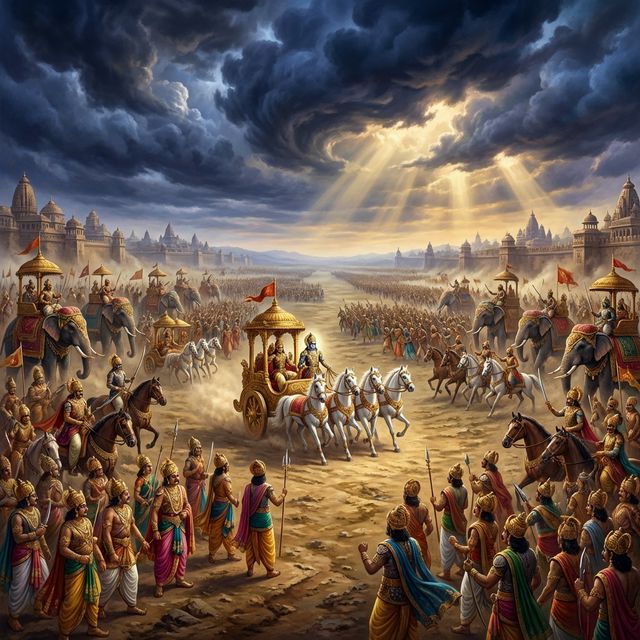
Arjuna Rides Out for Karna
The car is yoked again, the omen birds go on ahead, and the field between Arjuna and Karna breaks into duels
The Car Made Ready Again
Sanjaya was telling it to Dhritarashtra in the hall at Hastinapura, and this was the part he had come to: the seventeenth day of the war, some hours after noon, with Karna commanding the Kaurava army and Yudhishthira lying wounded in his tent behind the lines.
Arjuna had just come out of the worst quarter of an hour of his life. He had gone back to see his brother, had been reproached for coming, had drawn a sword on him over a word about Gandiva, had been stopped by Krishna, and had ended lying at Yudhishthira's feet asking to be forgiven. The king had forgiven him and had given him an order instead. Go and slay Karna.
So Arjuna turned to Govinda with a cheerful heart and spoke like a man giving instructions for an ordinary errand.
"Let my car be once more equipped and let my foremost of steeds be yoked to it. Let all kinds of weapons be placed upon that great vehicle. The steeds have rolled on the ground. They have been trained by men skilled in horse lore. Let them be brought quickly along with the other equipment of the car, and decked in their trappings. Proceed quickly, Govinda, for the slaughter of the Suta's son."
Krishna did not do it himself. He called Daruka, who was his own charioteer and drove for him on the days when he was not driving for Arjuna, and told him to do everything that Arjuna had said. Daruka yoked the horses to that car covered with tiger skins, and when it was ready he came and reported the fact, formally, as a servant reports.
Then the Brahmanas were brought to perform the propitiatory rites and to utter their benedictions over him, and Arjuna took his leave of Yudhishthira, and the king who had been shouting at him an hour before blessed him for victory. And Arjuna climbed up onto the car and had it turned toward Karna's.
Sanjaya said that when men saw that car begin to move, all creatures on the field regarded Karna as already slain.
The Birds That Went in Front
All the points of the compass became serene.
That is how Sanjaya described the weather of the next few minutes, and then he described the birds, because the birds were the omen and every man on that field knew how to read them.
Kingfishers and parrots and herons wheeled around the son of Pandu. A large number of beautiful and auspicious birds of the kind called Pung flew about him uttering their cries, and the cries were cheerful, and their timely appearance was the sort of thing that makes a man put on more speed. Then the other kind came. Terrible kankas and vultures, cranes and hawks and ravens, tempted by the prospect of food, went out in advance of his car and flew on ahead of him in the direction he was travelling.
Both flights meant the same thing. The first said that the gods were with him. The second said that there would shortly be a great deal to eat where he was going, and that it would be Kaurava.
And in the middle of all that, with the omens reading his way and the army opening for him, a copious perspiration covered Arjuna's body.
His anxiety became very great. He had sworn in front of his brother, touching his weapons, that he would kill Karna before the day ended or fall on the earth killed by him, and now the thing was in motion and could not be called back, and he was riding along thinking about how it was to be done.
Krishna had the reins and his back to him, and saw it anyway.
"Wielder of Gandiva," he said, "save thee there exists no other man that could vanquish those whom thou hast vanquished with this bow of thine. We have seen many heroes, endued with prowess like that of Sakra, who attained to the highest regions by encountering thy heroic self in battle. Who else, that is not equal to thee, would be safe and sound after encountering Drona and Bhishma and Bhagadatta, and Vinda and Anuvinda of Avanti, and Sudakshina the chief of the Kambojas, and Srutayudha of mighty energy? Thou hast celestial weapons, and lightness of hand, and might, and thou art never stupefied in battle. Thou hast also that humility which is due to knowledge."
He was steadying him the only way that works on a man of that kind. He was reading his record back to him.
Do Not Disregard Karna
Then, having built him up, Krishna took him down again, which was the purpose of the whole speech.
"I must, however, say that which is beneficial to thee. Do not, mighty-armed one, disregard Karna, that ornament of battle."
Arjuna had heard Karna abused for thirteen years, in his own camp, by men who had never once stood in front of him. What Krishna gave him instead was a measurement.
"Karna is possessed of might. He is proud and accomplished in weapons. He is a maharatha. He is conversant with all modes of warfare and well acquainted with all that suits place and time. What need is there of saying much? Hear in brief, son of Pandu. I regard the mighty car-warrior Karna as thy equal, or perhaps thy superior. With the greatest care and resolution shouldst thou slay him in great battle.
"In energy he is equal to Agni. As regards speed, he is equal to the impetuosity of the wind. In wrath, he resembles the Destroyer himself. Endued with might, he resembles a lion in the formation of his body. He is eight ratnis in stature. His arms are large. His chest is broad. He is invincible. He is sensitive. He is a hero, and again, the foremost of heroes. He is exceedingly handsome. Possessed of every accomplishment of a warrior, he is a dispeller of the fears of friends."
The man who wanted Karna dead more than anyone else alive was giving an honest inventory of him, and he did not leave out that Karna was handsome, or that he was easily wounded in his feelings, or that men on his own side stopped being afraid the moment he arrived.
Then the other half of it.
"Engaged in the good of Dhritarashtra's son, he always hates the sons of Pandu. No one, not even the gods with Vasava at their head, can slay the son of Radha, save thee, as I think. Slay, therefore, the Suta's son today. Despatch to Yama's presence that foremost of car-warriors whose death is near. Slay that tiger among men, that active and proud Karna, who hath a sword for his tongue, a bow for his mouth, and arrows for his teeth. Slay the brave Karna in battle, like a lion slaying an elephant."
The horses went on carrying them toward him the whole time he was speaking.
The Seventeenth Day, Counted Back
"Today is the seventeenth day, Bharata, of this terrible massacre of men and elephants and steeds."
Krishna said it the way a bookkeeper reads out a date, and then he went through the account.
At the outset the host that belonged to the Pandavas had been vast, and it had been very much reduced. The Kauravas had been numerous too, teeming with elephants and steeds, and they had been nearly exterminated. Ten of those days had belonged to Bhishma. Conversant with the highest weapons, he had shrouded the Cedis, the Pancalas, the Karushas, the Matsyas and the Kaikayas with shafts and deprived them of life. The welkin had been filled with the gold-winged arrows that issued out of his bow. He slew thousands of car-warriors at a time and a hundred thousand men and elephants in all, and made the terraces of numberless cars empty, and having assumed the form of Rudra in battle he did it all to rescue Suyodhana, who was sinking in a raftless sea. At last Shikhandi, protected by Arjuna, slew that tiger among men with straight shafts, and the grandsire was lying on his bed of arrows while they spoke.
Five days had belonged to Drona. He made an impenetrable array, he protected Jayadratha, he was fierce as the Destroyer in the fighting by night, and he consumed innumerable combatants with his arrows until he encountered Dhrishtadyumna and attained to the highest end. Krishna was careful about the mechanism of it. Drona could be slain by the son of Prishata only because Arjuna, on that day, had held in check the whole Dhartarashtra force headed by the Suta's son.
Then Jayadratha, killed inside the ring of an entire army by a man who had promised to do it before sunset.
"When Bhishma and Drona have been slain," Krishna said, "the terrible Dhartarashtra host may be regarded to have lost all its heroes. With its foremost warriors slain, with its steeds and cars and elephants destroyed, the Bharata army looketh today like the firmament reft of the Sun, the Moon, and the stars. The remnant of that grand master now consists of only five great car-warriors: Ashwatthama, Kritavarma, Karna, Shalya, and Kripa."
Five men. That was what was left of what had marched out of Hastinapura. And Krishna went down the five naming the reasons Arjuna had to spare four of them: his preceptor's son, and Kripa to whom the honour due to a teacher was owed, and Kritavarma who was kin on the mother's side, and Shalya, his own uncle, the ruler of the Madras.
"I ask thee, do thou, with keen shafts, slay Karna today with speed."
The Reasons, and the Raft
Then Krishna gave the reasons, in order, the way a man lays out the items of a debt.
The attempt made in the night to burn Kunti with all her children in the house at Varnavata: the wicked-souled Karna was the root of it. The conduct Suyodhana adopted toward them after that match at dice: in all those acts of injury Karna had been the leader. And Abhimanyu, the bull-necked son of Subhadra, surrounded by six mighty car-warriors of cruel heart. Karna had been unable to stay in the battle before that boy's face, mangled and bathed in blood, and had turned his back on the field, and had come back at Drona's word and cut Abhimanyu's bow from behind so that five men could kill him. When it was done, grief entered the heart of everyone on both sides. Two men on that field laughed, and Karna was one of them.
And there were the words in the assembly hall, which Krishna repeated exactly, sitting in front of the husband they had been said to.
"The Pandavas are dead. They have sunk into eternal hell. Choose other lords now. Enter now the abode of Dhritarashtra as a serving woman, for thy husbands are no more. Thou art the wife of men that are slaves, princess of Pancala, and thou art thyself a slave. It is evident that they are all sesame seeds without kernel."
"Let gold-decked shafts whetted on stone, shot by thee," Krishna said, "quench the fire of those words and all the other wrongs that that wicked-souled wight did unto thee."
Then he turned from the old debts to what was happening a mile in front of the horses, because that was the urgent thing.
The Bhargava weapon was out. Karna had it from Rama of Bhrigu's race, and its awful form was displayed and blazing with its own energy, surrounding the whole army, and the arrows out of his bow were coursing thick as a swarm of bees. The Pancalas had never turned their faces from Bhishma or from Drona. They were flying away in all directions now, and Karna was taking their lives in hundreds as a blazing fire takes the lives of myriads of insects. And Bhima, of unappeasable wrath, encompassed by the Srinjayas, was in the middle of that, afflicted by Karna with keen shafts.
"It behoveth thee to become a raft and rescue those brave warriors, those great bowmen, that are sinking in the raftless ocean represented by Karna. If neglected, Karna will exterminate the Pandavas, the Srinjayas and the Pancalas, like a neglected disease whose germ has entered the body."
Today
Hearing that, Vibhatsu soon cast off his anxiety and became cheerful.
He rubbed the string of Gandiva and stretched it, and held the bow for the destruction of Karna, and answered.
"With thee for my protector, Govinda, and when thou that art acquainted with the past and the future art gratified with me today, victory is sure to be mine. Aided by thee I can destroy the three worlds assembled together. What need be said of Karna then? I see the Pancala host is flying away. I see also Karna careering fearlessly in battle. I see too the bhargava weapon careering in all directions, invoked by him like the puissant thunder invoked by Shakra. This is that battle in which Karna will be slain by me."
Then came the litany, and every clause of it began with the same word.
Today Dhritarashtra would curse that intelligence of his by which he had installed Duryodhana, undeserving of sovereignty, upon a throne. Today Duryodhana would be made to call to mind the words Krishna had spoken in his own hall for the sake of peace. Today the son of Subala would learn that Arjuna's shafts were the dice, that Gandiva was the box for throwing them, and that his car was the chequered cloth. Today the earth would drink the blood of that Suta's son who in battle condemns all other men on earth.
Karna had sworn that he would not wash his feet until he had slain Phalguna. Arjuna proposed to falsify that vow by throwing his body down from his car with straight shafts.
"They that were on that occasion sesame seeds without kernel," he said, "will today become seeds with kernel, after the fall of the Suta's son. Today I will slay Karna in battle, as also his son, and give joy to Bhima and the twins and Satyaki. Today I will pay off my debt to the Pancalas, with Dhrishtadyumna and Shikhandi. Today I will free myself from the debt I owe to all bowmen, to my own wrath, to the Kurus, to my shafts, and to Gandiva. Today I will be freed from the grief that I have cherished for thirteen years.
"My palms bear these marks of arrows, and this excellent and outstretched bow with arrow fixed on the string. On each of the soles of my feet occurs the mark of a car and a standard. When a person like me goeth forth to battle, he cannot be vanquished by any one."
Having said that, with his eyes red as blood, he went quickly to battle, for two purposes: to rescue Bhima, and to cut the head from Karna's trunk.
A Baneful Shower Out of Season
"In that awful and fathomless encounter," Dhritarashtra asked, "when Dhananjaya proceeded for battle, how, indeed, did the fight occur?"
The innumerable divisions of the Pandava army, said Sanjaya, decked with lofty standards and united together, began to roar aloud, drums and other instruments constituting their mouth, like masses of clouds at the close of summer.
The battle that ensued resembled a baneful shower out of season, cruel and destructive of living creatures. Huge elephants were its clouds. Weapons were the water they were to pour. The peal of musical instruments, the rattle of car wheels and the noise of palms constituted their roar. Diverse weapons decked with gold formed their flashes of lightning, and arrows and swords and cloth-yard shafts constituted their torrents of rain. Blood flowed in streams. Many car-warriors united together encompassed one car-warrior and despatched him to Yama's presence. Or one foremost of car-warriors despatched many adversaries united together. One rider, with a single elephant, despatched car-warriors and horsemen at once.
Then the field sorted itself into pairs, as it always did once the lines had properly met, and Sanjaya listed them for the blind king the way a man lists the couples at a wedding.
Kripa and Shikhandi encountered each other. Satyaki proceeded against Duryodhana. Srutasravas was engaged with Drona's son. Yudhamanyu was engaged with Chitrasena. Sahadeva rushed against Shakuni, the king of the Gandharas, like a hungry lion against a mighty bull. Nakula, conversant with all modes of warfare, assailed Kritavarma. Dhrishtadyumna, the son of Yajnasena and king of the Pancalas, attacked Karna, the commander of the Kaurava army, with all his forces. And Dushasana, with the swelling host of the samsaptakas, fiercely attacked Bhima, that warrior of irresistible impetuosity.
Two of the pairs were sons.
The youthful Satanika, son of Nakula by the princess of Pancala, rushed against the youthful Vrishasena, son of Karna, shooting showers of shafts, and the son of Karna struck him with many arrows in return. And the great Srinjaya car-warrior Uttamauja, one of the two Pancala princes whom Dhrishtadyumna had appointed at the opening of the war to guard the wheels of Arjuna's chariot, was engaged with Karna's son Sushena.
Everywhere along that line the fathers had found the fathers, and in two places their children had found each other.
The Head of Sushena
The heroic Uttamauja, putting forth his strength, struck the son of Karna and cut off his head.
It fell down on the earth, Sanjaya said, filling the earth and the welkin with a loud noise, which is his way of saying that the whole field heard the armies react to it.
Karna saw the head of Sushena lying on the ground. He was in the middle of a duel with Dhrishtadyumna and he was the commander of an army in a battle that was going badly, and for the length of a breath he was only a father looking at part of his son in the grass. He became filled with grief.
The grief lasted about as long as it takes to fit an arrow to a string. Then, in rage, he cut off the steeds, the car and the standard of his son's slayer with many keen shafts, and left the man standing on the ground in the middle of a battle.
Uttamauja did not stop. On foot, in the press, he pierced the steeds of Kripa with his keen shafts and cut down with his bright sword the warriors who were protecting Kripa's flanks, and then, having no vehicle of his own any longer, he quickly climbed up onto the car of Shikhandi, who was fighting Kripa a few yards away.
And Shikhandi, standing on his own car with his bow in his hand and the old preceptor in front of him without horses or wheels, did not shoot.
Beholding Kripa deprived of his car, he wished not to strike him with his shafts. That is the whole of the reason Sanjaya gives, and it is enough. Kripa was the teacher of both houses, the man who had taught the sons of Pandu and the sons of Dhritarashtra their first lessons in arms while they were children in one courtyard, and he was standing in the wreck of his chariot, and Shikhandi let him stand. Then the son of Drona came across and covered the car of Kripa with his own and drew his mother's brother out of that place, Sanjaya said, like a bull sunk in a mire.
So in one small square of that field a Pancala prince killed a man's son; and the father took his revenge for it and stopped there; and a third man declined a shot he was entitled to; and a fourth pulled his uncle out of the mud. Meanwhile Bhima, the son of the Wind-god, clad in golden mail, went on scorching the troops of Dhritarashtra's sons with his keen arrows like the mid-day sun scorching everything in the summer season.
Bear Me Into the Midst of Them
Bhima was fighting alone, encompassed by innumerable foes, and what he said to his driver was that they should go further in.
"Bear me into the midst of the Dhartarashtra host. Proceed, charioteer, with speed, borne by these steeds. I will despatch all these Dhartarashtras to the presence of Yama."
The charioteer's name was Visoka. He had driven Bhima for years and was one of the few men in either army who could be spoken to in that voice and answer in an ordinary one, and he took the car quickly and with great impetuosity to the spot from which his master wished to do the slaughtering.
A large number of Kaurava troops advanced against him from all sides with elephants and cars and horse and foot, and began from every side to strike that foremost of vehicles with numerous arrows. Bhima cut all of those advancing arrows out of the air with shafts of his own with golden wings, so that they fell to the earth in two and three fragments. The foremost of Kshatriyas, struck by his shafts, set up a loud wail that resembled the din made by mountains when they are riven with thunder, and then rushed at him again from every side like new-fledged birds toward a tree. He displayed all his vim like the Destroyer armed with a mace at the end of the Yuga, and the Bharata host, mangled and burnt, broke and fled in fear in all directions like masses of cloud scattered by a tempest.
Having done that much, he cheerfully asked his driver two questions, and both of them are worth hearing.
"Ascertain, Suta, whether those assembled cars and standards that are advancing toward me are ours or the enemy's. Absorbed in battle, I am unable to distinguish them. Let me not shroud our own troops with my shafts."
That is the first: a man in the worst of a battle, with his blood entirely up, stopping to be sure of what he is shooting at.
Then the second, and behind it the thing that was actually eating him.
"Beholding hostile warriors and cars and the tops of their standards on all sides, I am greatly afflicted. The king is in pain. The diadem-decked Arjuna also has not yet come. These things, Suta, fill my heart with sorrow. Even this is my grief, that king Yudhishthira the just should have gone away, leaving me in the midst of the enemy. I do not know whether he, as also Vibhatsu, is alive or dead. This adds to my sorrow."
Are These Two Ears of Thine Gone
"Examining all the quivers containing my arrows," Bhima said, "tell me, Suta, ascertaining the matter well, what quantity of arrows is still left on my car, that is, how much of what sort."
Visoka counted, and gave him the inventory.
Of arrows, sixty thousand. Of razor-headed shafts, ten thousand, and of broad-headed ones as many again. Of cloth-yard shafts, two thousand. Of Pradaras, three thousand. What remained, he said, was not capable of being borne by six bullocks if it were placed on carts.
"Shoot and hurl them, learned one, for of maces and swords and other weapons used with the arms alone thou hast thousands upon thousands, as also lances and scimitars and darts and spears. Never fear that thy weapons will be exhausted."
So Bhima looked out over the field and began to say what he could see. The Bharata host was breaking. All the Kauravas, having lost their sense, were running like elephants filled with panic at a forest conflagration, uttering cries of woe.
"Why do those kings fly away?" he said. "It is evident that Savyasaci, that foremost of men, is quickly shrouding that host with his shafts."
And Visoka, who had been watching it for some time, lost patience with him.
"How is it, Bhima, that thou dost not hear the loud twang of the yawning Gandiva stretched by Partha in wrath? Are these two ears of thine gone? All thy wishes, son of Pandu, have been fulfilled. Yonder the Ape is seen in the midst of the elephant force. Behold, the string of Gandiva flashing like lightning amid blue clouds. There the diadem of Arjuna is shining, and the precious jewel upon it, endued with the splendour of the sun. There, behold his conch Devadatta of loud blare and the hue of a white cloud. There, by his side, reins in hand, is Janardana, and behold his discus of solar effulgence, its edge sharp as a razor. There the trunks of huge elephants, cut off by Kiritin, are falling on the earth like trees. Behold four hundred car-warriors and seven hundred elephants slain in this battle by him. Slaughtering the Kurus, thy younger brother is coming toward thy side even like the constellation Citra. All thy wishes are fulfilled. Let thy might, as also the period of thy life, ever increase."
Bhima, standing in the ruin he had made, with sixty thousand arrows still in the car and his brother's banner finally in sight, answered like a king in a hall.
"Since thou tellest me of Arjuna's arrival, I will give thee four and ten populous villages, and a hundred female slaves, and twenty cars, being pleased with thee, Suta, for this agreeable intelligence."
Dharma Lesson
Krishna spends the whole ride telling Arjuna that his enemy is the better man, because a warrior who despises the person he is about to fight is already half beaten. The same hour shows the shape of that respect in miniature: Shikhandi has Kripa carless in front of him and will not loose the arrow, and Karna, having avenged Sushena, cuts away his son's killer's chariot and leaves him alive on the ground. Between the omens and the arrow counts, this stretch of the war is mostly men measuring things accurately - what an enemy is worth, what is left in the quiver, whether the brother they are waiting for has come. The ones who measure honestly are the ones still standing at dusk.