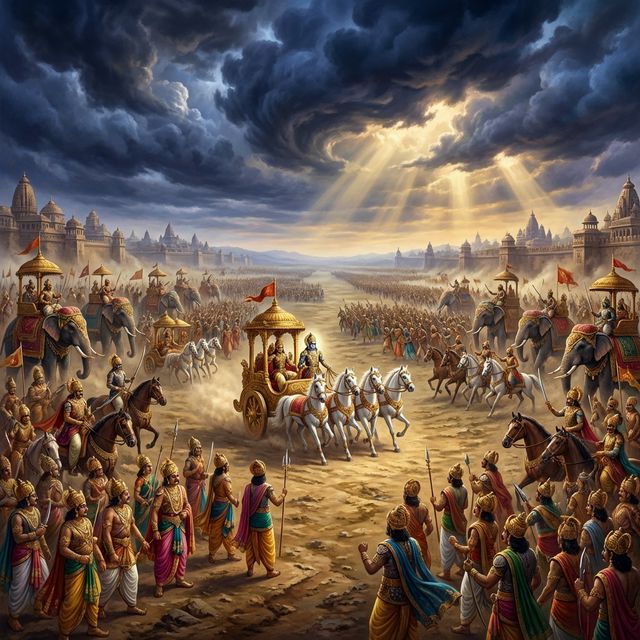
Arjuna Cuts His Way to Karna
An army ordered to tire one man before Karna kills him
The River He Left Behind Him
Sanjaya was telling the seventeenth day to a blind king in a hall at Hastinapura, and he had come to the hour in the afternoon when the two men who had been looking for each other since the war began at last saw each other's standards.
Arjuna had been working the far end of the field. He had slain the four kinds of forces, foot and horse and car and elephant, and when he turned and got his first sight of the angry son of the Suta in that dreadful battle, he had already caused a river to flow behind him.
Sanjaya described it to Dhritarashtra the way a man describes a country he has crossed.
It was tawny with flesh and marrow and bone. Human heads were its rocks and stones. Elephants and steeds made its banks. It was full of the bones of heroic combatants and it resounded with the cries of ravens and vultures. Umbrellas floated on it as swans, or as rafts. It ran bearing away heroes the way a river in flood bears away trees. Necklaces were its assemblage of lotuses and head-gears were its excellent foam, bows and shafts were its fishes, and the crowns of crushed men turned over and over on its surface. Shields and armour made its eddies. Cars were the rafts with which it teemed.
And it could be forded easily by any man who wanted victory. To cowards it was unfordable.
Having made that river, Arjuna spoke to his driver.
"Yonder, Krishna, the standard of the Suta's son is visible. There, Bhimasena and the others are fighting with that great car-warrior. There the Pancalas, afraid of Karna, are flying away. Yonder king Duryodhana, with the white umbrella over his head, looks resplendent beside him while he routs the Pancalas. There Kripa and Kritavarma and Drona's son are protecting the king, themselves protected by the Suta's son. There Shalya, well conversant with holding the reins, looks resplendent on the terrace of Karna's car as he guides it.
"Bear me to that mighty car-warrior. Without slaying Karna in this battle I will never return."
Keshava turned the white horses and went.
The Man Holding the Reins
Shalya, the ruler of the Madras, had been holding Karna's reins since morning. He had taken the work under protest and he did it well and he had spent the day saying things to the man in front of him that no charioteer says to his warrior.
He saw the white steeds coming before Karna did.
"There comes that car-warrior with white steeds yoked to his vehicle and Krishna for his driver, slaying his foes as he comes. There comes the man you were asking about, holding his bow Gandiva. If you can slay him today, great good may be done to us. He comes desiring an encounter with you, killing our chief warriors on the way.
"Avoiding all our warriors, Dhananjaya advances at speed. Judging by his form, swelling with rage and energy, he wants you. Blazing with wrath, Partha will not stop for battle with anybody else, especially now, when Vrikodara is being so much afflicted by you. He has learned that king Yudhishthira the just has been mangled by you and made carless. He has seen the state of Shikhandi and Satyaki and Dhrishtadyumna, and of the five sons of Draupadi, and of Yudhamanyu and Uttamauja, and of the brothers Nakula and Sahadeva. That is why he is coming impetuously on a single car against you.
"I do not behold any arrangements made for his protection, on his flanks or at his rear. He advances alone against you. Look after your success now.
"Go against him, Karna, for there is no other bowman among us who can. You are the equal of Bhishma, of Drona, of Drona's son, of Kripa. There, those kings, those mighty car-warriors of this army, through fear of Arjuna, are flying away and taking no account of one another. Except you there is no man who can dispel the fears of retreating men. All the Kurus have taken you for their refuge and stand depending on you."
Karna heard the whole of it out and answered mildly, which was new.
"You seem now to be in your usual frame of mind, and you are agreeable to me. Do not entertain any fear of Dhananjaya. Behold today the might of my arms and behold my skill."
Fear Enters My Heart Together With Courage
"Single-handed I will today destroy the mighty host of the Pandavas," Karna said, "and those two lions among men, the two Krishnas. I say this truly. I will never return from the field today without slaying those two heroes. Or, slain by them, I shall sleep on the field of battle. Victory is uncertain in battle. Slaying or slain, I shall today achieve my purpose."
"All great car-warriors say that this foremost of car-warriors, even when alone, is invincible," Shalya said. "When he is protected by Krishna besides, who will venture to vanquish him?"
And then Karna, who had spent the war being told what Arjuna was, told Shalya himself, item by item, in the voice of a man reading out an inventory he had memorised long ago.
"As far as I have heard, such a superior car-warrior has never been born on earth. His two arms are never covered with sweat. They never tremble. They are massive and covered with cicatrices. He takes a large number of arrows and shoots them as if they were one, and he sends them two miles, and they always fall on the foe. What warrior on earth is equal to him?
"With Krishna for his ally he gratified Agni at Khandava, and there Krishna obtained his discus and Savyasaci obtained Gandiva, and his terrible car with those white steeds, and two celestial quivers that are never empty, from the God of Fire. In the region of Indra he obtained the conch Devadatta and slew the Kalakeyas. He gratified Mahadeva himself in fair fight and got from him the Pasupata, which can destroy the three worlds. The Regents of the world gave him their weapons. And in Virata's city, moving on a single car, he vanquished all of us and took our cattle and took portions of our garments from us.
"He is protected, again, by Keshava, who is Narayana himself, whose attributes all the world united cannot exhaust in ten thousand years. Beholding the two Krishnas together on the same car, fear enters my heart together with courage. The mountains of Himavat may move from the spot where they stand, but not those two.
"Who else, Shalya, save myself, would proceed against them? Either I shall overthrow those two today, or the two Krishnas will today overthrow me."
Then he began to roar in that battle like a cloud.
Tire Them For Me
Before he went against Arjuna, Karna went to Duryodhana, and was saluted by him, and gave an order to the whole army standing round the king.
He said it to Kripa and to the Bhoja chief Kritavarma, to Drona's son, to the ruler of the Gandharvas and his son, to the preceptors, to his own younger brothers, and to the foot-soldiers and the horsemen and the elephant-riders together.
"Rush towards Achyuta and Arjuna and close up their path all around, and cause them to be tired with exertion, so that, you lords of the earth, I may easily slay those two after you have all mangled them deeply."
"So be it," they said, and went.
What followed was not a duel. It was an army spending itself on one car to blunt it for another man's use.
Like the great ocean receiving all rivers with their tributaries, Arjuna received them. His foes could not see when he fixed his arrows on the string or when he let them go. All that could be seen was men and steeds and elephants falling continually, pierced, deprived of life. Like men with diseased eyes unable to gaze at the sun, the Kauravas could not look at him, with arrows for his rays and Gandiva bent to a circle for his disc.
Drona's son came at him and pierced Dhananjaya with ten shafts and Keshava with three and the four horses with four, and rained arrows on the Ape on Arjuna's banner. Arjuna cut the full-drawn bow in his hands with three shafts, took the head off his driver with a razor-faced arrow, killed the four steeds, cut down the standard, and felled Ashwatthama from his car. The son of Drona stood up on the ground, took another bow bright as the body of Takshaka, decked with gems and gold, strung it where he stood, and went on shooting from close range.
Then Kripa and Kritavarma and Duryodhana closed over Arjuna like clouds shrouding the sun. Arjuna showered Kripa's bow and horses and standard and driver until the old preceptor stood with his weapons destroyed, afflicted with as many thousands of arrows as Ganga's son Bhishma had been on the day of his fall by the same hand. He cut the standard and bow of the roaring king. He destroyed Kritavarma's handsome horses and cut down his standard too.
That vast host broke into a hundred parts, like an embankment washed away by water.
Word From His Brother's Tent
Then Arjuna did something that cost him the ground he had gained. He saw Bhima far off, assailed by many of the foremost warriors of the Kuru army and seeming to sink under the attack, and he turned away from Karna's troops to get him out.
Successive showers of his shafts stood overspread on the sky while others were still killing men below. Filling the welkin with arrows that looked like dense flights of feathery creatures, Dhananjaya became the very Destroyer to the Kurus. With broad-headed arrows, and arrows flat and sharp as razors, and polished cloth-yard shafts, he mangled bodies and cut off heads, and the field was strewn with men cut and mangled, men stripped of armour, men without heads.
Sanjaya reached for the only comparison that would serve. Like the great Vaitarani, which separates the country of the living from the country of the dead, the field became uneven and impassable and unsightly and terrible, heaped with crushed horses and cars and elephants, covered with broken shafts and wheels and axles, with cars that had lost their horses and cars that had lost their drivers.
Four hundred trained elephants, ever-furious, excited with wrath, ridden by warriors cased in mail of golden hue and urged on by their guides with pressure of heels and toes, came at him and fell where they came, struck by the diadem-decked Arjuna, like loosened summits of gigantic mountains with living creatures still on them.
Like the sun piercing masses of cloud, Arjuna's car passed through those dense bodies of elephants. The twang of Gandiva was tremendously loud, like thunder in the sky. The Dhartarashtra army broke like a large vessel on the ocean lashed by a tempest, and the men who had been standing over Bhima left him and turned their faces from the battle.
Then Vibhatsu came up to his brother and stopped there a moment. In the middle of all that they held a short consultation, and what Arjuna had come to say was a piece of news from the camp.
The arrows had been drawn out of Yudhishthira's body. The king was perfectly well.
With Bhima's leave, Dhananjaya went back to his work.
Ten Brothers in Golden Mail
He had not gone far, with the rattle of his car making the earth and the sky resound, when ten heroic warriors surrounded him.
They were sons of Dhritarashtra, all of them younger than Dushasana. Sanjaya named them to their father that way and not by their names, and the old king in the hall would have known what the count meant without being told.
They afflicted Arjuna with their shafts the way hunters afflict an elephant with burning brands, and with their bows outstretched they seemed to dance upon their cars.
The slayer of Madhu, guiding the horses, put all ten of them on the right side of the car. He did it deliberately. He expected that Arjuna would very soon send all of them to Yama's presence, and he was arranging the ground for it.
Seeing the car going off in another direction, the ten young men rushed after it.
With cloth-yard shafts and crescent-shaped arrows, Partha cut off their standards and their steeds and their bows and their arrows and let all of it fall to the earth. Then he took ten broad-headed shafts of great impetuosity, equipped with wings of gold, and cut off their heads.
Sanjaya told his father what those heads looked like as they went. The lips were bitten. The eyes were blood-red with rage. And the faces, he said, looked beautiful, like an assemblage of lotuses.
That is the whole of the notice given to ten princes of the house of Kuru, cased in golden mail, on the seventeenth day. Ten arrows, one apiece.
Having slain them, the slayer of foes continued to proceed.
Thirteen Hundred Elephants of the Mlecchas
Ninety car-warriors came next, who had sworn a terrible oath about the other world, which is to say they had promised each other not to come back. They encompassed Arjuna and pursued him, pouring showers of shafts, while Krishna, not minding them at all, kept urging the white steeds, adorned with ornaments of gold and covered with networks of pearls, straight towards Karna's car.
Arjuna cut down all ninety with their drivers and bows and standards without changing direction. Slain by the diadem-decked one, they fell with their cars like Siddhas falling out of heaven when their merit is used up.
After that the Kauravas came on without counting: cars and elephants and horses together, a large force of Dhritarashtra's sons teeming with struggling men, swelling with foremost of elephants, and it closed around Dhananjaya and stopped him where he was. They shrouded him with darts and swords and lances and spears and maces and scimitars and arrows. Like the sun destroying darkness with his rays, he destroyed that shower of weapons overspread in the sky.
Then the elephant corps came into his flank.
They were Mlecchas, foreigners in the Kaurava host, riding thirteen hundred ever-infuriated elephants, and they had been ordered in at that spot by Duryodhana himself. They afflicted Partha with barbed arrows and Nalikas and cloth-yard shafts and lances and spears and darts and Kampanas and short arrows, and some of the weapons were not shot at all but hurled by the elephants with their tusks.
Phalguna cut that matchless shower out of the air with broad-headed shafts and crescent-shaped arrows of great keenness. Then he struck the elephants themselves, and their standards and banners and riders, like Indra striking mountains with thunderbolts. Afflicted with gold-winged shafts, those huge beasts in their necklaces of gold went down deprived of life, like mountains ablaze with volcanic fires.
Amid the roaring and shouting and wailing of men and elephants and horses, the twang of Gandiva rose over everything. Struck elephants fled in every direction. Horses whose riders had been killed wandered loose. Cars in thousands, empty of riders and steeds, drifted about the field looking like the changeful forms of vapour in the sky.
At that time, said Sanjaya, the might of Arjuna's arms was seen: that alone, in one battle, he vanquished horsemen and elephants and car-warriors who were coming at him from every side at once.
Come To Me
Bhima, seeing his brother ringed by a host of three kinds of forces, abandoned the small unslaughtered remnant of the car-warriors he had been fighting and drove impetuously to the spot where Dhananjaya's car was.
He was not tired. He came into what Arjuna had left with a mace in his hands, and the mace did the rest.
Sanjaya described it as a thing with an appetite. Fierce as the death-night, subsisting upon men and elephants and steeds as its food, capable of crushing walls and mansions and the gates of cities, it descended without stopping on everything within reach of his arms. It slew numberless horses and riders. It crushed men and horses cased in steel armour so that they fell with a great noise and bit the earth with their teeth, bathed in blood, their crowns and bows and lower limbs broken, and supplied all carnivorous creatures with food. Satiated with blood and flesh and marrow, and eating bones as well, that mace became like the death-night, difficult to gaze at.
Having killed ten thousand horses and numberless foot-soldiers, Bhima ran here and there in rage. The Kaurava troops, seeing him mace in hand, thought that Yama himself was among them with his fatal bludgeon. Then, resembling an infuriated elephant, he penetrated the elephant division like a Makara entering the ocean, and inside a very short time he had sent the whole of it to Yama's abode. Elephants with spiked plates on their bodies fell on every side with their riders and standards, like winged mountains.
Then he got back on his car and followed Arjuna at his rear.
What was left of that great host stood almost inactive, cheerless, about to run and not yet running, and Arjuna covered it with life-scorching shafts. Men and steeds and elephants pierced with those showers looked beautiful, Sanjaya said, like Kadamva flowers with their filaments.
The Kauravas gave it up. Judging the touch of Arjuna's arrows unbearable, they fled from the field, deserting Karna as they went and loudly calling on the Suta's son to rescue them. Partha pursued them shooting hundreds of shafts, and Bhimasena and the warriors behind him were glad.
So Dhritarashtra's sons ran to the car of Karna. Sinking as they seemed to be in a fathomless ocean, Karna became an island to them. Like snakes without poison they took his shelter, the way creatures burdened with their own acts take shelter in virtue from fear of death.
And Karna, who was not afraid, said to those men bathed in blood and stuck full of arrows: "Do not fear. Come to me."
Prasena and the Grandson of Sini
Seeing that the Kurus had left the field, Karna reflected a little, set his heart on the slaughter of Partha, and began to draw deep breaths. Then he bent his formidable bow and went at the Pancalas again in the very sight of Savyasaci, because they were what he could reach.
He destroyed the sons of the Pancalas the way a tempest destroys congregated masses of cloud. He felled the driver of the Pancala prince Janamejaya with broad-faced shafts called Anjalikas and then killed his horses. He pierced Satanika and Sutasoma, two of Draupadi's sons, and cut off both their bows. He pierced Dhrishtadyumna with six arrows and, without losing a moment, killed his horses. He killed the horses of Satyaki. Then he killed Visoka, the son of the ruler of the Kaikayas.
At that, Ugrakarman, who commanded the Kaikaya division and had just lost his prince, rushed forward and struck Prasena, a son of Karna, with many shafts of fierce impetuosity, and made him tremble on his car.
Karna cut off the arms and the head of his son's assailant with three crescent-shaped arrows, and Ugrakarman went down from his car like a Sala tree with its branches lopped off with an axe.
So Prasena, alive because his father had covered him, turned on the man whose horses had been killed. Satyaki, the grandson of Sini, was standing on a steedless car. Prasena covered him with many keen arrows of straight course and seemed to dance upon his own car while he did it.
Soon, however, struck by the grandson of Sini, the son of Karna fell down.
His heart filled with rage, Karna addressed that bull among the Sinis from the desire of killing him.
"Thou art slain, O grandson of Sini," he said, and sped at him an arrow capable of slaying all foes.
Shikhandi cut that arrow in the air with three shafts and struck Karna with three more. The fierce son of the Suta cut off Shikhandi's bow and standard with a couple of razor-faced arrows, pierced him with six, and then cut off the head of Dhrishtadyumna's son. He pierced Sutasoma with a very keen shaft.
And Krishna, watching the Pancala princes going down one after another while his own warrior kept driving forward, spoke.
"The Pancalas are being exterminated. Go, Partha, and slay Karna."
Arjuna smiled, and turned the car toward the son of Adhiratha.
Five Who Could Not Shake Him
Stretching Gandiva of loud twang, Arjuna created a darkness with his arrows, and the echoes travelled through the sky until the birds, finding no room left in their own element, took shelter in the caverns of mountains. Bhimasena came on behind him, protecting his rear, and the two of them drove toward Karna, fighting through whoever stood in the way. It took time, and in that interval Karna went on grinding the Somakas.
Five Pancala champions closed on him together, roaring: Uttamauja and the prince Janamejaya, and the enraged Yudhamanyu, and Shikhandi, uniting with Prishata's son Dhrishtadyumna. They pierced him with many shafts and could not shake him off his car, said Sanjaya, any more than the objects of the senses can shake a man of purified soul.
Karna cut off their bows and standards and horses and drivers and banners, struck each of the five with five arrows, and roared like a lion. People became cheerless at the sound, thinking that the earth with her mountains and trees might split at the twang of that bow.
Then he pierced Shikhandi with a dozen keen shafts, and Uttamauja with half a dozen, and Yudhamanyu with three, and Janamejaya with three, and Dhrishtadyumna with three. Vanquished, those five mighty car-warriors stood inactive on the field, gladdening their foes.
The five sons of Draupadi drove in with well-equipped cars and took their maternal uncles out of it, the way men in other vessels rescue shipwrecked merchants from the depths of the sea.
Then Satyaki came back at him, pierced Karna with many shafts made entirely of iron, and put eight into Duryodhana. Kripa and Kritavarma and the king and Karna all four turned on him at once, and that foremost one of Yadu's race fought the four of them like the chief of the Daityas fighting the Regents of the four quarters. The Pancala car-warriors, remounted and clad in mail, closed round him and protected him.
And while that was going on, Dushasana came out fearlessly against Bhima, and the two struck each other like elephants fighting near a she-elephant in her season. Bhima cut off his bow and standard with two razor-headed arrows, put a winged arrow through his forehead, and took the head off his driver. Dushasana took up another bow, held his own reins, and sent a shaft decked with gold and diamonds, irresistible as the stroke of Indra's thunder, into Bhima's body.
Bhima fell on the terrace of his own car with his limbs gone slack and his arms outstretched, like a man deprived of life.
Then he recovered his senses, and began to roar like a lion.
Dharma Lesson
Karna's order was sound generalship and it was also an admission. He asked an entire army to mangle one man deeply so that he could finish him easily, and the army obeyed and was consumed doing it. There is a kind of planning that spends everything a man has in order to arrange a single moment, and Karna spent the Kurus that afternoon the way he had spent everything else he was given. What the day actually showed is that the two men were already alone, and that everyone else on the field was only being used up in the space between them.