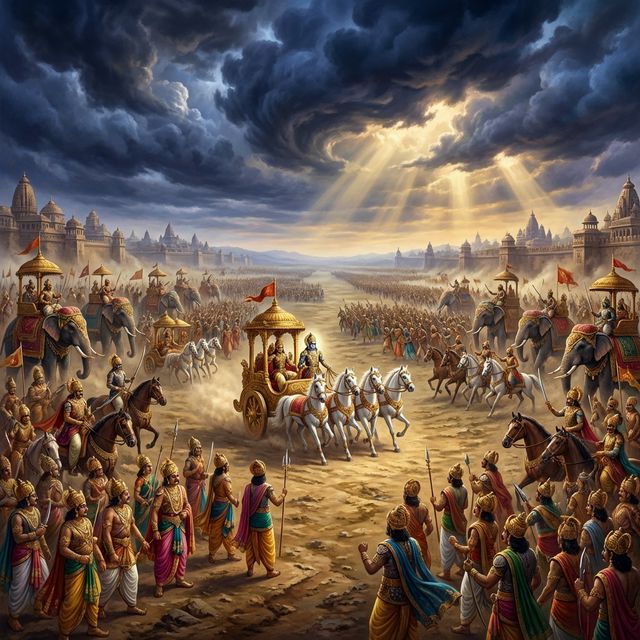
The Vows Before the Final Duel
Karna, Shalya, Krishna and Arjuna each say what they will do when the other man dies
Two Cars Like Two Suns
It was the seventeenth day of the war, and Sanjaya, who watched that field with the sight Vyasa had given him and carried it back every evening to a blind king in a hall, had come to the thing his master had been dreading since the war began.
Karna had just lost his son. Vrishasena, the heir of Anga, had been cut down in front of him by Arjuna a little while before, and Karna, filled with grief and rage, shed tears for the death of that boy. Then he stopped weeping. With eyes red as copper, he turned his car into the face of his enemy and summoned Dhananjaya to battle.
The two cars came together. Both had the effulgence of the sun on them and both were covered with tiger-skins, and when they closed they looked like two suns brought near to each other. Both had white steeds. On one stood Karna with Shalya, the king of the Madras and the finest driver alive, holding the reins on the fore-part of the car. On the other stood Arjuna with Krishna. High over Karna waved the standard with the elephant's rope, made of jewels and strung with rows of little bells, hard as iron, like the noose in the hands of Yama. Over Arjuna waved the ape, jaws wide open, terrible, difficult to look at as the sun.
Both were clad in mail, both had scimitars at their belts, both had white umbrellas and yak-tails to fan them, and the limbs of both were smeared with red sandal-paste. They rushed at each other like two bulls in a cow-pen, like two angry mountains, like two all-destroying Yamas, and filled with wrath they resembled two mighty planets risen for the destruction of the world at the end of the yuga.
The armies did not stand back. The sons of Dhritarashtra closed round Karna without losing a moment, and the Pandavas, headed by Dhrishtadyumna who commanded them, closed round Partha, and the field arranged itself into a ring. Thousands of men slapped their armpits and waved their garments in the air, and in all that noise a doubt entered the heart of every man there as to which of the two would live until evening.
Sanjaya described what he was watching in the only language that fitted it. Karna, he said, became the stake of your army in that battle, and Partha became the stake of the Pandavas. The soldiers of both sides were members of that assembly and had come to be the spectators of the game. As regards the parties engaged in it, either victory or defeat was certain.
The Worlds Take Sides
In the sky, said Sanjaya, differences and disputes arose among the creatures there, accompanied with revilings, on the subject of Karna and Arjuna. All the inhabitants of the world were heard to differ among themselves. The gods, the danavas, the gandharvas, the pishacas, the snakes and the rakshasas adopted opposite sides.
He gave the roll as he heard it called.
The welkin with all its stars became anxious on Karna's account, while the wide earth became anxious on Partha's account, like a mother for her son. The rivers and the seas and the mountains, the trees, the deciduous plants and the herbs took the side of the diadem-decked Arjuna. The asuras, the yatudhanas, the guhyakas, and the ravens and other rangers of the sky, sided with Karna.
All the gems and precious jewels went with Arjuna, and the four Vedas with the histories as the fifth, and the Upavedas, and the Upanishads with all their mysteries. Vasuki went with him, and Takshaka, and all the great snakes endued with poison, and the Nagas, and Airavata with his children, and the offspring of Surabhi. The smaller snakes all sided with Karna. Wolves and wild stags and every auspicious animal and bird wanted victory for Partha.
The Vasus, the Maruts, the Sadhyas, the Rudras, the Vishvedevas and the Ashvins, and Agni and Indra and Soma and Pavana, and the ten points of the compass, became the partisans of Dhananjaya, while all the Adityas sided with Karna. The vaishyas, the shudras, the Sutas, and those castes that were of mixed origin, all adopted the side of Radha's son. The brahmanas, the kshatriyas, the sacrifices and the gifts called dakshinas were for Arjuna. The pretas and the pishacas, the carnivorous birds, the rakshasas with all the monsters of the sea, the dogs and the jackals were for Karna. The celestial and regenerate and royal rishis were for the son of Pandu, and Yama and Vaishravana and Varuna stood with him.
It is the plainest statement the epic ever makes about what those two men were to the people who watched them. Everything that had been given a place in the world was for Arjuna. Everything that had been left out of it, and the castes that had been ranked at the bottom of it, and the men without kernel and without name, were for the charioteer's son.
Then Shakra said, "Let Arjuna vanquish Karna." And Surya said, "Let my son Karna, slaying Arjuna, gain the victory in this battle."
What Brahman Said About the Ending
With the father of one man and the father of the other quarrelling openly in the sky, the gods became frightened. Brahman himself had come, with the regenerate rishis and the Lords of creation, and Bhava had driven up on his car, and the celestials went to the Self-born with a request.
"Let the success of these two lions among men be equal," they said. "Let not the vast universe be destroyed in consequence of this encounter between Karna and Arjuna. O Self-born one, say but the word, let the success of these two be equal."
It was a plea for a draw, and it was refused.
Maghavat bowed to the Grandsire and reminded him of an older word. "Formerly it was said by thy holy self that the two Krishnas are always sure to win victory. Let it be now as thou then saidest."
Brahman and Isana answered him together. The victory of the high-souled Vijaya is certain, they said, of that Savyasaci who gratified the eater of sacrificial libations in the forest of Khandava, and who, coming to heaven, rendered assistance to thee. Karna is on the side of the danavas. It is proper, therefore, that he should meet with defeat. Phalguna is devoted to truth and to morality, and he has for the driver of his car that Lord of the universe, Vishnu himself. These two are Nara and Narayana, the two ancient rishis. There is none to rule over them. In heaven or among human beings there is none equal to either of them.
And then, having settled the outcome of the duel before a single arrow had been shot in it, the two gods said the other thing.
"Let Karna, that bull among men, obtain these foremost of regions of bliss here. Let him obtain identity with the Vasus or the Maruts. Let him, with Drona and Bhishma, be worshipped in heaven, for Vikartana's son is brave and is a hero. Let the victory, however, belong to the two Krishnas."
The deity of a thousand eyes worshipped those words, saluted all creatures, and told the assembled sky what it had just heard. "Ye have heard what has been said by the two gods for the benefit of the universe. It will be even so and not otherwise. Stay ye then, with cheerful hearts."
They stayed. The celestials showered fragrant flowers and blew their trumpets, and the gods and the danavas and the gandharvas settled themselves to watch a contest whose end they had all just been told.
The Standards Fight First
On the ground, the first thing to attack was not a man.
The impetuous ape on the standard of the wielder of Gandiva became desirous of battle, rushed from his station, and fell upon Karna's standard. Darting forward, he struck the elephant's rope with his nails and his teeth, like Garuda falling upon a snake. The rope, decked with rows of little bells, hard as iron, filled with wrath, closed with the ape. So in that fierce single combat between two heroes, which was the result of what had been settled at the time of the match at dice, their standards battled with each other before their masters did. The throw made over a board in a hall at Hastinapur, in front of an old king who would not stop it, was being paid out here, and the counters on the table this time were the two men themselves.
Under them the steeds of the one neighed at the steeds of the other.
Then the drivers looked at each other. The lotus-eyed Keshava pierced Shalya with his keen glances, and Shalya cast the same kind of glances back at him, and Sanjaya, who watched it, said plainly that Vasudeva vanquished Shalya with those glances of his, and that Dhananjaya at the same moment vanquished Karna with his.
It was then, with everything settled above him and nothing yet decided below, that Karna turned and smiled at the man holding his reins.
"If Partha by any means slays me in battle today," he said, "tell me truly, O friend, what thou wilt do after that."
Shalya was the king of the Madras and the uncle of Nakula and Sahadeva, tricked into this army on the road to the war and given to Karna as a driver only that morning, and the two of them had spent the day insulting each other on the same chariot floor. He did not hesitate.
"If thou art slain, I myself will slay both Krishna and Dhananjaya."
Then he said it a second time, in case Karna had not believed him the first time.
"If, O Karna, the white-steeded Arjuna slays thee in battle today, I myself, on a single car, will slay both Madhava and Phalguna."
That is the vow of a man who has been abusing his own warrior since sunrise and who intends, if his warrior falls, to go alone against the two people nobody on earth can go against. Shalya never got the chance to try it. But he had been asked, and he answered, and Karna took the answer and turned back to the front.
The Sun May Fall Down From Its Place
On the other car the same question was being asked, because Arjuna had thought of it too.
Krishna smiled at him and gave an answer of grave import.
"The Sun himself may fall down from his place, the Earth herself may split into a thousand fragments, fire itself may become cold. Still Karna will not be able to slay thee, O Dhananjaya! If, however, any such occurrence takes place, know then that the destruction of the universe will be at hand. As regards myself, I will, using my bare arms, slay both Karna and Shalya in battle."
Arjuna laughed at that, and answered his driver in the same style.
"Shalya and Karna, united together, are not a match for myself alone, O Janardana! Thou shalt today, O Krishna, behold Karna with his standard and banners, with Shalya and his car and steeds, with his umbrella and armour and darts and shafts and bow, cut in pieces with my shafts in battle. Thou shalt today behold him reduced to dust like a tree in the forest crushed by a tusker. Today the widowhood of the wives of Radha's son is at hand. Verily, they must have seen in last night's dreams the signs of approaching evil."
Then the boasting stopped and the old wound opened, as it always did with this man and this enemy.
"I cannot restrain my wrath at what was done before now by this fool of little foresight, when he beheld Krishna dragged to the assembly, and when, laughing at us, he abused us repeatedly in vile words. Today, O Govinda, thou shalt behold Karna crushed by me like a tree with its load of flowers crushed by an infuriated elephant."
And then, before a single arrow had been loosed, Arjuna described the evening.
"Today, O slayer of Madhu, thou shalt, after Karna's fall, hear those sweet words, 'By good luck, O thou of Vrishni's race, victory hath been thine!' Thou shalt today comfort the mother of Abhimanyu with a lighter heart, for having paid thy debt to the foe. Today thou shalt, filled with joy, comfort thy paternal aunt Kunti. Today thou shalt, O Madhava, comfort Krishna of tearful face, and king Yudhishthira the just, with words sweet as nectar."
Four vows had now been spoken over that narrow strip of ground, and every one of them was about what would happen after one of these two men was dead.
A Darkness Made of Arrows
The welkin by now had filled with gods and nagas and asuras and siddhas and yakshas, with large bands of gandharvas and rakshasas, with regenerate rishis and royal sages and birds of excellent feathers, and it resounded with musical instruments and song and hymns and laughter and dance. Men on the ground looked up and saw them standing in the air.
Then the two armies, filled with joy, made the earth and the ten points of the compass ring with drums and conchs and leonine roars, and began to slaughter each other again. The field, teeming with men and steeds and elephants and cars, crowded with lifeless bodies, crimsoned with gore, looked exceedingly resplendent.
In the middle of it the two archers shrouded the ten points of the compass with keen straight arrows until a darkness was caused there, and neither side could see anything at all. From fear, every warrior on that field sought the protection of either Karna or Arjuna, the way rays of light spread out in the sky converge towards either the sun or the moon. Each man baffled the other's weapons with his own, like the east wind and the west wind meeting. Each had encouraged his troops, saying, "Do not fly away!" and the two hosts stood their ground in a circle round them like the gods and the asuras standing round Vasava and Samvara.
Five great car-warriors decided that this could not be left to Arjuna alone. Duryodhana came, and Kritavarma the chief of the Bhojas, and Shakuni the son of Subala, and Kripa, and Ashwatthama who was the son of Sharadvata's daughter, and they assailed Dhananjaya and Keshava with shafts capable of producing great pain.
Arjuna cut off, all at the same time, their bows, their quivers, their steeds, their elephants and their cars with the drivers on them, mangled every one of the five, and then pierced Karna with a dozen arrows while he was about it.
So a hundred cars and a hundred elephants came, and Saka and Tukhara and Yavana horsemen with the foremost of the Kambojas among them, riding at him from every side to kill him. Cutting off with razor-headed arrows their weapons and their heads and their steeds, Dhananjaya felled them on the field.
Then the trumpets of the excellent gods were blown in the sky, mingled with the praises of Arjuna, and gentle breezes brought down showers of fragrant flowers on his head. Gods and men alike saw it and were filled with wonder.
Two people on that field felt neither pain nor wonder: Duryodhana, and the Suta's son, who were of the same opinion about everything.
Ashwatthama Takes the King by the Hand
Drona's son had seen enough. He caught hold of Duryodhana's hand, and adopting a soothing tone, said the thing that nobody in that army had been willing to say for seventeen days.
"Be gratified, O Duryodhana. Make peace with the Pandavas. There is no need for quarrel. Fie on war! The preceptor, conversant with the mightiest of weapons and like unto Brahma itself, hath been slain. Other bulls among men, headed by Bhishma, have also been slain. As regards myself, I am unslayable, as also my maternal uncle. Rule the kingdom for ever, sharing it with the sons of Pandu."
He was offering to do the work himself. Dissuaded by me, Dhananjaya will abstain, he said. Janardana does not desire hostilities. Yudhishthira is always engaged in the good of all creatures, Vrikodara is obedient to him, and so are the twins. Let the kings that are still alive go back to their homes. Let the troops abstain. If thou dost not listen to my words, O king, struck by foes in battle, thou wilt have to burn with grief.
Then he set out the old teaching about friends, and applied it to the man in front of him. Discerning persons say that there are four kinds of friends: those that are naturally so, those that are made so by conciliation, those that become so through wealth, and those brought under subjection by the exercise of power. All these elements are owned by thee with regard to the sons of Pandu. The Pandavas, O hero, are naturally thy friends. Obtain them again as friends by conciliation. I shall dissuade Karna also, provided thou art inclined to peace.
Duryodhana reflected for some time. He drew deep breaths, and answered with a cheerless heart.
"It is as thou, O friend, hast said. Listen, however, to the words that I would say unto thee. The wicked-hearted Vrikodara, having slain Dushasana like a tiger, spoke words that still dwell in my heart. Thou also heardest the same. How then can there be peace? Nor will the sons of Pritha have the least confidence in me, thinking of the many acts of forceful hostility done by me towards them."
That was the honest part. What followed was the hope.
"Nor, O preceptor's son of unfading glory, doth it behove thee to say unto Karna now, 'Abstain from battle!' Phalguna is exceedingly tired today. Karna will soon slay him."
Having said these words with humility, and repeatedly, to the man who had just offered him his kingdom whole, Duryodhana turned to his troops and commanded them.
"Armed with arrows, rush against and slay these foes. Why stand ye inactive?"
Fire, Water, Wind
When the conchs grew loud again, those two closed like two Himalayan elephants of full-grown tusk fighting over a she-elephant in her season, and both armies shouted advice.
The Somakas called out to Partha, "Be quick, O Arjuna, go and pierce Karna. Cut off his head, and with it the desire of Dhritarashtra's son for kingdom." Our own men, said Sanjaya, called out to Karna, "Proceed, proceed, O Karna, and slay Arjuna with keen shafts. Let the sons of Pritha once more go to the woods forever."
Karna pierced Partha first with ten mighty shafts, and Arjuna answered with ten in the centre of the chest. Then Arjuna rubbed his arms and the string of Gandiva and sped showers of cloth-yard shafts and nalikas and razors and anjalikas and crescent-headed arrows. They spread over the sky and went down into Karna's car like birds coming with their heads bent into a tree at evening to roost for the night, and Karna cut every shower of them out of the air with arrows of his own.
So the son of Indra sped a fiery weapon at him. It covered the earth and the sky and the very course of the sun with its light and set Arjuna's own body blazing. The robes of the warriors round about took fire and they fled, and there was a sound like a bamboo forest burning in a wilderness.
Karna, seeing that fire working on every side, shot the varunastra to quench it. A mass of clouds came up whose extremities looked like mountains and flooded the earth with water, and the conflagration went out in a trice, and nothing could be seen at all under that darkness.
Arjuna dispelled them with the vayavyastra.
Then, inspiring Gandiva and its string with mantras, he invoked the favourite weapon of the chief of the celestials. Arrows issued from it in thousands with the impetuosity of the thunderbolt, piercing Karna's limbs, his steeds, his bow, his yoke and his standard, entering them like snakes frightened by Garuda entering the earth.
Pierced all over and bathed in blood, his eyes rolling in wrath, Karna bent his bow until the twang of it was as loud as the roar of the sea, and invoked the Bhargava weapon that Rama had taught him. It cut Arjuna's shower to pieces at the mouth and went on into the Pandava army, destroying cars and elephants and foot-soldiers, and Karna, laughing at the two Krishnas, turned it on the foremost of the Panchala warriors and killed them where they stood, so that they fell like elephants slain by an angry lion.
Your troops, said Sanjaya, thought Karna had won, and clapped, and roared.
Slay Him Today
Bhima, watching his brother's weapon beaten in front of the whole army, squeezed his hands together, drew deep breaths, and shouted across at Arjuna with his eyes blazing.
"How, O Jishnu, could this wretch fallen off from virtue, this Suta's son, slay so many foremost of Panchala warriors in thy sight? Before now thou couldst not be conquered by the very gods. Thou receivedst the touch of the arms of Sthanu himself. How, then, could the Suta's son pierce thee first with ten long shafts? Recollect the woes of Krishna, and those cutting words this wicked-souled son of a Suta used towards us: 'Sesame seeds without kernel!' Recollecting all this, O Savyasaci, quickly slay the wretched Karna today. This is not the time for showing thy indifference. That patience with which thou didst vanquish all creatures and feed Agni at Khandava, with that patience, slay thou the Suta's son. I also will crush him with my mace."
Krishna said the same thing from the driver's seat, more quietly.
"What is this, O diadem-decked Arjuna, that Karna should succeed in crushing thy weapons today? Why dost thou lose thy wits? Markest thou not that the Kauravas are even now shouting in joy? That patience with which, yuga after yuga, thou hadst slain terrible kshatriyas and asuras born of pride, with that patience do thou slay Karna today. After that, bestow upon king Yudhishthira the earth with her belt of seas, from off whose surface all foes will have been removed."
Urged by his brother and by his friend, calling to mind the object for which he had come into this world, Arjuna asked leave of Keshava and of Brahman and of Bhava, bowed, and invoked the brahmastra, the weapon that is applied by the mind alone.
Karna baffled it, and went on shooting like a cloud pouring rain.
"People say that thou art a master of the high brahmastra," said Bhima, blazing. "Do thou then, O Savyasaci, use another weapon of the same kind."
He did. Arrows of golden wing, in hundreds upon hundreds, with the effulgence of the yuga fire, shrouded Karna's car in a moment, and out of that cloud came long darts and battle-axes and discs. A head fell from its trunk. A man who saw his comrade fall died of fear beside him. A right arm massive as an elephant's trunk came down with the sword still in the grasp. Arjuna pierced Karna's standard, struck Shalya with four shafts, and killed the Kaurava prince Sabhapati in his golden mail, who fell from his car like a sala tree cut with an axe.
The Field Empties Around Him
Karna answered with thousands of arrows, pierced Bhima and Janardana and Arjuna with three apiece, and roared, and Arjuna, struck by those shafts and looking at his brother and at his friend, could not endure it, and shot again.
Yudhishthira came up at that moment to watch. His wounds had been dressed and his arrows drawn out by the foremost of surgeons, he was made sound with mantras and drugs, and he arrived on that spot clad in golden mail like the full moon freed from the jaws of Rahu and risen in the firmament, and all creatures were filled with delight at the sight of him. The spectators, celestial and terrestrial, reined in the animals they rode and stood motionless.
Then Arjuna's bowstring broke with a loud noise, and in that interval Karna put a hundred small arrows steeped in oil into him, sixty into Vasudeva, and thousands upon thousands into Bhima. Five of his shafts, snakes that had taken the side of Ashvasena the son of Takshaka, went through Krishna's armour and out of his body and into the earth, and bathed there, and came coursing back towards Karna, and Arjuna cut each of the five into three fragments in the air.
Seeing Krishna's limbs mangled by snakes turned into arrows, Arjuna blazed up with wrath like a fire burning a heap of dry grass. He pierced Karna in every vital limb with blazing shafts shot from a string drawn back to his ear, and Karna trembled in pain and kept his feet only with the greatest difficulty, summoning all his patience.
After that, nothing round Karna could be seen at all: the points of the compass, the splendour of the sun, and his own car all went out of sight under the shower Arjuna was pouring, and the sky over them looked like a thick forest. In that darkness Savyasaci killed two thousand of the picked car-warriors of Duryodhana's host, the men who guarded Karna's wheels and his wings and his van and his rear, with their cars and steeds and drivers.
Then the Kauravas who were still alive fled. They deserted Karna where he stood and left behind them their dying and their wounded and their wailing sons and sires.
Karna looked round at the empty ground where his army had been. Sanjaya, telling it afterwards, was careful about this one detail, because it was the last thing about the man that could still be told without grief. Beholding himself abandoned by the terrified Kurus, and seeing the space around him empty, Karna felt no agitation.
He turned his car and rushed at Arjuna with a cheerful heart.
Dharma Lesson
Everyone in this episode knows how it ends. Brahman announces the verdict aloud before the first arrow, and the gods are told to sit down and watch anyway. What the men do with that is the whole of the story: Shalya promises to avenge a warrior he has spent the day insulting, Ashwatthama offers to talk both sides out of a war that has already killed his father, Duryodhana admits every one of his own crimes in one breath and refuses peace in the next. A settled ending does not excuse anybody from choosing. It only means the choosing is the part that belongs to them.