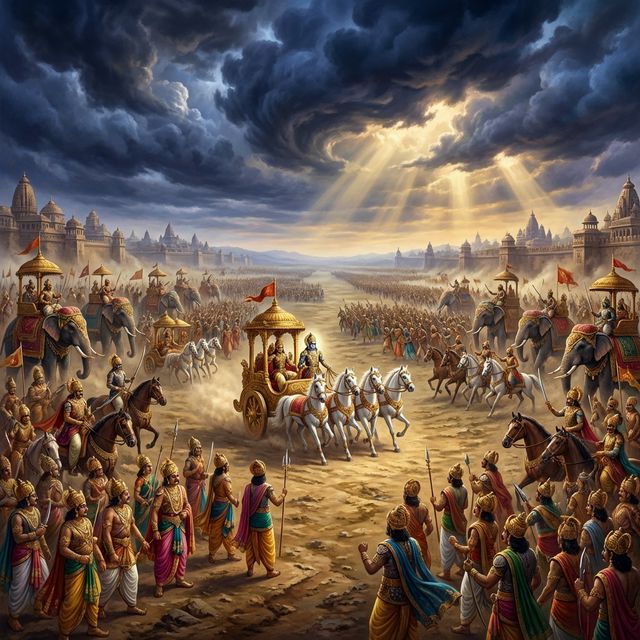
Karna's Tales of the Madrakas
The abducted woman's curse, the rakshasa's ranking of dirt, and a driver who cannot get off the chariot
The King Who Held the Reins
On the seventeenth morning of the war the man driving Karna's chariot was a king in his own right, and that was the whole trouble.
Sanjaya told it that way in the hall at Hastinapura, to a blind man who wanted to hear how his side had spent its last great captain. Shalya, ruler of the Madras, had agreed to take the reins only on the condition that he might say whatever came into his head while he held them, and Duryodhana, who wanted Karna to have a driver as good as Krishna, had agreed to the condition without thinking about it very hard.
So Shalya drove, and Shalya talked. All that morning he had praised Arjuna in the hearing of the troops and had told the son of Radha what would happen to him when the two cars finally met.
"These, O Karna, are ravings that thou utterest regarding the foe," he said at last. "As regards myself, without a thousand Karnas I am able to vanquish the foe in battle."
Unto the ruler of the Madras, of harsh features, who was saying such disagreeable things, Karna once more said words that were twice bitter.
He had already begun the thing he was going to do to Shalya that day. He was not going to argue about Arjuna. He was going to take the country Shalya came from, the land of the five rivers and the Madrakas and the Vahikas who lived along them, and he was going to lay it open in front of the whole army out of the mouths of brahmanas who had said these things in Dhritarashtra's own court, where Karna had sat and listened and remembered every word.
"Thou shouldst know all this, O Shalya," he said. "I shall, however, again speak unto thee. Listen with close attention to what I say."
Behind them the two arrays were still forming. The horses moved. The man with the whip had nowhere to go, and no way to stop his ears, and the man he was carrying had all day.
The Guest Who Had Seen Every Country
"Once on a time," Karna said, "a brahmana came to our house as a guest."
He meant the house of Adhiratha the charioteer, where he had been raised, and he said it deliberately, because Shalya had been sneering at that house since sunrise. The guest, Karna said, observed their practices and became highly gratified, and being gratified he talked, as travellers do.
"I dwelt for a long time on a peak of the Himavat quite alone," the man had said. "Since then I have seen diverse countries following diverse religions."
That was the credential, and the next sentence was the finding.
"Never, however, have I seen all the people of a country act unrighteously."
It is worth stopping on, because it is the most generous sentence in the whole of Karna's speech, and Karna quoted it only in order to produce an exception to it. All the races the man had met, he said, will admit that to be true religion which has been declared by persons conversant with the Vedas. Every country he had walked through kept some floor under itself. Then, travelling through various lands following various religions, he came at last among the Vahikas.
And there, he said, the order of the world ran backwards and in a circle.
There he heard that one at first becomes a brahmana, and then he becomes a kshatriya. Indeed, a Vahika would after that become a Vaishya, and then a Shudra, and then a barber. Having become a barber he would then again become a brahmana. Returning to the status of a brahmana he would again become a slave.
"One person in a family becomes a brahmana," the traveller said. "All the others, falling off from virtue, act as they like. The Gandharas, the Madrakas, and the Vahikas of little understanding are even such. Having travelled through the whole world I heard of these practices, destructive of virtue, of these sinful irregularities amongst the Vahikas."
Karna let the last three syllables of that sit where the driver could feel them.
"Thou shouldst know all this, O Shalya."
The Woman the Robbers Took
"I shall, however, again speak to thee," Karna said, "about those ugly words that another said unto me regarding the Vahikas."
And then he told the only story in the whole tirade that has a woman in it who is allowed to speak.
In former days, he said, a chaste woman was abducted by robbers hailing from Aratta. Nothing is given of her name or her house or where they took her from. She was carried off by men of that country, and sinfully was she violated by them, and there was nobody to prevent it and nobody afterwards to whom she could complain.
So she cursed them. That was the one thing she had left, and she used it with terrible precision. She did not curse the men who had held her. She did not ask for their deaths, which would have ended in a generation. She reached past them into their houses and cursed the thing they had used against her.
"Since ye have sinfully violated a helpless girl who am not without a husband," she said, "therefore the women of your families shall all become unchaste. Ye lowest of men, never shall ye escape from the consequences of this dreadful sin."
She had a husband. She names it in the curse. It is the only fact about her life that survives, and she put it in because it was the measure of what had been taken.
"It is for this, O Shalya," Karna said, "that the sisters' sons of the Arattas, and not their own sons, become their heirs."
That is the point at which the story stops being a story and becomes an explanation. A whole custom of inheritance, a whole arrangement about which child gets the land when a man dies, is being read backwards as the mark left on a people by one woman on one night, because after such a curse no man among them can be certain that his son is his.
Karna had found the sentence he wanted, and he was not done with it.
The Countries That Know
"The Kauravas with the Pancalas," Karna said, "the Salwas, the Matsyas, the Naimishas, the Koshalas, the Kasapaundras, the Kalingas, the Magadhas, and the Cedis, who are all highly blessed, know what the eternal religion is."
He was naming, deliberately and slowly, half the kings on both sides of the field. Men whose sons were at that moment sitting in cars a bowshot away waiting for the signal. He was inviting the entire war to agree with him about one thing before it resumed killing itself over everything else.
"The wicked even of these various countries know what religion is," he went on, and that clause is the sharp one. He was not claiming that the Kurus and the Pancalas and the Magadhas were good. He was claiming something narrower and harder to answer, that even their criminals could tell you what the rule was that they were breaking.
"The Vahikas, however, live without righteousness."
Then he said it again the other way round, in case anyone driving a chariot had missed it. Beginning with the Matsyas, the residents of the Kuru and the Pancala countries, the Naimishas as well and the other respectable peoples, the pious among all races are conversant with the eternal truths of religion.
"This cannot be said of the Madrakas, and the crooked-hearted race that resides in the country of the five rivers."
The five rivers were Shalya's rivers. The Madrakas were Shalya's people, and their king was holding the horses.
"Knowing all these things, O king," Karna said, "hold thy tongue, O Shalya, like one deprived of utterance, in all matters connected with religion and virtue."
There was a whole day of fighting still to come, and the two of them were tied to the same floor of the same car for the whole of it, and Karna had just told the man at the reins to be silent about dharma for the rest of his life.
Shalya, for the moment, said nothing at all, which was not the same as obeying.
A Sixth Part of the Demerit
What Karna went to next was the arithmetic of kingship, and it is the cruellest passage in the speech because it is the only one that is about Shalya personally.
"Thou art the protector and king of that people," he said, "and therefore the partaker of a sixth part of their merits and demerits."
That is the old reckoning, and every king in the hearing of that chariot knew it. A sixth of the harvest goes to the crown, and a sixth of the invisible harvest goes with it. The good a protected people does is credited to the man who protects them. So is the evil. It is the price of the throne and it is also the dignity of the throne, because it means a king is genuinely joined to his subjects and not merely seated above them.
Karna took the second half of it away from him.
"Or perhaps thou art the partaker of a sixth part of their demerits only, for thou never protectest them. A king that protects is a sharer in the merits of his subjects. Thou art not a sharer in their merits."
He was telling the ruler of the Madras that he carried the whole weight of his country and owned none of its worth. That he was liable and not entitled. That whatever his people had done wrong was on his head by law, and whatever they had done right had gone somewhere else, because he had never done the one thing that would have earned him a share of it.
Then he reached back past all living memory for a witness.
"In days of yore, when the eternal religion was reverenced in all countries, the Grandsire, observing the practices of the country of the five rivers, cried fie on them. When even in the krita age Brahman had censured the practices of those fallen people of evil deeds who were begotten by Shudras on others' wives, what wouldst thou now say to men in the world?"
The krita age is the first age, when the world was new and dharma stood on four legs and nothing anywhere had begun to rot. Karna's argument was that even then, when all people were observant of the duties of their respective orders, the Grandsire had to find fault with these men.
"Thou shouldst know all this, O Shalya. I shall, however, again speak to thee."
The Rakshasa in the Tank
"A Rakshasa of the name of Kalmashapada," Karna said, "while plunging in a tank, said this."
The scene is given in half a line and it is one of the strangest in the epic. A rakshasa is going down in water. Not fighting, not devouring anyone, not haunting a road at night. Sinking, in a still tank, and reciting as he sinks.
"Eleemosynation is a kshatriya's dirt, while the non-observance of vows is a brahmana's dirt. The Vahikas are the dirt of the Earth, and the Madra women are the dirt of the whole female sex."
Four judgements, and the first two are not about anybody's country. They are about how each order fails in its own particular way. A kshatriya's dirt is begging, the taking of alms, because a man born to protect and to give should never be found with his hand out. A brahmana's dirt is the vow he did not keep, because a brahmana is nothing except his observances. Each order is measured by the thing it was made for, and the stain named is the shadow of its own duty.
Then the two clauses that Karna had actually come for. The Vahikas are the dirt of the Earth. The Madra women are the dirt of the whole female sex.
Shalya was a Madra. His sister Madri had been the wife of Pandu and the mother of Nakula and Sahadeva, and both of those young men were somewhere out on the field that morning in the Pandava array. Karna was standing in a chariot driven by their uncle and quoting a drowning rakshasa on the subject of Madra women.
While sinking in the stream, Karna said, a king rescued the Rakshasa.
That is all the king gets. No name, no kingdom, no account of how he came to be at the water. He saw a thing going under and he put his hand in and pulled it out, and the thing he pulled out was a man-eater, and then he asked it a question.
"Asked by the former," said Karna, "the latter gave this answer. I will recite it to you. Listen to me."
The Order of the Dirt
The rescued rakshasa answered by building a ladder, and every rung of it was underneath the one before.
"The mlecchas are the dirt of mankind," he said. "The oilmen are the dirt of the mlecchas. Eunuchs are the dirt of the oilmen. They who avail of the priestly ministrations of kshatriyas in their sacrifices are the dirt of eunuchs."
Four steps down. Mankind at the top, and the barbarians who live outside the pale are the sediment mankind leaves. Below them the oil-pressers, whose trade crushes living seed in a mill. Below them men who cannot father children. And at the bottom of the four, not a people at all but a practice, a household that hires a kshatriya to do a brahmana's office at its fire and so puts the wrong hand on the ladle.
Then the rakshasa, who was standing dripping on a bank with the man who had just saved his life, delivered the price.
"The sin of those again that have the last-named persons for their priests, and also of the Madrakas, shall be thine if thou do not abandon me."
That is what the ladder had been for. Every rung of it was loaded onto the shoulders of the king who had reached into the water, and the only way out from under it was to let go of the creature he had rescued. The rakshasa was telling his rescuer, in careful order, exactly how much filth he had picked up along with him, and offering him the chance to put it down again.
And then the sting in the tail, which Karna delivered flatly, because it makes the whole recitation into something a person might actually use.
"Even this was declared by the Rakshasa to be the formula that should be used for curing a person possessed by a Rakshasa, or one killed by the energy of a poison."
The list is a charm. Said over a man who is raving with a spirit in him, or over a man dying of venom, that catalogue of dirt is supposed to drive the thing out. Karna was reciting a medicine at his driver, word for word, and the Madrakas were one of the ingredients.
"The words that follow," he said, "are all very true."
Who Guards Which Quarter
What followed was a survey of the whole world done in single clauses, and Karna went through it like a man reading out a ledger.
"The Pancalas observe the duties enjoined in the Vedas. The Kauravas observe truth. The Matsyas and the Surasenas perform sacrifices. The Easterners follow the practices of the Shudras. The Southerners are fallen. The Vahikas are thieves. The Saurashtras are bastards."
Then the roll of what a man is defiled by, which is not aimed at any nation and is the plainest thing in the speech. Ingratitude. Theft. Drunkenness. Adultery with the wives of one's preceptors. Harshness of speech. Slaughter of kine. Lustful wandering during the night out of home. The wearing of other people's ornaments.
"What sin is there," Karna said, "that they do not incur? Fie on the Arattas and the people of the country of the five rivers."
Commencing with the Pancalas, the Kauravas, the Naimishas, the Matsyas, all these know what religion is. The old men among the Northerners, the Angas and the Magadhas, follow the practices of the pious even without themselves knowing what virtue is, which is its own sort of compliment.
And then he named the guardians, and for a moment the quarrel opened out into something larger than a chariot.
Many gods, headed by Agni, dwell in the East. The pitris dwell in the South, that is presided over by Yama of righteous deeds. The West is protected by the mighty Varuna, who overlooks the other gods there. The North is protected by the divine Soma along with the brahmanas. Rakshasas and Pishacas protect the Himavat, best of mountains. The Guhyakas protect the mountains of Gandhamadana. And without doubt Vishnu, otherwise called Janardana, protects all creatures everywhere.
Every direction of the world has somebody standing over it. Every mountain has its watchers, and above the lot of them is the god who guards all creatures without exception.
Karna finished the list and left one hole in it.
For all that, he said, the Vahikas have no especial protectors among the gods.
That was the cruelty of the whole passage. Not that the five rivers were wicked. That the map had been drawn out in full, quarter by quarter and peak by peak, so that the driver could look at it and see that his own country was the one square of it with nothing standing over it at all.
The Ones Who Cannot Take a Hint
The last catalogue was about understanding, and Karna arranged it as a descent.
"The Magadhas are comprehenders of signs," he said. "The Koshalas comprehend from what they see. The Kurus and the Pancalas comprehend from a half-uttered speech. The Salwas cannot comprehend till the whole speech is uttered. The Mountaineers, like the Sivis, are very stupid. The Yavanas, O king, are omniscient, and the Suras are particularly so. The mlecchas are wedded to the creations of their own fancy, and other peoples cannot understand at all."
A ladder again, from the people who need only a gesture down to the people who need every word said out loud, and then off the bottom of it entirely.
"The Vahikas resent beneficial counsels," Karna said. "As regards the Madrakas, there are none amongst those mentioned above."
Not slow. Not stupid. Not on the list. A whole people filed under nothing, in a scheme that had found room even for men wedded to their own inventions.
"Thou, O Shalya, art so. Thou shouldst not reply to me."
Then he went back over the ground once more, because he wanted the ending to be the same words he had started with. The Madrakas are regarded on Earth as the dirt of every nation. So the Madra woman is called the dirt of the whole female sex. They that have for their practices the drinking of spirits, the violation of the beds of their preceptors, the destruction of the embryo by procuring miscarriage, and the robbing of other people's wealth, there is no sin that they have not.
"Fie on the Arattas and the people of the country of the five rivers. Knowing this, be silent."
And then, at last, what the whole hour had been for.
"Do not seek to oppose me. Do not let me slay Keshava and Arjuna having slain thee first."
That is the sentence under all of it. Karna had spent the morning of the day he was going to die proving that his own charioteer came from the one country on earth that the gods had left unguarded, and the reason he had done it was that he needed the man to shut up and drive, and could not think of any other way to make him.
Everywhere
Shalya heard him out and answered in about a minute, and his answer is the shortest speech in the quarrel.
"The abandonment of the afflicted and the sale of wives and children are, O Karna, prevalent amongst the Angas, whose king thou art."
One clause, in the same coin, to show that the game could be played back. Then he dropped it, because he had something better.
"Recollecting those faults of thine that Bhishma recited on the occasion of the tale of Rathas and Atirathas, drive away thy wrath. Do not be angry."
And then he took the whole enormous structure Karna had built, the brahmana on the Himavat, the cursed woman, the sinking rakshasa, the four dirts, the unguarded quarter, and he pulled the floor out from under it with one word repeated.
"Brahmanas may be found everywhere. Kshatriyas may be found everywhere. So also Vaishyas and Shudras, O Karna. Women of chastity and excellent vows may also be found everywhere. Everywhere men take delight in jesting with men and wounding one another. Lustful men also may be found everywhere."
Everywhere. Not that the Madras were clean. That nobody was, and that the dirt was distributed evenly over the earth, and so was the virtue, and a map that puts all of one thing in one country and all of the other thing in another is a map of somebody's temper and not of the world.
"Everyone on every occasion can command skill in speaking of the faults of others. No one, however, knows his own faults, or knowing them feels shame. Everywhere are kings devoted to their respective religions, and employed in chastising the wicked. Everywhere may be found virtuous men. It cannot be, O Karna, that all the people of a country are sinful. There are men in many countries that surpass the very gods by their behaviour."
It was the traveller's sentence from the beginning of the whole speech, the one Karna had quoted himself and then spent an hour trying to break: never have I seen all the people of a country act unrighteously.
Then Duryodhana came up and stopped the two of them from going on with their wordy warfare, addressing the son of Radha as a friend and beseeching Shalya with joined hands. Karna was quieted by him and forbore saying anything more. Shalya faced the enemy.
And Radha's son, smiling, once more urged the king of the Madras.
"Proceed."
Dharma Lesson
Karna's speech is the most learned thing he ever says and the least true. He has read and remembered and can quote brahmanas, rakshasas and the Grandsire himself, and he uses all of it to prove that wickedness lives in one country and not in his own, because he needs his driver silent and has no better way to silence him. Shalya answers with the only correction that ever works on such a map: everywhere. The epic gives the last word not to the man with the catalogue but to the man who says that virtue and filth are distributed evenly over the earth, and that no one who is fluent about the faults of others has yet looked at his own.