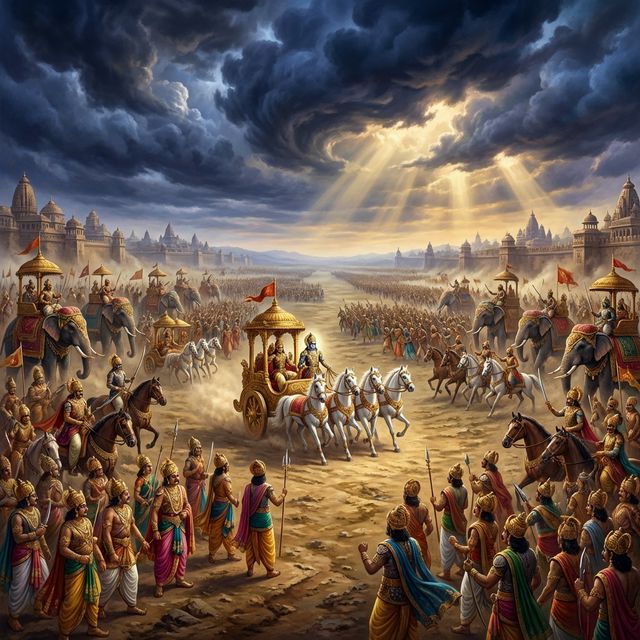
The King Put Off His Chariot
Satyaki kills Duryodhana's horses and driver, cuts his bow at the handle, and the king escapes on Kritavarma's car
The Uproar at Dead of Night
Sanjaya said: "Then all those kings of thy army, incapable of being easily defeated in battle, angrily proceeded against Yuyudhana's car, unable to brook his feats."
It was still the fourteenth day, or what was left of it. The sun had gone down on Jayadratha's death hours before, and neither army had stopped. Duryodhana had ordered lamps carried onto the field, torches in the hands of foot-soldiers and cressets fixed to the cars and the tusks of elephants, so that the fighting went on in a moving hall of light with darkness pressing at its edges.
Somewhere in that light was Satyaki.
He is called by many names in this part of the account and it is worth having them straight, because Sanjaya uses them all in the space of a page. Yuyudhana is his own name. He was the grandson of Sini, of the Satwata line, of the race of Madhu and of Vrishni, which is to say he was Krishna's kinsman, one of the Yadava chiefs who had come to Kurukshetra on the Pandava side. He was also Arjuna's pupil. Earlier that same day Yudhishthira had sent him alone through the whole Kaurava army to find Arjuna, and he had gone through it, and he had not come back, and he had been fighting ever since without rest.
Now the kings came for him together. They mounted their well-equipped cars, decked with gold and jewels, and brought cavalry and elephants with them, and they encompassed the Satwata hero on all sides. Hemming him in, those mighty car-warriors challenged him and uttered loud leonine roars. They were not trying to drive him off. They wanted him dead, and there were enough of them to do it.
They poured their keen arrows on him from every quarter.
Beholding them thus advancing with speed towards him, the mighty-armed grandson of Sini took up his bow and shot.
Yak-Tails and White Umbrellas
What followed is described by a man who was watching it and who had no fondness for the Pandava side.
The heroic and great bowman Satyaki, invincible in battle, cut off many heads with his fierce and straight arrows. And he of Madhu's race also cut off the trunks of many elephants, and the necks of many steeds, and the arms of many warriors, arms that were decked with Angadas, by means of razor-faced arrows.
An Angada is an armlet worn above the elbow, gold, heavy, the ornament of a man rich enough to fight in his jewellery. Sanjaya notices them lying on the ground because they were the only thing about those arms that could still be recognised.
Then he gives the image that stays.
With the fallen yak-tails and white umbrellas, the field of battle became almost full, and resembled the firmament with stars.
The yak-tail whisk and the white umbrella are what a king travels under. Every one of those umbrellas had been held over the head of somebody who mattered, and every whisk had been waved by a servant whose whole office was to wave it, and now they were down in the dirt in such numbers that a man looking across the field in lamplight saw only pale round shapes scattered over a dark surface, like the night sky turned upside down and laid on the earth.
The wails of the host thus slaughtered by Yuyudhana became as loud as those of shrieking ghosts. With that loud uproar the earth became filled, and the night became fiercer and more terrible.
That is the sound that carried across the field to the place where the king of the Kauravas was fighting, and that is how this episode begins: not with a challenge or an insult or a formal approach between equals, but with a noise in the dark that had to be gone to and stopped.
Urge the Steeds to That Spot
Beholding his host afflicted with Yuyudhana's arrows and breaking, and hearing that tremendous uproar at dead of night making the hair stand on end, thy son, that mighty car-warrior, addressed his driver, and repeatedly said one thing.
"Urge the steeds to that spot whence this uproar cometh."
Sanjaya says he repeated it, which is worth noticing. The order was given more than once, either because the driver hesitated or because Duryodhana could not stop saying it. Nothing in the line is boastful. He does not say find Satyaki, or bring me to the Vrishni. He says: go to the sound.
It should be said plainly what he was doing. Duryodhana was the king. He had a hundred brothers, most of them still alive that night, and Drona and Karna and Ashwatthama and Kritavarma and Shalya and his uncle Shakuni all fighting on the same field within reach of a horn. Any of them could have been sent. He had spent the whole war being told by better warriors to stay out of the worst places, and had mostly listened.
He did not send anybody. He went himself, toward a noise that had already eaten a piece of his army.
Then king Duryodhana, that firm bowman, above all modes of warfare, rushed against Yuyudhana.
Madhava saw him coming and did not wait. He pierced Duryodhana with a dozen blood-drinking shafts, sped from a bow drawn to its fullest stretch, and the fight was joined before the king had said a word.
Thus afflicted with arrows by Yuyudhana first, Duryodhana was excited with rage, and pierced the grandson of Sini in return with ten arrows.
Around them the battle between the Panchalas and all the Kaurava troops went on, and Sanjaya, who had been describing carnage for hours, pauses to say that it presented an exceedingly wonderful sight. Then he goes back to the two men.
Eighty Shafts in the Chest
Ten arrows from a king is not a small answer. Duryodhana was not a poor bowman and never had been. He had been Drona's pupil alongside Arjuna and Balarama's pupil with the mace, and on the eleventh day he had stood in front of Arjuna in armour of mantras and had not fallen. Sanjaya calls him a firm bowman and says he was above all modes of warfare, and that is the assessment of a man reporting to the king's father, but it is not flattery invented for the occasion. It is what the account says of him elsewhere too.
It made no difference at all.
Then the grandson of Sini, excited with rage in that battle, pierced thy son, that mighty car-warrior, with eighty shafts, in the chest.
Eighty. Not eighty over the course of the duel, but eighty in the exchange that followed ten, and all of them in the chest, which means every one of them found the same place on a moving man in a moving car by lamplight. That is the whole of what needs to be said about the difference between the two of them as archers, and Sanjaya says it with a number and moves on.
He then, with other shafts, despatched Duryodhana's steeds to Yama's abode.
And that slayer of foes then quickly felled his antagonist's driver from the car.
It took three strokes of work, delivered in order, the way a man dismantles a machine. First the man himself, so that he is hurt and cannot press. Then the horses, so that the car cannot move. Then the driver, so that even if fresh horses were brought up there would be nobody to handle them.
The king of the Kauravas was left standing on a chariot that was not going anywhere, in the middle of a night battle, in front of a Vrishni who had been killing since morning and was not tired.
The Bow Cut at the Handle
What Duryodhana did next is the reason this episode is remembered kindly by people who do not otherwise think well of him.
Thy son, O monarch, staying on that steedless car, shot many keen arrows towards Satyaki's car.
He did not get down. He did not call for help, and there is no speech from him here at all. He stayed on the wreck with dead horses in the traces and his charioteer on the ground beside the wheel, and he went on shooting, and he shot fifty arrows.
The grandson of Sini, however, displaying great lightness of hand, cut off those fifty shafts sped in that battle by thy son.
Lightness of hand is the phrase Sanjaya keeps for the very best archers on the field, and it is the same phrase he used of Karna a few hours earlier. Fifty arrows came at him and fifty arrows were cut out of the air, and nothing reached the car.
Then Madhava, with a broad-headed shaft, suddenly cut off in that encounter the formidable bow of thy son in the handle.
The handle is the grip, the thick middle of the stave where the hand closes on it. A bow cut at the tip can sometimes be restrung. A bow cut at the handle comes apart in two pieces in a man's fingers while he is holding it, and it is finished, and so is he.
Deprived of both his car and his bow, that puissant ruler of men then mounted quickly upon the bright car of Kritavarma.
Kritavarma was a Bhoja chief of the Vrishni house, one of Krishna's own kinsmen, who had taken the Narayana army to Duryodhana's side while Arjuna took Krishna. So the man who reached down and pulled the king of the Kauravas onto his chariot floor that night was of the same blood as the man who had just knocked him off his own.
Upon Duryodhana's retreat, the grandson of Sini afflicted and routed thy army at dead of night.
Shakuni Loses a Car in the Same Hour
The same thing was happening on the other side of the field, and Sanjaya sets the two down one after the other without comment, which is its own kind of comment.
Karna had persuaded Duryodhana earlier that night that the war could be won by killing Satyaki and Dhrishtadyumna while Arjuna was kept away from them, and Duryodhana had sent his uncle Shakuni to keep Arjuna away. So Shakuni encompassed Arjuna on all sides with many thousands of cars and several thousands of elephants and many thousands of steeds, and began to fight desperately. Many of them hurled celestial weapons of great power. Those Kshatriyas fought with Arjuna incurring the certitude of death, which is Sanjaya's way of saying that they knew.
Arjuna, excited with rage, checked those thousands of cars and elephants and steeds and ultimately caused those foes to turn back. Then Suvala's son, with eyes red as copper with rage, deeply pierced him with twenty shafts, and with a hundred more checked the progress of Partha's great car.
Then the field is described as it looked afterwards. Strewn with lopped off arrows and with dead bodies by thousands, the earth looked as if covered with flowers. Indeed, strewn with the heads of Kshatriyas, heads decked with diadems and handsome noses and beautiful ear-rings and lips bit in rage and wide open eyes, heads graced with collars and crowned with gems, heads which while life was in them spoke sweet words, the earth looked resplendent as if strewn with hillocks overspread with Champaka flowers.
Arjuna struck Uluka with an arrow in the sight of his sire, and roared. Then the son of Indra cut off Shakuni's bow. And then he despatched his four steeds to Yama's abode.
Then Suvala's son, jumping down from his car, quickly ascended the car of Uluka.
Within the same hour, on one field, the king and the king's uncle were both put off their chariots and both finished the night standing on somebody else's.
The River Between the Hosts
Father and son rode on the one car after that and showered their arrows on Partha like two risen clouds pouring torrents of rain on a mountain, and the son of Pandu pierced both of them and caused the Kaurava troops to fly away in hundreds and thousands.
Like a mighty mass of clouds dispersed on all sides by the wind, that army was dispersed. That host, slaughtered on the night, fled away in all directions, afflicted with fear, in the very sight of their leaders. Many abandoned the animals they rode. Others urged their animals to their greatest speed and turned back from the battle, inspired with fear, during that fierce hour of darkness.
Having vanquished those warriors, Vasudeva and Dhananjaya cheerfully blew their conchs.
At the third place on the field, Dhrishtadyumna was still where he had been all night, in front of Drona, who had killed his father. He pierced Drona with three arrows and cut the preceptor's bowstring with a sharp one. Throwing that bow on the earth, heroic Drona, that grinder of Kshatriyas, took up another that was exceedingly tough and strong, and pierced Dhrishtadyumna with five arrows and his driver with five more. Checking Drona with his arrows, the Panchala prince began to destroy the Kaurava host like Maghavat destroying the army of the Asuras.
During the slaughter of thy son's army, a terrible river having blood for its current began to flow. And it ran between the two hosts, bearing away men and steeds and elephants along its current. And it resembled the Vaitarani that flows towards the domains of Yama.
The Vaitarani is the river at the edge of the world of the dead, which the dead have to cross. Sanjaya does not say it looked like a river of the dead. He says it ran between the two armies, so that each host stood on its own bank and looked across at the other over water that was carrying their men away.
Then Dhrishtadyumna and Shikhandi blew their large conchs, and so did the twins, and Vrikodara, the son of Pandu.
Thus those fierce warriors vanquished thousands of kings of thy side who were endued with great energy, at the sight of thy son, and of Karna, and of the heroic Drona, and of Drona's son.
Dharma Lesson
Duryodhana comes off better in this passage than in almost any other, and it costs him everything anyway. He goes toward the screaming himself instead of sending a brother, and when the horses and the driver are gone he stays on the dead car and keeps shooting, and none of it matters against a better archer. Courage is not the same thing as competence, and a man who has been told all his life that he is the equal of the men fighting for him will only find out on a night like this one. The kindest reading of the scene is also the most damning: he was brave, and it changed nothing, because the war was never going to be decided by how much heart he had.