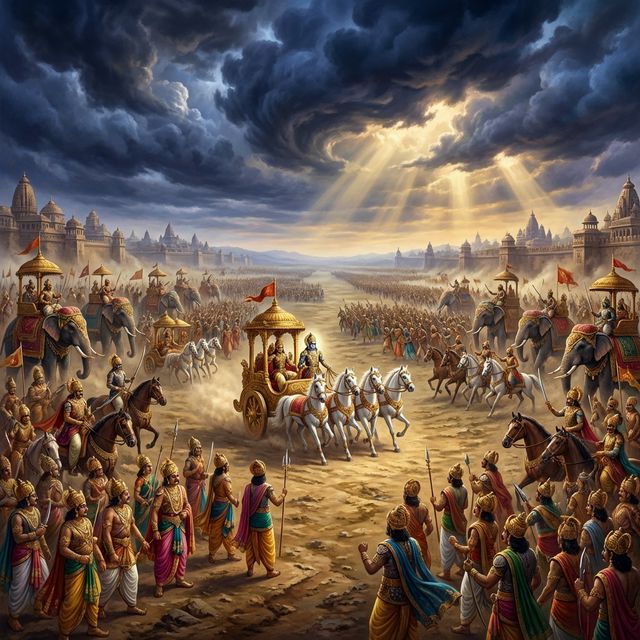
Seven Bows Against One
Dhrishtadyumna rides at Drona in the night battle and answers seven champions with three arrows apiece
Two Oceans in the Lamplight
Sanjaya was describing the night. Not a night of rest, because there was none on the fourteenth day of that war, which had run past sunset and gone on burning in the dark by the light of lamps set on cars and elephants and horses, so that the field looked like day and the men on it could not tell one side from the other.
"Sire slew son," Sanjaya said, "and son, from ignorance, slew sire, and friend slew friend. In that dreadful nocturnal encounter, O king, all fought furiously, ceasing to have any regard for one another."
Into that, holding his formidable bow and stretching the string again and again as he came, went the prince of the Panchalas.
Dhrishtadyumna had been born out of a sacrificial fire for one purpose, which everybody on both sides of the field knew. His father Drupada had bought him from the fire to kill Drona. He had been given the command of the whole Pandava host, and he had spent fourteen days doing a general's work, and now, at dead of night, he set his car straight at the one man he existed for.
Drona's car was decked with gold and easy to find in the lamplight.
The Panchalas and the Pandavas, seeing where their commander was going, came after him and surrounded him, because a man riding at Drona alone does not come back. And Duryodhana, seeing the preceptor assailed, put himself and his men round Drona on all sides and contended resolutely to keep him.
So the two masses of troops came together on that night, and Sanjaya said they looked like two terrible oceans lashed into fury by a tempest, with every living creature inside them agitated.
Then the prince of the Panchalas pierced Drona in the chest with five arrows, and uttered a leonine roar.
The Arrow That Lit the Army
Drona answered the roar with five and twenty arrows, and with one more, broad-headed, he cut off Dhrishtadyumna's bright bow at a stroke.
There is a thing that happens to a man who has been made for a single task and is stopped at the door of it. Dhrishtadyumna threw the useless bow aside and bit his lower lip. Sanjaya gives that detail and no other about his face.
Then he took up another formidable bow, for the accomplishing of the destruction of Drona.
He was, Sanjaya said, a warrior endued with great beauty, and he stretched that bow to his ear, and shot one terrible shaft capable of taking Drona's life.
It lit the whole army as it went. Men on both sides saw their own hands and their own dead by the light of it, as though the sun had risen at midnight over the field. And the gods, the Gandharvas and the Danavas, watching from above the lamps, said these words aloud: "Prosperity to Drona!"
It was Karna who answered them.
He was not fighting Dhrishtadyumna. He was somewhere along the line with his own work in front of him, and he saw the shaft go and read where it was going, and displaying that lightness of hand for which he was famous he cut it into a dozen fragments while it was still in the air, before it reached the preceptor's car.
The pieces came down on the earth like a snake without poison.
Then Karna, having cut the arrow, went after the archer. He shot away Dhrishtadyumna's own shafts with his straight ones, and then pierced the prince himself with many sharp arrows, and the night closed round the Panchala's car.
Three Arrows Each
What followed is set down by Sanjaya as a list, because that is what it was.
Drona's son Ashwatthama pierced him with five. Drona himself with five. Shalya, the king of the Madras, with nine. Dushasana with three. Duryodhana with twenty. Shakuni with five. And Karna, who had begun it, with many.
Seven of the foremost car-warriors of the Kaurava side, all of them shooting at one man in the dark, and all of them exerting themselves for one purpose, which was the rescue of Drona.
Dhrishtadyumna pierced every one of the seven with three arrows.
That is the whole of his answer and it is worth pausing on. He did not withdraw, he did not call for the Panchalas who had come out with him, and he did not choose one of the seven and turn on him. He divided himself among all of them, three arrows apiece, and kept his car where it was, and went on afterwards to strike Drona again, and Karna, and Drona's son, and the king's son, singling out the four heaviest of them for a second time.
Thus pierced by that bowman, they fought together and pierced him again, roaring the while.
Anyone counting arrows in the lamplight would have said the thing was already decided. Seven bows against one, and every one of the seven a name that armies moved for. The Kaurava troops nearest the place had begun to look at the Panchala prince the way men look at something that is finished and does not yet know it.
They were still looking when a fresh voice came out of the press on his flank, calling him to stop.
Wait, Wait
"Wait! Wait!"
The man who said it was Drumasena, one of the warriors of Duryodhana's side, and he had come up excited with wrath and had already pierced the Panchala prince with a winged arrow and then quickly with three more. He wanted the prince to turn and give him the fight.
Dhrishtadyumna gave it to him in the time it takes to draw three times.
Three straight arrows first, equipped with wings of gold, steeped in oil, and capable of taking the life of the man at whom they are sped. Then a fourth, broad-headed, that cut the head from Drumasena's trunk while it was still wearing its bright ear-rings of gold.
Sanjaya, who watched a great many heads come off that fortnight and does not usually stop for one, stopped for this one. The head fell on the ground, he said, with its lower lip bit in rage, like a ripe palmyra fruit separated from the stalk by the action of a strong wind.
It had been alive and shouting a moment earlier. That is the reason the image is there. The man had time to be angry and no time at all to be afraid.
Then Dhrishtadyumna turned back to the seven as though nothing had interrupted him. He pierced all of them again with keen shafts, and with some broad-headed ones he cut off the bow of Radha's son, that warrior conversant with all modes of warfare.
Karna could not brook the loss of it. Sanjaya says he took it as a fierce lion takes the cutting off of his tail. He caught up another bow with his eyes red, breathing hard, and covered the Panchala prince with clouds of arrows.
And the six others, seeing Karna in that state, closed in and encompassed Dhrishtadyumna from every side, wanting to kill him there.
Every soldier of the Kaurava army who could see the place regarded him as already within the jaws of the Destroyer.
The Grandson of Shini Arrives
He was not, because somebody was crossing the field toward him.
Satyaki of the Dasarha race, the grandson of Shini, had been fighting his own way through that army since the afternoon, and he came now scattering his shafts as he went, and reached the spot where Dhrishtadyumna was battling the six.
Karna saw him coming and pierced him with ten arrows before he had finished arriving.
Satyaki pierced Karna with ten in return, in the very sight of all those heroes, and said one line to him.
"Do not fly away. Stay before me."
The encounter that followed, Sanjaya said, was like the one between Vali and Vasava in the days of yore. Satyaki terrified the kshatriyas around him with the rattle of his car and pierced the lotus-eyed Karna again and again; Karna made the earth tremble with the twang of his bow and answered with hundreds of shafts, long and barbed and pointed and razor-headed and tall-toothed, and Yuyudhana shrouded him back with arrows, and for a time the battle proceeded equally between them.
Then Duryodhana put Karna at the head of them all and the whole group turned on Satyaki, piercing him from every side.
Satyaki resisted the weapons of all of them and of Karna also, and while he was doing it he sent one arrow into the centre of Vrishasena's chest.
Vrishasena was Karna's son. He was of great splendour and he was valiant and he fell down on his car, casting his bow away, and lay still.
Karna, looking at him, believed that mighty car-warrior slain.
What Sanjaya says next is that Karna became scorched with grief on account of the death of his son, and began to afflict Satyaki with great force. The boy was not dead. His father fought the rest of that engagement believing he was, and Satyaki, afflicted by a man in that condition, pierced him with many shafts and then cut off the leathern fences and the bows of both sire and son together, so that the two of them had to string fresh bows before they could go on.
What Karna Heard in the Dark
While the two of them were stringing those bows, another sound arrived over the whole field.
It was the twang of Gandiva, and it was louder than everything else in that darkness, and the rattle of the car under it was like thunder.
Karna heard it and turned to Duryodhana and spoke, and what he said is the clearest account anybody on the Kaurava side gave that night of what was happening to them.
"Slaughtering our entire army and the foremost of heroic warriors and many mighty bowmen among the Kauravas, Arjuna is loudly twanging his bow. It is evident, the son of Pandu is achieving feats worthy of his own self. This son of Pritha will grind our large host. Many of our troops are already breaking. No one stays in battle. Indeed, our army is being dispersed like a risen mass of clouds dispersed by the wind. Encountering Arjuna, our host breaks like a boat on the ocean.
"Hear, O tiger among car-warriors, the sound of drums and cymbals near Arjuna's car at dead of night, resembling the deep roll of thunder in the welkin. Hear also the loud wails of afflicted combatants, and the tremendous leonine shouts, in the vicinity of his car.
"Here, however, this Satyaki, this foremost one of the Satwata race, stayeth amid us. If this object of our aim can be struck down, we can then vanquish all our foes. Similarly, the son of the Panchala king is engaged with Drona. He is encompassed on all sides by many heroic and foremost of car-warriors. If we can slay Satyaki and Dhrishtadyumna, the son of Prishata, without doubt, O king, victory will be ours.
"Surrounding these two heroes, as we did the son of Subhadra, we will strive to slay them."
As we did the son of Subhadra. He said it plainly to the king, in the middle of a battle, as a method that had worked once and could be used again. Abhimanyu had been sixteen years old and had been surrounded by six of these same men eight days before.
Back Where It Began
Duryodhana took the advice, and turned to his uncle to give the order, and Sanjaya, telling it afterwards to a blind man in a hall, said that he addressed Shakuni the way the illustrious Indra addresses Vishnu.
"Surrounded by ten thousand unretreating elephants and ten thousand cars also, proceed against Dhananjaya. Dushasana and Durvishaha and Suvahu and Dushpradharshana, these will follow thee, surrounded by a large number of foot-soldiers. O uncle, slay those great bowmen, the two Krishnas, and Yudhishthira, and Nakula, and Sahadeva, and Bhima, the son of Pandu. My hope of victory resteth on thee, like that of the gods on their chief Indra. O uncle, slay the son of Kunti."
So Shakuni clad himself in mail and went off with a large force and the king's brothers to keep Arjuna away from the place, and the Suta's son went at Satyaki with hundreds of shafts and a great many men behind him, and the Kaurava warriors combined and encompassed the grandson of Shini.
Which left the thing where it had begun.
Bharadwaja's son brought his own car up against the car of Dhrishtadyumna, and the two of them fought a wonderful and fierce battle at dead of night, the preceptor and the Panchalas, exactly as they had been fighting when Karna cut the first arrow out of the air.
Nothing in the whole exchange had moved either of them a foot. Seven of the greatest bowmen in the world had shot at one man in turn and together; he had answered every one of them with three arrows apiece, taken a head off in the middle of it, cut Karna's bow, and stood where he was until help came. And Drona, who had been the target from the first line of it, was still on the field and still had his weapon in his hand, and the man born to kill him was in front of him again with a bow.
They had eight hours of darkness left, and then a morning, and Drona had one more day to live.
Dharma Lesson
Dhrishtadyumna was made for one man and rode at him with seven bows in the way, and what he did was not to break through and not to retreat, but to answer every one of the seven with the same three arrows and hold his ground until help arrived. Courage of that kind is not the will to win a thing quickly; it is the refusal to let being outnumbered decide what you attempt. Karna, meanwhile, proposed to win by surrounding two men the way six of them had surrounded a boy eight days before, and said so to the king without embarrassment. The same night shows both: a man who would not change his purpose because the odds were against him, and men who had already changed theirs because the odds were with them.