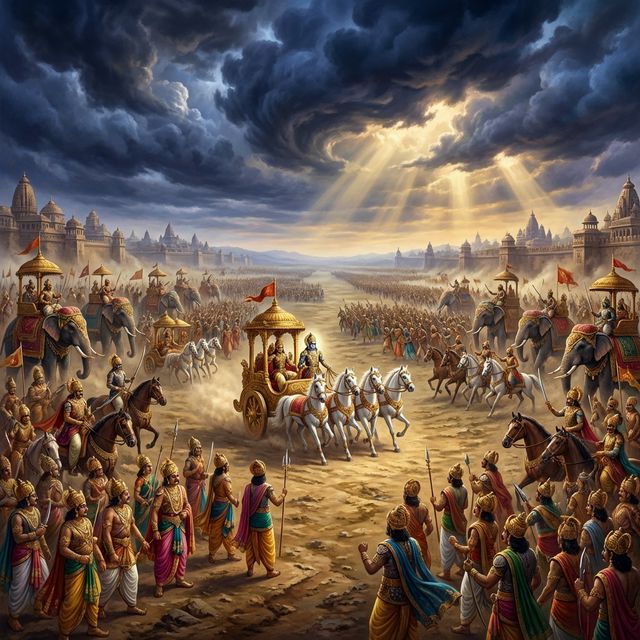
The Fourth Son Karna Let Go
Karna disarms Sahadeva in the night battle and sends him away alive
The Fourth Brother Goes for Drona
Sanjaya went on telling it to the blind king in the hall, the whole of that night battle on Kurukshetra, one encounter after another as the lamps burned down the field.
And he came to Sahadeva.
He was the youngest of the five, the second of Madri's two sons, the quiet one who was reckoned wise rather than terrible, and on that night he was doing what half the Pandava army was doing. He was trying to get at Drona. The teacher was the centre of everything in those days, the axle the whole war turned on, and every division that could move was pushing toward the place where his standard stood.
Karna resisted him.
"Karna, the son of Vikartana," said Sanjaya, and he used the names the way a herald uses them, because that man had four or five of them and each one said something different about him. Son of Vikartana, which is to say son of the sun. Son of Radha, after the woman who raised him. Son of Adhiratha, after the charioteer who found him. The Suta's son, which was what men said when they meant to wound.
He put himself in front of Sahadeva, and the road to Drona closed.
Sahadeva did not hesitate at the sight of him. He pierced the son of Radha with nine shafts, and then, before the man could answer, with nine more straight arrows on top of them.
That is how it began, and it is worth marking, because it is the last moment in the whole encounter when the two of them are doing the same thing to each other. Nine shafts, and nine again, from a young man who had ridden up against the greatest bowman on the field and had not slowed down.
Then Karna began.
A Hundred Shafts, and the String
He answered the eighteen with a hundred.
A hundred straight shafts into Sahadeva, in return for nine and nine, and then, displaying that great lightness of hand which everybody on both sides had heard about and which very few men had watched from close range, he cut off the son of Madri's strung bow.
A bow is not cut in a duel by accident. It is the one stroke that says the difference between two archers plainly, without any need to count wounds, and Karna made it the first thing he did.
Sahadeva took up another bow.
That is the detail Sanjaya lingers on, and he says so outright. The valiant son of Madri, with a hundred arrows in him and his weapon in two pieces at his feet, reached down for a second bow and pierced Karna with twenty arrows, and this feat of his seemed exceedingly wonderful.
Understand what is being praised there. Not the twenty arrows. Twenty arrows were nothing to Karna that night; he had taken worse from Bhima that same afternoon and gone on smiling. What was wonderful was that a man who had just been disarmed by the foremost of car-warriors, in the dark, with the lamps guttering and the whole Kaurava host at that man's back, did not turn his horses. He armed himself again and shot.
Karna took the twenty and made his reply in a form Sahadeva could not answer at all.
He killed the horses. Many straight shafts, and the four steeds went down in their harness. Then a single broad-headed shaft, and the driver went with them, despatched, said Sanjaya, to the abode of Yama.
And Sahadeva was standing on a car that could not move, behind dead animals, with nobody to hold the reins if they had been worth holding.
Sword, Then Mace, Then Dart
So he took up a sword and a shield and got ready to fight on foot.
Those weapons were cut off by Karna smiling the while.
That is the sentence, and the smile is in the text, and it is not put there as decoration. Karna smiled at this stage of nearly every duel he ever fought. He smiled at Bhima. He smiled at the men he was about to kill and the men he was about to let go. It was the face he wore while he worked, and to the man in front of him it was unbearable, and he knew it was unbearable, and he did not stop.
Sahadeva, weaponless twice over now, reached for the thing a kshatriya reaches for when the shooting has failed him.
There was a mace on that car, heavy and terrible and decked with gold, and the mighty son of Madri sped it at the car of Vikartana's son with everything he had left. It came across the dark ground at Karna with the whole weight of the man behind it.
Karna cut it out of the air with shafts and let it fall on the earth.
Think about what that requires. A mace is not an arrow to be turned aside; it is a mass of iron and gold moving fast, and he broke it in flight with arrows, quickly, and it dropped in the dust between them, and neither man said anything.
Beholding his mace cut off, Sahadeva hurled a dart.
That dart also was cut off by Karna.
There is no boasting in the account here, and no speech from either side. It is a list, and the list is the point: bow, second bow, horses, driver, sword, shield, mace, dart. Everything a man carries into a battle, taken off him one item at a time by somebody who was not hurrying and was not angry and had not stopped smiling.
The Wheel, and Everything on the Ground
Then the son of Madri jumped down from his excellent car.
He was blazing with wrath, Sanjaya says, upon beholding Karna stationed before him. Stationed. Not advancing, not pressing the advantage, not finishing it. Standing there on his own car, waiting, as though the two of them had all night.
Sahadeva took up a car-wheel from the wreckage and hurled it at the son of Adhiratha.
It is one of the oldest images in the epic, a wheel lifted off a broken chariot and thrown, and Sanjaya reaches for the comparison the moment it leaves the man's hands: it came at Karna like the uplifted wheel of Death.
The Suta's son cut it apart with many thousands of arrows.
And when the wheel had been cut, Sahadeva did not stop. This is the part of the encounter that is hard to read and harder to forget, because what follows is not warfare any more, it is a man on foot in the dark throwing the field itself at his enemy.
He threw the shafts of his car. He threw the traces of his dead steeds. He threw the yokes. He threw the limbs of elephants and horses lying broken around him, and then he threw dead human bodies, aiming every one of them at Karna.
Karna cut off all these with his shafts.
Nothing reached him. Not the wheel, not the yoke, not the bodies of men who had been alive an hour before. He stood on his car in the lamplight and broke each thing as it came, and when there was nothing left within reach of Sahadeva's hands the encounter was simply over.
Seeing himself deprived of all weapons, struck by Karna with many shafts, the son of Madri left the battle.
He turned and went. There was no other thing to do, and no dishonour in it that any soldier on that field would have named aloud.
Karna followed him.
Touched With the Horn of the Bow
He pursued him for a while, the son of Radha, and then he came up alongside and spoke, smiling, and Sanjaya calls what he said cruel words.
"Do not, O hero, fight in battle with those that are superior to thee. Fight with thy equals, O son of Madri. Do not mistrust my words."
O hero. He kept the courtesy in and put the knife inside it, which was his particular skill, and he had used the same skill on Bhima and would use it again before the war ended.
Then he touched him with the horn of his bow.
That gesture is the whole story in one movement. The horn is the tip of the bow, the end of the stave, and to reach across and lay it on a disarmed man is to say in front of everyone watching that this could have been a shaft and was not. It is a mark of ownership. Karna did it to Bhima on that same field, twice, and Bhima went to Arjuna afterwards and demanded that the man be killed for it.
And having touched him, Karna said the rest.
"Yonder, Arjuna is fighting resolutely with the Kurus in battle. Go there, O son of Madri, or return home if thou likest."
Go and stand behind your brother, or go home to your mother. Those were the two roads he offered a grown man and a king's son in the hearing of both armies, and then he wheeled his car and left, still smiling, and proceeded against the troops of the king of the Panchalas, because there was still a war on and Drona still had to be defended and Sahadeva was no longer any part of the night's business.
He had not taken a life he had every right to take, and he had made the sparing sound exactly like scorn.
Devoted to Truth
Then Sanjaya, who had been describing the encounter as a soldier describes one, stopped and explained it, and the explanation is a single sentence.
The slayer of foes, that mighty car-warrior, devoted to truth, slew not the son of Madri although he had got the opportunity, recollecting the words of Kunti.
Devoted to truth. Of all the things that could be said about the man who was holding the war together for Duryodhana that night, the one the herald reaches for is that he kept his word.
Because there had been a meeting, before any of this, on the bank of a river, when a woman came to him alone while he stood praying with his face to the sun and told him whose son he was. She had asked him to come over to her sons. He had refused that. But he had given her something before she left: that of her sons no one but Arjuna would die by his hand, and that she would have five living sons at the end of the war whatever else happened, five either way, with him or without him.
So the count had to hold. Sahadeva, disarmed, on foot, out of weapons, throwing dead men at him in the dark, was one of the five, and Karna had promised his mother, and Karna paid.
What it cost the man he spared is set down too, and it is not gratitude.
Sahadeva, heartless and afflicted with arrows, and pierced with the wordy darts of Karna, no longer cherished any love for life.
The arrows are named first and the words second, and it is the words the sentence ends on. He had been let go, and he had been told to go home, and the shame of it emptied him out. That mighty car-warrior then quickly ascended the car of Janamejaya, the illustrious prince of the Panchalas, because he had no car of his own left, and the night battle went on around him.
He lived. That was the arrangement, and neither he nor his mother had been asked whether he wanted it.
Dharma Lesson
Karna keeps his promise to Kunti exactly, and takes care that it should look like nothing but contempt. The vow is honoured, the life is spared, and the man who was spared goes away wishing he had not been, because mercy delivered as humiliation is still mercy and still wounds. It is worth asking which of the two got the worse of that meeting: the prince who lost every weapon he carried, or the man who could only be good to his brothers in a voice that sounded like scorn.