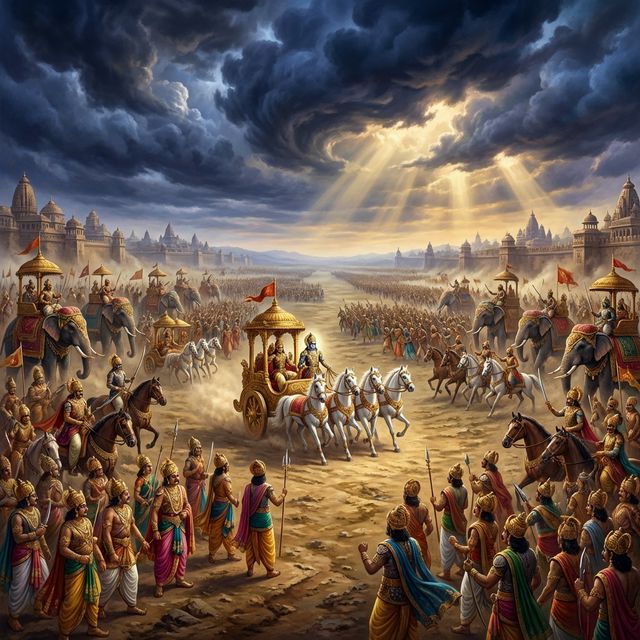
The King They Thought Was Dead
Bhima's mace crushes Duryodhana's chariot, and both armies believe the Kuru king killed
The Order Given at Dead of Night
Sanjaya was telling it to a blind king in a hall, and he had come to the part of the war that no one had planned for: a battle that did not stop when the sun went down.
It was the fourteenth night. Arjuna had killed Jayadratha before dusk and the armies had gone on fighting into the dark, and lamps had been carried onto the field, so that men killed each other by the light of oil and torches held up by servants who had no other business there. The carnage, Sanjaya said, was indiscriminate. Nobody could see far enough to be careful.
In the middle of it Yudhishthira gathered the Pandavas and the Panchalas and the Somakas around him and gave them one instruction, and it was not a complicated one.
"Proceed ye against Drona only, for slaying him."
That was the whole of the order. Not hold the line, not push the wing, not stay alive until morning. The teacher who had held the Kaurava command since Bhishma fell was to be reached and killed, and everything else on that field was in the way.
At the king's command the Panchalas and the Somakas ran at Drona alone, shouting.
"And ourselves, excited with rage," said Sanjaya, "and loudly roaring in return, rushed against them, to the best of our prowess, courage, and might."
So the night sorted itself into single combats, each one an attempt to stop a man who was trying to get to Drona. Kritavarman took Yudhishthira. Karna took Sahadeva. Shakuni took Nakula. Kripa took Shikhandi. Alambhusha the rakshasa took Arjuna. Duryodhana himself went out against Bhima, who was coming on in his car like the Destroyer.
And a Kuru prince named Bhuri, a son of the old king Somadatta and a grinder of foes in battle, put himself in front of Satyaki, the grandson of Shini, who was advancing scattering arrows on every side like an elephant going down to a lake full of water.
Elephant riders ground each other to pieces by the thousand. Horsemen with lances and darts and swords shouted and could not see who they were shouting at. At dead of night, Sanjaya said, the steeds rushing at one another looked like winged hills.
Bhuri and the Dart
Satyaki opened the exchange with five keen shafts into Bhuri's chest, and the blood began to come.
Bhuri answered in kind, ten shafts into the chest of a man reckoned difficult to defeat in battle, and shot them fast. Then the two of them drew their bows to the fullest stretch, with their eyes red in wrath, and set about mangling each other.
Sanjaya, who had watched a great many of these, said the arrowy downpour of those two was exceedingly terrible: both men excited with rage, each resembling Death himself, or the sun scattering his rays. Each shrouded the other with shafts. Each stayed where he was and would not give ground. For a short while, he said, that battle proceeded equally, which on a night like that one meant that neither man could be got at.
Then Satyaki, excited with rage and smiling the while, cut off the bow of the Kuru warrior.
Having cut it, he did not wait. Nine keen arrows went into Bhuri's chest, and Satyaki called across at him the two words men on that field kept calling to each other in the dark.
"Wait! Wait!"
Bhuri, deeply pierced, took up another bow within the moment and pierced the Satwata hero in return. Three shafts into Satyaki, and then, smiling in his turn, a sharp broad-headed arrow that cut Satyaki's bow in two.
That was the mistake, though it looked like the winning stroke. A bow can be replaced in the twinkling of an eye, and Satyaki did not reach for one. His bow gone, maddened with rage, he took up a dart and hurled it with everything he had at the broad chest of Bhuri.
It went in. Pierced with that dart, the son of Somadatta fell down from his excellent car covered with blood, like the sun dropping out of the firmament.
The house of Bahlika had lost another of its princes, in the dark, in a duel that had been even a minute earlier. And the man who had killed him was still standing on his car without a bow in his hands.
Wait, Son of Drona
Ashwatthama saw Bhuri go down.
Drona's son had spent that night doing what nobody else on either side could do, and he was in a state to punish somebody for it. He rushed impetuously at the grandson of Shini, and he used the same two words.
"Wait, wait."
Then he shrouded Satyaki with showers of shafts, Sanjaya said, like clouds pouring torrents of rain on the crest of Meru.
Satyaki had no bow. What arrived instead was a rakshasa.
Ghatotkacha was Bhima's son by the rakshasa woman Hidimba, got in the forest years before the war, and he had grown into the one warrior in either army who was stronger by night than by day. Darkness was his own hour, and he had a hundred kinds of illusion in him. He had been fighting Ashwatthama earlier in that same night. Now he saw the son of Drona bearing down on a disarmed man, and he roared.
"Wait, wait, O son of Drona. Thou shalt not escape from me with life. I will presently slay thee like the six-faced Karttikeya slaying the Asura Mahisha. I shall today, on the field, purge thy heart of all desire of battle."
Skanda of the six faces killed the buffalo demon Mahisha when the gods themselves had failed at it, and every man within hearing knew the story, and knew what was being promised.
Having said it, Ghatotkacha rushed at Ashwatthama with his eyes red like copper in wrath, like a lion going at a prince of elephants. He sped shafts as thick as the axle of a car and covered that bull among car-warriors with them, like clouds pouring torrents of rain.
Drona's son dispelled the whole shower before it could reach him. His own shafts went out like snakes of virulent poison and met the axle-thick arrows in the air and broke them there. Then he pierced Ghatotkacha with hundreds of keen and swift-coursing arrows, all of them capable of penetrating the very vitals.
Stuck full of them, said Sanjaya, the rakshasa looked beautiful on that field, like a porcupine with its quills erect.
Fireflies in the Welkin
Then the son of Bhimasena, filled with rage, went at Drona's son with the whole contents of his quiver.
He mangled him with fierce arrows that whizzed through the air with the roar of thunder. He rained down shafts of every kind there is: some equipped with heads like razors, some shaped as the crescent, some only pointed, some frog-faced, some with heads resembling the ear of a boar, some barbed, and others of other species again. It was not a display. A rakshasa fighting at night throws everything he has, because the night is his and he does not expect to have to husband anything.
Ashwatthama stood in it without his senses being agitated.
He answered it the way the wind answers mighty masses of cloud. His own terrible arrows, inspired by mantras with the force of celestial weapons, went up into that fierce, unbearable and unrivalled shower and destroyed it in the air, and the shafts that had been falling incessantly upon him stopped falling.
What the two armies saw then, looking up, was not a duel between men at all. It seemed, Sanjaya said, that another encounter was taking place in the welkin between the weapons themselves, as though the arrows had become the combatants, and it was terrible, and it filled the warriors with awe.
Sparks came off the clash. Iron striking iron overhead, hundreds of strokes in a moment, and the sparks scattered all around, so that the sky above that part of the field looked beautiful, illumined as if by myriads of fire-flies in the evening.
That is the image Sanjaya chose, and he chose it deliberately, because it is a thing men see on a summer night in a field outside a village, and because the men making it were killing each other.
Then Drona's son filled all the points of the compass with his shafts and shrouded the rakshasa entirely, doing it, Sanjaya said, for the pleasure of Dhritarashtra's sons, who were watching from their cars.
And the battle between the two of them started over again on that night of thick darkness, and it resembled, said the old charioteer, the encounter between Sakra and Prahlada.
The Man Holding the Flagstaff
Ghatotkacha, filled with rage, struck Drona's son on the chest with ten shafts, each of them resembling the Yuga-fire that burns the world at the end of an age.
Ashwatthama began to tremble like a tall tree shaken by the wind.
He did not fall. He reached out and got hold of the flagstaff of his own car and held on to it, and then his senses went, and he swooned standing up, with the standard of his house in his fist.
The whole Kaurava army made one sound at that. Cries of Oh and Alas went along the line, and Sanjaya, who was standing where he could see it, said plainly what his own warriors believed in that moment: all of them regarded Drona's son as slain. The Panchalas and the Srinjayas, seeing the same thing from the other side, uttered leonine roars.
For a few breaths, on a battlefield lit by lamps, the invincible man was dead.
Then he recovered his senses.
He had no time to be careful about it. He drew the bow forcibly with his left hand, stretched the string all the way to his ear, and shot one terrible shaft resembling the rod of Yama himself, aiming at Ghatotkacha.
That excellent shaft, fierce and equipped with golden wings, went through the rakshasa's chest and out of his back and entered the earth.
Ghatotkacha, who a moment before had been standing over him, sat down on the terrace of his own car with his senses gone.
His charioteer looked at Drona's son and was afraid, and did the only sensible thing a driver can do. He took the horses and got his master out of there, bearing Hidimba's son away from the presence of Ashwatthama with the prince slumped behind him.
Ashwatthama uttered a loud roar. Duryodhana's men came to him, and the warriors of the whole army worshipped him where he stood, and Sanjaya said his body blazed up like the midday sun.
It was still the middle of the night.
Five Bows
Bhima was fighting in front of Drona's car, which is where a man goes who intends to obey Yudhishthira's order, and Duryodhana came to stop him himself.
The king opened with many whetted shafts. Bhima pierced him back with nine. Duryodhana pierced Bhima with twenty. Covered with each other's arrows on that field, Sanjaya said, those two looked like the sun and the moon covered with clouds in the firmament, which is as close as he ever came to saying that they were equals.
Then Duryodhana put five winged arrows into Bhima and called out the two words.
"Wait! Wait!"
Bhima cut off his bow and his standard with keen shafts and put ninety straight arrows into the Kuru king.
Duryodhana, filled with rage, took up a more formidable bow and afflicted Bhima with whetted shafts at the van of the battle, in the very sight of all the bowmen, where everyone could see who was doing what to whom. Bhima baffled the shafts and answered with five and twenty short arrows.
And here Duryodhana found the thing he was better at than his cousin.
Excited with wrath, he cut off Bhimasena's bow with a razor-faced arrow, and pierced Bhima with ten shafts while his hands were empty. Bhima took up another bow and got seven keen shafts away, and Duryodhana, displaying great lightness of hand, cut that bow too.
The second, the third, the fourth, and the fifth bow that Bhima took up were similarly cut off.
That is the sentence Sanjaya gives it, and it is worth reading slowly, because it is the one passage in the war where Duryodhana outshoots Bhima in front of both armies and goes on doing it. Proud of his prowess and desirous of victory, said Sanjaya, thy son cut off Bhima's bow as soon as the latter took up one. Five times a man reached down for a weapon, and five times it was ruined in his hands before he could use it, in the lamplight, with the whole Kuru host watching their king do it.
Bhima stopped reaching for bows.
The Mace, and the King They Thought Was Dead
What he took up instead was a dart made wholly of iron and hard as the thunder. It blazed like a flame of fire, and Sanjaya called it the sister of Death, and Bhima threw it.
Duryodhana cut it out of the air.
He did it in the very sight of all the warriors and before the eyes of Bhima himself, and he did not merely knock it down. He cut that dart into three fragments as it came at him through the welkin with the splendour of fire, dividing it, Sanjaya said, as though by a straight line, such as is visible on the head of a woman parting her tresses.
It was the finest thing Duryodhana did in the whole of that war, and it bought him nothing at all, because Bhima had one weapon left and it was the one he had been born for.
He whirled the heavy blazing mace and hurled it with great force at the car of Duryodhana.
The mace crushed the steeds. It crushed the driver. It crushed the car. In one stroke there was nothing left standing where the king of the Kurus had been shooting from, and the king himself, afraid of Bhima and shrinking within the narrowest compass, scrambled off the wreck and got up onto another car, that of the illustrious Nandaka, and put a stranger's chariot between himself and his cousin.
In the darkness Bhima could not see any of that. He saw the car go to pieces and he did not see a man come out of it.
So he took Suyodhana to be dead, and threw back his head, and uttered a loud leonine roar, challenging the Kauravas to come and answer for their king.
Duryodhana's own warriors, hearing that roar and seeing the wreck, believed it too. Cries of Oh and Alas went up along the Kaurava line for the second time that night.
And far off across the field Yudhishthira heard the wailing of the affrighted warriors with the roar of Bhima on top of it, and he also regarded Suyodhana as slain, and turned his car and rushed quickly to the place where Vrikodara was.
The Panchalas and the Srinjayas and the Matsyas and the Kaikeyas and the Chedis went forward with all their might against Drona, because the order still stood.
There too a dreadful battle began. And the combatants of both sides, said Sanjaya, enveloped in thick gloom, struck and slew one another.
Dharma Lesson
Duryodhana fought better than Bhima that night. He cut five bows out of his cousin's hands and divided a hurled dart as cleanly as a comb divides hair, and none of it counted, because Bhima only had to land once. Skill can win every exchange in a contest and still lose the contest, when what is at stake is not points but a life. The wailing that went up when the car broke is worth noticing too. On both sides men believed the war had just ended, and they were wrong, and they went back to killing each other in a darkness that hid the truth from everybody equally.