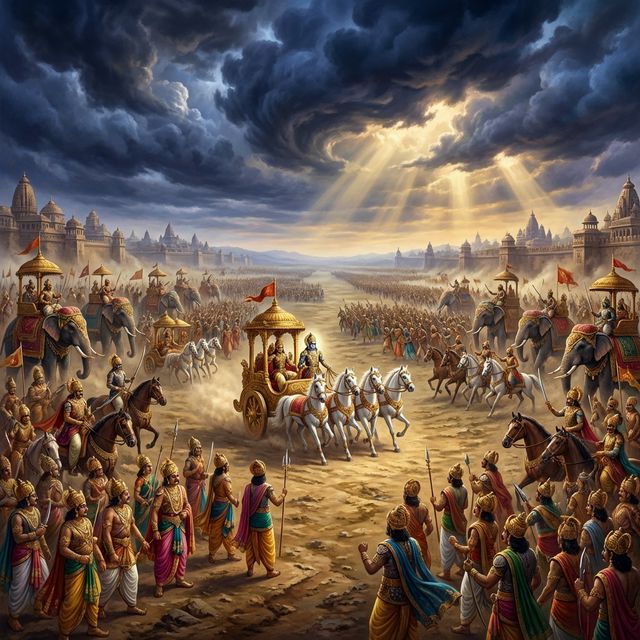
The Brahma Weapon Answered
Drona empties the celestial arsenal at Yudhishthira on the fourteenth night, and the king matches him astra for astra
Four Men in the Torchlight
Sanjaya said: "Beholding the sons of Drupada, as also those of Kuntibhoja, and Rakshasas too in thousands, slain by the son of Drona, Yudhishthira and Bhimasena, and Dhrishtadyumna the son of Prishata, and Yuyudhana, uniting together, set their hearts firmly on battle."
It was the night that followed the fourteenth day. The sun had gone down on Jayadratha's death and neither army had consented to stop, so lamps were lit on the chariots and the elephants carried torches on their backs, and the war went on in a light that showed a man only what was directly in front of him. In that light the Rakshasas fought best, and Ghatotkacha had come out with a full akshauhini of them, and Ashwatthama had burned the whole of it. He had killed Drupada's sons Suratha and Satrunjaya. He had killed the ten sons of Kuntibhoja with ten arrows. He had put a shaft through Ghatotkacha's chest and left him for dead on the floor of a chariot, and the Siddhas and the Gandharvas and the Pisachas in the air above the field had all applauded him for it.
So there was a hole in the Pandava line where an army had been, and four men closed it: the king; his brother Bhima; the prince of the Panchalas who had been born out of a fire for the express purpose of killing Drona; and Yuyudhana of the Vrishnis, whom both armies called Satyaki.
Sanjaya was telling this in a hall at Hastinapura to a blind man who wanted to know how his sons had died. He told it in order, and the order that night began with an old man named Somadatta.
The Parigha and the Shaft
Somadatta was an old king of the Kuru line, and that same afternoon Satyaki had cut off his son's head.
The son was Bhurisravas. Arjuna had shorn away his sword-arm with an arrow while he had Satyaki pinned under his knee, and Bhurisravas, robbed of the arm, had spread a seat of arrows on the field and sat down on it in praya, the vow of a man who has resolved to fast until he dies. Satyaki had got up and killed him where he sat. Somadatta had said to him afterwards, in front of everybody, that he had abandoned the duties of a kshatriya and taken up the practices of robbers.
Now, seeing that Satwata hero in front of him again, Somadatta covered him with a dense shower of arrows, and there began a battle that Sanjaya called fierce and exceedingly wonderful to behold, both parties solicitous of victory and neither able to see far.
Bhima came in on Satyaki's side and pierced the Kaurava hero with ten shafts. Somadatta answered with a hundred. Then Satyaki, filled with rage, pierced with ten keen shafts endued with the force of the thunder that old warrior who was afflicted with grief on account of the death of his son, and who was, besides, endued with every estimable virtue, like Yayati the son of Nahusha. Having pierced him with great force, he struck him once more with seven.
Then two things left two hands in the same moment. Bhima hurled at Somadatta's head a parigha, a new one, hard and terrible, the iron-bound club that is made for breaking gates. Satyaki shot at his chest an excellent shaft, keen, equipped with goodly wings, resembling fire itself in splendour.
The club and the arrow fell together upon the body of that mighty car-warrior, and he went down on the terrace of his car and did not get up again.
The Old Man of Pratipa's Line
Somadatta had a father, and his father was on the field.
Valhika, the son of Pratipa, was an old man even by the reckoning of that house, of the generation before Bhishma's, one of the elders who had sat in the assembly hall at Hastinapura on the day a woman was dragged into it and had said nothing that stopped anything. Three generations of the one family were fighting that night, and by the middle of it the grandson was dead and the son was lying senseless on his chariot floor.
Beholding his son thus fallen into a swoon, Valhika rushed at Satyaki, scattering showers of arrows like a cloud in season.
Bhima put himself in the way again. For Satyaki's sake he afflicted the illustrious Valhika with nine shafts and pierced him with them at the van of the battle. The old man was not to be handled in that fashion. Filled with great fury, the mighty-armed son of Pratipa hurled a dart at Bhima's chest, as Purandara hurls the thunder, and Bhima, struck with it, trembled where he stood and swooned away.
There was a gap in the fighting then, a few breaths long, in which the strongest man in either army stood upright and unconscious behind his horses while an old king shot at him.
Then Bhima recovered his senses and took up a mace.
He hurled it, and that mace snatched away the head of Valhika, who fell down lifeless on the earth like a tree struck down by lightning.
He was the last of Pratipa's line standing on that field. Ten of Duryodhana's brothers were near enough to watch it happen, and they came.
Ten Arrows for Ten Brothers
They were ten sons of Dhritarashtra, and Sanjaya, who had watched them grow up, said that each of them was equal in prowess to Rama the son of Dasaratha.
He named them for their father, one after another, the way a man reads out a list he cannot bring himself to summarise. Nagadatta. Dridharatha. Viravahu. Ayobhuja. Dridha. Suhasta. Viragas. Pramatha. Ugrayayin.
Upon the slaughter of that bull among men, Valhika, they came at Bhima together and began to afflict him. Beholding them, Bhimasena became filled with rage. He took up a number of arrows, each capable of bearing a great strain, and he aimed at each of the brothers one after another, in turn, without hurry, and sped those arrows at them, striking each in his vital part.
Pierced therewith, they fell down from their cars, deprived of energy and life, like tall trees broken from mountain cliffs by a tempest.
Ten shafts, ten princes. It was the arithmetic Bhima had been performing all through that fortnight, and he had announced it publicly before the war began, in an assembly hall, with a vow in his mouth: that every son of Dhritarashtra would be killed by his hand. He was well past the halfway mark of the hundred by that night, and the men still standing on both sides kept the count as carefully as he did.
Having with those ten shafts slain those ten sons of yours, Sanjaya said, Bhima shrouded the favourite son of Karna with showers of arrows, and did not stop moving.
Karna's Brother, and Shakuni's
Vrikaratha, the brother of Karna, saw the arrows going into the boy and came between, and pierced Bhima with many shafts. The mighty Pandava, Sanjaya said, soon disposed of him effectually. That is the whole of what the account gives him. A man came out of the dark to save his nephew, and the record closes over him in a single line.
Then Bhima went into the division of the king's brother-in-law, which is to say Shakuni's own people, the Gandharas who had come east with him and stayed. He slew seven car-warriors among them with his shafts. He pressed Satachandra down into the earth.
Unable to bear the slaughter of that mighty car-warrior, five of Shakuni's brothers rushed towards Bhimasena and attacked him with their keen shafts: Gavaksha, and Sarabha, and Bibhu, and Subhaga, and Bhanudatta. They came at him the way torrents of rain come at a mountain, from every side, which is the comparison Sanjaya chose for that particular kind of futility.
Bhima slew those five mighty kings with five shafts of his.
Beholding those heroes slain, many great kings began to waver.
That is the sentence in the account that matters, and it is easy to read past. It does not say the line broke. It says that on the Kaurava side, in the dark, with the torches burning low and the dead of one family lying in a row, the kings who had brought their own armies from their own countries to fight for Duryodhana began to lose their conviction.
And it was into that wavering, in the sight of the Pot-born himself and of Dhritarashtra's sons, that Yudhishthira drove his chariot.
The King Nobody Expected
Yudhishthira was not the fighter of that family. Arjuna was the bowman, Bhima was the arm, and the eldest was the one who held the whole enterprise together by being what he was, which was a man so exact about dharma that his own brothers found him difficult to live beside. Drona had also sworn, in front of Duryodhana, to take him alive, and the Kauravas had spent days trying to make that promise good, so the king had been kept behind a screen of guards for most of the war, like a piece being protected on a board.
That night he came out from behind them.
Filled with wrath, he began to destroy the Kaurava ranks in the sight, Sanjaya said, of the Pot-born and of your sons. With his shafts he began to despatch to the regions of Yama the Amvashthas, the Malavas, the brave Trigartas and the Sivis. Cutting off the Abhishahas, the Surasenas, the Valhikas and the Vasatis, he caused the earth to be miry with flesh and blood. Within a trice, by means of many shafts, he sent the Yaudheyas and the Malavas and large numbers of the Madrakas to Yama's domains.
These are nations, not men. The account stops naming individuals because there were no longer individuals in front of him to name.
Then a loud uproar arose in the vicinity of Yudhishthira's car, and out of the uproar the same words kept surfacing, shouted by men who could not see who was giving the orders. Slay. Seize. Capture. Pierce. Cut into pieces.
Duryodhana heard it, and understood what was happening to his flank, and turned to the only man on that field who could stop it.
Beholding him thus slaying and routing the troops, Sanjaya said, Drona, urged on by your son, shrouded Yudhishthira with showers of shafts.
Wind Against Wind
What began then was not ordinary archery, and every man on that field knew it as soon as it started.
An astra is not a special arrow. It is an ordinary shaft into which a warrior calls a power by mantra, having received the mantra from a teacher, having earned the right to it by austerity, and having also been taught the words that withdraw it again. There were perhaps a dozen men living who could do this at all. Two of them were now facing one another across a few hundred paces of torchlit ground, and one of them had taught the other.
Drona, filled with great wrath, struck Yudhishthira with the Vayavya weapon, which belongs to Vayu, and which is the wind made into a thing that can be aimed.
The son of Pandu, however, baffled that celestial weapon with a similar weapon of his own. Wind met wind and the two of them went out together in the air above the dead.
Seeing his weapon baffled, the son of Bharadwaja, filled with great wrath and desirous of slaying the son of Pandu, sped at Yudhishthira diverse celestial weapons one upon another: the Varuna, which is the water; the Yamya, which belongs to the lord of the dead; the Agneya, which is fire; the Tvashtra; and the Savitra, which is the weapon of the sun.
The mighty-armed Pandava, however, conversant with morality, fearlessly baffled all those weapons of the Pot-born that were hurled or in course of being hurled at him.
That last clause is the whole of Yudhishthira's standing as a bowman, and it is Sanjaya, a Kaurava's man reporting to a Kaurava's father, who hands it to him. The king was not merely surviving the weapons. He was answering some of them while they were still leaving the string.
The Brahma Weapon
Drona had vowed to take this man alive. Duryodhana had accused him to his face of never intending to finish the war at all, of sparing the sons of his old pupils out of affection, and Drona, an old brahmana who had come to that field for a wage and a grudge, had been carrying the accusation about with him for days.
So the Pot-born, striving to accomplish his vow and desirous also of your son's good, now set himself to kill the son of Dharma. He invoked into existence the Aindra weapon, which is Indra's, and the Prajapatya, which belongs to the lord of creatures.
Then that foremost one of Kuru's race, Yudhishthira, of the gait of the elephant or the lion, of broad chest and large red eyes, endued with energy scarcely inferior to Drona's own, invoked into existence the Mahendra weapon. With that he baffled the weapon of his teacher.
Seeing all his weapons baffled, Drona, filled with wrath and desirous of accomplishing the destruction of Yudhishthira, invoked into existence the Brahma weapon.
There is nothing above it. It is the weapon that carries the Creator's name, the one an archer is taught last if he is taught it at all, and the books are careful to say that it must never be loosed upon an ordinary man, because it does not stop at the man it is aimed at.
Enveloped as we then were by a thick gloom, Sanjaya said, we could not observe what passed. All creatures also, O monarch, were filled with great fright.
The torchlight went out of that field. Two armies stood in a darkness they could not see through, and every living thing on the plain understood that something had been called down which answered to nobody.
Beholding the Brahma weapon uplifted, Kunti's son Yudhishthira baffled it with a Brahma weapon of his own.
Then, Sanjaya said, all the foremost warriors applauded those two bulls among men, Drona and Yudhishthira, those great bowmen acquainted with every mode of warfare.
Both armies. The men who had spent a fortnight trying to capture the king clapped for him in the dark, and clapped for the teacher with him, because something had been done in front of them that they would not see done again.
The Panchalas Run
Nothing came of it. That is what an even contest of celestial weapons produces: applause, and not one thing on the ground altered by it.
Abandoning Yudhishthira, Drona then, with eyes red as copper in rage, began to consume the division of Drupada with the Vayavya weapon. He could not have his pupil, so he took the Panchalas, who were the men he had been born to hate and who had been born to kill him. Oppressed by Drona, they fled away from fear, in the very sight of Bhimasena and of the illustrious Partha.
Then the diadem-decked Arjuna and Bhimasena, checking that flight of their troops, suddenly encountered that hostile force with two large throngs of cars, Vibhatsu attacking on the right and Vrikodara on the left, so that Bharadwaja's son was met with two mighty showers of shafts at once. The Kaikeyas, the Srinjayas and the Panchalas of great energy followed the two brothers, and the Matsyas and the Satwatas came after them.
Then the Bharata host began to break, and Sanjaya named the two reasons to the blind king without softening either of them.
They were slaughtered by the diadem-decked Arjuna, he said, and they were overcome with sleep and darkness.
They had been fighting since sunrise and it was now the small hours of a night nobody had agreed to. Drona tried to rally them. Duryodhana himself tried to rally them. The combatants, however, were incapable of being then checked in their flight, and they went back through their own lines in the dark, past the burnt ground where the Rakshasas had died, while somewhere behind them the two men who had exchanged the Brahma weapon and been applauded for it were already looking about for somebody else to fight.
Dharma Lesson
Yudhishthira is remembered for his patience and his scruples rather than for his bow, and the epic itself keeps him behind a screen of guards for most of the war. Yet when the teacher who taught him spends the entire celestial arsenal on him, he answers every weapon in turn, and it is the enemy's own herald who records it. Skill that is never displayed is still skill, and the men who applauded that night were applauding something they had never credited him with. The duel shows what a vow costs as well: Drona had sworn to take this man alive, and by the fourteenth night he was reaching for the weapon that spares nothing.