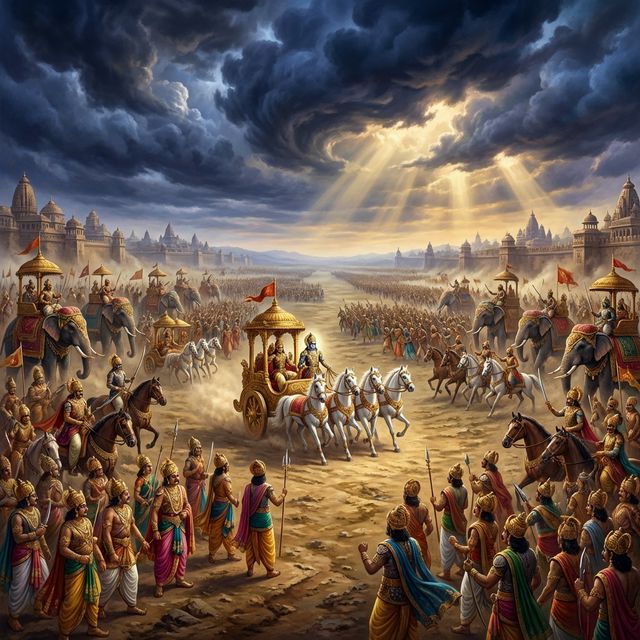
The Seven Winds
Vyasa halts a recitation on the Himavat and names the winds that move the worlds
Permission to Go Down
Bhishma had been telling the story of Shuka since the morning, and by now it had carried the two of them a long way from the field where he was lying.
Shuka was the son Vyasa had struck out of the fire sticks. He had gone to Mithila with a question about emancipation, he had heard king Janaka answer it, and he had asked nothing further. He had gone north instead, to the mountains of Himavat, with the speed of the wind and like the wind, and at the foot of those mountains, in a retired spot, he had found his father teaching the Vedas to four disciples: Sumantra, Vaisampayana, Jaimini of great wisdom, and Paila of great ascetic merit. Shuka came in among them like a shaft let from a bow, so light on the ground that he did not seem to touch the trees or the rocks, and he touched his father's feet and told him everything that had passed in the court of the king.
So there were five students on that mountain, and the recitation went on there day after day, and one day the four disciples had asked their preceptor for a boon and had been given instead the rules by which the Vedas are to be taught: that they are for the man who is willing to become a disciple, that a student is to be tested as gold is tested by heat and cutting and rubbing, and that no teacher should set his students to tasks that are fraught with danger.
They heard him out, and then they embraced one another.
"That which has been said by our illustrious preceptor in view of our future good will live in our remembrance," they said to each other, "and we shall certainly act according to it."
Then they came back to him with joyful hearts, being thorough masters of words, and asked for the thing they had been working toward all along.
"If it pleases thee, O puissant one, we wish to descend from this mountain to the Earth, O great ascetic, for the purpose of subdividing the Vedas."
Vyasa did not keep them.
"You may repair to the Earth or to the regions of the celestials, as ye like. You should always be heedful, for the Vedas are such that they are always liable to be misunderstood."
They walked round him, bowed their heads, and went down.
A Mountain Without Vedic Sound
On the Earth the four did exactly what they had asked leave to do. They performed the Agnishtoma and the other sacrifices. They officiated at the rites of Brahmanas and Kshatriyas and Vaisyas. They passed their days happily in the domestic mode of life and were treated by the Brahmanas with great respect, and they grew famous and prosperous, employed in teaching and in officiating at fires all over the world. The Vedas spread, which is what their preceptor had told them to do.
Behind them the asylum went quiet.
Vyasa remained there with only his son for company. He passed his days in anxious thoughtfulness, and he kept silent, sitting in a retired corner of the hermitage, a man of great wisdom with nothing in front of him to say it to.
Into that silence came Narada, who goes everywhere, and who noticed at once what was missing.
"O regenerate Rishi of Vasishtha's race, why are Vedic sounds silent now? Why art thou sitting silent and alone, engaged in meditation like one taken up with an engrossing thought? Alas, shorn of Vedic echoes, this mountain hath lost its beauty, even as the Moon shorn of splendour when assailed by Rahu or enveloped in dust. Though inhabited by the celestial Rishis, yet shorn of Vedic sounds, the mountain no longer looks beautiful now, but resembles a hamlet of Nishadas. The Rishis, the deities, and the Gandharvas too no longer shine as before, in consequence of being deprived of Vedic sound."
The Island-born answered him without defending himself.
"O great Rishi, thou art conversant with the declarations of the Vedas, and all that thou hast said is agreeable to me, and it truly behoves thee to say it unto me. Thou art omniscient, thou hast seen everything. All that has ever occurred in the three worlds is well known to thee. Do thou then set thy commands on me. Tell me what I am to do. Separated from my disciples, my mind has become very cheerless now."
Narada gave him a list of four things and a single instruction.
"The stain of the Vedas is the suspension of their recitation. The stain of the Brahmanas is their non-observance of vows. The Valhika race is the stain of the Earth. Curiosity is the stain of women. Do thou with thy intelligent son recite the Vedas, and do thou with the echoes of Vedic sounds dispel the fears arising from Rakshasas."
Vyasa, who was firmly devoted to Vedic recitation, was filled with joy and said, "So be it."
The Wind That Stopped the Recitation
So the sound came back to the mountain, and it came back from two throats instead of six.
Father and son set themselves to recite the Vedas in a loud sonorous voice, observing all the rules of orthoepy, letter by letter and accent by accent, and between them they filled the three worlds with that sound. Both of them were well conversant with all duties. Neither of them hurried. This went on for days.
Then, on one of those days, while they were in the middle of a recitation, a violent wind arose.
It did not come like the ordinary wind of a mountainside. It seemed to be impelled by the gales that blow on the bosom of the ocean, and it came up the slope of the Himavat and shook it, and the whole of that great mountain moved under a thing that could not be seen.
Vyasa stopped at once. He understood from the circumstance what the hour had become, and he bade his son suspend the recitation, and the Vedic sound broke off in the middle of the mountain that had just got it back.
Shuka fell silent because he had been told to. Then he became filled with curiosity, which is a thing the story has been careful to record about him more than once.
"O regenerate one, whence is this wind? It behoveth thee to tell me everything about the conduct of the Wind."
Vyasa was filled with amazement.
It was not the question that amazed him. It was who was asking it. This was the son who had already been told by a king what emancipation was and had needed nothing further, who had come up the mountain barely touching the ground, who was completely dissociated from all objects of the senses. Such a man is not supposed to still want to know where a wind comes from. And yet the wind had shaken a mountain in the middle of a Veda, and the boy had asked, and there was an answer, and the answer was long.
His father began by telling him first that this was an omen: a sign that the recitation of the Vedas was to be suspended. Then, instead of stopping there, he told him the rest.
Two Paths, and the Breath That Fathered Breath
"Thou hast obtained spiritual vision," Vyasa said. "Thy mind too has of itself become cleansed of every impurity. Thou hast been freed from the attributes of Passion and Darkness. Thou stayest now in the attribute of Goodness. Thou beholdest now thy Soul with thy Soul, even as one beholds one's own shadow in a mirror. Staying thyself on thy own Soul, do thou reflect on the Vedas."
Then he laid down the two roads before describing the winds that blow along them.
"The path of the Supreme Soul is called Deva-yana, the path of the gods. The path that is made up of the attribute of Tamas is called Pitri-yana, the path of the Pitris. These are the two paths in the world hereafter. By one, people go to heaven. By the other, people go to hell.
"The winds blow on the Earth's surface and in the welkin. There are seven courses in which they blow. Listen to me as I recount them one after another."
He began not with the sky but with the body, because the two are the same account told at two sizes. The body is furnished with senses, and those senses are dominated over by the Sadhyas and by many great beings of mighty strength, and from that source came a son who could not be conquered, and his name was Samana. From Samana sprang Udana. From Udana sprang Vyana. From Vyana arose Apana, and last of all, from Apana, sprang the wind that is called Prana.
And Prana, that invincible scorcher of all foes, became childless. The line stops there. There is no eighth breath waiting to be born.
"The wind is the cause of the different functions of all living creatures," Vyasa said, "and because living creatures are enabled to live by it, therefore is the wind called Prana, which is to say life."
That is the hinge of the whole teaching, and it is worth holding on to before the catalogue begins. What is about to be described is weather. Clouds, lightning, the rising of the moon, rain, storms that break trees, the wind that holds up the celestial Ganga. And every one of them is also something happening inside the chest of the man being told about it, at that moment, on that mountain, while he holds his recitation.
"I shall now recite to thee the different functions of those winds."
Pravaha, and Avaha
"That wind which is the first in the enumeration, and which is known by the name of Pravaha, urges along the first course the masses of clouds that are born of smoke and heat. Coursing through the welkin, and coming into contact with the water contained in the clouds, that wind displays itself in effulgence among the darts of lightning."
That is the first of the seven, and it is the one a man sees on any hot afternoon without knowing what he is looking at. The clouds that pile up out of smoke and heat do not walk to their places. Something drives them along a road. And when that same something meets the water they carry, it does not stay invisible: it shows itself, briefly, as the light inside the lightning. The wind is in the flash. It is the same wind that was moving the cloud a moment before, and the flash is the only part of the whole operation that the eye is allowed to catch.
Vyasa had said that within the body the winds carry other names, and Pravaha is the one the wise call Samana, the breath at the middle of a man, the one that keeps the fire of digestion going where the food is. What drives cloud along the sky drives food through the body, and what strikes as lightning is the same power, on a smaller stage, doing the same work.
"The second wind, called Avaha, blows with a loud noise. It is this wind that causes Soma and the other luminaries to rise and appear. Within the body, which is a microcosm of the universe, that wind is called Udana by the wise."
The moon does not simply come up. It is raised. So are the other lights, planet and star alike, and the wind that lifts them is not a quiet one: it goes with a loud noise, which is why the sky is never silent even on a still night if a man knows how to listen to it.
And the same wind, in a body, is Udana, the breath that goes upward. It is the one that carries speech out of a man's throat. So the power that lifts the moon over the ridge of the Himavat is the power that was lifting the Vedas out of Shuka's mouth an hour earlier, and there is no difference between them except scale.
Udvaha, and Samvaha
"That wind which sucks up water from the four oceans, and having sucked it up imparts it to the clouds in the welkin, and which, having imparted it to the clouds, presents them to the deity of rain, is third in the enumeration and known by the name of Udvaha."
Here is the whole water cycle, given as a chain of deliveries with a servant carrying the parcel at every stage. The wind goes down to the four oceans and draws the water up out of them. It hands what it has taken to the clouds. Then it does not stop there and let the rain happen by itself: it takes the loaded clouds and presents them, formally, to the god whose office is rain, the way a steward brings a full vessel to the master of a house. Nothing in the sequence is automatic. Every step of it is somebody carrying something to somebody.
"That wind which supports the clouds and divides them into diverse portions, which melts them for pouring rain and once more solidifies them, which is perceived as the sound of the roaring clouds, which exists for the preservation of the world by itself assuming the form of the clouds, which bears the cars of all celestial beings along the sky, is known by the name of Samvaha. The fourth in the enumeration, it is endued with great strength, so that it is capable of rending the very mountains."
The fourth wind is given more work than any of the others, and every item on its list is worth taking separately. It holds the clouds up. It breaks the mass of them into portions and drives the portions apart. It melts a cloud so that the rain falls out of it, and then it hardens the same cloud again so that there is something left to melt tomorrow. When thunder is heard, that sound is not a by-product of the cloud: the roar is the wind itself, perceived. And because the world would not last a season without rain, this wind exists for the preservation of the world, and to do that work it takes the form of the clouds, so that the thing carrying and the thing carried are one.
It has one more duty, and it is the one that shows what it is. The chariots of the celestials do not fly. They are borne along the sky by Samvaha. The wind that carries water is strong enough to carry gods, and strong enough, when it chooses, to rend a mountain apart.
Vivaha, and the Wind That Holds Up the Ganga
"The fifth wind is fraught with great force and speed. It is dry, and it uproots and breaks down all trees. Existing with it, the clouds come to be called by the name of Valahaka. That wind causes calamitous phenomena of many kinds, and produces roaring sounds in the firmament. It is known by the name of Vivaha."
This is the one everybody has met. It is dry, which is the first thing said of it and the worst, because a wind that carries no water takes water instead. It comes at speed. It pulls trees out of the ground by their roots and breaks the ones it cannot pull. The clouds that ride with it get a name of their own, Valahaka, and they are not the gentle sort. Its work is listed as calamitous phenomena of many kinds, and it announces itself with a roaring in the firmament before anybody sees what is coming.
Four of the seven, so far, have been busy with water and light and the movement of things through the sky. The sixth is different. Its whole office is to hold something back.
"The sixth wind bears all celestial waters in the firmament and prevents them from falling down. Sustaining the sacred waters of the celestial Ganga, that wind blows, preventing them from having a downward course."
Everything above is heavy, and it is not falling, and the reason it is not falling is a wind. The Ganga of the sky is held in the sky by nothing but this, and it blows continually to keep the river up.
Two other things follow from the same wind, and Vyasa gives them both.
"Obstructed by that wind from a distance, the Sun, which is really the source of a thousand rays and which enlightens the world, appears as a luminous body of but one ray. Through the action of that wind, the Moon, after waning, wanes again till he displays his full disc. That wind is known, O foremost of ascetics, by the name Parivaha."
So the sun a man looks at is not the sun. The thousand rays are all there, and this wind stands between at a great distance and lets one through, and the disc in the sky is what is left of a fire nobody could survive seeing whole. And the moon that thins away night after night is not dying. It is being worked upon by the same wind, and the wearing away runs on past the dark and comes back around into the full, so that waning and filling are one continuous action of one wind, and not two things at all.
Paravaha, the Last and Irresistible
"That wind which takes away the life of all living creatures when the proper hour comes, whose track is followed by Death and by Surya's son Yama, which becomes the source of that immortality which is attained by Yogins of subtile sight who are always engaged in Yoga meditation, by whose aid the thousands of grandsons of Daksha, that lord of creatures, by his ten sons, succeeded in days of old in attaining to the ends of the universe, whose touch enables one to attain to Emancipation by freeing oneself from the obligation of returning to the world, that wind is called by the name of Paravaha. The foremost of all winds, it is incapable of being resisted by anybody."
The seventh is the one that carries the breath out of a body at the appointed hour, and it is worth noticing the order in which it is described. The wind goes first. Death comes behind it, and Yama, the son of the Sun, comes behind that. Neither of them leads. They follow a track that has already been made, and the making of the track is not their work but the wind's, and it is done at the proper hour and not before.
Then the same sentence turns over, and the wind that ends life is called the source of immortality.
It is the road that the Yogins of subtile sight take, the ones always engaged in meditation, and they go along it while alive. It was the road that the grandsons of Daksha travelled, the thousands of them born of his ten sons, who by its aid reached the ends of the universe in days of old. And its touch, simply its touch, is enough to free a man from the obligation of coming back, which is what emancipation means and all that it means.
So the wind that kills and the wind that liberates are not two winds with a resemblance between them. They are one wind, doing one thing, met by different men in different conditions. It carries out whatever it comes to carry, and the difference is entirely in what it finds when it arrives.
"The foremost of all winds," Vyasa said again, because it needed saying twice, "it is incapable of being resisted by anybody."
There is no argument to make against it, no penance that holds it off, no weapon and no vow. Of the seven that move the worlds, six can be watched. This one can only be met.
The Breath of Vishnu's Nostrils
"Wonderful are these winds," Vyasa said, "all of whom are the sons of Diti. Capable of going everywhere and upholding all things, they blow all around thee without being attached to thee at any time."
That is the seven finished, and it is also the whole answer to the boy's question about the conduct of the Wind. They go everywhere. They hold everything up. And of the man they are blowing around at this moment, on this mountain, they take no hold whatever, which is precisely the condition Shuka had spent his life trying to reach.
Then Vyasa came back to the particular gust that had interrupted them.
"This, however, is exceedingly wonderful, namely, that this foremost of mountains should thus be suddenly shaken by that wind which has begun to blow. This wind is the breath of Vishnu's nostrils. When urged forth with speed, it begins to blow with great force, at which the whole universe becomes agitated."
The Himavat had moved. That was the thing that had made him stop the recitation, and now the reason for it was on the table: what had come up the slope was not one of the seven going about its business but a breath, taken by somebody, and the somebody was Vishnu, and when that breath is driven out hard the universe shakes with it.
And there is a rule that follows from it, which is the rule that had shut Shuka's mouth an hour before.
"Hence, when the wind begins to blow with violence, persons conversant with the Vedas do not recite the Vedas. The Vedas are a form of wind. If uttered with force, the external wind becomes tortured."
Two breaths were being driven at once, one out of a man's chest and one out of the nostrils of a god, and they are made of the same thing. The recitation is wind shaped into syllables. When the great wind is already blowing hard, a man who pushes his own out against it is not being pious. He is putting a strain on something enormous, and the mountain under him is evidence of what that something can do when it is agitated.
So they waited. The gale went over the Himavat and passed, and the trees stopped moving, and the air on the slope came back to rest.
Then the puissant son of Parasara bade his son go on with his Vedic recitation, and the sound started again in the place where it had broken off. And when it was going steadily, Vyasa rose and left that spot, and went down to plunge into the waters of the celestial Ganga, which are held up in the sky, and held there by the sixth wind.
Dharma Lesson
The seven winds are one power met in seven conditions, and the last of them, which takes life away at the appointed hour, is the same one whose touch sets a man free. Vyasa does not teach his son to master the wind or to stand against it; he teaches him to know when to stop reciting. The Vedas are themselves a form of wind, and forcing breath out against a breath already blowing is not devotion but strain. Wisdom here is a matter of timing rather than effort, and of recognising that what upholds everything holds on to nothing.