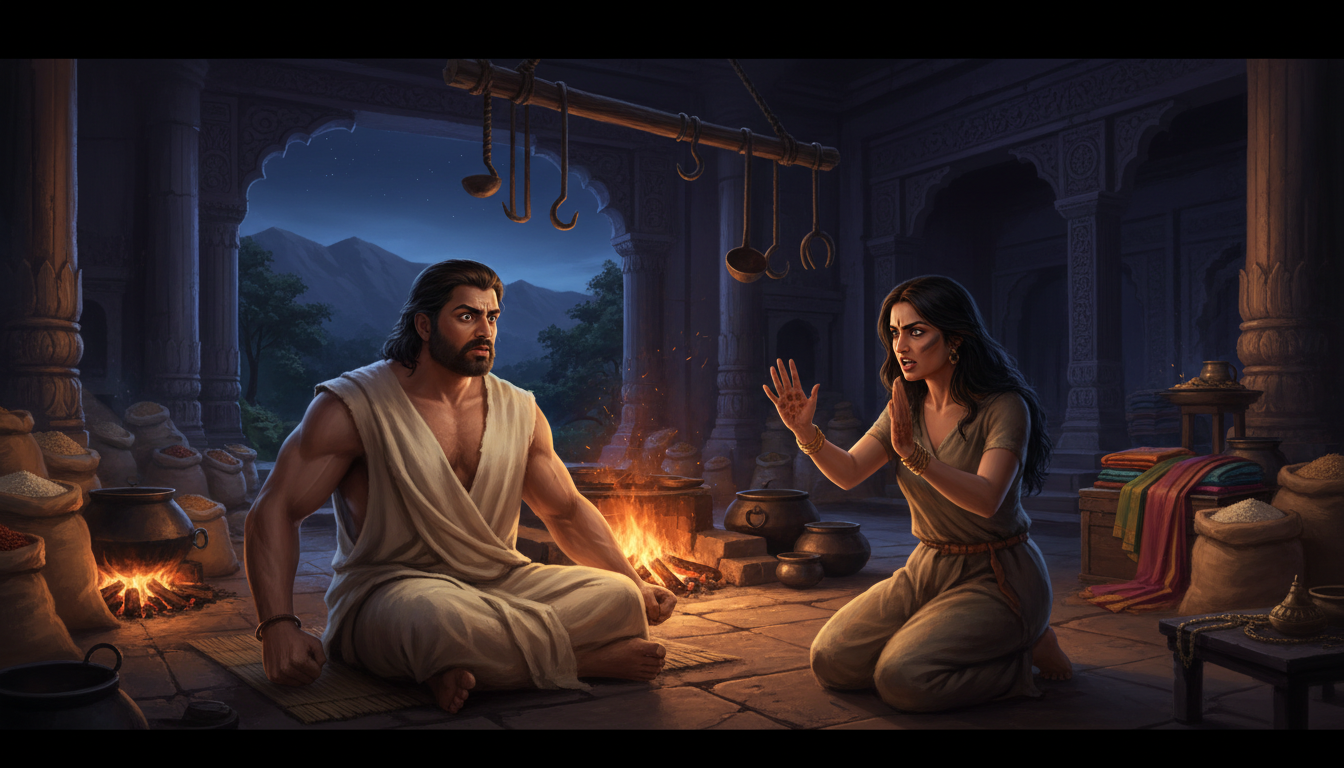
The Hands Marked With Corns
A night in the kitchen, and everything she had not said
Look For Trees For Fuel
Kichaka knocked her down on the floor of Virata's court and kicked her, in front of the king, in front of the courtiers, in front of the charioteers and the elephant riders and the citizens who had come in to watch the dice.
In the cook's place at the side of the hall, wrinkles appeared on Bhima's forehead and a smoky exhalation shot out of his eyes and his eyelashes stood on end. He pressed his forehead with both hands. He was already coming up off the ground when Yudhishthira, sitting at the board opposite the king with the dice in his fingers, squeezed his own thumbs together and looked at him.
"Are you looking for trees for fuel, cook?" said Yudhishthira mildly. "If you are in need of faggots, go outside and fell some."
Bhima sat down.
Draupadi came to the entrance of the court with her hair loose and her eyes burning, and she saw her husbands sitting there melancholy and keeping their disguises, and she spoke to Virata instead.
"The son of a Suta has kicked today the beloved wife of men whose enemy can never sleep in peace, though four kingdoms lie between him and them. He has kicked the wife of men who, if they were not fettered by the ties of a pledge, could destroy this entire world. Where are they today, those warriors who have always granted protection to whoever asked it? Why do they quietly suffer their wife to be insulted by a Suta's son? And what can I, one woman, do, when Virata himself, deficient in virtue, coolly permits my innocent self to be wronged? You do not act like a king toward this Kichaka. Your behaviour is that of a robber and does not shine in a court."
"I do not know what your dispute has been out of our sight," said Virata. "Not knowing the true cause, how can I show my discrimination?"
The courtiers, who had learnt everything within a minute, cried "Well done, well done" and censured Kichaka, and said among themselves that such a woman was surely a goddess, and did nothing else whatever.
Sweat stood on Yudhishthira's forehead. He did not look up from the board.
"Do not stay here, Sairindhri," he said. "Go to the apartments of Sudeshna. The wives of heroes bear affliction for the sake of their husbands. Your Gandharva husbands, effulgent as the sun, do not appear to consider this an occasion for showing their anger, since they have not rushed to your aid. You are ignorant of the timeliness of things, and so you weep like an actress, and interrupt the play of dice in Matsya's court."
"They whose wedded wife I am," she said, "are, I think, extremely kind. And as the eldest of them is addicted to dice, they are all liable to be oppressed by everybody."
And she ran out with her hair unbound.
Washing at Midnight
Sudeshna was still awake in her apartments when the Sairindhri came in with her face wet.
"Who has insulted you? Why do you weep? Who has done you wrong?"
"As I went to bring you wine, Kichaka struck me in the court, in the very presence of the king, as though we stood in the middle of a solitary wood."
"Since Kichaka, maddened by lust, has insulted one he cannot possess," said the queen, "I shall have him slain, if you wish it."
"Others will slay him," said Draupadi. "They whom he has wronged. I think it is clear that he will go to the abode of Yama this very day."
Then she went to her own quarters and washed her body and her clothes, because that is what the day had left her to do with her hands. And standing in the wet, Drupada's daughter began to weep and to turn the thing over.
What am I to do? Where shall I go? How can my purpose be effected?
The answer was very short. There was one man in that palace who would not tell her to be timely, and he was asleep at the other end of it.
So the princess of Panchala rose in the middle of the night and left her bed and walked through the sleeping house toward the quarters of Bhimasena, and the corridors were empty, and nobody stopped a serving woman going anywhere at that hour, which was one of the very few advantages her year had given her.
Waking Him in the Cooking Quarters
She found him in the cooking apartments, among the banked fires and the covered vessels, breathing hard like a lion in his sleep. And the chamber, filled all at once with the beauty of Drupada's daughter and of the high-souled Bhima, blazed forth in splendour.
She came to him the way a young cow of the woods comes to a great bull, and she put her arms around him as a creeper embraces a huge sala on the bank of the Gomati, and woke him as a lioness wakes a sleeping lion in a trackless forest.
"Arise. Arise. Why do you lie down like this, Bhimasena, as one dead? Surely a man who is not dead never lets a wicked wretch who has disgraced his wife go on living."
Bhima came up out of sleep, sat on the couch with its rich covering, and looked at her.
"Why have you come here in such a hurry? Your colour is gone. You look lean and pale." He took her by the shoulders. "Tell me everything in detail. I must know the truth. Whether it is pleasurable or painful, agreeable or disagreeable, tell me all. Having heard everything, I shall apply the remedy. I alone am entitled to your confidence in all things, for it is I who deliver you from perils again and again. Tell me quickly what your wish is, and what purpose you have in view, and then go back to your bed before the others wake."
She did not go back to her bed. She stood in the kitchen of another man's house and talked until the fires had gone grey, and it was the longest she had ever spoken to anyone in her life.
The Emperor Who Casts Dice
"What grief has she not," said Draupadi, "who has Yudhishthira for her husband? Knowing all my griefs, why do you ask me?
"The Pratikamin dragged me into the court in the midst of an assembly of courtiers and called me a slave. That grief consumes me. What other princess, save Draupadi, would live after suffering such misery? Who else could bear the second insult, which the wicked Saindhava offered me in the forest? Who else of my position could live, having been kicked by Kichaka in the very sight of the king of the Matsyas?
"Censure that elder brother of yours who is addicted to execrable dice, through whose act alone I have come to this. Who else, save a desperate gambler, would play away a kingdom and everything in it, including me? If he had gambled morning and evening for years together, staking nishkas by the thousand, his silver and gold and robes and vehicles, his goats and sheep and his multitudes of steeds and mares and mules would not have suffered any diminution at all. And now, stripped of prosperity by the rivalry of dice, he sits dumb like a fool, reflecting on his own misdeeds.
"He who was followed by ten thousand elephants with golden garlands now supports himself by casting dice. That Yudhishthira, who at Indraprastha was adored by kings by the hundred thousand; in whose kitchen a hundred thousand maidservants stood plate in hand, feeding guests day and night; who gave away a thousand nishkas every day; who maintained eighty-eight thousand household Snatakas with thirty maidservants apportioned to each, and ten thousand yatis who accepted nothing in gift; who was waited on by a thousand sages of ascetic merit as his courtiers, morning and evening, with bards by the thousand in earrings of brilliant gems singing to him. That Yudhishthira, who was without malice, who gave every creature its due, who out of compassion maintained in his kingdom the blind, the old, the helpless and the parentless.
"That man is now a dependant and a servant of Matsya, a caster of dice in his court, and he calls himself Kanka. He to whom all the rulers of the earth once paid timely tribute now begs his subsistence at another's hands. Having dazzled the whole earth like the sun with his energy, he is now a courtier of king Virata, sitting beside another man and breathing adulatory speeches into his ear. Who can behold that and not be afflicted with grief?"
Vallava, Who Fights the Beasts
"This is another grief of mine," she said, "and you must not blame me, for I tell it to you out of sadness of heart.
"Whose grief is not enhanced at the sight of you, bull of the Bharata race, engaged in the ignoble office of a cook, so entirely beneath you, calling yourself one of the Vallava caste? What can be sadder than that people should know you as Virata's cook, and therefore as one sunk in servitude? When your work in the kitchen is over and you sit humbly down beside Virata and name yourself Vallava the cook, despondency seizes my heart.
"And when the king in his joy makes you fight with elephants, and the women of the inner apartments laugh all the while, I am sorely distressed. When you fight with lions and tigers and buffaloes there, with the princess of Kekaya looking on, I almost swoon away. And when Sudeshna and her maidservants leave their seats and come to help me, and find that I have taken no injury in any limb and that it is only a swoon, then the queen says to her women, 'Surely it is from affection, and from the duty begotten of intercourse, that this lady of sweet smiles grieves for the exceedingly powerful cook when he fights with the beasts. The Sairindhri is possessed of great beauty and Vallava also is eminently handsome. The heart of a woman is hard to know, and I fancy they are deserving of each other. It is likely that the Sairindhri weeps at such times on account of her connection with her lover. And after all, they both entered this royal household at the same time.'
"So she upbraids me. And when she sees me angry at it, she takes that too for proof that I am attached to you. Great is the grief I feel when she speaks so. Seeing you afflicted with such calamity, Bhima of terrible prowess, sunk as I already am in grief on account of Yudhishthira, I do not desire to live."
Braids and Bracelets of Conch
"That youth who on a single car vanquished all the celestials and men is now the dancing master of king Virata's daughter. He who gratified Agni in the forest of Khandava now lives in the inner apartments like a fire hidden in a well.
"He whose mace-like arms were scarred by the strokes of his own bowstring covers his wrists now with bracelets of conch. He, the twang of whose bowstring and the sound of whose leathern fences made every foe tremble, entertains gladdened women with songs. He whose head was decked with a diadem of solar splendour now wears braids ending in unsightly curls. That high-souled hero, master of all the celestial weapons, repository of all the sciences, now wears earrings like one of the fair sex.
"Bhima, when I see that terrible bowman in the midst of women, wearing braids, my heart is stricken. He whom kings of incomparable prowess could not overpower in fight, any more than the waters of the ocean can overleap the continents, now waits upon Virata's daughters in disguise.
"Arjuna, the clatter of whose car wheels made the whole earth tremble with her mountains and her forests, her mobile and her immobile things, whose birth dispelled all the sorrows of Kunti. When I behold the godlike Partha in the music hall, like an elephant with rent temples surrounded by she-elephants, standing among the women and waiting before Virata the king of the Matsyas, I lose all sense of direction.
"Surely my mother-in-law does not know that Dhananjaya is afflicted with such distress. Nor does she know that Ajatashatru, addicted to disastrous dice, is sunk in this misery."
The One Who Sleeps On Calf-Skins
"Beholding the youngest of you all, Sahadeva, superintending the kine in the guise of a cowherd, I grow pale. Always thinking of Sahadeva's plight I cannot obtain sleep, and what am I to say to you of the rest? I do not know what sin Sahadeva may have committed, that a hero of unbaffled prowess should suffer such misery. To see that bull among men employed by Matsya to look after his cattle, gratifying Virata by living at the head of his cowherds in robes dyed red, fills me with woe. I am attacked with fever when I look at him.
"My mother-in-law always applauded the heroic Sahadeva for his nobility, his excellent behaviour, his rectitude of conduct. When we were setting out for the great forest, the weeping Kunti stood embracing him, and she said to me, 'Sahadeva is bashful and sweet-spoken and virtuous. He is also my favourite child. Therefore, Yajnaseni, tend him in the forest day and night. Delicate and brave, devoted to the king and always worshipping his elder brother, do you, Panchali, feed him with your own hands.' Beholding that foremost of warriors tending kine and sleeping at night on calf-skins, how can I bear to live?
"And he who is crowned with the three attributes of beauty, arms and intelligence is now the superintendent of Virata's horses. Behold the change brought on by time. Granthika, at the sight of whom hostile hosts fled from the field of battle, now trains horses in the presence of the king and drives them at speed for him to admire. I see that handsome youth wait upon the gorgeously decked Virata and display horses to him.
"Afflicted as I am with all these hundred kinds of misery on account of Yudhishthira, why, chastiser of foes, do you still deem me happy? Listen now, son of Kunti, while I tell you of woes far surpassing these."
These Hands, Which Were Not So Before
"Because of that desperate gambler I am now under Sudeshna's command, living in this palace in the guise of a Sairindhri, and I am living in expectation of the close of a stated period. That is the extreme of misery.
"Success of purpose, victory and defeat are transitory things among mortals, and prosperity and adversity revolve like a wheel. As a tank once dried is filled up again, so, hoping for a change for the better, I await the return of good fortune. I have heard that persons who give may come to beg; that they who slay may be slain; that they who overthrow others may themselves be overthrown. Nothing is difficult for Destiny and none can override Destiny.
"But look at me. She who had the whole earth to the verge of the sea under her control is now under the control of Sudeshna and lives in fear of her. She who had attendants walking before her and behind her now walks herself before and behind Sudeshna.
"And here is another grief of mine, which is intolerable, and you must listen to it. She who had never pounded unguents even for her own use, save only for Kunti, now pounds sandal for others."
She held out her hands to him, palms up, in the light of the banked fire.
"Look, son of Kunti, at these hands of mine, which were not so before."
They were marked with corns.
"She who never feared Kunti herself, nor you, nor your brothers, now stands in fear before Virata like a slave, anxious about what the king may say to her concerning the proper preparation of the unguents, because Matsya does not like sandal that has been pounded by other hands than mine."
Then she stopped talking and wept without any sound, looking at him. And after a while, with her words choked in tears, she said, "Signal must have been my offence of old against the gods, that I am still alive when I should be dead."
And Bhimasena, slayer of hostile heroes, took those delicate hands marked with corns and covered his face with them and wept, holding them in his own, and the tears ran down over her palms.
Fie On the Might of My Arms
"Fie on the might of my arms," said Bhima, "and fie on the Gandiva of Falguni, since your hands, that were red before, are now covered with corns.
"I would have made a carnage in Virata's court today, but Kunti's son looked at me and forbade it. I would have crushed the head of Kichaka without any ado, the way an elephant crushes a tree. When I saw you kicked by Kichaka I conceived in that instant the wholesale slaughter of the Matsyas. Yudhishthira forbade me with a glance, and understanding his intention I kept quiet.
"That we have been deprived of our kingdom; that I have not yet slain the Kurus; that I have not yet taken the heads of Suyodhana, and of Karna, and of Suvala's son Shakuni, and of the wicked Dushasana. These acts and these omissions are consuming every limb of mine. The thought of them abides in my heart like a javelin implanted in it."
He held her hands and would not let go of them.
"But do not sacrifice virtue, and subdue your wrath. If king Yudhishthira hears such rebukes from you, he will surely put an end to his life. If Dhananjaya and the twins hear you speak so, even they will renounce life. And if these give up life, I shall not be able to bear my own.
"In olden days Sharyati's daughter, the beautiful Sukanya, followed into the forest Chyavana of Bhrigu's race, whose mind was under complete control and over whom, while he sat in meditation, the ants had built a hill. You may have heard that Indrasena, who in beauty was like Narayani herself, followed a husband a thousand years old. You may have heard that Janaka's daughter Sita, the princess of Videha, followed her lord into the dense woods, and that lady of graceful hips, afflicted with calamities and persecuted by the Rakshasas, at length regained the company of Rama. Lopamudra also, endued with youth and beauty, followed Agastya, renouncing all the objects of enjoyment that are unattainable by men. And the intelligent and faultless Savitri followed the heroic Satyavan, the son of Dyumatsena, alone into the world of Yama.
"Like these chaste and beautiful ladies whom I have named, you bloom with every virtue. Spend a short while more, measured by even a half month. And when the thirteenth year is complete, you will again become the queen regnant of a king."
The Work of the Hour
"Unable to bear my griefs, it is from grief alone that I have shed these tears," said Draupadi. "I do not censure Yudhishthira. Nor is there any use in dwelling on the past. Bhima of mighty strength, come quickly forward to the work of the hour.
"Sudeshna, jealous of my beauty, always pains me with her endeavours to prevent the king from taking a fancy to me, and understanding this disposition of hers, the wicked-souled Kichaka constantly solicits me himself. Angry with him, but suppressing my wrath, I answer that wretch deprived of sense by lust, and I say, 'Kichaka, protect yourself. I am the beloved queen and wife of five Gandharvas. Those heroes in their wrath will slay you, rash as you are.' And he answers me, 'I have not the least fear of the Gandharvas, O Sairindhri of sweet smiles. I will slay a hundred thousand Gandharvas, encountering them in battle. Therefore, timid one, consent.' And I say to him again, 'You are no match for those illustrious ones. I am of respectable parentage and good disposition, I adhere always to virtue and never wish for the death of anyone. It is for that reason that you are still alive.' And at this he burst out into a loud laugh.
"Then Sudeshna, urged by her brother beforehand and moved by affection for him, sent me to his quarters, saying, 'Go, Sairindhri, and fetch wine from Kichaka's apartments.' He addressed me first in sweet words, and when that failed he became enraged and intended to use violence. Understanding his purpose, I rushed to the place where the king was. He felled me to the ground and kicked me, in the very presence of the king himself, before the eyes of Kanka and of many others, charioteers and royal favourites and elephant riders and citizens. I rebuked the king and Kanka again and again. The king neither prevented Kichaka nor inflicted any chastisement upon him.
"He is Virata's principal ally in war, and reft of virtue as he is, he is loved by both the king and the queen. Though repulsed again and again, if he sees me once more he will outrage me, and then I shall surely renounce my life. And on my death your highly meritorious acts will come to nothing, and you who are now obeying your pledge will have lost your wife. By protecting one's wife one's offspring are protected, and by protecting one's offspring one's own self is protected; it is because a man begets his own self in his wife that the wife is called Jaya by the wise. And I have heard it from Brahmanas expounding the duties of the orders that a Kshatriya has no other duty than the subduing of enemies.
"It was you who delivered me from the terrible Jatasura, and you who with your brothers vanquished Jayadratha. Smash this lustful creature like an earthen pot dashed upon a stone. If tomorrow's sun sheds his rays upon the man who is the source of all these griefs of mine, then I shall mix poison with some drink and drink it up, for I will never yield to Kichaka. Far better, Bhima, that I should die before you."
And having said it, she hid her face in his breast and wept.
Bhima held her and consoled her as well as he could, with words of grave reason and sense, and wiped her face with his hands where it was flooded with tears. Then he thought of Kichaka, and licked the corners of his mouth, and spoke.
"I will do even as you say. I will presently slay Kichaka with all his friends. Tomorrow evening, putting away sorrow and grief, manage to have a meeting with him. The king of the Matsyas has caused a dancing hall to be built."
Dharma Lesson
Endurance kept silently is still endurance, but it is owed one honest hearing from the person it is being kept for. Draupadi does not ask Bhima to break the vow; she asks him to look at what the vow costs, and to look at her hands while he does it. Duty carried without ever being spoken aloud turns into a debt between the people carrying it.