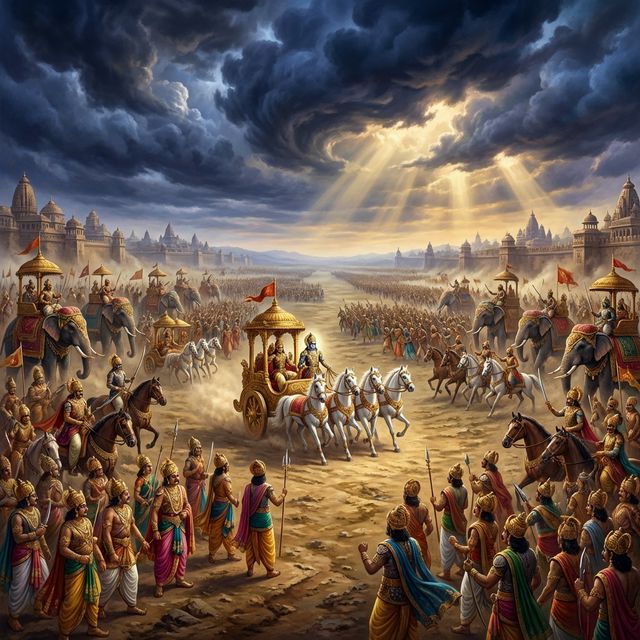
The Gods Ask for Rama
Agni pleads before Brahma, and the answer is a king's son and an army of monkeys and bears
Havyavaha Speaks for the Worlds
Markandeya was telling this in a forest, to five brothers who had lost a kingdom at dice and had years of trees ahead of them, and the place he had reached in the telling was the place where the world becomes unbearable and nobody can do anything about it.
He had just finished the boons. The Ten-headed Ravana, son of the Muni Visrava, had stood on one leg for a thousand years with the five sacred fires burning around him, supporting life by air alone, and at the end of it he had cut off his own heads and poured them into the flame as an offering. Brahma had come down in person and given him what he asked for: never to be defeated by Gandharvas, Celestials, Kinnaras, Asuras, Yakshas, Rakshasas, Serpents, or any other creature. Then Ravana had beaten his brother Kuvera and taken Lanka from him, and the celestial chariot Pushpaka along with it, and the man-eating Rakshasas and the Pisachas had assembled and made him their sovereign. After that he went up against the gods and the Daityas and wrested from them every valuable thing they had.
"And as he had terrified all creatures," Markandeya said, "he was called Ravana."
Then came the sentence that begins this story. Ravana, capable of mustering any measure of might, inspired the very gods with terror.
So the Brahmarshis and the Siddhas and the Devarshis went in a body and sought the protection of Brahma, and they put one of their number in front to speak for them. They chose Havyavaha, which is a name of Agni, and it means the carrier of oblations, the fire that takes what men pour into it and delivers it upward to whoever is owed it. Of the whole deputation he had the plainest grievance. When Rakshasas break a sacrifice it is his mouth that is stopped.
And Agni said, "That powerful son of Visrava, the Ten-headed, cannot be slain on account of thy boon! Endued with great might he oppresseth in every possible way the creatures of the earth. Protect us, therefore, O adorable one! There is none else save thee to protect us!"
He did not ask the Grandsire to punish Ravana. He told the Grandsire whose fault it was.
The Death That Was Already Arranged
Brahma did not defend the boon and did not take it back. A boon of his cannot be taken back; that is what makes it a boon and not a promise. What he said instead was that the fire god had come late to a matter that was already in hand.
"O Agni, he cannot be conquered in battle by either the gods or the Asuras! I have already ordained that which is needful for that purpose. Indeed his death is near! Urged by me, the four-headed God hath already been incarnate for that object. Even Vishnu, that foremost of smiters, will achieve that object!"
Everything in the episode hangs on the one word Agni had not thought about. When Ravana stood before the Grandsire and listed the orders of beings from whom he wished to be safe, he named Gandharvas, Celestials, Kinnaras, Asuras, Yakshas, Rakshasas and Serpents, and Brahma had answered him, "From those thou hast named, thou shalt never have cause of fear; except from men." The Ten-headed One had been highly gratified by that. He was a man-eater with a perverted understanding, and he slighted human beings. He had heard the exception and had counted it as nothing, in the way that a man who has bought a house does not read the one clause that will one day take it away from him.
So the answer to a Rakshasa who cannot be killed by gods was not a bigger god. It was a man.
And Vishnu, who is the one who does this work, went down into the exception. He divided himself and was born in the city of Kosala as the four sons of the pious king Dasaratha, who was mindful of the old and assiduous in religious ceremonies, and who was greatly pleased when those sons were born to him. The eldest of them was Rama.
Markandeya passed over the birth in a sentence, because a birth is a small thing to describe and because everything that would be famous about that eldest son was still years off in the future of the story. The gods standing in Brahma's presence were not being shown a hero. They were being told that the counter-measure had already been taken, and that it was a baby.
Be Born on Earth
Then the Grandsire turned, in the presence of them all, to Sakra.
Sakra is Indra, the king of the gods, the one who had the most to lose by Ravana and the least success in doing anything about it, and what Brahma said to him was not a consolation.
"Be thou, with all the celestials, born on earth! And beget ye on monkeys and bears heroic sons possessed of great strength and capable of assuming any form at will as allies of Vishnu!"
Read the order slowly, because it is a strange one and the strangeness is the point. The gods are not told to fight. They are not told to lend weapons or to send down curses or to stand behind the man they have just been promised. They are told to go down into the world, take animal wives, and have children, and the children are to be the army.
It follows from the boon exactly. Ravana had made himself proof against every order of being that had come to Brahma's court in glory. He had not troubled to make himself proof against men, and he had not troubled to make himself proof against monkeys and bears either, because it had not occurred to him or to anybody else that a war could be fought with such things. The way to kill a man who has armoured himself against everything worth naming is to be born as one of the things he did not think worth naming.
At this, Markandeya said, the gods and the Gandharvas and the Danavas quickly assembled to take counsel among themselves as to how they should be born on earth according to their respective parts.
That is the whole of the celestial war council. No strategy, no muster, no oath. A crowd of deathless persons standing together and working out, share by share, which portion of himself each of them would send down into a forest to be born with fur on it. They had come to Brahma to be rescued from Ravana. They were being sent home to become their own rescue, in a shape none of them would have chosen.
A Gandharvi Named Dundubhi
And in their presence the boon-giving god commanded a Gandharvi, by name Dundubhi.
She is given one line and no history. Dundubhi is a word for a war-drum, the deep kind that is beaten to start things, and she was a Gandharvi, one of the celestial singers, which is to say she belonged to the order of beings whose whole occupation is music and beauty and the pleasant middle air. Nothing in her name or her kind prepares anybody for the errand.
"Go there for accomplishing this object," Brahma said to her.
And Dundubhi, hearing these words of the Grandsire, was born in the world of men as the hunchbacked Manthara.
That is the sentence to stop at. Every other god in the assembly was being sent down to be strong. The celestials were to father sons who could split mountain peaks. Vishnu was to be a prince. This one was sent down to be a bent old serving-woman in a queen's apartments, ugly by the account of everyone who ever wrote about her, with no strength, no beauty, no weapon and no army, and her work was to be done entirely with her mouth.
Because the plan had a gap in it, and Brahma could see the gap. Vishnu was to be born a king's eldest son in a prosperous city, with a father who loved him and ministers who agreed with the father and a people who wanted nothing better than to see him crowned. Left alone, that man would be installed as regent on the night of the Pushya constellation and would rule in Kosala for a long and admirable reign and would die in his bed, and Ravana would still be sitting in Lanka with everything he had taken from the gods.
Something had to go wrong in Ayodhya. Somebody had to say the poisonous thing to the right woman at the right hour.
So the Creator of the Universe, having arranged for the deliverance of the worlds, arranged also for a quarrel, and the instrument he chose for it was a singer.
Sons Equal to a Thousand Elephants
Then all the principal celestials, with Sakra and the others, begot offspring upon the wives of the foremost of monkeys and bears.
Markandeya spends more words on those children than on anything else in the episode, and the words are worth having in the order he put them in, because they are the specification of an army being built to a requirement.
Those sons equalled their sires in strength and fame. They were capable of splitting mountain peaks. Their weapons were stones, and trees of the Sala and the Tala species. Their bodies were hard as adamant. They possessed very great strength, and they were all skilled in war, and capable of mustering any measure of energy at will. They were equal to a thousand elephants in might. They resembled the wind in speed. And some of them lived wherever they liked, while others lived in forests.
Not one item on that list is a thing a soldier is issued. They have no bows, no cars, no mail, no standards, no formations and no cities. What they have is what the hillside has: rock, timber, and the strength to pick both up. An army that carries no weapons cannot be disarmed, and an army whose weapons are the mountain it is standing on cannot be cut off from its supply.
And every one of them, being got by a god upon a monkey or a bear, was capable of assuming any form at will, which was the one gift Ravana had asked for himself and thought he was alone in having.
The last clause is the quietest and the strangest. Some of them lived wherever they liked, while others lived in forests. There is no muster and no camp. The children of the gods were simply loose in the world, in the trees and on the rocks and wherever else they cared to be, for as long as it took, waiting without knowing they were waiting, until a prince in bark and deerskins should come south through the woods with his brother, having lost his wife, and need them.
Hither and Thither
And the adorable Creator of the Universe, having ordained all this, instructed Manthara as to what she would have to do.
The text does not report the instruction. It says only that she was given it, and it says what she made of it: Manthara, quick as thought, understood all his words.
That is the whole account of her briefing. There was no argument and no explanation, no promise of reward and no threat, and above all no persuading. A Gandharvi who had spent her existence singing was told once what would be required of a hunchbacked servant in the women's quarters of a palace in Kosala, and she took it in at the speed of thought, and went.
And went hither and thither, Markandeya said, ever engaged in fomenting quarrels.
The episode ends on that line, with no scene and no city and nobody named. It is not a picture of a wicked woman. It is a picture of a purpose walking about the earth looking for the place where it will fit, going from house to house and from ear to ear, trying quarrels, the way a fire that has been lit somewhere goes along a wall until it finds the dry timber.
The listeners in the forest knew where she would stop walking, and what she would say when she got there, and which queen would be sitting in the room. Markandeya would come to all of it before the day was out, and the five men listening had a particular reason to hear it, since the last thing that story would ask of its hero was fourteen years in the woods.
But in this part of the telling none of that has happened yet. There is only an old god who has finished arranging things, an assembly of gods dispersing to go and be born, an ocean of monkeys and bears getting to their feet all over the south of the world, and one small crooked woman on a road, walking down toward Ayodhya, in no hurry at all.
Dharma Lesson
Brahma cannot unsay a boon, and does not try. He works instead in the space the boon left open, the one class of creature Ravana was too proud to name, and the deliverance of the worlds is assembled out of exactly the things the tyrant had dismissed: a man, a serving-woman, and animals in the trees. Pride does not usually lose by being defeated. It loses by having decided in advance what is beneath its notice.