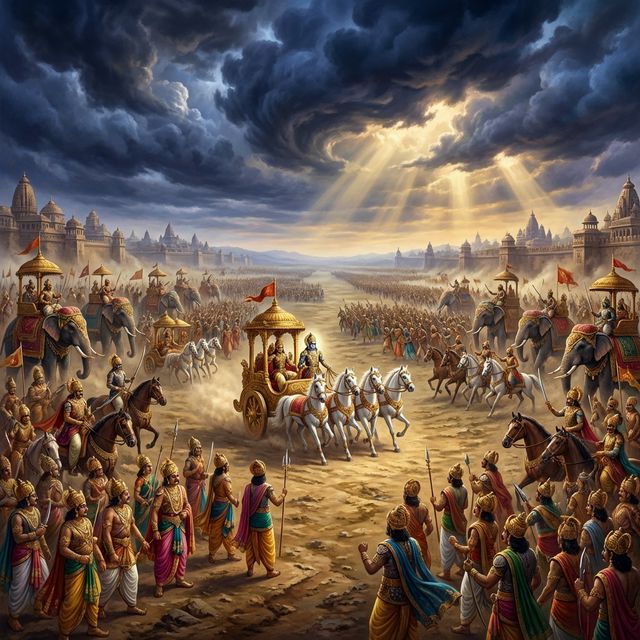
The Eighth Portion of Vishnu
Sanatkumara tells the defeated Vritra what holds up the universe, and Bhishma tells Yudhishthira who Krishna is
The Sage Who Came While They Were Talking
Yudhishthira had asked, that morning, when he would be allowed to put the kingdom down. He had been given it a few days before and he already found it heavy, and he wanted to know when a man born into sorrow could go out into the woods and be finished with sorrow altogether. Bhishma, lying on the arrows with the whole of his answer still ahead of him, had told him that everything has an end, that even rebirth has an end, and that the fear he was expressing had been felt before by someone in a far worse position than a newly crowned king.
That someone was Vritra, chief of the Danavas, who had ruled the three worlds and lost them, and who sat among his enemies without sovereignty and without grief. His preceptor Usanas, whom the world calls Shukracharya, teacher of the Asuras, had asked him whether the defeat did not gnaw at him, and Vritra had answered with the whole round of birth and death, and had ended by asking the questions that a man asks only when he has nothing left to lose.
From whom do creatures spring and live? Through whom do they act? What is that high fruit by attaining to which a creature succeeds in living eternally as Brahma? By what act, by what knowledge, is it reached?
"Listen with undivided attention," Bhishma said, "to what the sage Usanas said, after he had been thus addressed by that prince of Danavas."
Usanas began with a bow.
"I bow to that divine and illustrious and puissant Being who holds this earth with the firmament in his arms. I shall speak to thee of the pre-eminent greatness of that Vishnu whose head, O best of the Danavas, is that Infinite place."
He meant the place called Emancipation, and he did not get past the sentence.
For while the two of them were conversing there came to them the great sage Sanatkumara, of righteous soul, for the purpose of dispelling their doubts. He was worshipped by the prince of the Asuras and by Usanas both, and he sat down on a costly seat, and when he was comfortable Usanas gave away his own discourse without a word of complaint.
"Discourse to this chief of the Danavas," he said, "on the pre-eminent greatness of Vishnu."
The teacher of the Asuras sat down beside his pupil and became a listener.
The Goldsmith and the Sesame Grains
"Listen, O Daitya, to everything about the greatness of Vishnu," Sanatkumara said. "Know, O scorcher of foes, that the entire universe rests on Vishnu."
He laid out the shape of the thing first. It is He who creates all creatures mobile and immobile. In course of Time it is He who withdraws all things, and in Time it is He who once more casts them forth from Himself. Into Hari all things merge at the universal destruction, and from Him all things again come forth. There is no other warehouse. What goes away goes into Him and what arrives arrives out of Him, and the interval between the two is what creatures call the world.
Then he answered the question about the means, and the answer was a series of refusals.
Men possessed of scriptural lore cannot obtain Him by such lore. Nor can He be obtained by penances. Nor by sacrifices. The only means by which He can be attained is by restraining the senses.
Sanatkumara did not leave the sacrifices lying there insulted. Not that they are entirely useless towards such an end, he said. A man relying upon both external and internal acts, and upon his own mind, can purify them by his own understanding, and by such means he succeeds in enjoying infinity in the world. The rite is not the payment. The rite is one of the tools with which a man cleans himself, and the cleaning is slow.
He gave three pictures of how slow.
As a goldsmith purifies the dross of his metal by casting it into the fire again and again, with very persistent efforts of his own, so Jiva succeeds in cleaning himself by his course through hundreds of births. Some one may be seen to purify himself in only one life by mighty efforts, but that is the exception, and it is named as an exception.
As one should wipe stains from off one's person before they become thick, so one should with vigorous efforts wash off one's faults, and the time to do it is early.
And the third. By mixing only a few flowers with them, grains of sesame cannot be made to cast off their own odour. But when those grains are perfumed repeatedly with the aid of a large quantity of flowers, then they give up what they smell of and take the smell of the flowers instead.
"After this manner," he said, "faults, in the form of attachments to all our environments, are dispelled by the understanding in course of many lives, with the aid of a large dose of the attribute of Sattwa, and by means of efforts born of practice."
The Body That Is the World
"The Supreme Lord creates all creatures mobile and immobile," Sanatkumara said. "He is without beginning and without end."
Unendued with attributes of any kind, He assumes attributes when He chooses to create. He is the universal Destroyer, the Refuge of all things, the Supreme Ordainer, and pure Chit. In all creatures it is He who dwells as the mutable and the immutable. Having eleven modifications for His essence, He drinks this universe with His rays.
And then, because a Danava asked to be told what holds up the world will not be satisfied by abstractions, the sage gave him the body.
Know that the Earth is His feet. His head is constituted by Heaven. His arms are the several points of the compass. The intermediate space is His ears. The light of His eye is the Sun, and His mind is in the Moon. His understanding dwells always in Knowledge, and His tongue is in Water. The Planets are in the midst of His brows. The stars and the constellations are from the light of His eyes. The Chandas, the metres in which the hymns are sung, are the hair on His body, and Akshara, which is Pranava, the syllable Om, is His word. The diverse orders of men and the modes of life are His refuge. His mouths are many. Duty is planted in His heart.
Rajas, Tamas and Sattwa are of Him. He is the fruit of all the modes of life. He is the reward of every pious act, of japa and of sacrifice, and He is also, being the Highest and the Immutable, the fruit of abstention from all work whatsoever. The man who acts and the man who has stopped acting arrive at the same door.
Then the names, which Sanatkumara did not soften.
He is Brahma. He is the highest Righteousness. He is Sat and He is Asat. He is Sruti. He is the scriptures. He is the sacrificial vessel. He is the sixteen Ritwijes who conduct the rite. He is all the sacrifices. He is the Grandsire. He is Vishnu. He is the twin Aswins. He is Purandara, who is Indra. He is Mitra. He is Varuna. He is Yama. He is Kuvera, the lord of treasures.
"Although the Ritwijes seem to behold Him as separate," the sage said, "He is, however, known to them as one and the same. Know that this entire universe is under the control of One divine Being."
The Veda that is in the soul, he added, regards the unity of various creatures. When a living creature realises that unity in consequence of true knowledge, he is then said to attain to Brahma.
The Lakes and the Tip of a Hair
Vritra had ruled for a long time, by any measure a Danava would use, and it had ended. So the sage gave him a measure that was not a Danava's.
The period of time for which one creation exists, or for which it ceases to exist, is called a Kalpa. Living creatures exist for a thousand millions of such Kalpas. Immobile creatures also exist for an equal period. Those numbers are said plainly and are not meant to be imagined, because they cannot be, and Sanatkumara knew it, and so he put the same quantity into a shape that a mind can hold.
"Conceive a lake," he said, "that is one Yojana in width, one Krosa in depth, and five hundred Yojanas in length."
That is a body of water long enough to take a marching army many days to walk beside.
"Imagine many thousands of such lakes."
Not one. Thousands, filled, standing side by side.
"Seek then to dry up those lakes by taking from them, only once a day, as much water as may be taken up with the end of a single hair."
Once a day. One hair's tip of water. Not a cup, not a drop, but the wet that clings to the end of one hair when it is dipped and lifted out, and then nothing more until tomorrow.
The number of days that would pass in drying up those lakes completely by that process is the period occupied by the life of one creation, from its first start to the time of its destruction.
And a thousand millions of those are the term of a creature's wandering.
It is worth noticing what the sage was doing to his listener, who had come to this conversation as a defeated king. He was not consoling him. He was not telling him that his loss was small. He was showing him a clock beside which sovereignty over the three worlds is not even an event, and he was about to explain that the wandering is not aimless, that it has a scale of hues from the bottom to the top, and that a creature can be somewhere on it deliberately rather than by accident.
Six Colours
"The highest Evidence for all things," Sanatkumara said, "says that creatures have six colours."
Dark, Tawny, Blue, Red, Yellow and White. These are not the colours of skin or of cloth. They are the colours a life takes on, and they proceed from mixtures, in various proportions, of the three attributes, Rajas and Tamas and Sattwa. The sage gave the proportions one by one, and the arithmetic of it is worth following, because it is the whole map.
Where Tamas predominates, Sattwa falls below the mark, and Rajas keeps to the mark, the result is the colour called Dark.
When Tamas predominates as before, but the relations between Sattwa and Rajas are reversed, the result is the colour called Tawny.
When Rajas predominates, Sattwa falls below the mark, and Tamas keeps to the mark, the result is the colour called Blue.
When Rajas predominates as before, and the proportion between Sattwa and Tamas is reversed, the result is the intermediate colour called Red. That colour is more agreeable than the one before it.
When Sattwa predominates, Rajas falls below the mark, and Tamas keeps to the mark, the result is the colour called Yellow. It is productive of happiness.
And when Sattwa predominates and the proportion is reversed between Rajas and Tamas, the result is the colour called White. It is productive of great happiness.
Three ingredients, six recipes, and every creature that has ever lived standing somewhere in that list.
"The White is the foremost colour," the sage said. "It is sinless in consequence of its being free from attachment and aversion. It is without grief, and free from the toil involved in Pravritti. Hence, White, O prince of Danavas, leads to success."
Jiva, having undergone thousands of births derived through the womb, attains at last to that success. It is the identical end which the divine Indra declared after having studied many auspicious spiritual treatises, and it has for its essence the apprehension of the Soul.
Then one line that put the whole scheme back into motion, and that a listener who was about to die would not have missed.
The end that creatures obtain is dependent on their colour, and colour, in its turn, depends upon the character of the Time that sets in.
Fourteen Hundred Thousand Stages
"The stages of existence through which Jiva must pass are not unlimited," Sanatkumara said. "They are fourteen hundreds of thousands in number."
In consequence of them Jiva ascends, stays, and falls down, as the case may be. The sage then walked the ladder from the bottom, and there was no hurry in it anywhere.
The end attained by a Jiva of the Dark hue is very low, for he becomes addicted to acts that lead to hell, and then he has to rot in hell. The learned say that in consequence of his wickedness the continuance of a Jiva in such a form is measured by many thousands of Kalpas.
Having passed many hundred thousands of years in that condition, Jiva then attains to the colour called Tawny, and is born as an intermediate creature, an animal, and there he dwells for many long years in perfect helplessness.
At last, when his sins are exhausted, having endured all the misery that they are capable of bringing, his mind casts off its attachments and cherishes Renunciation. When Jiva becomes endued with the quality of Sattwa, he dispels everything connected with Tamas by the aid of his intelligence, and exerts himself for what is good, and as the result of that he attains to the colour called Red. If the quality of Sattwa is not gained, he travels instead in a round of rebirths in the world of the inert, having attained to the colour called Blue.
Having reached humanity, and having been afflicted for the duration of one whole creation by the bonds born of his own acts, Jiva attains to the colour called Yellow, which is to say that he becomes a deity. He exists in that condition for the space of a hundred creations, then leaves it to be a human being, then returns to it. He sports for thousands of Kalpas as a Deva. Being still unemancipated, even then, he has to stay in hell, enjoying or enduring the fruits of his acts of past Kalpas, and wandering through nineteen thousand courses.
Falling from the world of the gods he obtains the status of humanity once more, and stays in it for a hundred and eight Kalpas, and then attains once more to the status of a Deva.
And here the sage put in the trapdoor.
If, while in the status of humanity for the second time, he falls through the evil acts represented by Kala in the form of Kali, he sinks into the Dark colour and occupies the very lowest of all the stages of existence.
Godhood, twice held, is not a safe place to stand.
The Road Out
"I shall tell thee now, O foremost of Asuras, how Jiva succeeds in effecting his Emancipation."
Desirous of Emancipation, Jiva relies upon seven hundred kinds of acts, every one of which is characterised by a predominance of the attribute of Sattwa, and by them he gradually courses through Red and Yellow and at last attains to White. Arrived there, he travels through several regions that are most adorable, which have the eight well-known regions of felicity beneath them, and all the while he pursues that stainless and effulgent form of existence which is Emancipation's self.
Then he qualified it. Know, he said, that the Eight already referred to, which are identical with the Sixty subdivided into hundreds, are, unto those that are highly effulgent, only creations of the mind. The highest object of acquisition with one who is White of hue is that condition called Turiya, the fourth, which transcends the three other states of consciousness, wakefulness and dream and dreamless slumber.
Then he described the two men who stop short.
There is the Yogin who is unable to abandon the felicities that Yoga-puissance brings about. He has to dwell in one and the same body for one century of Kalpas in auspiciousness, and after that in four other regions, called Mahar and Jana and Tapas and Satya. That is the highest end of one who belongs to the sixth colour, and who is unsuccessful though crowned with success, and who has transcended all attachments and passions.
And there is the Yogin who falls off from his practices after attaining that eminence. He resides in heaven for a century of Kalpas with the unexhausted remnant of his past acts, and with the seven, which are the five senses of knowledge and the mind and the understanding, purged of all stains by their leaning towards Sattwa. At the expiry of that period he comes to the world of men, where he attains to great eminence. Turning back from the world of men he departs for new forms of existence that run higher and higher, coursing through seven regions seven times, his puissance always increased in consequence of his Samadhi and his re-awakening from it.
The one who wants the end itself does something harder. He suppresses those same seven by Yoga-knowledge, and continues to dwell in the world of life freed from attachments, and taking the seven for certain means of grief he casts them off, and attains afterwards to that which is Indestructible and Infinite.
"Some say that that is the region of Mahadeva," the sage said. "Some, of Vishnu. Some, of Brahman. Some, of Sesha. Some, of Nara. Some, of the effulgent Chit. And some, of the All-pervading."
What Happens When the Worlds Are Put Away
There remained the question of what a universal destruction does to those who are caught in it, and Sanatkumara sorted the caught into three kinds.
When universal destruction comes, those persons who have succeeded in completely consuming by Knowledge their gross and subtle and karana bodies always enter into Brahma. All their senses too, which have action for their essence and which are not identical with Brahma, merge into the same. These are the ones for whom the ending of the worlds is simply the ending of the worlds, and no more.
Those Jivas who have attained to the position of Devas, and who still have an unexhausted remnant of the fruits of acts to enjoy or endure, revert in the subsequent Kalpa to the stages of life that had been theirs in the previous one. This is due to the similarity of every successive Kalpa to every previous one. The universe is dismantled and rebuilt to the same plan, and a creature wakes up on the same rung he was standing on when the lights went out.
And those whose acts have been exhausted by enjoyment or endurance in respect of their fruits fall down from heaven and take birth among men in the subsequent Kalpa, for without Knowledge one cannot destroy one's acts in even a hundred Kalpas. All superior Beings, endued with similar powers and similar forms, revert to their respective destinies at a new creation, ascending and descending precisely in the same manner as during the creation that was dissolved.
Then the sage turned from the machinery to the man who is done with it.
As regards the person who is conversant with Brahma, so long as he continues to enjoy and endure the unexhausted remnant of his acts of previous Kalpas, it is said that all creatures and the two stainless sciences live in his body. When his Chitta becomes cleansed by Yoga, and when he practises Samyama, this perceptible universe appears to him as only his own fivefold senses. The world does not vanish for such a man. It shrinks to what it always was, five doors and what comes in at them.
Enquiring with a cleansed mind, Jiva attains to a high and stainless end. Thence he attains to a spot which knows no deterioration, and thence to eternal Brahma, that is so difficult of acquisition.
"Thus, O thou of great might," Sanatkumara said, "I have discoursed to thee of the eminence of Narayana."
Vritra Puts Down His Breath
Vritra had asked five questions and had been answered at a length that would have exhausted a patient man, and what he said at the end of it was not an argument.
"These words of thine, I see, perfectly according with the truth. Indeed, when this is so, I have no cause of grief. Having listened to thy words, O thou of great powers of mind, I have become freed from sorrow and sin of every kind."
Then he said what he was looking at.
"O illustrious Rishi, O holy one, I see this wheel of Time, endued with mighty energy, of the most effulgent and Infinite Vishnu, has been set in motion. Eternal is that station, from which all kinds of creation spring. That Vishnu is the Supreme Soul. He is the foremost of Beings. In Him this entire universe rests."
He had begun the conversation as a king who had lost a kingdom and had refused to weep about it, which his own teacher had called foolish rhapsody. He ended it having been told the size of a Kalpa and the price of a colour and the fourteen hundred thousand stages, and having found in all of that not a rebuke but a place to stand.
Usanas, who had opened the discourse and then handed it away, said nothing at all.
"Having said these words, O son of Kunti," Bhishma said, "Vritra cast off his life-breaths, uniting his soul in Yoga with the Supreme Soul, and attained to the highest station."
That is the whole of the death. There was no battle in it, no weapon, no last defiance. A defeated Danava sat in front of two brahmanas, listened until he understood, and then let go of his breath the way a man puts down a load he has been told he may put down, and went where the discourse said he would go.
On the field at Kurukshetra the old man stopped there, and the king who had been listening asked the one question that such a story leaves behind.
"Tell me, grandsire," Yudhishthira said, "whether this Janardana is that illustrious and puissant Lord of whom Sanatkumara spoke unto Vritra in days of old."
The Eighth Portion
Janardana was the man who had driven his brother's chariot and gone to Hastinapur as their envoy and come back refused. Bhishma answered with an arrangement.
"The Highest Deity, endued with the six attributes, is at the Root. Staying there, the Supreme Soul, with his own energy, creates all these diverse existent things. Know that this Kesava who knows no deterioration is from His eighth portion. Endued with the highest Intelligence, it is this Kesava who creates the three worlds with an eighth portion of His energy."
An eighth of an eighth, then, is what the three worlds cost.
Coming immediately after Him who lies at the Root, Bhishma said, this Kesava, who is eternal compared with all other existent things, changes at the end of each Kalpa. But He who lies at the Root, endued with supreme might and puissance, lies in the waters when universal destruction comes, in the form of the potential Seed of all things. Kesava is that Creator of pure Soul who courses through all the eternal worlds, filling all space with emanations from Himself and coursing through the universe in the form of everything that constitutes it. Freed from limitations of every kind, He suffers Himself to be invested with Avidya and awakened to Consciousness, and creates all things.
"In Him," the old man said, "rests this wondrous universe in its entirety."
Yudhishthira went back to the colours.
Vritra, he said, must have seen beforehand the excellent end that awaited him, and that was why he did not yield to grief. He who is White of hue, who has taken birth in a stainless race, and who has attained to the rank of a Sadhya, does not come back. But he who has attained to either the Yellow or the Red hue is seen sometimes to be overwhelmed by Tamas and to fall among the order of intermediate creatures.
"As regards ourselves, we are exceedingly afflicted, and attached to objects that are productive of sorrow or indifference or joy. Alas, what will the end be to which we shall attain? Will it be the Blue, or the Dark, which is the lowest of all hues?"
"Ye are Pandavas," Bhishma said. "Ye have been born in a stainless race. Ye are of rigid vows. Having sported in joy in the regions of the gods, ye shall come back to the world of men. Living happily as long as the creation lasts, all of you at the next new creation will be admitted among the gods, and enjoying all kinds of felicities ye will at last be numbered among the Siddhas. Let no fear be yours. Be you cheerful."
Dharma Lesson
Vritra asks his questions from the worst position a king can occupy, having held the three worlds and lost them, and the answer he receives offers him no compensation at all. It gives him a clock beside which his empire was not even an event, a ladder with a trapdoor near the top where godhood is held twice and then forfeited, and a road out that is walked over hundreds of births by a soul cleaning itself the way a goldsmith burns dross out of metal. What steadies him is not consolation but scale. And when Yudhishthira, newly crowned and already sick of it, asks where his own life stands on that ladder, the old man does not lecture him. He tells him whose son he is, and tells him to cheer up.