Galava Asks What Is Beneficial
Narada answers a student who cannot tell which scripture to obey
The Question About the Man Who Cannot Follow
By that stage of the teaching Yudhishthira had asked about kings and about penance, about sacrifice and about grief, and the answers had all assumed a man who could hold them. What he asked on this morning was about the man who cannot.
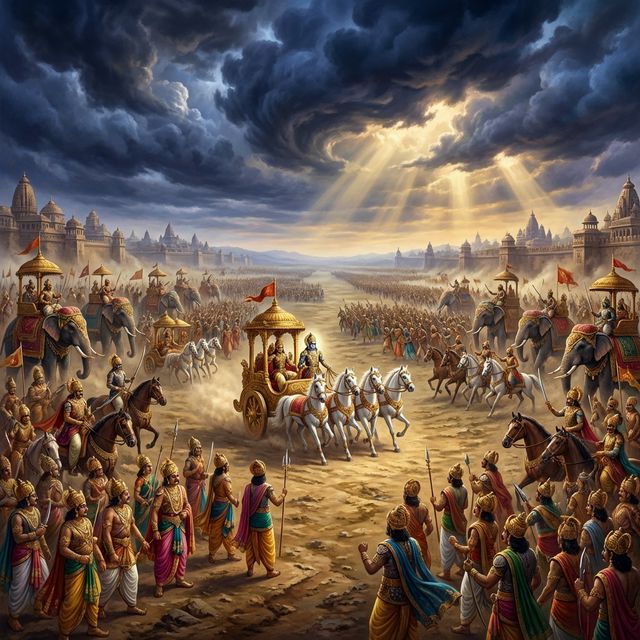
Bhishma lay where he had lain since the tenth day, on the bed of his own arrows at Kurukshetra, waiting for the sun to turn north. The brothers sat about him. Krishna sat with them. Arjuna and Bhima were within hearing, as they were every morning, and the question the eldest put was this one.
"Tell me, O grandsire, what is beneficial for one that is unconversant with the truths of the scriptures, that is always in doubt, and that abstains from self-restraint and the other practices having for their object the knowledge of the Soul."
It is worth noticing who is being described. Not a wicked man. Not a lazy one. A man who has not read the books, who cannot settle any question in his own mind because he has no instrument for settling it, and who does not practise the disciplines by which the Soul is known, because those too are beyond him. That is nearly everybody, and Yudhishthira knew it, and he was asking whether the whole apparatus of the scriptures had anything at all to say to such a person.
Bhishma gave him three things, and not one of them requires understanding anything.
"Worshipping the preceptor," he said. "Always waiting reverentially on those that are aged. And listening to the scriptures when they are recited by competent Brahmanas. These are said to be of supreme benefit to a person such as thou hast described."
Serve a teacher. Sit with the old. Be present when the words are said aloud, whether or not you follow them.
"In this connection also is cited the old narrative," said Bhishma, "of the discourse between Galava and the celestial Rishi Narada."
Galava was a Brahmana who wanted to know what was for his own benefit, and who had the sense to take the question to a man who would not flatter him.
Galava Puts His Difficulty
Narada is described before he is allowed to speak, and the description is a list of the things Galava did not have.
He was freed from error. He was freed from fatigue. He was learned in the scriptures and gratified with knowledge, which is to say that knowing was enough for him and he wanted nothing further out of it. He was a thorough master of his senses. His soul was devoted to Yoga.
Galava came to him desirous of obtaining what was for his benefit, and began by saying exactly that.
"Those virtues, O Muni, by the possession of which a person becomes respected in the world, I see dwell permanently in thee. Thou art freed from error, and as such it behoveth thee to remove the doubts that fill the minds of men like ourselves, that are subject to error and that are unacquainted with the truths of the world."
Then he stated the difficulty, and it is a real one.
"We do not know what we should do. The declarations of the scriptures generate an inclination for the acquisition of Knowledge simultaneously with the inclination for acts."
That is the knot. The same books that tell a man to withdraw and know the Self also tell him to marry, to keep his fires, to beget sons, to give and to sacrifice, and they do not tell him which of the two impulses they have just planted in him is the one he is supposed to obey.
"O illustrious one," Galava went on, "the different asramas approve different courses of conduct. This is beneficial. This other is beneficial. The scriptures exhort us often in this wise. Beholding the followers of the four asramas, who are thus exhorted, and who fully approve of what has been laid down for them, thus travelling in diverse courses, and seeing that we ourselves are equally content with our own scriptures, we fail to understand what is truly beneficial.
"If the scriptures were all uniform, then what is truly beneficial would have become manifest. In consequence, however, of the scriptures being multifarious, that which is truly beneficial becomes invested with mystery. Do thou then discourse to me on the subject. I have approached thee for this. O, instruct me."
He had not come with a doubt about doctrine. He had come with a doubt about his own life, which is harder to answer.
Four Roads and Two Kinds of Sight
Narada did not begin by resolving the contradiction. He began by agreeing that it was there.
"The Asramas are four in number, O child. All of them serve the purposes for which they have been designed, and the duties they preach differ from one another. Ascertaining them first from well qualified preceptors, reflect upon them, O Galava."
Then he set out the disagreement in the plainest terms available, and he did not soften a word of it.
"Behold, the announcements of the merits of those Asramas are varied in respect of their form, divergent in respect of their matter, and contradictory in respect of the observances they embrace."
Varied, divergent, contradictory. The student who came complaining that the books do not agree was told by the sage that the books do not agree. What Narada added was the reason a man might see it that way and still be looking at something whole.
"Observed with gross vision, verily, all the Asramas refuse to clearly yield their true intent. Others, however, endued with subtle sight, behold their highest end."
The true intent is knowledge of the Self, and every one of the four orders is a road toward it. The student, the householder, the forest recluse and the man who has renounced altogether are not four competing recommendations for how to spend a life. They are four positions on one road, and each has its own duties precisely because a man standing at that point on the road needs those duties and not the ones ahead of him or behind. Looked at coarsely, from outside, they are a quarrel. Looked at with a finer eye, they are an order.
But Narada did not leave Galava with a metaphysics, because Galava had not asked for one. He had asked what he should do, and so the sage turned from the four orders to the thing that does not change between them.
"That which is truly beneficial, and about which there is no doubt," he said, "has been declared by the wise to be supreme excellence."
What followed was a list. It is not a mystery and it is not addressed to any one order. It is the conduct of a man who is not attached to what he is doing, and it can be practised in any of the four.
The Things About Which There Is No Doubt
He began with what a man owes to the people around him.
Good offices to friends. The suppression of enemies. The acquisition of the aggregate of three, which is Religion, Profit and Pleasure, each in its place and none of them devouring the others. About these, Narada said, there is no doubt at all.
Then conduct. Abstention from sinful acts. Constancy of righteous disposition, which means not being righteous in seasons. Good behaviour towards those that are good and pious. These, without doubt, constitute excellence.
Then manner, which he treated as a matter of substance and not of polish. Mildness towards all creatures. Sincerity of behaviour. The use of sweet words. These, without doubt, constitute excellence.
Then the household, and here the rule is arithmetic. An equitable apportionment of what one has among the deities, the Pitris and guests, and adherence to servants. A man is not to feed his gods and his dead and his guests out of the surplus and forget the people who work in his house. These, without doubt, constitute excellence.
Then he came to truth, and stopped to put in a warning.
"Truthfulness of speech is excellent. The knowledge, however, of truth is very difficult of acquisition. I say that that is truth which is exceedingly beneficial to creatures."
Then the inward things. The renunciation of pride. The suppression of heedlessness. Contentment. Living by one's own self, and not upon others. These are said to constitute supreme excellence. And with them, the study of the Vedas and of their branches according to the well known rules, and all enquiries and pursuits having for their sake the acquisition of knowledge.
Last, the senses, and here Narada cut on both sides of the road.
"One desirous of achieving what is excellent should never enjoy sound and form and taste and touch and scent to excess, and should not enjoy them for their sake alone."
Not to excess, and not for their own sake, which are two different faults. Then the catalogue of what must be given up: wandering in the night, sleep during the day, indulgence in idleness, roguery, arrogance, excessive indulgence in the objects of the senses.
And then the last item on that list, which is the one nobody expects. Total abstention from all indulgence in the objects of the senses is to be relinquished too. The man who starves his senses to make a display of it has not left the subject of his senses at all.
Flowers Do Not Announce Their Own Fragrance
From conduct Narada turned to reputation, and spent longer on it than on anything else in the discourse, because it is where men who are otherwise doing well come apart.
"One should not seek self elevation by depreciating others. Indeed, one should by one's merits alone seek distinction over persons that are distinguished, but never over those that are inferior."
Two rules in one breath. Do not climb by pulling another man down, and if you must be measured, be measured against the best. Then he described the man who does the opposite.
"Men really destitute of merit, and filled with a sense of self admiration, depreciate men of real merit by asserting their own virtues and affluence. Swelling with a sense of their own importance, these men, when none interferes with them for bringing them to a right sense of what they are, regard themselves to be superior to men of real distinction."
The clause worth keeping is the one about nobody interfering. Such a man is not made by his own vanity alone. He is made by a room in which no one is willing to correct him.
Then the images, which are the most quoted lines of the whole discourse.
"Flowers shed their pure and sweet fragrance without trumpeting forth their own excellence. Similarly, the effulgent Sun scatters his splendours in the firmament in perfect silence."
After the same manner, Narada said, those men blaze in the world with celebrity who by the aid of their intelligence cast off these faults and do not proclaim their own virtues. The fool can never shine in the world by bruiting about his own praise. The man of real merit and learning obtains celebrity even if he be concealed in a pit.
"Evil words, uttered with whatsoever vigour of voice, die out in no time. Good words, uttered however softly, blaze forth in the world."
And the last figure is a cruel one. As the Sun shows his fiery form inside the gem called Suryakanta, so the multitude of words of little sense that vain fools utter display only the meanness of their hearts. The talk does not conceal the man. It concentrates him, and holds him up to the light.
"For these reasons," said Narada, "men seek the acquisition of wisdom of various kinds. It seems to me that of all acquisitions, that of wisdom is the most valuable."
Then the rule for using it. "One should not speak until one is asked, nor should one speak when one is asked improperly. Even if possessed of intelligence and knowledge, one should still sit in silence like an idiot."
The House You Should Leave
Then Narada changed the subject in a way that looks like a change of subject and is not. Having said what a man should be, he began to say where a man should stand, because he did not believe that the first could be sustained without the second.
"One should seek to dwell among honest men devoted to righteousness and liberality and the observance of the duties of their own order. One desirous of achieving what is excellent should never dwell in a place where a confusion occurs in the duties of the several orders."
Why place should matter so much he explained without any appeal to mystery.
"By living amid the righteous one succeeds in acquiring pure righteousness. After the same manner, one by living amid the sinful becomes stained with sin. As the touch of water or fire or the rays of the moon immediately conveys the sensation of cold or heat, after the same manner the impressions of virtue and vice become productive of happiness or misery."
You do not choose to absorb the company you keep, any more than you choose to feel cold when you put your hand in a river. Along the way he dropped in a test a man can apply at his own table. They that are eaters of Vighasa, the leavings after the gods and the guests have been served, eat without taking any notice of the flavours of what is placed before them. They, however, who eat carefully discriminating the flavours of the viands prepared for them should be known as persons still tied by the bonds of action.
Then the list of places to leave.
Leave the place where a Brahmana discourses on the duties of the Soul to disciples who do not enquire after that knowledge with reverence. Who, however, will leave the spot where the behaviour between disciples and preceptors is what the scriptures have laid down? What learned man desirous of respect will dwell where people bruit about the faults of the learned even when those faults have no foundation to stand upon?
"Who is there that will not leave that place, like a garment whose end has caught fire, where covetous men seek to break down the barriers of virtue?"
Where men practise the duties of religion for the sake of wealth and other temporal advantages, one should not dwell, for the people of that place are all to be regarded as sinful. And where the inhabitants, desirous only of obtaining the means of life, are engaged in the practice of sinful deeds, one should fly away with all speed, as if from a room in which there is a snake.
The Country Worth Living In
From the house he went out to the kingdom, and gave Galava a way to read a country from the inside.
Leave the kingdom where the king and the king's officers exercise equal authority, and where they are given to the habit of eating before feeding their relatives when the latter come as guests. A place where the servants of power are as powerful as power itself, and where the men at the top do not wait for their own kin, has already told you what it will do to a stranger.
Dwell in that country where Brahmanas possessed of a knowledge of the scriptures are fed first, where they are devoted to the due observance of religious duties, and where they are engaged in teaching disciples and officiating at the sacrifices of others. Dwell unhesitatingly where the sounds Swaha and Swadha and Vashat are duly and continuously uttered, because a country in which the fires are still being fed is a country that has not yet given up.
"One should leave that kingdom, like poisoned meat, where one sees Brahmanas obliged to betake themselves to unholy practices, being tortured by want of the means of life."
That is the sharpest of the tests, and it is a test of the kingdom and not of the Brahmanas. A land that starves its learned men into disgraceful work has poisoned itself, and the meat looks perfectly good from outside.
With a contented heart, deeming all his wishes as already gratified, a righteous man should dwell in that country whose inhabitants cheerfully give away before even they are solicited. He should live and move about, among good men devoted to acts of righteousness, in that country where chastisement falls upon the wicked and where respect and good offices are the portion of those that are of subdued and cleansed souls. Dwell where the king is devoted to virtue and rules virtuously, having cast off desires, and where severe chastisement is dealt to those that visit self controlled men with the consequences of their wrath, to those that act wickedly towards the righteous, to the violent and to the covetous.
"Kings endued with such a disposition," Narada said, "bring about prosperity to those that dwell in their kingdoms when prosperity is on the point of leaving them."
That is the promise held out to a country that gets its king right. Not that it will never lose its fortune, but that a virtuous king can turn fortune back at the door when it is already halfway out.
What Cannot Be Described
Then Narada finished, and the ending is an admission.
"I have thus told thee, O son, in answer to thy enquiry, what is beneficial or excellent. No one can describe, in consequence of its exceedingly high character, what is beneficial or excellent for the Soul."
He had answered the question that could be answered. The conduct is describable, item by item, and he had described it. Where a man should live is describable, and he had described that too, down to which country to walk out of and how fast. What is beneficial for the Soul itself is not describable, because of its exceedingly high character, and Narada stopped at that edge and said so.
Consider who he was saying it to. Galava had come unable to tell one scripture from another and had asked to be handed the answer. He would not have known the difference between a truth and a fine phrase, and there was nobody standing by to correct the sage if he had chosen to fill the silence. He did not fill it.
What he gave Galava instead was the last sentence.
"Many and high will the excellences be, through the observance of the duties laid down for him, of the man who for earning his livelihood during the time of his sojourn here conducts himself in the way indicated above, and who devotes his soul to the good of all creatures."
And Bhishma, having recited it on the bed of arrows, left it there for the king, who had asked what could be done by a man who understands nothing, and had been given an answer that requires no understanding at all: serve the old, sit where the words are said, and live like that.
Dharma Lesson
Galava wanted the scriptures to agree with one another, and Narada would not tell him that they do. What he told him instead is that the disagreement is between roads and not between destinations, and that a man standing at any point on any of those roads owes the same things: mildness, sincerity, a fair division of what he has, no climbing by another man's fall, and no announcement of his own merits. The teaching ends by refusing to go further. What is beneficial for the Soul cannot be described, and the honest teacher stops at the edge of it rather than fill the silence with words.