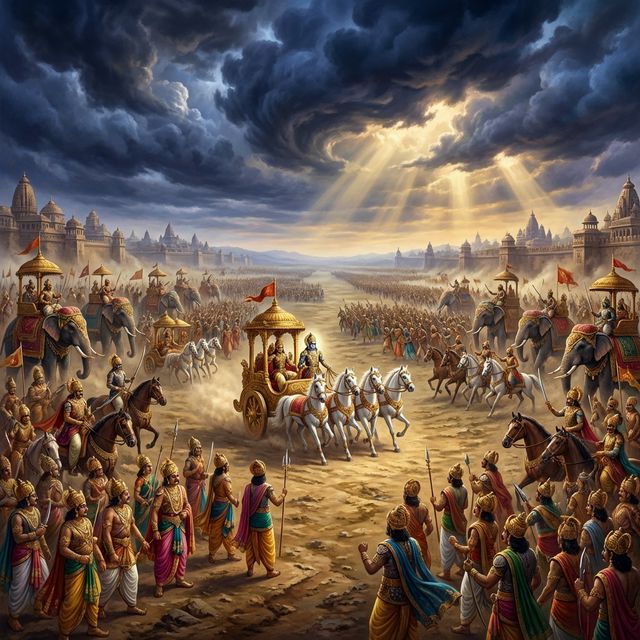
Nala's Bridge
The Ocean refuses to part and names a workman instead, and the monkey army walks to Lanka
The Hill Where the Monkeys Gathered
Markandeya, the sage who had outlived several destructions of the world, was sitting with the sons of Pandu in their forest and telling them, to ease the weight of thirteen years, the story of a prince who had lost more than Yudhishthira had lost and had borne it without bitterness.
He had brought that story as far as the hill called Malyavat. Rama was living on it with Lakshmana and with Sugriva, the monkey king he had put on a throne, and Hanuman had just come back over the water with a jewel in his hand and the news that Sita was alive in Ravana's city. The question was no longer where she was. The question was how a hundred thousand creatures were to reach her.
"It was on the breast of that very hill where Rama was seated," Markandeya said, "that the great monkey chiefs, at the command of Sugriva, began to flock together."
They came by nations. Sushena, the father-in-law of the dead Vali, came to Rama with a thousand crores of active apes behind him. Gaya and Gavakshya came, each with a hundred crores. Gavakshya, of terrible mien and endued with a bovine tail, had collected sixty thousand crores. Gandhamadana, who dwelt on the mountains that bear his name, brought a hundred thousand crores. Panasa, intelligent and mighty, mustered fifty-two crores. Dadhimukha brought an army of monkeys of terrible prowess. And Jamvuvan showed himself there with a hundred thousand crores of black bears, of terrible deeds, their faces marked as though with the Tilaka.
These and many other chiefs of chiefs came, countless in number, for Rama's cause.
Markandeya described what a hill looks like when that many arrive on it. Bodies huge as mountain-peaks. Roaring like lions. Some of them like buffaloes to look at, some the hue of autumnal clouds, the faces of some red as vermillion. Some rose high and some fell down and some cut capers and some scattered the dust, running restlessly from place to place, and the uproar was continuous.
Then, at Sugriva's bidding, that army vast as the sea at full tide sat down and encamped, and waited to be told where to go.
Under a Lucky Constellation
When the monkeys had mustered from every direction, the descendant of Raghu set out. He did it properly: in an auspicious moment of a very fair day, under a lucky constellation, with Sugriva at his side and the host arrayed in order of battle, as if for the purpose of destroying all the worlds.
Hanuman, the son of the Wind-god, went in the van, because he was the only one of them who had already been where they were going. The rear was protected by the fearless son of Sumitra. The two princes of Raghu's house walked in the middle of that press of monkey-chiefs with their fingers cased in guana skin, the leather guard a bowman wears so the string will not cut him, and Markandeya said they shone as they went like the Sun and the Moon in the midst of the planets.
The army had no weapons to speak of. It carried stones, and Sala trees, and Tala trees, pulled up whole, and from a distance the moving mass of it looked like a far-extending field of corn under the morning sun.
Six names are given for the officers who kept that field of corn in order. Nala and Nila. Angada, the son of Vali, who had every reason to hate the man walking beside his uncle and did not. Kratha, Mainda and Dwivida. One of those six names would matter more than the other five before the month was out, and the story does not pause on it here. It simply lists him with the rest.
They marched without interruption of any kind, camping in succession on wide and healthy tracts and in valleys that had fruits and roots and water and honey and meat in them, so that an army of that size fed itself as it went and nobody starved.
And then the ground ran out.
They came down to the shore of the briny sea, and that mighty host with its countless colours, itself like a second ocean, halted at the edge of the first one and took up its abode there. There was nothing further to march toward. The whole strength of the monkey nations stood on a beach, looking at water, a hundred Yojanas of it, with Lanka somewhere on the other side.
A Hundred Yojanas of Water
Then the illustrious son of Dasaratha, standing among all those foremost monkeys, addressed Sugriva with the words the occasion required, and they were not the words of a man making a speech.
"This army is large," Rama said. "The ocean also is difficult to cross. What contrivance, therefore, commends itself to thee for crossing the ocean?"
Many vain-glorious monkeys answered at once. "We are fully able to cross the sea."
They were probably telling the truth about themselves. That was exactly the trouble. The ones who could leap a hundred Yojanas could be counted on the fingers of a hand, and an army is not the sum of its best members. The answer, as Markandeya put it, was not of much use, since all could not avail of that means.
Others had more practical proposals. Some of the monkeys said they should cross in boats. Some said rafts, of various kinds.
Rama conciliated them all before he refused them, which is worth noticing in a man who was being told nonsense by people who loved him.
"This cannot be," he said. "The sea here is a full hundred Yojanas in width. All the monkeys, ye heroes, will not be able to cross it. This proposal, therefore, that ye have made, is not consonant to reason. Besides we have not the number of boats necessary for carrying all our troops. How, again, can one like us raise such obstacles in the way of the merchants?"
That last objection is the one nobody expects. Somewhere behind him a coast full of traders was using those boats to make a living, and the prince who wanted his wife back would not commandeer their season to do it.
He had a second objection, and it was military. "Our army is very large. The foe will make a great havoc if a hole is detected." A crossing strung out over open water in small craft is not a crossing, it is a line of targets, and Ravana had the whole sea to watch it in.
"Therefore, to cross the sea in boats and rafts doth not recommend itself to me. I will, however, pray to the Ocean for the necessary means. Foregoing food, I will lie down on the shore. He will certainly show himself to me. If, however, he doth not show himself, I will chastise him then by means of my great weapons that are more blazing than fire itself and are incapable of being baffled."
So the plan was to ask, and the plan if asking failed was to drink the sea.
The Bed of Kusa Grass
Having said those words, Rama and Lakshmana touched water in the manner the vow required, and duly laid themselves down on a bed of kusa grass on the seashore.
That is the whole of the ceremony. There is no fire in it, no priest, no offering. Two men who commanded the largest army in the world lay down on cut grass at the tide line with nothing in their stomachs and waited, and behind them a hundred thousand crores of monkeys and bears kept quiet.
The divine and illustrious Ocean, that lord of male and female rivers, came to Rama in a vision.
He came surrounded by aquatic animals and by countless mines of gems, which is to say he brought his whole household with him, everything that lives in him and everything that is buried in him, and he addressed the man lying on the grass in sweet accents.
"O son of Kausalya, tell me what aid, O bull among men, I am to render thee. I also have sprung from the race of Ikshwaku, and am therefore a relative of thine."
He had opened by claiming kinship. The kings of Rama's line were his own people, and he said so first, before he was asked for anything, the way an older relation establishes the terms of a conversation.
Rama did not soften what he wanted.
"O lord of rivers, male and female, I desire thee to grant me a way for my troops, passing along which I may slay the Ten-headed, that wretch of Pulastya's race. If thou dost not grant the way I beg of thee, I will then dry thee up by means of my celestial arrows inspired with mantras."
It is a strange sentence to say to a kinsman who has just offered help, and it is said to the sea. The man was lying hungry on a beach with his wife in another man's house, and he had reached the end of his patience with everything that stood between them, including geography.
And the genius of Varuna's abode, who could have drowned the entire monkey army by rising the breadth of a hand, joined his hands and answered in great affliction.
The Ocean Names a Monkey
"I do not desire to put any obstacle in thy way," the Ocean said. "I am no foe of thine. Listen, O Rama, to these words, and having listened, do what is proper."
Then he explained why he could not simply do what he had been asked to do, and the reason he gave was not about Rama at all.
"If, at thy command, I get a way for the passage of thy army, others then, from strength of their bows, will command me to do the same."
He was thinking about the men who would come after. Part the sea once for a bowman who threatens it, and the sea becomes a road that any sufficiently armed man may demand, for any purpose, for ever. He was not refusing the crossing. He was refusing the precedent, and he was asking the one person who wanted that crossing most to see why it mattered.
Then he gave him what he had instead, and it was better.
"In thy army there is a monkey of the name of Nala, who is a skilful mechanic. And endued with great strength, Nala is the son of Tashtri, the divine artificer of the Universe."
That is the whole introduction the epic gives him. Tashtri, whom men also call Vishwakarma, is the maker who built the halls of the gods and forged their weapons, and one of his sons was walking about on that beach in the shape of a monkey, listed fourth among the officers of the line of march, and nobody had thought to ask him anything.
"And whether it is wood, or grass or stone, that he will throw into my waters, I will support the same on my surface, and thus wilt thou have a bridge."
Not a road opened by force, but a road built by hands, out of what the forest was already full of. The sea would not divide. The sea would hold up whatever the artificer's son laid on it, and the army could walk across on the work of its own labour.
And having said these words, the genius of the Ocean disappeared, and Rama woke on the kusa grass with the answer, and it had a name in it.
Nala's Bridge
Rama, awaking, called Nala unto him, and said one sentence to him.
"Build thou a bridge over the sea. Thou alone, I am sure, art able to do it."
There is no record of Nala answering. There is no scene of him objecting that it cannot be done, or asking for time, or naming a price, or pointing out that nobody had spoken to him for the whole of the march. He is a monkey of body huge as a hill who has been carrying trees for somebody else's siege, and the son of Dasaratha turns to him and tells him what his father made him for, and he goes down to the water.
What went into the sea was what the monkeys had been carrying all along. Wood. Grass. Stone. The Sala and Tala trees they had pulled up whole and the rocks they had brought as weapons went in as material instead, and the Ocean kept his word and bore every piece of it on his surface, and the thing grew out from the shore.
Markandeya gives the measurements, because the measurements are the point. Ten Yojanas in width. A hundred Yojanas in length. It was not a footway for heroes. It was wide enough for an army with its bears and its baggage to cross in column without crowding, and it ran the entire distance that the boasting monkeys had claimed they could leap, and it was built on open water by one workman and whatever hands he could direct.
And to this day, the sage said, sitting in a forest in another age and telling it to five exiled brothers, that bridge is celebrated over all the world by the name of Nala's bridge.
Not Rama's bridge. Not the bridge of the descendant of Kakutstha, who commanded it, nor the Ocean's bridge, who held it up. The world remembered whose hands did the work, and it kept the name, and it has never given it to anybody else.
And having completed that bridge, Nala, of body huge as a hill, came away at the command of Rama.
That is the last thing the story says about him. He built the road to Lanka, he was told he could go, and he went back into the ranks.
The Brother Who Came Over the Water
While Rama was still on this side of the ocean, a Rakshasa came to the camp with four counsellors behind him and asked to be received.
It was Vibhishana, the virtuous one, the brother of the king of the Rakshasas, and there was no good reason on earth to believe him. He had come from the city they were about to besiege, on the eve of the crossing, out of a family whose head had stolen Rama's wife, and he came at exactly the moment when a spy would be most useful to the other side.
Sugriva said so. The monkey king feared, thinking he might be a spy, and he was not being small-minded. He had been a hunted man himself, driven out by his own brother, and he knew what a brother could be worth.
But Rama received him with due welcome, and then did the thing that decides such cases. He watched him. The son of Raghu was perfectly satisfied in consequence of the sincerity of his exertions and the many indications of his good conduct, and only then did he worship him with respect.
Then he went further than anybody expected.
He installed Vibhishana in the sovereignty of all the Rakshasas.
Ravana was alive and unbeaten in a fortified city across a hundred Yojanas of water, and Rama crowned his brother king of that city and of the whole Rakshasa race before a single arrow had been shot at its walls. He was not paying for the defection. He was declaring what the war was for. He had not come south to end the Rakshasas. He had come to remove one of them, and he had just said aloud who would be sitting on the throne afterwards.
And he made him his own junior counsellor, and a friend of Lakshmana's, which is the smaller thing and perhaps the harder one. The refugee was not left at the edge of the camp with an honorary crown on him. He was put into the council, and given to the younger brother as a friend, and set to work.
It was under Vibhishana's guidance, then, that Rama took his troops across.
The Crossing, and the Envoy
The army crossed the great ocean by means of that bridge in the course of a month.
A month of it. That is the figure Markandeya gives, and it is worth holding beside the leap Hanuman had made over the same water in a single day. The son of the Wind-god could cross it because he was the son of the Wind-god. Everybody else crossed it because a mechanic had built a road and the Ocean had agreed to hold it up, and they went over in column, monkeys and bears and two princes of Ayodhya, for thirty days, on foot.
And having crossed the ocean and arrived at Lanka, Rama caused its extensive and numerous gardens to be devastated by his monkeys.
He began with the pleasure grounds. Not the walls, not the gates, not the trenches. The orchards and the groves that made Ravana's island the loveliest place in the world were pulled apart first, in full view of the city, by an army that had just walked across the sea it was supposed to be unable to cross.
Two of Ravana's counsellors, Suka and Sarana, came out to count that army. They came as spies, having assumed the shape of monkeys, and it was Vibhishana who caught them, because a Rakshasa was the only creature in that camp who could have known them by their walk. The new king of the Rakshasas made his first arrest on his first day of office, against his brother's officers.
When those wanderers of the night resumed their real forms and stood there caught, Rama did not kill them and did not hold them. He showed them his troops, all of it, and dismissed them quietly, and let them go home to report.
Then he quartered his host in the woods that skirted the city.
And having done all that, he sent the monkey Angada, with great wisdom, as his envoy to Ravana. Vali's son walked up to the gate of Lanka alone with the last offer in his mouth, and the army that had come a hundred Yojanas over the water sat down in the trees behind him and waited to hear what the Ten-headed would say.
Dharma Lesson
Rama came to the sea ready to empty it with celestial weapons, and what he actually needed was standing in his own line of march, listed fourth among the officers, and had never been asked. The Ocean would not part, and the reason he gave was not fear but precedent: a road opened by threat becomes a road any armed man may demand for ever. So the crossing was made instead out of ordinary wood and grass and stone, by the one pair of hands that knew how. The world kept the name of those hands and not the name of the prince who commanded them, which is the only payment a workman is ever certain of, and here it was enough.