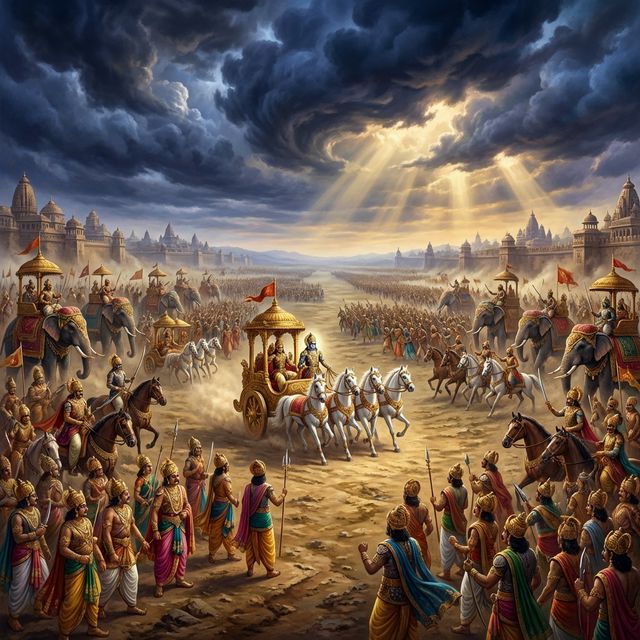
Indra Comes to Gandhamadana
Matali brings Arjuna home from heaven, and the king of the gods follows him down
Waiting on the Mountain of Fragrance
Vaisampayana said: the five of them had been living on the mountain for a month, and every day and night of it had felt to them like a year.
That was the state Janamejaya's forefathers were in on Gandhamadana. Arjuna had gone north out of the Kamyaka forest at Yudhishthira's own command, with Dhaumya's permission, his hair matted for penance, walking with the tread of a mad elephant, and joy had left the brothers from the moment he passed out of sight. He had been five years in the house of the god of a thousand eyes. In that time he had received the weapons of Agni and Varuna, of Soma and Vayu and Vishnu, of Indra and Pasupati, of Brahma and Parameshthi and Prajapati, of Yama, of Dhata, of Savita, of Tvashta and of Vaisravana, and then he had bowed to the lord of a hundred sacrifices, walked round him, taken his leave, and set out cheerfully for the mountain where his brothers were.
They did not know that. They knew only the mountain, which was a beautiful place to be unhappy in. There were lakes on it covered with lotuses and ringed with trees, loud with swans and karandavas. There were slopes full of flowers and the crying of peacocks and cranes. The summit had its own light in it, so that between the shining of the herbs and the splendour of the place itself there was no difference there between night and day, and men standing on it could watch the sun come up and go down and see the cardinal points blazing all round them at once.
They filled the days with the only things that answer waiting. They recited the Vedas. They performed the daily rites. They kept their vows and held to the truth and sat in yoga, saying to one another, let us have our delight here, when we are joined without delay by Arjuna, who is accomplished in arms.
Then one day, while they were thinking of him as usual, something came across the sky.
The Car with Horses of Lightning
It was Mahendra's own car, yoked with horses that had the brightness of lightning in them, and Matali was driving.
It came suddenly and it lit the whole sky as it came. The Pandavas, looking up, saw what appeared to be smokeless tongues of flame, or a great meteor lying in the middle of a bank of cloud, and then they saw who was sitting in it: Kiriti, wearing garlands, wearing new-made ornaments, coming down to them.
Dhananjaya alighted on the mountain blazing with beauty, with the prowess of the wielder of the thunderbolt on him and a diadem on his head, and the first thing that man did with his feet on the ground was bow at the feet of Dhaumya, the family priest who had walked into exile with them and had given him leave to go.
Then he bowed at the feet of Ajatasatru, his eldest brother. Then he paid homage to the feet of Vrikodara. Then Nakula and Sahadeva bowed down to him, because he was older than they were and the order of these things does not bend even for a man who has come out of heaven.
Then he went to Krishna, which is Draupadi's other name, and cheered her.
And after that he went and stood in front of his elder brother in humble guise, and began to praise him.
That is the detail worth holding on to. He had spent five years in Amaravati. He had learned the weapon of Brahma and the weapon of Rudra. He had been embraced by Indra in the sight of the celestials. He came home, and he touched five sets of feet in the right order, and comforted his wife, and then stood before Yudhishthira like a younger brother waiting to be spoken to, and the speech he made was about the king.
On meeting with that matchless one they were exceedingly delighted, and he, meeting with them, rejoiced exceedingly.
As a Father Instructs His Sons
Then they turned and looked at the chariot.
It was standing on the mountain where it had come down, and the Parthas walked round it, keeping it on their right, the way men go round a shrine. They had reason. This was the car in which the slayer of Namuchi had annihilated seven phalanxes of the offspring of Diti. Whatever else it was, it was the vehicle in which the wars of heaven had been won, and it was parked in a flowering meadow among five men in bark and deerskin.
And they worshipped Matali.
They offered him excellent worship, Vaisampayana says, as unto the lord of the celestials himself, which is to say that they gave the charioteer exactly what they would have given the god. Matali is a driver. He holds reins for a living. The Pandavas, who had lost a kingdom at dice and had been living on roots for years, treated him as though Indra had come in person, because the man had brought their brother back.
Then the son of the Kuru king enquired of him, duly, after the health of all the gods. It is the ordinary courtesy one shows a traveller: how are they, all of them, where you have come from. Yudhishthira asked it of a man who had come that morning from heaven, and asked it in the correct form, and Matali greeted them in return.
And then Matali, before he left, instructed the Parthas, and the words used of it are these: even as a father doth his sons.
The text does not report what he told them. It reports only the relation. The charioteer of the king of the gods stood on Gandhamadana with five exiled princes and their wife and their priest around him, and spoke to them the way a father speaks to his children, and they took it that way.
Then he ascended that incomparable car and went back to the lord of the celestials, and the sky was empty again, and Arjuna was still standing there.
The Gems for the Mother of Sutasoma
When Matali had gone, Arjuna turned to what he had brought back.
Sakra had made him presents in heaven, gems and ornaments with the splendour of the sun in them, and the foremost of the royal race, Sakra's own son, the high-souled destroyer of all foes, made the whole of it over to his love, the mother of Sutasoma.
She is named that way here on purpose. Draupadi had a son by each of the five brothers, and the one she bore to Arjuna was Sutasoma, and so it is as the mother of Sutasoma that she receives what he carried down from the sky. The gems came out of Indra's own hand and went straight into hers, in a forest, where there was nowhere to wear them and no one to see.
Then he sat down in the middle of them, the foremost of the Kurus and the best of the Brahmanas around him, all of them effulgent like fire or the sun, and told them what had happened.
He kept it short.
"In this way," he said, "I have learnt weapons from Sakra, from Vayu, and from the manifest Siva. And all the celestials, with Indra, have been pleased with me, on account of my good behaviour and my concentration."
That is the whole of the account he gave that night. Five years of it. The mountain penance, the boar, the hunter who fought him until his weapons were swallowed one after another and his Brahma weapon was baffled and he fell stupefied on the ground; the god who then stood up out of the hunter with Uma beside him and gave him back his bow and put the Pasupata into his hand; the city of heaven, the seat beside Indra, the year that was taken from him by a curse and turned into armour. All of it compressed into one sentence about weapons and one sentence about behaviour, and not a word in it about himself except that he had been well conducted and had paid attention.
Having briefly narrated unto them his sojourn in heaven, Kiriti of spotless deeds slept agreeably that night with the two sons of Madri.
The Sound That Came Down the Sky
In the morning, when the night had been spent, Dhananjaya together with his brothers paid homage to Yudhishthira the just.
And at that moment, out of the sky, the noise began.
It came from the celestials and it was mighty and tremendous: the sound of musical instruments, the rattling of car-wheels, the tolling of bells, all of it at once and all of it descending. Every animal on the mountain answered it. The beasts and the beasts of prey and the birds each cried out in their own separate voices, so that the flowering slopes that had been quiet for a month were suddenly full of sound from the ground and from the air together.
Then the sky filled up.
From every side, in cars as resplendent as the sun, hosts of Gandharvas and Apsaras came following their lord, the represser of foes. And in the middle of that procession, in a car yoked with steeds and decorated with burnished gold, a car that roared like a mass of clouds, blazing in beauty, the king of the celestials came to the sons of Pandu.
Purandara, the sacker of cities. He of a thousand eyes.
He had not sent a messenger. He had sent Matali the day before with the boy, and now he had come himself, with his court behind him, to a mountain in the north where five men were living out a sentence passed on them in a gambling hall.
And having arrived at that place, he descended from his car.
That is a small line and it should not be read past. The lord of the celestials got down. He did not remain seated and let them come up to the rim of the wheel. He put his feet on Gandhamadana, in front of a hermitage of leaves, and stood there in the noise of his own arrival while the eldest son of Kunti came toward him.
Thou Shalt Rule the Earth
As soon as Yudhishthira the just saw that high-souled one, he and his brothers went to him, and he worshipped the king of the immortals in accordance with the ordinance, duly, in the manner suited to his dignity.
Then Dhananjaya, who had lived five years in that god's house, bowed down to Purandara and took his place standing in front of him in humble guise, like a servant.
His hair was still clotted from the mountain. He had the ascetic merit on him and the diadem was of no use to him here, and he stood in front of the lord of the celestials as a man stands who is waiting to be given something to do.
Yudhishthira looked at his brother standing like that.
Then the son of Kunti, of great energy, took his brother's head and smelt the crown of it, which is what the older members of a family do to the younger in this epic in place of an embrace, and it is the gesture that a father makes over a son who has come back from somewhere dangerous. He was exceedingly glad, beholding Phalguna in that attitude. And in worshipping the king of the celestials he experienced the highest bliss.
So the strongminded monarch was standing there swimming in felicity, with his brother restored to him and heaven in his front yard, when the intelligent lord of the celestials, Purandara, spoke to him.
"Thou shalt rule the earth, O Pandava. Blessed be thou. Do thou, O son of Kunti, repair again unto Kamyaka."
Two sentences. The first was a victory that was still eleven years and a war away, promised flatly, as a thing already settled. The second was an order to go back down the mountain to the forest they had come from and finish the term.
And Vaisampayana added the promise that goes with the telling. That learned man who for one year leads the Brahmacharya mode of life, subduing his senses and observing his vows, and who reads this meeting of Sakra with the Pandavas with rapt attention, lives a hundred years free from disturbances, and enjoys happiness.
Dharma Lesson
Arjuna comes back from heaven with the Pasupata in his hand and the friendship of the gods, and the first thing he does is put his head at the feet of the priest and the brother who sent him. Rank in this story runs the other way from power. Indra, who could have summoned the Pandavas, gets down from his car in a forest instead, and the blessing he gives is not a weapon but an instruction to go back and serve out the rest of the sentence. What is promised is certain; what is asked in the meantime is patience.