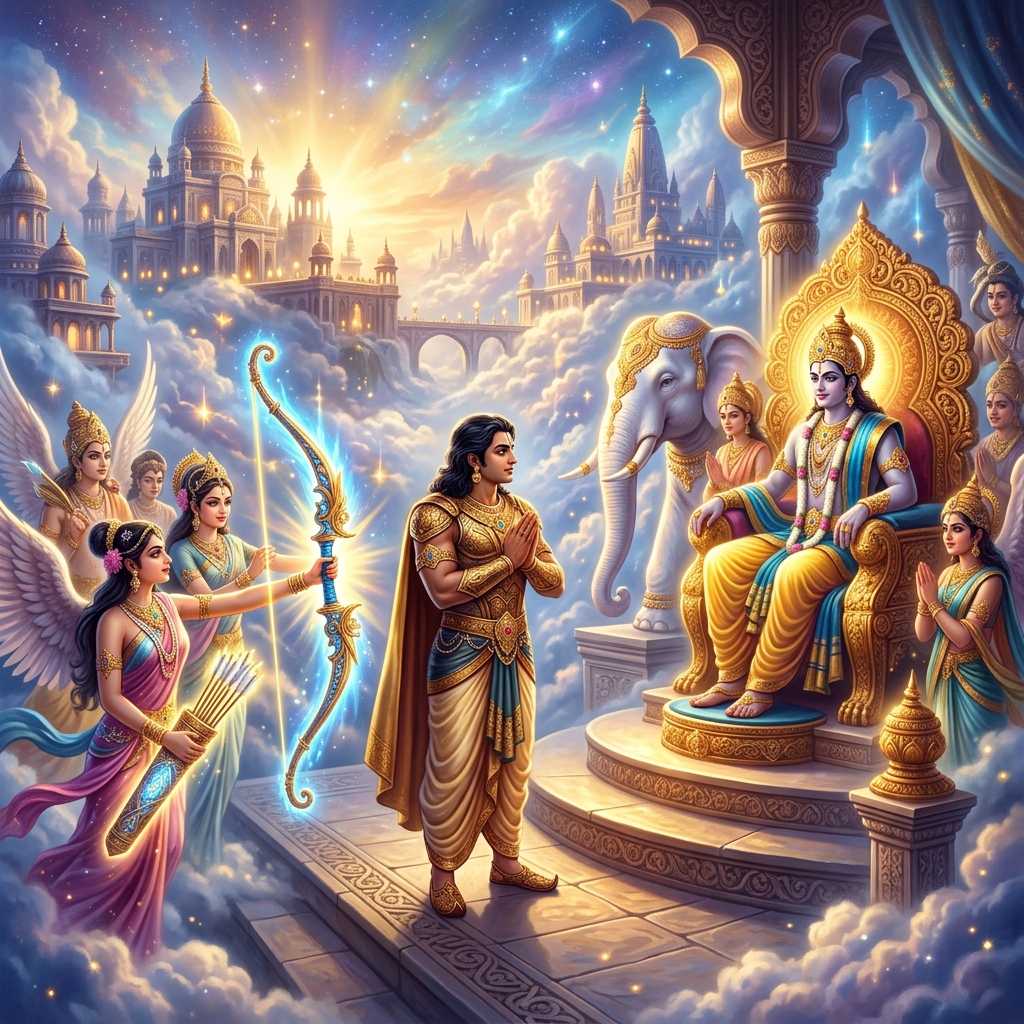
The City Above Meru
Set the map aside. Amaravati is not a place anyone walks to.
It stands above Meru, the mountain at the center of the world, in the country of the gods, and the epic describes it exactly the way it describes a rich capital on earth, only with every limit taken off. It is not hot there and it is not cold. Nothing ages, nothing sickens, and nothing is ever short of anything. There is no dust in the streets, and the flowers on the trees do not wilt and do not fall until somebody wants them.
The gate is kept by an elephant. Airavata came out of the churning of the ocean, white as a bank of cloud, and stands at Indra's door with four tusks, and he is the standing sign that this is the house of the one who took the largest share of that churning.
Inside are the groves. Nandana is the famous one, and its trees give whatever is asked of them, and its paths are crowded with the apsaras, Urvashi and Menaka and Rambha and Tilottama and the rest, who dance for the court and are sent down to earth whenever some ascetic's penance begins to worry the throne. The gandharvas sing, and Chitrasena leads them. Behind the groves stands the palace Vaijayanta, and over everything the banner of Indra.
And through all of it, at every hour, the traffic that makes the place what it is: kings arriving. Men who died facing forward on a battlefield come here. Men who gave away enough, or fasted long enough, or performed the correct sacrifices the correct number of times, come here.
They do not stay. That is the one thing the epic never lets you forget about Amaravati. It is a reward, and rewards are measured out, and when the measure has been used up the gate that let a man in opens the other way for him. Heaven, in this epic, is a place with an exit.
The Hall of Sudharma
When Narada came to Indraprastha and Yudhishthira asked him what the assembly halls of the gods were like, the sage began with Indra's.
"It is called Sudharma," he said, "and it was not built for him. He earned it with his own austerities. It is a hundred yojanas in length and it moves wherever he wishes it to go, and it has the color of fire, and a man who enters it stops feeling hunger and thirst and weariness and fear, and does not age inside it, and cannot be made to grieve while he is there."
He went through the roll of who sits in it. The Maruts and the Siddhas, the Rudras and the Adityas, the ancestors, the sciences and the sacrifices in bodily form, the sages who were never born of a woman, all of them attending upon Indra and his queen Shachi, and Indra himself in the middle of them in white garlands, turning his golden crown over on his knee, without arrogance, listening.
Then Yudhishthira asked the question that every king in the room wanted asked.
"And of men? Of kings, mortal kings who have ruled and died. How many of those are in that hall?"
Narada took his time about answering.
"One," he said. "Harishchandra of the Ikshvakus. He is the only royal sage seated in Indra's assembly, and he is there because he performed the Rajasuya sacrifice, and because he lost everything he had in the world afterward and did not tell one lie while he was losing it. There is no other king of the earth in that hall."
Yudhishthira heard it and said nothing, and Narada watched him hear it, and then delivered the rest of what he had been sent to say: that Pandu was waiting in Yama's country, and that Pandu's message to his eldest son was to perform the Rajasuya and rise as Harishchandra had risen.
The Rajasuya of the Pandavas began in that sentence, and everything that came of it came of a single count of the kings in a room.
The Guest Who Was a Son
Of all the mortals who ever entered the city, only one entered it as family.
Arjuna had gone alone up the Himalaya, had fought a mountain hunter over a boar and discovered halfway through that he was fighting Shiva, and had been given the pashupata weapon for it. Then the chariot of the gods came down for him, driven by Matali, and carried him up past the paths of the stars, and Indra's capital opened for Indra's son.
He lived there five years. His father seated him on half of his own throne in front of the entire court, and the epic makes a point of the gandharvas playing and the apsaras dancing as he sat down, because a mortal on that seat had never been seen.
He was not there to be entertained. Indra gave him the weapons of the gods one after another, with the formulas for calling them and, more to the point, the formulas for withdrawing them, and made him swear never to loose them on men who did not deserve them. Chitrasena, king of the gandharvas, was assigned to teach him music and dance and the arts of song, on his father's instruction, and Arjuna learned those the way he learned everything else.
That was the arrangement when Urvashi came to his rooms at night.
Indra had sent her, having misread his son's attention entirely. Arjuna stood up and bowed to the ground.
"You were the wife of Pururavas," he said, "who is the root of my line. You are a mother to me, and I look at you as a son looks. Be pleased to look at me the same way."
No one had ever refused her. She told him that a man who turns away a woman who has come to him is no man at all, and cursed him to live among women as a dancer, without his sex.
Indra could not undo it and shortened it instead. One year, he said, and let my son choose which year.
Arjuna chose the thirteenth, and walked into Virata's court in bangles and a braid to teach the princess to dance, and a curse pronounced in Amaravati became the hiding place that kept him alive.
The Mortal on the Throne
The city has been taken once, and by a man.
Indra killed Vritra, which was the greatest thing he ever did and also the killing of a brahmana, because Vritra was one. The guilt of it came after him in a shape he could not fight. He ran, and hid himself inside the fibre of a lotus stalk in a lake in the far north, made small, saying nothing to anyone, and heaven stood open behind him with no one on the throne.
The gods and the sages went down to earth to find a replacement, and at first they chose well. Nahusha of the lunar line was a good king, generous, exact in sacrifice, spoken of everywhere, and they brought him up and crowned him in Amaravati and gave him Indra's powers to hold in trust.
He held them about as long as such things are held. Within a short time he had gods carrying his messages, and after that he looked around the palace and asked why one thing in it was not yet his.
"Indra's wife lives in Indra's house," he said, "and I have Indra's house."
Shachi asked for time. Then, on Brihaspati's advice, she asked for a condition, and made it flattering and impossible at once.
"Come to me," she said, "in a palanquin. But not one carried by gods. Let the great rishis carry it, and then I will know that you are greater than the one you replaced."
He did it. He put the sages under the poles of his litter, and among them was Agastya, who is very short, so the litter went crooked and slowly, and Nahusha lost patience and kicked Agastya on the head with his foot and said, sarpa, sarpa, move, move.
Agastya straightened up under the pole.
"Sarpa," he said. "Then be one. Go down and crawl."
And the king of heaven went off the terrace as a python, and lay in a forest on the earth for an age, until the day he caught a very strong man in his coils and could not let go of him until that man's brother had answered his questions correctly.
The Fall of Yayati
Nahusha's son came to the same city by the front door and left it the same way.
Yayati had ruled the earth to its edges, had borrowed a thousand years of youth from his own son and handed it back when he was finished with it, and had performed sacrifices beyond counting. When he died he went up, and Amaravati received him, and he lived there among the gods for a very long time on the strength of what he had done.
One day the conversation turned, as it does in such places, to merit.
"Who is there," said Yayati, "among gods or men or gandharvas or the great ascetics, whose austerities are the equal of mine?"
Indra looked at him.
"You did not know the size of what you were holding," he said, "and you have just spent the last of it in one breath. The man who praises himself is finished. Go down."
He fell out of heaven. On the way he was allowed a single request, and he asked, having learned exactly one thing on that terrace, to be set down among good men. So he came to earth in the middle of a sacrifice on the open plain, among four kings, and they looked up and saw a man coming down out of the sky with the garlands still fresh on him.
They were Ashtaka, Pratardana, Vasumanas and Shibi, and they were the sons of his daughter Madhavi, and they knew him. They argued with him about merit and the worlds until the argument became a scripture in its own right, and then each of them offered him the fruit of his own sacrifices to climb back up on, and by that gift he rose again.
So the city keeps its accounts. Nahusha entered it as a king and left it as a snake. Yayati entered it by merit and left it by one sentence. Arjuna lived in it five years as a son of the house and came down when his exile required him on earth. And the Pandavas at the very end, climbing the last mountain, would find the door of heaven a stranger thing to stand in front of than any of them had expected.
Dharma Lesson
Amaravati is the epic's argument against heaven as a goal. Everything in it is earned, and everything earned runs out, so the city is full of residents quietly spending down a balance they cannot add to. Nahusha and Yayati each lost it in a single sentence, and the one mortal king seated permanently in its hall got there by losing everything he owned on earth and not lying about it once.