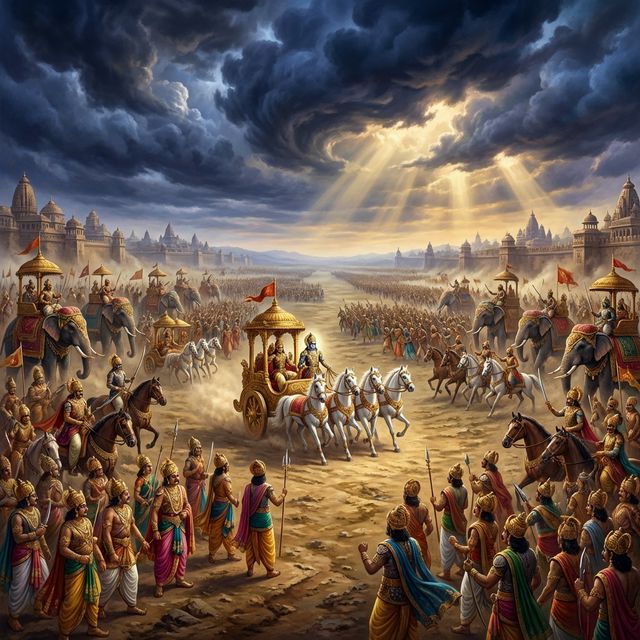
Tarkshya Asks Saraswati
What a gift is worth, and the one merit a man with nothing can still earn
The Muni Who Asked a Goddess
Markandeya had been talking about Brahmanas all morning, and the story he had just finished was not a comfortable one. Atri had gone to the horse-sacrifice of the royal sage Vainya, had praised the king to his face in the hearing of the assembled Munis, had been called a flatterer and a child steeped in ignorance by Gautama for doing it, and had been vindicated by Sanatkumara and sent home with a hundred millions of gold coins and ten bharas of gold. He had given every coin of it to his sons and then walked into the forest to perform penances with nothing.
So the exiles in the Kamyaka woods had just been shown a man who took an enormous gift and was not damaged by it, and Yudhishthira, who had lost a kingdom at dice and had been thinking for years about what wealth is for, was listening closely.
"O thou conqueror of hostile cities," Markandeya said, "in this connection Saraswati too, when interrogated by that intelligent Muni Tarkshya, had said this. Do thou listen to her words."
The epic tells us almost nothing about Tarkshya. He was a Brahmana and a Muni, he was cheerful, he was eager to learn, and he was intelligent, and that is the whole of his description. He is not a king with a doubt or a sage with a grievance. He is simply a man who went to the goddess of speech and of learning and asked her the question that every householder in the world is entitled to ask, which is what he ought to be doing with his days.
"Excellent lady," Tarkshya said, "what is the best thing for a man to do here below, and how must he act so that he may not deviate from the path of virtue? Tell me all this, O beautiful lady, so that instructed by thee, I may not fall away from the path of virtue. When and how must one offer oblations to the sacred fire, and when must he worship, so that virtue may not be compromised? Tell me all this, O excellent lady, so that I may live without any passions, craving, or desire, in this world."
Saraswati looked at him, cheerful and eager and intelligent as he was, and began to answer.
The Lakes Whose Sight Assuages Grief
She did not begin with the fire. She began with the man.
"He who is engaged in the study of the Vedas," Saraswati said, "and with sanctity and equanimity perceives the supreme Godhead in his proper sphere, ascends the celestial regions and attains supreme beatitude with the Immortals."
Three conditions, and none of them is a rite. Study, which is work done daily and without an audience. Sanctity, which is the condition of a man who has kept himself clean in the ways his order requires. And equanimity, which is the one Tarkshya had asked for by name when he said that he wished to live without passions, craving, or desire. The goddess had heard the last clause of his question and answered it first. What takes a man up is not a transaction. It is a settled mind that has learned to see God where God actually is.
Then she described the place such a man arrives at, and the description is worth having whole, because it is not a description of a throne room.
There are lakes there. Many of them, large and beautiful and pellucid and sacred, and they abound with fish and with flowers and with golden lilies. They are like shrines, she said, and the very sight of them is calculated to assuage grief.
That is the promise. Not that the man who arrives there will be powerful, and not that he will be praised, but that he will look at water and stop grieving.
On the shores of those lakes the pious dwell in contentment, and they are distinctively worshipped by Apsaras who are virtuous and well-adorned and golden-complexioned. It is a settled life rather than a festival. Men who have arrived sit by good water among flowers and are honoured by beautiful beings, and nobody in the account is doing anything strenuous at all.
A man in a forest, listening to this in the fourth or fifth year of an exile, would have understood the appeal of it better than most. The goddess had put the reward in front of the muni before she named a single price, which is the reverse of how such teachings usually run, and having shown him the lakes she began on the arithmetic of how a householder gets to them.
Cows, Bullocks, Clothes, Gold
What follows in Saraswati's answer is a table, and the site's habit is to give a table as a table rather than to blur it into a sentence about generosity.
He who gives cows to Brahmanas attains the highest regions.
By giving bullocks he reaches the solar regions, which are the regions of Surya.
By giving clothes he gets to the lunar world.
By giving gold he attains to the state of the Immortals.
Four gifts and four destinations, ranked and distinguished, and the order of them is the first surprise. Gold, which is the gift a king makes and the gift the world notices, is in the list, and it buys a great deal. But it is the cow that is put at the top of the list and the cow that the goddess will spend the rest of her answer on. A man who has one cow and gives it away is doing something that the man with ten bharas of gold cannot outbid, and Markandeya was telling this to listeners who had just heard about a hundred millions of coins changing hands at a royal sacrifice.
The reason is not stated because it did not need stating to anyone who had ever kept an animal. Gold is inert. It sits where it is put. A cow is a thing that goes on producing after it has left your hands, every morning, for years, in another man's yard, and the merit of the gift keeps pace with the milk. What is being measured in these verses is not the value of the object at the moment of parting with it. It is the length of the good that the object goes on doing.
So the goddess did not stop at the word cow. She began to specify which cow, because the epic is never content to say that a man should be generous when it can instead say exactly what he should hand over and exactly what he will get for it, and because a rule that can be checked is a rule that can be kept.
Counted by the Hairs on Her Body
"He who giveth a beautiful cow with a fine calf," Saraswati said, "and which is easily milked and which doth not run away, is destined to live for as many years in the celestial regions as there are hairs on the body of that animal."
Every adjective in that sentence is a condition. Beautiful. With a calf at her side. Easily milked, which is to say she stands still and does not have to be fought every morning. And she does not run away, which is the quality a man discovers only after the animal is his and which he never mentions when he is selling her. The goddess has ruled out the gift that looks like a gift. A difficult cow given to a Brahmana is a burden dressed up as an offering, and it earns what a burden earns.
The measure of the reward is the strangest and the most memorable thing in the passage. Years in heaven, counted one for one against the hairs on the animal's hide. Nobody can count them. That is the point of the figure. The number is real, it is fixed, it is attached to a particular animal standing in a particular yard, and it is beyond the arithmetic of the man who gave her.
Then the bullock. He who gives a fine, strong, powerful, young bullock, capable of drawing the plough and of bearing burdens, reaches the regions attained by men who give ten cows. Again the qualities are the price. Young, so that there is work left in him. Strong enough to plough and strong enough to carry, which is to say good for the field and good for the road. One such animal is reckoned at ten cows, and a worn-out one is reckoned at nothing.
And then the gift with the extras attached. When a man bestows a well-caparisoned kapila cow, a tawny cow, together with a brazen milk-pail and with money given afterwards, that cow, by her own distinguished qualities, becomes a giver of everything, and she reaches the side of the man who gave her away.
She goes to him. Not the merit of her, not a record of her. The animal herself, waiting on the other side for the man who let her go.
Seven Generations Up and Down
Then the goddess widened the account, because in her reckoning a gift is not settled between two men only.
He who gives away cows reaps innumerable fruits of his action, measured by the hairs on the body of that animal. And he also saves, from perdition in the next world, his sons and his grandsons and his ancestors to the seventh generation.
That is the doctrine that makes sense of everything else in the passage. A householder is not standing alone at the altar. He is standing in the middle of a line that runs seven deep behind him and seven deep in front, and what he does with an animal in his yard reaches people who are dead and people who are not born.
For the man who has no cow there is a substitute, and the substitute is described with the same precision as the animal. He who presents to a Brahmana sesamum made up in the form of a cow, with horns made of gold, with money besides, and a brazen milk-pail, afterwards attains easily to the regions of the Vasus. A figure of seed shaped like the beast, gilded at the horns, sent with the pail she would have been milked into and the money that goes with her. The poor man's cow is not a lesser thing pretended into a greater one. It is an honest declaration of what he would have given if he had it, made in the shape of the thing itself.
Then Saraswati named what is at stake, and the image is the darkest in her answer. By his own acts, she said, a man descends into the darksome lower regions, infested by the evil spirits of his own passions, like a ship tossed by the storm in the high seas. That is the default. Nobody sends him there. He sails himself down. But the gift of kine to Brahmanas saves him in the next world.
Two more entries close the list. He who gives his daughter in marriage in the Brahma form, which is the giving of her freely to a man of character with no price taken for her, and who bestows gifts of land on Brahmanas, and who duly makes other presents, attains to the regions of Purandara, which is Indra's own heaven.
"And O Tarkshya," she said, "the virtuous man who is constant in presenting oblations to the sacred fire for seven years sanctifieth by his own action seven generations up and down."
Now Tell Me How to Keep the Fire
Seven years, and seven generations in both directions.
It is the only item in the whole of her answer that costs nothing but time. Every other line has a price attached to it that a poor man might not be able to pay. A cow with a calf. A young bullock. A brazen pail and money afterwards. Gold at the horns of a figure made of sesamum. Land. A daughter given away without a price taken for her. All of these are gifts, and all of them require that a man have something in the first place.
The fire requires only that he be there. It has to be fed at the right times, in the right way, without a gap, for seven years, by a man who is present every one of those mornings, and at the end of it the same reach is claimed for him that was claimed for the giver of cows. Seven generations before him and seven after, sanctified by his own action. The householder who cannot buy heaven can still keep the fire.
And Tarkshya, who was intelligent, heard that immediately and asked the only question left to ask.
"O beautiful lady," he said, "explain to me who ask thee the rules for the maintenance of the sacred fire as inculcated in the Vedas. I shall now learn from thee the time-honoured rules for perpetually keeping up the sacred fire."
He had come with a broad question about how a man ought to live, and he had been answered with a table of gifts and their fruits, and he had listened to the whole of it and picked out the one line that was addressed to a man with empty hands. Not what shall I give. How is it kept.
Markandeya let the question stand there, and the exiles in the Kamyaka forest sat with it, five brothers and a wife who had no cows and no land and no gold to give to anybody, and a fire of their own to keep every morning for years yet.
Dharma Lesson
The passage is usually read as a price list for heaven, and it is one, but the order of the items is the argument. Gold buys the state of the Immortals and a cow buys more, because what is being weighed is not what the gift is worth when it leaves your hands but how long it goes on giving after it does. And the list ends where nobody would expect a list of gifts to end, with a man who owns nothing keeping a fire on time for seven years and reaching as far in both directions as the man who gave away the herd.