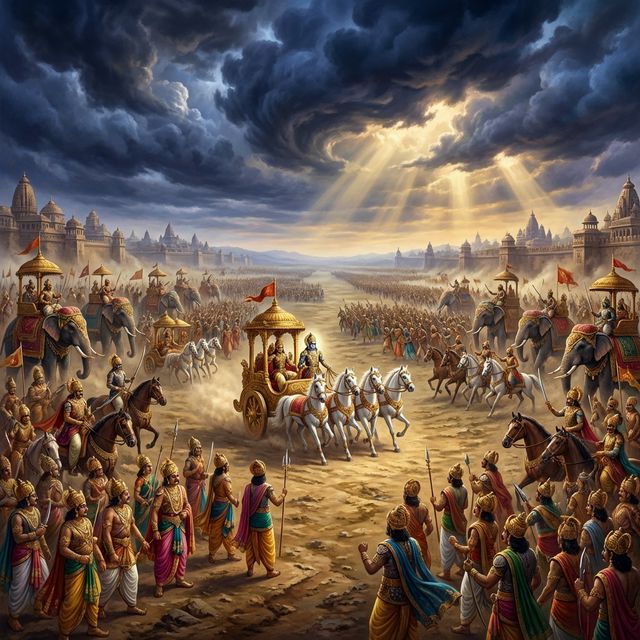
Gifts Under the Lunar Mansions
Narada tells Devaki what to give under each star, and the gods ask Brahman for ground to stand on
What Gratifies a Brahmana
Bhishma had finished with the gift of earth. He had said that it was the first of all gifts, that it cleansed the giver as a mother cleanses, and that Vasava himself, hearing the same doctrine from Vrihaspati, had handed over the whole world with its jewels and its gems. Yudhishthira had listened to all of it lying at the foot of the arrow bed, and what he asked next was smaller and more practical.
"When a king becomes desirous of making gifts in this world," he said, "what, indeed, are those gifts which he should make, O best of the Bharatas, unto such Brahmanas as are possessed of superior accomplishments? What gift is that by which the Brahmanas become immediately gratified? What fruits do they bestow in return? What gifts, O king, are productive of rewards both here and hereafter? I desire to hear all this from thee. Do thou discourse to me on all this in detail."
It was the question of a man who now owned everything and had not yet worked out what to do with any of it. He had the earth. He wanted the list.
Bhishma did not answer out of his own authority.
"These very questions were on a former occasion put by me to Narada of celestial appearance," he said. "Hear me as I recite to thee what that celestial sage told me in reply."
Narada is the rishi who goes everywhere. He walks into the halls of gods and the courtyards of kings with his lute and his news, and he is the one figure in the epic who has seen every household in the three worlds from the inside. If anyone knew what a Brahmana actually wants at the door, it was he.
And his answer did not begin with gold, or with land, or with any of the things a king thinks of first.
"The deities and all the Rishis applaud food," Narada said. "The course of the world and the intellectual faculties have all been established on food. There has never been, nor will there be, any gift that is equal to the gifts of food."
The Man at the Door
Narada built his case from the body upward. In this world food is the cause of energy and strength. The life breaths are established on food. It is food that upholds the wide universe. Householders, mendicants and ascetics, three kinds of men who agree about almost nothing, all exist depending upon food and nothing else.
Then he turned from the doctrine to the doorway, because that is where the doctrine is tested.
"The householder should never disregard the man that comes to his abode," Narada said, "nor should he insult him by sending him away."
A deserving old man spent with toil, walking far from home, honours a house by entering it. That is the direction the transaction runs in, and Narada is careful to put it that way round. The one who arrives hungry is doing the favour. And the giver must give with his temper packed away. The man who, casting off wrath that overleaps every bound, and becoming righteous in disposition and freed from malice, makes gifts of food, is sure to attain happiness both here and hereafter.
Then the line that cuts under every rule about who is fit to receive.
"A gift of food made unto even a Chandala or a dog is never lost."
The Chandala is the man outside the four orders, whom the codes will not let sit down with anybody. The dog is not a person at all. Narada puts them in the same clause and says the merit survives in both cases, and he adds the traveller nobody knows: the man who gives clean food to a stranger on the road, toil worn and unknown to the giver, acquires great merit for it.
Asked for food, one should not enquire about the asker's race, or his conduct, or his Vedic learning. Asked for food, one should give food to him that asks.
The Brahmana, Narada said, is the guest of all creatures in the universe and is entitled to the first portion of every food. He is a great being and he is also a fertile field, and whatever seed is sown on that field returns an abundant crop of merit. That house grows in prosperity to which Brahmanas come asking for alms and from which they go away satisfied and honoured.
And unlike every other gift, this one can be watched working. A gift of food is visibly and immediately productive of the happiness of both the giver and the receiver. All other gifts produce fruits that are unseen.
Food is Earth, Food is Heaven
Then Narada widened the frame until the whole cosmos was inside it.
In a former Kalpa, he said, the Lord of all creatures declared that food is Amrita, the source of immortality. Food is Earth. Food is Heaven. Food is the Firmament. Everything is established on food.
And he proved it by subtraction. In the absence of food the five elements that constitute the physical organism cease to exist in a state of union, which is to say the body comes apart. From absence of food the strength of even the strongest man is seen to fail. Invitations cease. Marriages cease. Sacrifices cease. And then the last item on that list, which is the one nobody expects: the very Vedas disappear when food there is none. The eternal word is kept alive in the throats of men who have eaten, and hunger can erase it from the world.
Then he described the circuit, which is the reason food can be called Heaven without exaggeration.
The deity of wind, who is the lord of the life breaths, carries above the clouds the water that the Sun has sucked up. Sakra causes that water to be poured back down upon the earth. The Sun, by means of his rays, draws the moisture of the earth up again, and the wind brings it down from the Sun. When the water falls from the clouds the goddess Earth becomes moist, and then men sow diverse kinds of crops, and upon the outturn of those crops the universe of creatures depends.
It does not stop at the harvest. It is in the food thus produced that the flesh, the fat, the bones and the vital seed of all beings have their origin. From that seed spring the diverse kinds of living creatures. Agni and Soma, the two agents living within the body, create the seed and maintain it. Wind, rain, sun, soil, grain, blood, seed, child: Narada says that all of these are to be counted as one element, one single quantity, and that it is from this one thing that all creatures spring.
Which is why the last sentence of the discourse is not about heaven at all. It is about a doorway again.
"That man who gives food unto one who comes into his house and solicits it," Narada said, "is said to contribute both life and energy unto living creatures."
The Mansions Bright as Stars
"Thus addressed by Narada," Bhishma said, "I have always made gifts of food. Do thou also, therefore, freed from malice and with a cheerful heart, make gifts of food."
Then the old man on the arrows did something he does rarely. He described the reward in full, the way a man describes a country he expects shortly to see.
The mansions of those high souled persons shine with resplendence in the regions of Heaven. They are bright as the stars in the firmament and supported upon many columns. They are white as the disc of the moon and hung about with many tinkling bells, and they are rosy like the newly risen sun, and some of them stand where they are and some of them travel. Some have the effulgence of lapis lazuli. Some have the resplendence of the sun. Some are made of silver and some of gold.
Inside them are trees capable of crowning with fruition every desire of the inmates. Tanks, roads, halls, wells and lakes occur all around. Thousands of conveyances stand ready with horses and other animals harnessed to them, and the clatter of their wheels is always loud.
And then, because the gift was food, the country is made of food. Mountains of it. Heaps of cloths and ornaments beside them. Rivers that run milk. Hills of rice and other edibles. Palatial residences that look like white clouds, with beds of golden splendour inside them.
It is a heaven arranged as the opposite of a famine, and it is worth noticing what a man who is dying of thirst on a battlefield chooses to dwell on when he is free to imagine anything at all. Not thrones. Not victories. Milk, rice, cloth, shade and a hall with room enough for whoever arrives.
"All these are obtained by those men that make gifts of food in this world," Bhishma said. "Do thou, therefore, become a giver of food."
Narada Comes to Dwaraka
"I have heard the discourse regarding the ordinance about the gift of food," Yudhishthira said. "Do thou discourse to me now about the conjunction of the planets and the stars in relation to the subject of making gifts."
He was asking for the calendar. The moon passes each night into a different one of the twenty seven mansions, and the old teaching is that a gift laid down under one star is not the same gift as the one laid down under the next.
"In this connection," Bhishma said, "is recited this ancient narrative of the discourse between Devaki and Narada, that foremost of Rishis."
Devaki is Krishna's mother, the woman whose first six children were killed in a prison cell in Mathura. She had come at last to Dwaraka on the sea, and one day Narada of godlike feature arrived there as he arrives everywhere, and she put the question to him, and he answered her in order, star by star, beginning where the list begins.
Under Krittika, gratify deserving Brahmanas with payasa mixed with ghee, and you attain regions of great happiness.
Under Rohini, to free yourself of the debt you owe the Brahmanas, give them many handfuls of venison along with rice and ghee and milk and other kinds of edibles and drinks.
Under Mrigasiras, which is also called Somadaivata, give away a cow with a calf, and you go from this region of human beings to a region in heaven of great felicity.
Under the star that follows, keep a fast and give away krisara mixed with sesame, and you will pass in the next world over even those mountains whose rocks are sharp as razors.
Under Punarvasu, give cakes and other food, and you become possessed of personal beauty and great fame and are born next time into a family where there is abundance of food.
Under Pushya, give gold, wrought or unwrought, and you shine like Soma himself in regions of surrounding gloom.
Under Aslesha, give silver, or a bull, and you are freed from every fear and attain great affluence.
Under Magha, give earthen dishes filled with sesame, and you get children and animals here and felicity hereafter.
Under Purva Phalguni, fasting, give food mixed with phanita, the thickened juice of the cane, and the reward is great prosperity both here and hereafter.
Under Uttara Phalguni, give ghee and milk with the rice called shashthika, and you attain great honours in heaven. Whatever is given under that star, Narada said, produces merit that is inexhaustible. This is very certain.
From Hasta to Bharani
Narada went on around the circle, and Devaki listened without once interrupting.
Under Hasta, fasting, give a car with four elephants, and you attain regions that grant the fruition of every wish.
Under Chitra, give a bull and good perfumes, and you sport among the Apsaras as the deities sport in the woods of Nandana.
Under Swati, give wealth, and you attain whatever regions you desire and win great fame.
Under Visakha, give a bull, a cow that yields a copious measure of milk, a cart full of paddy with a prasanga to cover it, and cloths for wear. Such a person never meets with any calamity and certainly reaches heaven.
Under Anuradha, fasting, give embroidered cloth and food, and you are honoured in heaven for a hundred Yugas.
Under Jyeshtha, give the potherb called kalasaka with the roots still on it, and you attain great prosperity.
Under Mula, with a restrained soul, give fruits and roots, and you gratify the Pitris.
Under Purvashadha, fasting, give cups filled with curds to a Brahmana conversant with the Vedas, and you are born in a family possessed of abundant kine.
Under Uttarashadha, give jugs full of barley water, with ghee and inspissated juice of sugarcane, and you obtain the fruition of every wish.
Under the conjunction called Abhijit, give milk with honey and ghee unto men of wisdom, and you attain heaven.
Under Sravana, give blankets or cloth of thick texture, and you rove through every region of felicity riding on a white car of pure resplendence.
Under Dhanishtha, give a vehicle with bulls yoked to it, or heaps of cloths and wealth, and you attain heaven at once in your next life.
Under Satabhisha, give perfumes with aloe wood and sandalwood, and you attain the companionship of the Apsaras and eternal perfumes.
Under Purva Bhadrapada, give rajamasha beans, and you become possessed of an abundant stock of every edible and fruit.
Under Uttara, give mutton, and you gratify the Pitris and attain inexhaustible merit.
Under Revati, give a cow with a vessel of white copper for milking her, and in the next world that same cow approaches you, ready to grant every wish.
Under Aswini, give a car with steeds yoked to it, and you are born among numerous elephants and cars.
Under Bharani, give kine and sesame to the Brahmanas, and you acquire great fame and an abundance of kine.
"Even thus did Narada discourse unto Devaki," said Bhishma. And Devaki, having listened, recited the whole of it in her turn to her daughters in law, who were the wives of Krishna. It went from a rishi to a mother, and from her to the women who ran the houses.
Gold, Water, Ghee and an Umbrella
Bhishma came back from the stars to the ordinary furniture of a life, and he cited his authorities by name as he went.
The illustrious Atri, son of the Grandsire Brahman, said that they who make gifts of gold are said to make gifts of everything in the world. King Harischandra said that the gift of gold is sin cleansing, leads to long life, and is productive of inexhaustible merit unto the Pitris.
Manu said that a gift of drink is the best of all gifts. Therefore a man should cause wells and tanks and lakes to be excavated. A well full of water, from which diverse creatures draw, takes off half the sinful acts of the man who dug it. The whole race of that man is rescued from hell in whose well or tank kine and Brahmanas and righteous people constantly quench their thirst.
Ghee gratifies Vrihaspati and Pushan and Bhaga and the twin Aswins and the deity of fire. It has high medicinal virtue, it is a requisite for sacrifice, and it is the best of all liquids. Upon the man who gives ghee to Brahmanas in the month of Aswin, the twin Aswins confer personal beauty. Rakshasas never invade the house of the man who gives payasa mixed with ghee. The man who gives jars filled with water never dies of thirst.
Firewood is on the list too, which is a plain thing to be on a list of holy gifts. The man who gives Brahmanas wood for their cooking and for driving off the cold finds all his purposes crowned with success. The deity of fire is pleased with him. He is never divested of cattle. He is sure to achieve victory in battles.
The man who gives an umbrella obtains children and great prosperity, is never affected by any disease of the eyes, and gets besides the merits that spring from a sacrifice.
And the Rishi Sandilya, Bhishma said, held that of all gifts the gift of a car is the best.
Then Yudhishthira asked about the smallest thing yet. What are the merits of the man who gives a pair of sandals to a Brahmana whose feet are being scorched by hot sand while he walks?
"The man that gives unto the Brahmanas sandals for the protection of their feet," said Bhishma, "succeeds in crushing all thorns and gets over every kind of difficulty. Such a man stays over the heads of all his foes. Vehicles of pure splendour, with mules harnessed thereto, made of gold and silver, approach him. He who makes a gift of sandals earns the merit of giving a vehicle with well broken steeds yoked to it."
Seeds From the Limbs of Kasyapa
"Do thou tell me in detail once more, O grandsire," Yudhishthira said, "of the merits that attach to gifts of sesame and land and kine and food."
Bhishma began with the smallest of the four, and it turned out to have the longest pedigree.
Sesame seeds were created by the Self born Brahman as the best food for the Pitris. That is their origin and their office. Everything else about them follows from it. Gifts of sesame always gladden the fathers greatly, and the man who gives sesame to Brahmanas in the month of Magha has never to visit hell, which abounds with all frightful creatures. He who adores the Pitris with offerings of sesame is regarded as worshipping the deities at all the sacrifices at once. One should never scatter sesame at a Sraddha idly, without cherishing some purpose in doing it.
And they came out of a body. Sesame seeds sprang from the limbs of the great Rishi Kasyapa, who is one of the fathers of the world, and it is because of that birth that they are held in the matter of gifts to be of such high efficacy. They bestow prosperity. They bestow personal beauty. They cleanse the giver of all his sins. For this reason the gift of sesame is distinguished above the gift of every other article, and the merit of it is called inexhaustible.
Bhishma named the men it had carried. Apastamva of great intelligence, and Kankha, and Likhita, and the great Rishi Gautama, all ascended to heaven by having made gifts of sesame seeds. Those Brahmanas who make homa with offerings of sesame, and abstain from sexual intercourse, and observe the religion of acts, are reckoned equal in purity to the offering of clarified butter itself.
Then the story that settles the matter. In ancient times havi, the clarified butter without which no libation can be poured, became on one occasion unobtainable. The Rishi Kusika stood before his three sacrificial fires with nothing to give them. So he offered sesame seeds instead, into all three, and by that offering he attained to an excellent end.
The fire took it. That is the whole of the argument. What a man has, offered in the absence of what he ought to have had, is accepted.
The Deities Beg for a Piece of Earth
"After this, listen to what I would say," Bhishma said.
Once on a time the deities wished to perform a sacrifice, found they could not, and went to the presence of the Self born Brahman to explain why.
"O illustrious one, thou art the lord of all the earth as also of all the deities," they said. "With thy permission we desire to perform a sacrifice. The person who has not obtained by lawful means the earth whereon to make the sacrificial altar earns not the merit of the sacrifice he performs. Hence it behoveth thee to grant us a piece of earth for the sacrifice we wish to make."
See what the gods have admitted. They cannot lawfully own a patch of ground the width of an altar, without lawful title the whole rite is void, and they know it, and they have come to ask like anybody else.
"Ye foremost of deities," said Brahman, "I shall give you a piece of earth whereon, ye sons of Kasyapa, you shall perform your intended sacrifice."
"Our wishes have been crowned with fruition," the deities said. "We shall perform our sacrifice even here with large Dakshina. Let, however, the Munis always adore this piece of earth."
And the Munis came, since a thing adored requires adorers: Agastya, Kanwa, Bhrigu, Atri, Vrishakapi, Asita and Devala. The deities performed their sacrifice on the breast of Himavat, that foremost of mountains, and concluded it in due time. And they did not keep the whole of what they had earned. They attached to the gift of earth a sixth part of the merit arising from their sacrifice, and left it there for whoever should afterwards give ground away.
So the rules came down with the gods' sixth share behind them. The man who gives even a span of earth with reverence never languishes under any difficulty. He who gives a house that keeps out cold and wind and sun attains the region of the deities and does not fall from it when his merit is spent. He who gives a shed for kine rescues seven generations of his race. Arable earth brings prosperity, and earth with mineral wealth aggrandises his family.
And the refusals. Never give away earth that is barren, or burnt and arid, or lying close to a crematorium, or that a sinful man has owned before you. When a man performs a Sraddha for his fathers upon another man's ground, the Pitris render both the gift and the Sraddha futile. Hence a wise man buys even a small piece of earth and gives that. Only forests, mountains, rivers and tirthas are exempt, being regarded as having no owners at all.
The River Made From Skins
"I shall now discourse to thee upon the gift of kine," Bhishma said.
Kine are regarded as superior to all the ascetics, and it was for that reason that the divine Mahadeva performed his penance in their company. They benefit human beings with milk, ghee, curds, dung, skin, bones, horns and hair. They do not feel cold or heat. They always work. Because they attain the highest end in the company of Brahmanas, the wise say the two are equal.
Then Bhishma told the piece of history that explains why the rules are what they are now.
In days of yore king Rantideva performed a grand sacrifice in which an immense number of kine were slaughtered. From the juice that ran out of the skins of the slaughtered animals a river was formed, and it is there still, and is called the Charmanwati.
He does not moralise over it. Kine no longer form animals fit for sacrifice. They are now animals fit for gift.
Once they are gifts, the weight falls on who receives them. The cow must never be given to one who will kill her. Not to a tiller of the soil. Not to an atheist. Not to a man whose trade is the keeping of cattle. Whoever gives a cow to any of these sinks into everlasting hell. Nor may a man palm off a bad animal on a Brahmana: not one that is lean, nor one whose calves do not live, nor one barren, diseased, defective of limb, or worn out with toil.
The reward climbs with the count. A thousand kine given, and the giver does not go to hell and obtains victory everywhere. Ten thousand, and he sports in bliss in the companionship of Indra. A hundred thousand, and he acquires many regions of inexhaustible felicity. The milk of kine is nectar, so the giver of a cow is a giver of nectar. Kine are the life breath of living creatures, so he is a giver of life breath.
And then the old man closed the circle where he had opened it. Rantideva himself, the king who made that river, ascended to heaven by having made gifts of food. Men fail to reach by gifts of gold and robes what givers of food reach. Even this has been said by Parasara. Dedicate food to the deities first, for the food a man eats is the food the gods he worships eat also. Give to a hungry guest at your door and you attain those regions reserved for men acquainted with Brahma.
"I have thus discoursed to thee," Bhishma said, "upon the merits of making gifts of food, of sesame, of earth, and of kine."
Dharma Lesson
The catalogue looks like superstition until you notice what it is doing. It takes a year of ordinary nights and leaves no night on which there is nothing to give, and it prices the gifts in things a household actually has: curds, blankets, firewood, a pair of sandals for a man walking on hot sand. Narada begins the whole teaching by refusing to let the giver ask who the asker is, and the gods end it by admitting that they cannot hold a sacrifice on ground they have not been lawfully given. Nobody in this discourse, not even Brahman's own children, is permitted to give from a position of ownership rather than of debt.