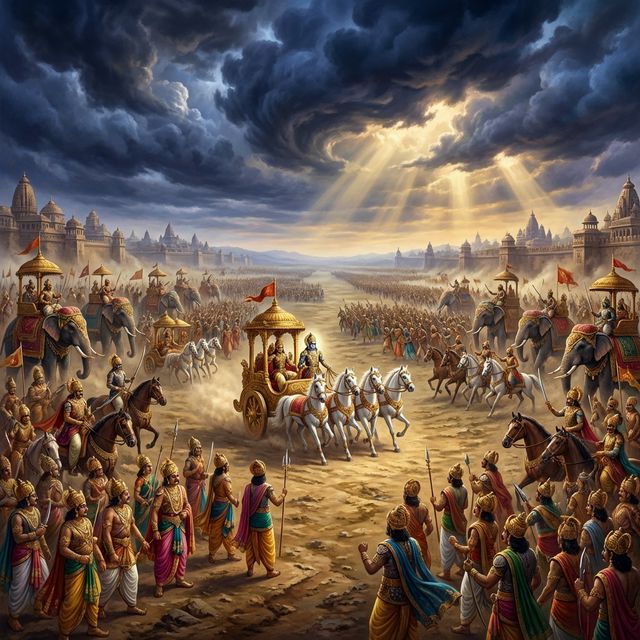
The Wrong Man Before Yama
A crow-faced messenger seizes the neighbour instead of Sarmin, and Yama sends him home with a rule of life
After Water, What Else
Bhishma had just finished making the largest claim in the whole science of giving. Food and drink, he had told Yudhishthira, are gifts that nothing can rise above, because a man who hands over food hands over life itself, and everything that is eaten in the three worlds, the nectar of the deities and the Sudha of the Nagas and the Swadha of the Pitris and the rice of men, comes up out of water in the end.
So the king went on down the list, to the cheaper things.
"Do thou discourse to me once again, O grandsire," Yudhishthira said, "upon the merits attaching to gifts of sesame and of lamps for lighting darkness, as also of food and robes."
It is nearly a household inventory of a question. A handful of oily black seed. A lamp carried out and set down where the path is dark. A meal. A length of cloth. These are not the gifts of kings. They are what an ordinary man in an ordinary house actually has in his hands, and Yudhishthira, who had been given a kingdom back over the bodies of his kinsmen, kept asking about them.
Bhishma lay on the arrows with the field behind him and the winter waiting, and he did not answer with a rule. He answered the way he answered everything in those weeks, by reaching back for somebody older.
"In this connection, O Yudhishthira," he said, "is recited the narrative of the discourse that took place in ancient times between a Brahmana and Yama."
Which is a promise of a particular kind of story. Nobody converses with the ruler of the dead by appointment. If a Brahmana had a discourse with Yama and lived to carry the answers home, then something had gone wrong first, and the teaching that follows is the sort a man is given by mistake.
Bhishma began, as such tales begin, with a place.
Bring Me Sarmin and Not the Other
In the country lying between the rivers Ganga and Yamuna, at the foot of the hills called Yamuna, there was a large town inhabited by Brahmanas. It was celebrated under the name of Parnasala and was very delightful in appearance, and a large number of learned Brahmanas lived in it.
One day Yama, the ruler of the dead, called a messenger of his and gave him an errand in that town.
The messenger is described before he is sent, and the description is the reason the rest of the story happens. He was clad in black. His eyes were blood red and his hair stood erect, and his feet and his eyes and his nose all resembled those of a crow. This is not a clerk. This is the thing that comes for people, built to be seen at the last moment and not before.
"Go thou to the town inhabited by Brahmanas," Yama said, "and bring hither the person known by the name of Sarmin and belonging by birth to the race of Agastya. He is intent on mental tranquillity and possessed of learning. He is a preceptor engaged in teaching the Vedas and his practices are well-known."
Then, because he knew the town, Yama added the warning.
"Do not bring me another person belonging to the same race and living in the same neighbourhood. This other man is equal unto him I want, in virtues, study, and birth. With respect to children and conduct, this other resembles the intelligent Sarmin. Do thou bring the individual I have in view."
Two men of one lineage, in one quarter of one town, matched in learning, matched in observance, matched even in the number and quality of their children. The judge of the dead, who is famous for keeping the accounts of every creature that breathes, had looked into Parnasala and found a place where his own records could be misread, and he said so out loud to the crow-faced thing standing in front of him.
And he gave one more instruction, which was about manners.
"He should be worshipped with respect," Yama said, instead of being dragged hither with irreverence.
The Very Reverse of What He Was Bidden
The messenger having come to the place, did the very reverse of what he had been bidden to do.
There is no explanation offered for it and none is needed by anyone who has ever handed a careful instruction to an eager subordinate. He had been given a name, a lineage, a description, and an explicit warning about the one man in the town he must not touch, and he went straight to that man. Attacking that person, he brought him who had been forbidden by Yama to be brought. Not invited. Not escorted. Attacked, seized, and carried off, which was also the exact opposite of the courtesy he had been told to show.
So a learned Brahmana of Agastya's line, who had done nothing that morning except be the neighbour of somebody else, was hauled out of the world before his time by a creature with a crow's face, and set down in the hall of the king of the dead.
And Yama, possessed of great energy, rose up at the sight of the Brahmana and worshipped him duly.
Hold on to that. The ruler of the dead, in his own house, before whom every creature that has ever lived is eventually brought to be measured, got to his feet for the man who had been dragged in wrongly, and paid him the honours due to a guest and a teacher of the Vedas. The error had not lowered the Brahmana's standing by so much as a syllable. If anything it had exposed him, since a man who is taken by force and set down in front of Yama has no time to arrange his face, and what Yama saw when he looked up was worth standing for.
Then he turned to his servant and dealt with the mistake in one sentence.
"Let this one be taken back," the king of the dead said, "and let the other one be brought to me."
It is the only correction he makes in the whole account. He does not curse the messenger and he does not discuss the failure. The dead man is not dead, he is misfiled, and Yama says so and expects the filing to be put right.
And the Brahmana, who had been standing there listening, spoke up and said that he would rather not go home.
I Cannot Ascertain the Period Ordained by Time
"I have completed my study of the Vedas and am no longer attached to the world," the Brahmana said. "Whatever period may yet remain of my mortal existence, I wish to pass, dwelling even here, O thou of unfading glory."
It is a strange and very calm request, and it comes from a man with nothing left to finish. His study was done. His household was raised. He had been carried out of his life by accident and had found, on arriving, that the place did not frighten him and the master of it had stood up to greet him, and he asked to be allowed to stay on as a resident for whatever remained of his term. Not to die early. To live out the rest of it here.
Yama refused, and the reason he gave is the most interesting thing he says in the story.
"I cannot ascertain the exact period, ordained by Time, of one's life," he said, "and hence, unurged by Time, I cannot allow one to take up one's residence here. I take note of the acts of righteousness, or otherwise, that one does in the world."
The king of the dead does not know when anyone dies. He is not the one who decides it. Time ordains the period, and Yama waits to be urged by Time, and what he himself does in the meanwhile is only what he had just been doing with two neighbours in Parnasala: keeping the account of what men do, and taking delivery when the summons comes. Even the mistake in this story was not his. He asked for the right man and was brought the wrong one, and the moment the wrong one is in front of him he cannot keep him, because nothing in his own house authorises it.
"Do thou, O learned Brahmana of great splendour, return immediately to thy abode," he said, and then he did what a host does for a guest who has been badly handled at the door. "Tell me what also is in thy mind and what I can do for thee, O thou of unfading glory."
An open offer, from Yama, to a man who was not supposed to be there.
The Brahmana did not ask for years, and he did not ask about his own death.
"Do thou tell me what those acts are by accomplishing which one may earn great merit," he said. "O best of all beings, thou art the foremost of authorities on the subject even in the three worlds."
Sesame, and Then Water
"Do thou hear, O regenerate Rishi," Yama said, "the excellent ordinances regarding gifts."
He began with sesame, and he began by rating it high. The gift of sesame seeds is a very superior one, and what it produces is not a term of comfort somewhere but everlasting merit. One should make gifts of as much sesame as one can. By making gifts of sesame every day, a man is sure to attain the fruition of his every wish.
Then the particulars, which are the sort a householder can act on before the week is out.
Sesame given at Sraddhas, in the rites for the fathers, is applauded. Gifts of sesame should be made to Brahmanas according to the rites ordained in the scriptures. On the day of the full moon of the month of Vaisakha one should make gifts of sesame to the Brahmanas particularly. And they should also be made to eat sesame and to touch sesame on every occasion that a man can afford it, so that the seed passes through the hands and the mouths of learned men as often as the household's means allow. They that are desirous of achieving what is beneficial to them should, with their whole souls, do this in their houses.
Then Yama turned to water, and the instruction stops being about a rite at all and becomes about public works.
Without doubt, he said, men should similarly make gifts of water, and establish resting places for the distribution of drinking water. One should cause tanks and lakes and wells to be excavated. And then a line that reads like a man who has watched the whole world go past his court and knows exactly how rare the useful people are: such acts are rare in the world, O best of regenerate persons.
"Do thou always make gifts of water. This act is fraught with great merit. O best of regenerate persons, thou shouldst establish resting places along the roads for the distribution of water."
And last, the smallest item in the whole discourse, which is also the only one that requires no digging, no season and no wealth. After one has eaten, the gift unto one should especially be made of water for drink.
Dig a tank if you can. If you cannot, hand the man who has just finished his meal a cup.
The Right Man Is Fetched
After Yama had said these words unto him, the messenger who had borne him from his abode conveyed him back to it. The Brahmana, on his return, obeyed the instructions he had received. He had gone out of the world by mistake and come back with a rule of life, and he kept it.
Then the messenger went again and fetched Sarmin, who had really been sought, and informed his master. And Yama worshipped that righteous Brahmana also, and having conversed with him a while dismissed him to be taken back to his abode. Unto him also Yama gave the same instructions. Sarmin, too, coming back into the world of men, did all that Yama had said.
The two neighbours who could not be told apart were given, in the end, the same errand. The mistake cost nobody anything, because what the king of the dead had to say was not addressed to a particular man at all.
Bhishma went on from where Yama had stopped.
Like the gift of water, Yama applauds the gift of lamps to light dark places, and he does so from a desire of doing good to the Pitris. The giver of a lamp for a dark place is regarded as benefiting the fathers, and one should always give lamps for dark spots, for the giving of lamps enhances the visual power of the deities, of the Pitris, and of one's own self.
The gift of gems, he said, has been called a very superior gift, and its rules are generous. A Brahmana who accepts a gift of gems and sells them in order to perform a sacrifice incurs no fault. A Brahmana who accepts a gift of gems and gives them away again to Brahmanas acquires inexhaustible merit himself and confers inexhaustible merit upon the man from whom he first received them. Manu himself said that he who is observant of proper restraints and gives gems to a Brahmana observant of proper restraints earns inexhaustible merit and confers it on the recipient too. The gem keeps paying as it travels.
And robes, last, with a condition attached that has nothing to do with cloth. The man who is content with his own wedded wife and who makes a gift of robes earns an excellent complexion and excellent vestments for himself.
"I have told thee, O foremost of men," Bhishma said, "what the merits are that attach to gifts of kine, of gold, and of sesame, agreeably to the precepts of the Vedas and the scriptures. One should marry and raise offspring upon one's wedded wives. Of all acquisitions, O son of Kuru's race, that of male issue is regarded as the foremost."
Dharma Lesson
Yama stands up for the man his own servant dragged in by mistake, and the error costs the Brahmana nothing, because the ruler of the dead does not decide when anyone dies. He only keeps the account of what a man did while he was alive. What he gives the wrong man and the right man is identical, and it is a list any household can act on: seed, drinking water, a lamp in a dark place, cloth. The story puts the whole apparatus of death behind the smallest ordinary kindnesses, and then says that such acts are rare in the world.