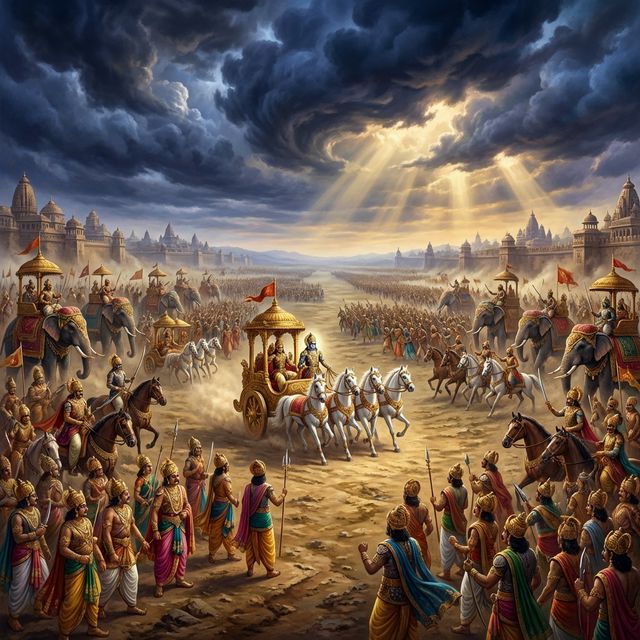
The Sraddhas Under the Constellations
Yama's calendar of offerings to the fathers, and the king who won the earth by it
The Optional Rites
Bhishma had been lying on the bed of arrows for many days by then, and the questions the eldest Pandava carried to him each morning had settled for a long while now on the sraddha, the offering a man makes to his fathers.
They had worked through the food first. Yudhishthira had asked what offering, once dedicated to the Pitris, becomes inexhaustible, and Bhishma had gone down the whole table of it. Sesame and rice and barley and water and roots and fruits, which keep the fathers gratified for a month. Fish for two months, mutton for three, and so on upward through the year, and past the year to the few rare offerings that never run dry at all. That was the matter of the sraddha. What goes into the hand.
Now he turned to its timing, which is a different question and an older one.
"Listen to me, O Yudhishthira," he said, "as I tell thee what those optional sraddhas are that should be performed under the different constellations, and that were first spoken of by Yama unto king Sasavindu."
Three things in that sentence are worth holding on to.
The first is the word optional. A man owes his fathers a sraddha at the fixed seasons and on the anniversary of a death, and what is owed is owed whether he wants anything by it or not. The rites Bhishma was about to name are not of that kind. No one is obliged to perform them. A man performs one because there is something he wants, and he waits for the night on which it may be asked for.
The second is constellations. The moon crosses twenty-seven of them and lodges a night in each, so what follows is not a body of doctrine. It is a calendar. Every one of these nights comes round again within the month, to anybody, in any kingdom, and none of them can be bought or withheld.
The third is Yama. The teaching came from the god who receives the dead. Whoever else in the world may be uncertain about what reaches the fathers, he is not.
And the man he gave it to was a king. Sasavindu heard the list out, and what he did with it afterwards is the last line of the chapter.
Bhishma began where such lists begin, at Krittika.
Krittika, and the Fire a Man Never Lit
That man who always performs the sraddha under the constellation Krittika, Bhishma said, is regarded as performing a sacrifice after having established the sacred fire. Such a person, freed from fear, ascends to heaven with his children.
It is worth stopping on the first entry, because it sets the terms of everything after it. To establish the sacred fire is the largest undertaking of a householder's life. It wants priests, wants cattle, wants means, and until a man has done it the whole apparatus of sacrifice stands closed to him. And here at the head of Yama's list a night is named on which a man who has never lit that fire is regarded as having lit it. He gives what he can afford to give, under Krittika, and he is counted among the men who could afford everything.
Then the two clauses that follow. Freed from fear. And with his children, which is to say he does not go up alone.
He that is desirous of children should perform the sraddha under the constellation Rohini, Bhishma said, while he that is desirous of energy should do it under Mrigasiras.
By performing the sraddha under Ardra, a man becomes the doer of fierce deeds.
Notice that nothing is said for or against that. Yama is not recommending fierceness and he is not warning anyone off it. He is a lawgiver reading out a table, and a man who has come to the point where something fierce has to be done is told which night is his, in the same voice used for sons and cattle. The list does not moralise. It answers what it is asked.
A mortal, by performing the sraddha under Punarvasu, makes such again by agriculture.
That line is compressed almost to breaking, and what is under it is a ruined man. Whatever he had, he had lost. The remedy offered him is not treasure and not the favour of a king. It is that he will make it again, himself, out of the ground, and the night under which he asks for that is Punarvasu.
Five constellations gone, and already the list had provided for a poor man, a childless man, a weak man, a man with a hard thing to do, and a man with nothing left.
The Nights for Increase
The man that is desirous of growth and advancement should perform the sraddha under Pushya.
By doing it under the constellation Aslesha, one begets heroic children. Not children merely, which had been asked for already under Rohini. Heroes. The list distinguishes between wanting sons and wanting a particular kind of son, and gives each wish its own night.
By doing it under the Maghas, Bhishma said, one attains to pre-eminence among kinsmen.
Magha is the one constellation in this whole calendar that the fathers had already named for themselves. In the verses the Pitris are said to have sung, which Sanatkumara gave to Bhishma long before, they ask their descendants for payasa mixed with ghee under Magha, and for the meat of the goat, and for the petals of the Kanchana flower. So the night on which a man rises highest among his own relatives is the night his dead relatives had asked to be fed on. The two facts are set down in different chapters and no one connects them out loud.
By doing it under the prior Phalgunis, the doer becomes endued with good fortune. By doing the sraddha under the later Phalgunis, one attains to many children.
The Phalgunis are a pair, one following the other across two nights, and Yama assigns them two different rewards. A man may sleep through the first and rise for the second. The calendar is that fine-grained. It is not enough to know the month or the fortnight; the difference between fortune and a full house is one night's attention.
And by performing it under Hasta, one attains to the fruition of one's wishes.
That is the widest entry on the list and it sits quietly in the middle of it, between children and beauty, asking for nothing in particular and promising everything a man has in mind. There is no sign that Yama regarded it as the greatest of the twenty-seven. It is simply Hasta, and it comes round with the rest of them, once a month, forever.
Beauty, Trade, and the King of Kings
By performing the sraddha under the constellation Chitra, Bhishma said, one obtains children endued with great beauty.
By doing it under the constellation Swati, one makes much profit by trade.
Set those two side by side and the range of the thing becomes plain. A man wanting a beautiful child and a merchant wanting a good season are both provided for, by the same god, in the same table, two nights apart. Nobody is told that his wish is beneath the rite. The trader is not sent away to a lesser ceremony. He is given Swati.
The man that desires children acquires the fruition of his wish by performing the sraddha under the constellation Visakha. That is the fourth time children have been asked for, under four separate stars, and it is the plainest measure in the list of what men actually wanted when they came to Yama.
By doing it under Anuradha, one becomes a king of kings.
By making offerings in honour of the Pitris under the constellation Jyeshtha with devotion and humility, one attains to sovereignty, O foremost one of Kuru's race.
Jyeshtha is the only entry in the whole calendar that names a condition inside the man. Everywhere else the instruction is the night and the offering, and the fruit follows. Here Yama adds two words, devotion and humility, and he adds them precisely where the reward is a throne. The one wish that comes with a warning attached is the wish to rule, and the warning is not that a man may fail to get it. It is that he may get it while being the wrong sort of person, and the god will not put a crown into the hand of a man who has not bent his head.
Two nights in a row, Anuradha and Jyeshtha, hand out empire. And Bhishma, who had given away a throne himself and had spent his whole life watching what men did to get one, read them out in order without a word of comment and went on to the next.
Fame, Knowledge, and a World Without Sorrow
By doing the sraddha under Mula, one attains to health.
And by doing it under the prior Ashadha, one acquires excellent fame. By performing it under the later Ashadha, one succeeds in roving over the whole world, freed from every sorrow.
There is the Phalguni pattern again, a pair of neighbouring constellations carrying two unlike gifts, and the second of them is the strangest promise so far. Not wealth, not sons, not a kingdom. The freedom of the whole earth and the absence of grief in it, which is the wish of a man who does not want anything he can carry home.
By doing it under the constellation Abhijit, one attains to high knowledge.
Abhijit is the extra one. Twenty-seven constellations divide the moon's road, and Abhijit is the twenty-eighth, wedged in between the later Ashadha and Sravana, small and often left out of the reckonings altogether. Yama does not leave it out. He gives the odd night, the one the calendars quarrel over, to knowledge.
By doing it under Sravana, one, departing from this world, attains to a very high end.
Something has turned over in the list here and it is worth saying so. It began with fire and children and land and hard deeds, all of them things a man wants inside his own life. Now, in four consecutive entries, it offers him fame that outlasts him, a world with no sorrow in it, high knowledge, and a good end after death. The same rite, the same handful of sesame, the same fathers being fed. Only the night has changed, and what is being asked for has stopped being provisions and become a destination.
Then, without any change of tone at all, Yama went back to cattle.
Kingdoms, Medicine, and Copper Pots
The man that performs the sraddha under the constellation Dhanishtha becomes the ruler of a kingdom.
By doing it under the constellation presided over by Varuna, which is Satabhisha, one attains to success as a physician.
That entry is easy to read past. A man may ask the fathers to make him good at healing people, and there is a night on which he may ask it, and it stands in the table between a kingdom and a flock of goats without any special dignity. The list does not think of a calling as a smaller thing than a crown. It thinks of it as the next line.
By performing the sraddha under the constellation of the prior Bhadrapada, one acquires large property in goats and sheep, while by doing it under the later Bhadrapada, one acquires thousands of kine.
The Bhadrapadas are the third pair to be split this way, and the split runs along the exact line that separated a modest man from a rich one in that world. Goats and sheep on the first night. Thousands of cattle on the second.
By performing the sraddha under the constellation Revati, one acquires much wealth in utensils of white brass and copper.
Pots. After sovereignty and healing and herds, the list comes down without embarrassment to the metal in a household, the vessels a family eats from and hands on, and counts them out as carefully as it counted the kingdoms. It is one of the marks of the older parts of this teaching that nothing is thought too small to be asked for. A man who wants a house properly furnished has a night of his own, and the god of the dead knows which one it is.
Twenty-five constellations were behind him now. Bhishma named the last two.
What Sasavindu Did With It
By doing it under Aswini, Bhishma said, one acquires many steeds. While under Bharani, one attains to longevity.
Horses, and then long life, and the calendar closes.
It is a fitting end, because Bharani is the wish that lies under all the others. Every man on the list wanted something for the years he expected to have, and the last night on the wheel is the one on which he may ask for more of them. And it is granted on the same terms as the goats and the copper pots. Feed your fathers on the right night, in the right spirit, and the thing you want may come to you.
Then Bhishma finished the chapter with a single sentence about the king who had heard all this first.
"Listening to these ordinances about the sraddha, king Sasavindu acted accordingly, and succeeded in easily subjugating and ruling the whole earth."
Read it again for what is not in it.
There is no army in that sentence. There is no war, no alliance, no astra, no counsellor, no marriage into a stronger house. The epic has spent a hundred thousand verses on how men take and hold the earth, and it accounts for this emperor's whole conquest in a subordinate clause. He listened. He acted accordingly. He performed the sraddha, month after month, under whichever star answered to whatever he needed that month, and the earth came to him easily.
Easily. That is the word Yama's list earns for him, and it is the one word in the sentence that no soldier in the Kuru host had ever been able to use about anything.
Yudhishthira was going to become the ruler of that same earth in a few days, over the bodies of his cousins and his teachers and most of the men he had grown up with. He sat at the foot of the arrow bed and heard how another king had done it, and asked his next question, which was about brahmanas.
The grandsire answered that one too. There was still time.
Dharma Lesson
The list is remarkable for what it refuses to rank. A man asking for a beautiful child, a trader asking for a good season, an ascetic asking for high knowledge and a ruined farmer asking for his land back are all given a night and sent away satisfied, by the same god, in the same even voice. Only the wish for a throne carries a condition, and the condition is devotion and humility. What the calendar teaches is that the fathers are not fed in order to be flattered, and that the earth was once won by a king who simply remembered them on time.