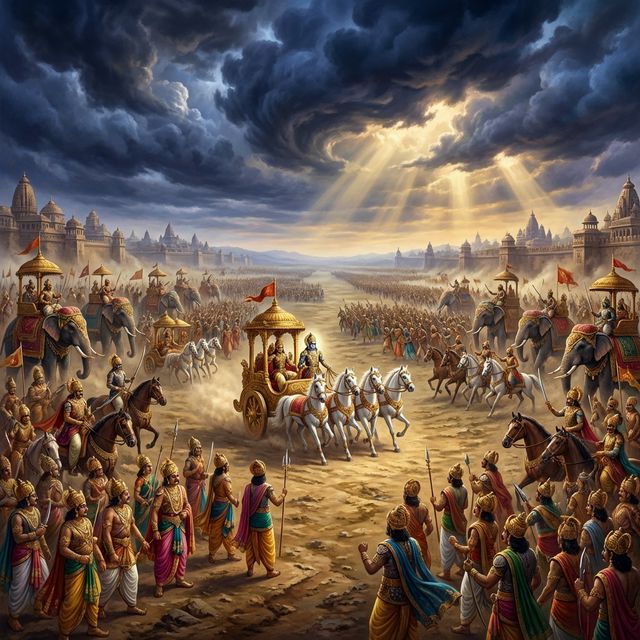
Ashwatthama at Dhrishtadyumna's Throat
The vow he very nearly kept on the seventeenth day
The Hosts Close Again
Sanjaya, who sat in a hall in Hastinapura and told a blind king what his sons were doing on the field, had reached the afternoon of the seventeenth day.
"Then the Kurus and the Srinjayas once more fearlessly encountered each other in battle," he said, "the Parthas being headed by Yudhishthira, and ourselves headed by the Suta's son."
The samsaptakas were nearly finished. Those were the sworn men, the ones who had taken an oath to kill Arjuna or die in the attempt, and only a remnant of them were left unslaughtered somewhere at the edge of the field with Arjuna working through them. Everywhere else the battle had narrowed to one man.
Dhrishtadyumna saw it and took the chance. He was the commander of the Pandava host, the son of Drupada who had been born out of a sacrificial fire for one purpose, and the purpose had already been accomplished four days earlier when he took Drona's head. He gathered the kings on his side, and the mighty car-warriors, and the Pandavas themselves, and every one of them rushed against Karna only.
Karna was unaided by anyone.
Sanjaya described what followed with an image he must have turned over for some time afterwards. Like a mountain receiving a vast body of water, Karna received in that battle all those advancing warriors, filled with joy and longing for victory. And those mighty car-warriors, encountering him, were beaten off and broken like a mass of water beaten back on all sides when it strikes a mountain.
The battle that took place between them and that one man made the hair stand on end.
It is worth marking what the Pandava commander was doing when the day turned on him. He had not come looking for Drona's son. He had come for Karna, at the head of an army, in the ordinary business of a war he was winning.
The son of Drona was elsewhere on the field, and coming.
Wait, Wait
Dhrishtadyumna assailed the son of Radha with a straight shaft, and called out to him across the noise.
"Wait, Wait."
Karna, filled with rage, shook Vijaya, which was the foremost of his bows, and answered the summons in the shortest way available to him. He cut off Dhrishtadyumna's bow. He cut off the arrows in the prince's hand as well, shafts that Sanjaya said resembled snakes of virulent poison, and then he put nine arrows into the man himself.
Those nine went through the gold-decked armour of the high-souled son of Prishata and came out bathed in blood, and Sanjaya, telling it, could not help noticing how they looked. Beautiful, he said, like so many cochineal.
That is the habit of the whole account. Men are being opened up and the language keeps finding them handsome.
Dhrishtadyumna cast aside the broken bow. He took up another, and a number of shafts of the same poisonous kind, and with seventy of those straight arrows he pierced Karna in return. Karna covered Prishata's son with as many again, and for a while the two of them stood in a cloud of their own making.
Then the slayer of Drona, a great bowman by any reckoning, retaliated by piercing Karna with many keen shafts.
The name matters. Sanjaya rarely calls Dhrishtadyumna by his own name in this hour without also calling him what he had made himself: the slayer of Drona. Everyone on that field had one word for him now, and it was not commander, and it was not son of Drupada. It was the thing he had done to an old Brahmana who sat in yoga on the terrace of a car with his weapons laid down.
Karna, filled with rage, reached for something heavier.
The Shaft That Was Cut Into Seven
What Karna sped at his antagonist was a gold-decked shaft that resembled a second rod of death.
It went for Prishata's son impetuously, and it did not arrive. The grandson of Sini cut it into seven fragments in the air.
Satyaki was Krishna's kinsman and the best archer of the Vrishnis, and he had spent two days making himself a nuisance to the Kaurava line, and the lightness of hand he showed in that one instant, taking a death-shaft apart into seven pieces while it was still travelling, turned Karna's attention off Dhrishtadyumna and onto himself.
Beholding his shaft baffled by the arrows of Satyaki, Karna resisted Satyaki with showers of arrows from every side, and pierced him with seven clothyard shafts. The grandson of Sini pierced him in return with many arrows decked with gold.
The battle that took place then between those two, Sanjaya said, was such as to fill both spectators and listeners with fear. Though awful, soon it became beautiful, and a deserving object of sight. The hair of all the creatures present seemed to stand on end.
So the field arranged itself the way a field does when two famous men begin. Karna and Satyaki had the crowd. Everyone was watching them, which meant that for a space of time nobody was watching the commander of the Pandava army, who was still on his car in the middle of it with a fresh bow, bleeding through his gold armour, and no particular protection near him.
Meanwhile the mighty son of Drona rushed against Prishata's son.
Sanjaya introduces him with the whole of his reputation. Ashwatthama was that chastiser of foes and queller of the prowess of all enemies, the son of the preceptor, the one man in that army whom weapons were not able to kill. He had spent four days looking for exactly this.
Slayer of a Brahmana
"Wait, wait, O slayer of a Brahmana," said Drona's son. "Thou shalt not escape me today with life."
Having said it, he began. He was a car-warrior of great lightness of hand and he strove resolutely, and he pierced the brave son of Prishata, who strove to the utmost of his own prowess, with many keen and terrible shafts endued with great impetuosity.
The charge in that opening word is simply the fact of the case. Drona was a Brahmana. He had taught arms for a living because there was no other living to be had, but the order he was born into is the one that is not to be killed, and on the fifteenth day Dhrishtadyumna had climbed onto his car while the old man sat with his weapons put down and his eyes closed, and had taken his head off with a sword, in front of an army that was shouting at him to stop.
Ashwatthama had been in the field when it happened. He had been drawn away by a lie about his own death, and he had come back to find his father's body handled and his father's killer alive.
Sanjaya sets the two men against each other with a symmetry he clearly enjoyed. As Drona while alive, beholding the son of Prishata, had become cheerless and regarded him as his death, even so the son of Prishata, beholding Drona's son in that battle, now regarded him as his death.
The father had looked at this man and seen his own end. Now the man looked at the son and saw his.
That is what a vow does to a battlefield. It converts two ordinary combatants into a fixed appointment that both of them can see coming, and that neither can decline without becoming somebody else.
Dhrishtadyumna did not decline it.
The Destroyer Running Against the Destroyer
What steadied him was a piece of knowledge that everybody on that field possessed and nobody could do anything with.
Remembering that Ashwatthama was unslayable in battle by means of weapons, Dhrishtadyumna rushed with great speed against him.
Read it slowly, because it is not the reasoning of a hopeful man. He was not remembering that he could win. He was remembering that arrows would not settle this, that the thing in front of him was not going to be killed by anything he had on the car. Having remembered it, he went straight at him, and Sanjaya reached for the largest comparison he had. Like the Destroyer running against the Destroyer at the time of the universal dissolution.
Drona's heroic son, beholding Dhrishtadyumna stationed before him, drew deep breaths in wrath and rushed towards him. Both of them were filled with great rage at the sight of each other.
Then Ashwatthama, staying not far off, said the rest of what he had to say.
"O wretch amongst the Pancalas, I shall today despatch thee to Yama. The sin thou hast committed before by slaying Drona will fill thee today with regret, to thy great evil, if thou stayest in battle without being protected by Partha, or if thou dost not fly away, O fool, I tell thee truly."
Thus addressed, Dhrishtadyumna answered him.
"That same sword of mine which answered thy sire, resolutely engaged in battle, will today answer this speech of thine. If Drona could be slain by me, O thou that art a Brahmana in name only, why should I not then, putting forth my prowess, slay thee also in battle today?"
It is a cruel reply and an exact one. He was throwing the sword back in the son's face, and he was returning the insult in its own coin, because Ashwatthama had called him a slayer of Brahmanas and he called Ashwatthama a Brahmana in name only, a priest's son who had chosen the bow.
Having said it, the commander of the Pandava forces pierced Drona's son with a keen arrow.
Arrows Enough to Put Out the Sky
Drona's son, filled with great rage, shrouded every side of Dhrishtadyumna with straight arrows.
Shrouded with thousands of them, neither the welkin, nor the points of the compass, nor the combatants all around could any longer be seen. Dhrishtadyumna did the same to him, and did it in the very sight of Karna, which is the detail Sanjaya thought worth adding, because Karna was the man everyone had come to watch and here were two others putting out the sky beside him.
Karna, for his part, was doing something no other man on the field could have done at all. Singly he resisted the Pancalas and the Pandavas and the five sons of Draupadi and Yudhamanyu and the mighty car-warrior Satyaki, all of them at once, and in consequence of that feat, Sanjaya said, he became the cynosure of all eyes.
So the whole army was looking one way. Which is how the thing that mattered most that afternoon came to happen almost privately, off to the side, between two men inside a cloud of arrows.
Inside the cloud, Dhrishtadyumna was winning.
He cut off the very tough and formidable bow of Drona's son, and all his arrows with it.
That was the last good moment he had. Because Ashwatthama, bowless for a heartbeat, took up another, and within the twinkling of an eye destroyed the bow, the dart, the mace, the standard, the steeds, the driver and the car of Prishata's son.
Seven things, and Sanjaya lists them in the order they went, and the whole list occupies less time than a man takes to breathe. The commander of the Pandava army had been standing on a chariot at the head of a host. Now the chariot was wreckage under him, the horses were down in their traces, and the man who drove him was dead at his feet.
He was still standing. He reached for what was left.
The Scimitar and the Hundred Moons
Bowless and carless and steedless and driverless, the son of Prishata took up a huge scimitar and a blazing shield decked with a hundred moons.
He had that much left, and it was the right choice. A sword and a shield are the weapons of a man who means to come down off a ruined car and finish the argument on foot, and a sword was the thing he had used on this man's father.
He never got down.
Endued with great lightness of hand, Ashwatthama quickly cut off those weapons also, with many broad-headed arrows, before the prince could come down from his car. All this, Sanjaya said, seemed exceedingly wonderful.
Consider what the shooting required. A shield is a moving disc and a scimitar is a moving edge, both of them in the hands of an experienced man who is bracing to jump, and Drona's son took them both off him with broad-headed arrows in the space of that jump, from a car, at speed, in a battle. Nobody there had seen better archery. Everybody there could see what it was for.
And then the thing neither of them expected.
The mighty car-warrior Ashwatthama, though struggling vigorously, could not slay the carless and steedless and bowless Dhrishtadyumna, although the prince was pierced and exceedingly mangled with many arrows.
He had stripped him of everything a warrior has, and he still could not kill him with arrows. Sanjaya does not explain it. He records only that the shafts would not finish the work, and that after a while the son of Drona understood what he was being told.
When he found that he could not slay his enemy with arrows, he laid aside his bow and quickly proceeded towards the son of Prishata.
The best archer alive put his bow down in the middle of a battle and went to do it with his hands.
The impetuosity of that high-souled one, as he rushed towards his foe, resembled that of Garuda swooping down to seize a large snake.
Within the Jaws of Death
Some distance off, Krishna was driving Arjuna through the wreck of the field, and he saw it.
"Behold, O Partha, how the son of Drona is rushing with great speed towards the car of Prishata's son. Without doubt, he will slay the prince. O mighty-armed one, O crusher of foes, rescue the son of Prishata, who is now within the jaws of Drona's son as if within the jaws of Death himself."
Having said these words, Vasudeva urged the steeds towards that spot. They were horses of the splendour of the moon, and, urged by Keshava, they proceeded towards the car of Drona's son devouring the very skies.
Ashwatthama looked up and saw them coming: Krishna and Dhananjaya together, in the one chariot the whole war had learned to be afraid of, driving straight at him.
He did not turn to meet them. Beholding those two of great energy coming towards him, the mighty Ashwatthama made great efforts for slaying Dhrishtadyumna soon.
That is the coldest sentence in the section. He had one chance and less time than he needed, and he spent it on the vow instead of on his own safety. He had the man off the car now, and he was dragging him.
Seeing Dhrishtadyumna dragged by his enemy, Partha sped many arrows at the son of Drona. Those arrows, decked with gold and sped from Gandiva, approached him and pierced him deeply, like snakes penetrating into an ant-hill.
Thus pierced with those terrible arrows, the valiant son of Drona abandoned the Pancala prince of immeasurable energy.
He let go. He had been perhaps a breath away from the thing he had sworn, twice over, in front of witnesses, and Gandiva took it out of his hands. Afflicted with Dhananjaya's shafts, he mounted his car, took up his own excellent bow, and began to pierce Partha with many shafts, which is to say he went back to being an archer in a battle.
Behind him, on the churned ground, the commander of the Pandava army lay where he had been dropped.
Sahadeva's Car
Meanwhile the heroic Sahadeva bore away on his car the son of Prishata.
He is given one line and no speech. The quiet brother, the fourth of the five, the one remembered for knowing things rather than for killing them, came in under the fighting, got the wrecked and bleeding commander of his army up onto his own chariot, and took him out. That is the whole of Sahadeva's part in the hour, and without it the vow would have been kept.
Arjuna then pierced Drona's son with many arrows. Filled with rage, Drona's son struck Arjuna in the arms and the chest. Thus provoked, Partha sped at him a long shaft that resembled a second rod of Death, or rather Death himself.
That arrow of great splendour fell upon the shoulder of the Brahmana hero. Exceedingly agitated by the violence of the stroke, he sat down on the terrace of his car and swooned away.
Karna, watching from wherever he stood in that press, shook his bow Vijaya and, filled with rage, repeatedly eyed Arjuna, desiring a single combat with him. Those two had one appointment left, and it would not be kept for another hour yet.
The driver of Drona's son, beholding his master senseless, quickly bore him away on his car from the field of battle. The same rescue, run twice within a few minutes, in opposite directions.
Beholding Prishata's son rescued and Drona's son afflicted, the Pancalas, expectant of victory, began to utter loud shouts. Thousands of sweet instruments were sounded. Seeing such wonderful feats in battle, the combatants uttered leonine roars.
Having achieved that feat, Partha addressed Vasudeva.
"Proceed, O Krishna, towards the samsaptakas, for this is greatly desired by me."
Hearing those words of Pandu's son, he of Dasharha's race proceeded on that car, graced with many banners, whose speed resembled that of the wind or the mind. The two of them went off to finish the sworn men, and left the field.
The vow was not cancelled. It was postponed. Ashwatthama would come back for Dhrishtadyumna on a night when there was no Gandiva anywhere near him and no Sahadeva awake, and would do with his hands what he had not been permitted to do that afternoon.
Dharma Lesson
Ashwatthama's vow was made out of grief for a father killed while his weapons were down, and the epic does not pretend that grief was unjust. What it shows is what such a vow becomes once it outlives the hour that made it. It stops being a demand for justice and becomes a debt to be collected in whatever hour it can be collected, by whatever hand is free, and it will wait years if it has to. Arjuna's arrows bought Dhrishtadyumna a few more days. They did not buy him anything else.