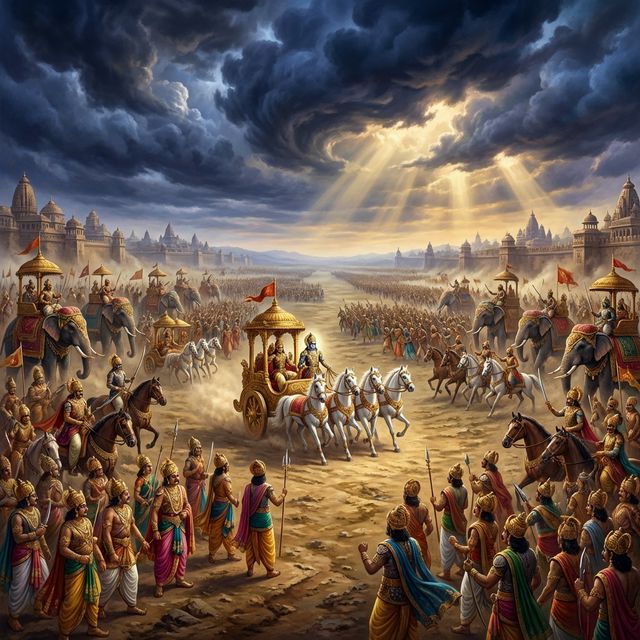
The Elephant Standard Comes Down
Dhrishtadyumna leaves Duryodhana without horses, driver, weapons or banner at noon on the seventeenth day
Three Fires at Noon
Sanjaya said: it was the seventeenth day, the second day of Karna's command, and by the middle of it the field had three fires burning in it in three different places.
Vikartana, the son of the Sun, stood in Bhimasena's way with the Pancalas and the Cedis and the Kaikayas ranged behind Bhima, and covered him with arrows. In Bhimasena's very sight he killed many great car-warriors of the Cedis and the Karushas and the Srinjayas, one after another, so that Bhima had to watch it happen and could do nothing. Then Bhima did what a man does who has somewhere else to be. He left Karna, that best of car-warriors, and went at the Kaurava troops the way a blazing fire goes at a heap of dry grass.
So the Suta's son turned back to the Pancalas and the Kaikayas and the Srinjayas and began to kill their mighty bowmen in thousands.
Three men were doing this at once. Partha was exterminating the samsaptakas, who had sworn to conquer him or die. Vrikodara was exterminating the Kauravas. Karna was exterminating the Pancalas. Sanjaya named the three of them together and then turned the account on the man he was speaking to.
"In consequence of thy evil policy, O king, all these Kshatriyas, scorched with excellent shafts by those three great warriors, began to be exterminated in that battle."
Dhritarashtra said nothing. He had been hearing that sentence in one form or another for sixteen days.
And into that noon, with his own commander burning one wing of the Pandava host and his own troops burning under Bhima on the other, Duryodhana went looking for somebody to fight, and found the two youngest sons of Pandu.
The Twins and the Circle of the Bow
Nakula and Sahadeva were the sons of Madri, the youngest of the five, and their cousin had known them since they were boys in Hastinapura.
Filled with rage, Duryodhana pierced Nakula and his four steeds with nine arrows. Then, with a razor-faced shaft, he cut off Sahadeva's golden standard, so that it came down in front of its owner.
Nakula struck him with seventy-three arrows. Sahadeva struck him with five. Duryodhana, in his anger, struck each of those foremost of bowmen with five, and then with a couple of broad-headed arrows cut off both their bows at once, and while their hands were empty pierced each of the twins with seventy-three shafts.
They took up two other bows, beautiful, each resembling the bow of Indra himself, and standing there with the new weapons the two of them looked like a pair of celestial youths. Then they poured ceaseless showers of terrible shafts on their cousin, like two masses of cloud pouring rain on the breast of a mountain.
Duryodhana received both of them at once. The bow in his hands, said Sanjaya, seemed to be continuously drawn into a circle, so that no one could see it come to rest, and shafts seemed to issue from it ceaselessly on every side. The twins ceased to shine. They looked like the Sun and the Moon in the firmament when clouds have taken their splendour away, and the arrows that did it, winged with gold and whetted on stone, covered all the points of the compass like the rays of the Sun, until the whole sky was one uniform expanse and the expanse looked like the Destroyer at the end of the Yuga.
The great car-warriors watching from both sides came to the same conclusion at the same moment. Beholding the prowess of Dhritarashtra's son, they regarded the two sons of Madri as standing in the presence of Death.
The Son of Prishata Rides Across
The commander of the Pandava army saw it.
Dhrishtadyumna was Drupada's son and Prishata's grandson, born out of a sacrificial fire for one purpose, and he had already accomplished that purpose: on the fifteenth day he had killed Drona. He was the prince of the Pancalas, and Draupadi's brother, and since the fall of Bhishma and Drona he had carried the whole weight of the Pandava order of battle on his own car. He came now to the place where Duryodhana was.
He did not stop to consult the twins. Transgressing those two great car-warriors, riding straight past the brave sons of Madri as though they were not there, he put himself between his king's youngest brothers and the king of the Kurus, and began to resist Duryodhana with his shafts.
Duryodhana was pleased to see him. He had a debt against this man that no one on his side had been able to collect, and he was smiling as he shot.
He pierced the prince of Pancala with twenty-five arrows. Then, filled with the desire to retaliate, he pierced him again with sixty shafts, and again with five, and uttered a loud roar over him so that the men nearby heard which of the two was winning.
Then the king took a sharp razor-faced arrow and cut off, in that battle, the bow of his antagonist with the arrow already fixed on the string, and cut away the leathern fence that guarded his hand.
Dhrishtadyumna cast the broken bow aside. He was that crusher of foes, and he had been in this position before. He took up another bow, new, capable of bearing a great strain, and stood up on his car blazing with impetuosity, his eyes red as blood from rage, his body carrying so many wounds that Sanjaya, who had no love for him, said he looked resplendent standing there in them.
Fifteen Shafts Through Gold
Desirous of slaying Duryodhana, the Pancala hero sped fifteen cloth-yard shafts that resembled hissing snakes as they went.
They were whetted on stone and feathered with the plumes of Kankas and peacocks, and they were shot with everything he had. They cut through the king's armour, which was decked with gold, and passed clean through his body, and went into the earth behind him because of the force with which they had been sent.
Duryodhana stood in his car with fifteen wounds in him. Sanjaya, describing his own master's son to that son's blind father, could find only one thing in the world that the sight resembled: a gigantic Kinsuka tree in the season of spring, standing under the weight of its own red flowers.
He did not fall. His armour was pierced and every limb of him had been made infirm by the wounds, and out of that condition he became filled with rage and did the one thing still available to him. With a broad-headed arrow he cut off Dhrishtadyumna's bow.
Then, with great speed, before the other man could reach for another, he struck him with ten shafts on the forehead, in the space between the two eyebrows.
They stood there in a row in the bone. Polished by the hands of the smith, they adorned Dhrishtadyumna's face, said Sanjaya, like a number of bees settling on a full-blown lotus because they want the honey in it.
That was the whole of Duryodhana's advantage, and it lasted as long as it took a man to throw away a broken bow and pick up a whole one. Dhrishtadyumna threw the bow aside and took up another, and with it he took up sixteen broad-headed arrows, and he had already decided what each of them was for.
The Elephant Standard Comes Down
With five of the sixteen he killed the four steeds and the driver of Duryodhana.
With one he cut off the king's bow, the one decked with gold.
With the remaining ten the son of Prishata took the car apart while its owner was standing in it. He cut off the upashkara, the frame of the vehicle itself. Then the umbrella that marked the man under it as a king. Then the dart, and the sword, and the mace, one after another, so that there was nothing left within reach of Duryodhana's hand that could be used against anybody.
The last of the ten took the standard.
All the kings on that part of the field saw it go. The beautiful standard of the Kuru king, decked with golden Angadas, bearing the device of an elephant worked in jewels, the mark by which every man in both armies located Duryodhana in a battle, was cut off by the prince of the Pancalas and came down.
The man who had ruled the earth for thirteen years stood in the wreck of his car with no horses, no driver, no bow, no sword, no mace, no umbrella and no banner, in front of the man who had killed his preceptor.
Then the uterine brothers of Duryodhana rescued him. They came in around the carless king, whose weapons had all been cut off besides, and in the very sight of Dhrishtadyumna one of them, Durdhara, took his elder brother up onto his own car and quickly bore him away from the battle.
Dhrishtadyumna let him go. He had emptied his sixteenth arrow and there was no seventeenth prepared, and by the time another bow could be bent the elephant standard was lying on the ground and the man it belonged to was already behind the shields of his own people.
Karna Comes for the King
Meanwhile the mighty Karna had beaten Satyaki, and heard what had happened to the king he served.
Desirous of rescuing the ruler of the Kurus, he turned his car and proceeded straight against the face of Drona's slayer, that warrior of fierce shafts. Satyaki, however, would not be left behind. The grandson of Sini pursued Karna from behind, striking him with arrows as he went, the way one elephant pursues a rival and strikes him in the hinder limbs with his tusks.
In the space that lay between Karna and the son of Prishata the two armies met, and the battle that raged there between the high-souled warriors of both sides became fierce beyond anything that day had shown. Not one combatant of either the Pandavas or the Kauravas turned his face away from it.
Then Karna, unable to reach Dhrishtadyumna through that, went at the Pancalas instead with great speed.
The Sun had ascended the meridian. At that hour a great slaughter of elephants and steeds and men took place on both sides. The Pancalas, inspired with the desire of victory, rushed at Karna the way birds rush to a tree, and the son of Adhiratha, filled with rage, began to strike them from the front with the keen points of his shafts, singling out their leaders: Vyaghraketu, Susharma, Citra, Ugrayudha, Jaya, Sukla, Rochamana, and the invincible Singhasena. Those eight encompassed him with their cars and poured their shafts on him, and he afflicted the eight of them with eight keen arrows.
Then he killed thousands of others skilled in fight. He killed Jishnu and Jishnukarman and Devapi, Citra and Citrayudha, Hari and Singhaketu and Rochamana and the great car-warrior Salabha, and he called out his own name each time, in every instance, so that the men he was killing would know whose arrow it was.
The elephants he wounded fled on all sides in fear and threw the field into agitation. Others fell with cries, like mountains riven by thunder. Along the track of Karna's car the earth became strewn with fallen elephants and steeds and men and broken vehicles, and Sanjaya said that neither Bhishma nor Drona nor any other warrior of that army had ever achieved what Karna achieved in that hour.
The Whole Host Against One Man
As a lion careers fearlessly among a herd of deer, so Karna careered among the Pancalas. As a lion routs a terrified herd to all points of the compass, so he routed those throngs of Pancala cars. As a herd that has come to the jaws of a lion never escapes with life, so the great car-warriors who approached him did not escape. As people who touch a blazing fire are burnt, so the Srinjayas were burnt by the Karna-fire when they came in contact with it.
Sanjaya, watching, thought that not a single Pancala would get away from the son of Adhiratha alive.
Yudhishthira saw the same thing and would not have it. Wounded as he was, the king rushed at Karna in wrath, and Dhrishtadyumna came with him, and the sons of Draupadi, and hundreds of warriors, and they encompassed that slayer of foes on every side. Shikhandi came, and Sahadeva, and Nakula, and Nakula's son, and Janamejaya of the Pancalas, and the grandson of Sini who had been chasing him all afternoon, and innumerable Prabhadrakas, all of them endued with immeasurable energy, with Dhrishtadyumna riding in their van. They looked magnificent, said Sanjaya, as they struck Karna with shafts and with diverse weapons.
Like Garuda falling upon a large number of snakes, the son of Adhiratha, single-handed, fell upon all those Cedis and Pancalas and Pandavas together.
The battle between them became as fierce as the one fought in days of old between the gods and the Danavas. He was one man in the middle of an army that had come specifically for him, and he stood in it like the Sun dispelling the darkness that surrounds it, fearless, alone, encountering all those great bowmen united together while they poured repeated showers of arrows upon him.
Nobody on that field could say, at that hour, that the man who had been given the command two days ago was unequal to it.
What Bhima Was Doing Meanwhile
While the son of Radha was thus engaged with the Pandavas, Bhimasena was at the other end of the field with nobody to stop him.
Filled with rage, he slaughtered the Kurus with shafts every one of which resembled the rod of Yama. Fighting single-handed against the Bahlikas and the Kaikayas, the Matsyas, the Vasatas, the Madras and the Saindhavas all at once, he looked exceedingly resplendent. Elephants struck in their vital limbs by his cloth-yard shafts fell with their riders slain and made the earth tremble with the violence of their fall. Steeds fell with their riders dead on them. Foot-soldiers lay pierced and vomiting blood in quantity. Car-warriors fell in thousands with the weapons loosened out of their hands, and lay there deprived of life, their bodies mangled, with the fear of Bhima still on their faces.
The earth in that quarter became strewn with car-warriors and horsemen and elephant-men and drivers and foot-soldiers and steeds and elephants, all of them mangled with the shafts of Bhimasena.
And the army of Duryodhana, cheerless and mangled and afflicted, stopped fighting and stood still.
Sanjaya could not get past what he had seen there. That melancholy host stood motionless in that dreadful battle, he said, like the Ocean during a calm in autumn. Stupefied, it stood even like the Ocean in a calm. However endued with wrath and energy and might it had been, the army of Dhritarashtra's son, divested of its pride, lost all its splendour. Drenched with gore, it seemed to bathe in blood, and the combatants, drenched, went on approaching one another and killing one another because there was nothing else left to do.
The Suta's son, filled with rage, routed the Pandava division. Bhimasena, filled with rage, routed the Kurus. Both of them, while thus employed, looked exceedingly resplendent, and neither of them knew what the other was accomplishing.
The White Horses Go In
In the middle of that, Arjuna finished with the array he had been given and looked across the field.
He had slain a large number of samsaptakas in the midst of their own formation. Now he spoke to Vasudeva.
"This struggling force of samsaptakas, O Janardana, is broken. Those great car-warriors among them are flying away with their followers, unable to bear my shafts, like deer unable to bear the roar of the lion. The vast force of the Srinjayas also seems to break in this great battle. There is that banner of the intelligent Karna, bearing the device of the elephant's rope, seen in the midst of Yudhishthira's division, where he is careering with activity. The other great car-warriors of our army are incapable of vanquishing Karna. Thou knowest that Karna is possessed of great energy as regards prowess in battle. Proceed thither where Karna is routing our force. Avoiding others in battle, proceed against the Suta's son, that mighty car-warrior. This is what I wish, O Krishna. Do, however, that which thou likest."
Govinda smiled, and said, "Slay the Kauravas, O son of Pandu, without delay."
Then the steeds white as swans, urged by Govinda, carried Krishna and the son of Pandu into that vast host, and the host broke on all sides as they went in. The ape-bannered car, the clatter of whose wheels was like the deep roar of clouds, passed into the army like a celestial car passing through the sky. The two of them, with eyes red from rage, piercing through that press, looked like the twin Ashvinis invoked with proper rites at a sacrifice.
Duryodhana, seeing that, once more urged the samsaptakas at him: a thousand cars, three hundred elephants, fourteen thousand horse, and twenty thousand foot-soldiers armed with the bow, all of sure aim and conversant with every way of battle. They covered Partha with showers of arrows from every side, and covered in them he took on a fierce form like the Destroyer with his noose.
Ten thousand kshatriyas later he reached their further wing, which the Kambojas were holding, and began to grind it as Vasava grinds the Danavas.
The Preceptor's Son, and Two Miles of Quiet
When the wing and the further wing of the samsaptakas had been exterminated by Savyasachi, Ashwatthama came for him.
Drona's son rushed at him shaking his formidable bow and carrying many terrible arrows, like the Sun appearing with his own rays. His mouth was wide open from rage and his eyes were red, and he shot showers of fierce shafts and began to rout the Pandava army with them. The moment he saw Keshava on the car he sped at him, and with hundreds of keen arrows he shrouded both Krishna and Dhananjaya and stupefied them where they stood.
Beholding the two protectors of all mobile and immobile creatures covered with arrows, the universe uttered cries of "Oh!" and "Alas!" Crowds of Siddhas and Charanas came to that spot from every side, uttering one prayer in their minds: "Let good be to all the worlds."
Sanjaya said he had never seen prowess like that of Drona's son in that hour. Arjuna, endued with great firmness and lightness of hand, beheld him and became stupefied, and regarded his own prowess as destroyed.
Krishna drew deep breaths and looked at both of them as though he would burn them with his eyes.
"This, O Partha, that I behold in battle regarding thee, is exceedingly strange, since Drona's son surpasseth thee today. Hast thou not now the energy and the might of thy arms thou hadst before? Hast thou not that Gandiva still in thy hands, and dost thou not stay on thy car now? Are not thy two arms sound? Hath thy fist suffered any hurt? Why is it then that I see the son of Drona prevail over thee in battle? Do not, O Partha, spare thy assailant, regarding him as the son of thy preceptor. This is not the time for sparing him."
Partha took up fourteen broad-headed arrows at a time, when speed was of the highest moment, and with them cut off Ashwatthama's bow and standard and umbrella and banners and car and dart and mace. Then a few calf-toothed arrows went deep into his shoulder, and Ashwatthama, overcome with a deep swoon, sat down on the wreckage supporting himself against his flagstaff, and his driver carried him away insensible.
Within a short time Vibhatsu had routed the samsaptakas, Vrikodara the Kurus, and Vasusena the Pancalas.
And Yudhishthira, in great pain from his wounds, retreated about two miles from the battle, and rested there for some time.
Dharma Lesson
Duryodhana fought well that noon. He beat two of the Pandavas, he stood upright with fifteen shafts through his gilded armour, and he still lost everything he was carrying inside a single exchange of bows. A kshatriya's standard is not a decoration; it is how his army finds him and how his enemies measure the day, and a man who has staked a war on being the visible centre of it has given his enemies exactly one thing to cut. What Dhrishtadyumna took from him at noon was not his life but his place on the field, and from here to the end of the war Duryodhana is a king other men keep having to carry off it.