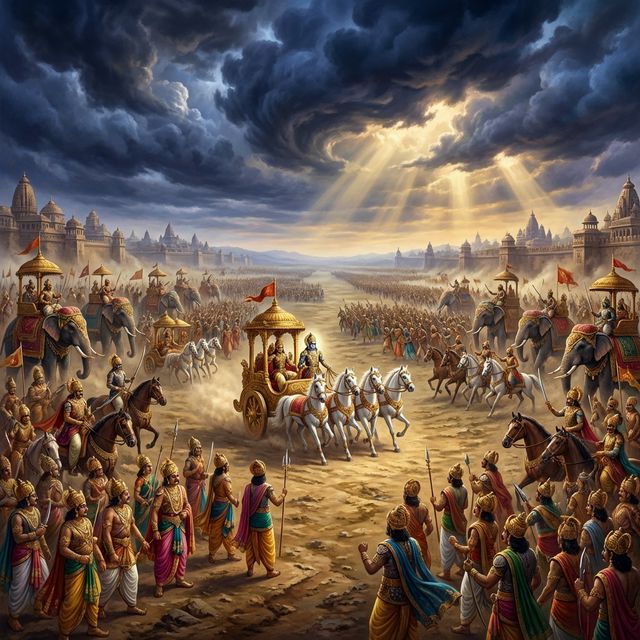
The Arrow Cut in the Air
Satyaki saves Dhrishtadyumna from the preceptor's shaft and holds three great bowmen at once, and the day ends with Drona's head in the dust
The Circle That Closed on Satyaki
Sanjaya was telling the fifteenth day to a blind king in a hall, and he began this part of it with one man alone in the middle of the Kaurava line.
Drona had fixed on his bowstring a shaft of great impetuosity, meant for Dhrishtadyumna, the Panchala prince who had been born out of a fire to kill him and who was at that moment carless, swordless and shieldless in front of him. The preceptor was about to slay the disciple who was to him as his own son. Satyaki cut that shaft out of the air with ten arrows.
He did it in the sight of Duryodhana and in the sight of Karna, and Dhrishtadyumna, who had been on the point of succumbing, was still alive.
Satyaki of the Satwata race, the grandson of Shini, was a Vrishni and Krishna's kinsman, and he had spent that whole day doing things of this kind for people who could not do them for themselves. Now he was careering in the car tracks of the Kuru warriors, inside the range of the shafts of Drona and Karna and Kripa at once, and destroying the celestial weapons of all three as they came.
From somewhere across the field Krishna and Arjuna saw him doing it.
"Excellent," they said. "Excellent." They said it loudly, so that men heard.
"Behold, Kesava," Arjuna said, "that perpetuator of Madhu's race, Satyaki of true prowess, sporting before the preceptor and those mighty car-warriors, and gladdening me and the twins and Bhima and king Yudhishthira. With skill acquired by practice and without insolence, behold that enhancer of the fame of the Vrishnis, careering in battle, sporting the while with those mighty car-warriors."
The Siddhas in the sky were applauding him. The warriors of both armies were applauding him.
Beholding those feats of the Satwata hero, Duryodhana and the others, filled with rage, quickly encompassed the grandson of Shini on all sides.
One Man Against the Downpour
Kripa came at him with keen arrows, and Karna, and Duryodhana's own division, and the whole weight of that quarter of the field turned inward on one chariot.
Then Yudhishthira saw it, and Bhimasena of great might, and the two sons of Madri, and they came and stood around Satyaki to keep him alive.
It was not needed. Contending with all those car-warriors at once, the grandson of Shini baffled that terrible downpour of arrows as suddenly as his foes had created it. They aimed celestial weapons at him, the great ones, the ones a man spends a lifetime earning the right to call, and Satyaki answered each of them with a celestial weapon of his own and put it out. Karna's, Kripa's, Duryodhana's. He resisted them all duly, said Sanjaya, which is a small word for what was happening.
What the field looked like while those royal combatants fought is set down without softening.
It resembled that scene of old when Rudra, filled with rage, destroyed all creatures. Human arms and heads and bows lay in heaps. Umbrellas displaced from cars, and yak-tail whisks, the ornaments of kings, lay in the same heaps with the arms and the heads. The earth was strewn quickly with broken wheels and with cars, with massive arms lopped off from trunks, with brave horsemen deprived of life. And large numbers of warriors, mangled by falling arrows, were seen to roll and writhe on the ground in the agony of the last spasms of death.
That was the ground on which the two armies were watching one Vrishni fight, and admiring him.
The old comparison for such a battle is the encounter between the celestials and the Asuras, and Sanjaya used it, because there was nothing on earth left to compare it to.
And while it was at its worst, Yudhishthira the just looked past Satyaki and past Karna at the one man on that field whose death would end the day, and gave an order.
Rush Against the Pot-Born
"Putting forth all your vigour," the king said to his great car-warriors, "rush against the Pot-born."
They called Drona that because of his birth. He had not been carried in a woman's body; the sage Bharadwaja's seed had been kept in a vessel, a drona, and the boy had grown in it, and the name that came of that was still on him at eighty-five with an army at his back.
"Yonder the heroic son of Prishata is engaged with Drona," Yudhishthira said. "He is endeavouring to the utmost of his might to slay the son of Bharadwaja. Judging from the aspect he is presenting in this great battle, it is evident that, filled with rage, he will today overthrow Drona. Uniting together, all of you fight with the Pot-born."
It is worth noticing what the king was ordering and what he was not. He did not send them to kill Drona. He sent them to converge on him, so that the man ordained to kill him would have the room and the time to do it. Yudhishthira had already spent one lie that morning on the same purpose, indistinctly adding the word elephant to a name, and he had said it because Krishna had told the sons of Pandu to lay righteousness aside and take care of victory. The order he gave now was the second half of the same decision, and there was no lie in it at all, only arithmetic.
Thus ordered, the mighty car-warriors of the Srinjayas rushed with great vigour to slay the son of Bharadwaja.
And Drona, of sure aim, rushed against those advancing warriors.
Sanjaya said the thing plainly, because he wanted his king to understand that the preceptor was not surprised by any of what followed. That mighty car-warrior went out to meet them knowing for certain that he would die.
The Earth Trembled and His Left Hand Twitched
When Drona proceeded, the earth trembled violently.
Fierce winds began to blow, inspiring the hostile ranks with fear. Large meteors fell, seemingly issuing out of the sun itself, blazing fiercely as they came down, foreboding great terrors. His weapons seemed to blaze forth in his hands. The cars produced loud rattles of their own. The steeds shed tears.
And the mighty car-warrior Drona seemed to be divested of his energy. His left eye began to twitch, and his left hand with it.
He looked up and saw Prishata's son in front of him again, and he remembered what the Rishis had said to him earlier in the day about laying down his weapons and leaving the world for heaven, and he became cheerless.
Then he made the only decision left to a man in that position, and it was not surrender. He desired to give up his life by fighting fairly.
Encompassed on every side by the troops of Drupada's son, the old man began to career in that battle, consuming Kshatriyas. Sanjaya gave his king the count, because the count was the point. Having slain four and twenty thousand Kshatriyas, he then despatched to Yama's abode ten times ten thousand more by means of his shafts of keen points. Exerting himself with care, he seemed to stand in that battle like a smokeless fire.
A smokeless fire is the image for something burning at its absolute limit, with nothing left over, nothing wasted, no soot and no obscurity, only the flame.
Then, for the extermination of the Kshatriya race, he had recourse to the Brahma weapon.
This is the aged Brahmana whom Bhima was about to lecture on the duties of Brahmanas. He was of a dark complexion, with white locks hanging down to his ears, five and eighty years old, and for Duryodhana's sake alone he had been careering on that field with the activity of a youth of sixteen, for five days, and he was not finished yet.
The Burden Rests Upon You
Somewhere inside that fire the prince of the Panchalas was still on his feet, and he had nothing.
Drona had taken his bow, his car, his horses, his driver, his mace, his sword and his shield decked with a hundred moons, one after another, and Dhrishtadyumna had gone on attacking him anyway, on foot, from a near point, close enough to be killed by a man shooting arrows the length of a span.
Bhima saw the illustrious and irresistible prince of the Panchalas carless and weaponless, and went to him quickly.
He did not tell him to withdraw. He reached down and took him up onto his own car, standing beside him where the driver's rail was, with the noise of a hundred and twenty-four thousand deaths going on around the two of them, and said one thing.
"Save thee there is no other man that can venture to fight with the preceptor. Be quick to slay him. The burden of his slaughter rests upon thee."
That is the whole speech. It is a strange kind of comfort, and it was the truest thing anyone said to Dhrishtadyumna in his life. He had been born out of Drupada's sacrificial fire for one purpose, at a great cost, and he was the only man on the Pandava side whom nobody had asked to spare the teacher, because he was the only one who had never been the teacher's pupil in any way that mattered.
Thus addressed by Bhima, the mighty-armed Dhrishtadyumna speedily took up a strong bow, a new one, a superb one, capable of bearing a great strain.
He was filled with rage. He shot his arrows in that battle at the irresistible Drona and covered the preceptor with them, meaning to withstand him, and for a time he did more than withstand him.
Two Ornaments of Battle
Those two ornaments of battle, both foremost of fighters, both filled with rage, invoked into existence the Brahma weapon and diverse other celestial weapons, and threw them at each other across a few yards of ground.
Dhrishtadyumna covered Drona with many mighty weapons. And then he did the thing that no one else on that field had managed all day. He destroyed all the weapons of Bharadwaja's son as they came, every one, and having destroyed them he turned on the men who were keeping his enemy alive.
The Vasatis, the Sivis, the Valhikas and the Kurus: those were the troops posted to protect Drona, and the Panchala prince began to kill them where they stood. Shooting showers of arrows on all sides at once, he looked at that moment, said Sanjaya, resplendent like the sun himself shedding his thousands of rays.
It did not last. Drona, once more, cut off the prince's bow, and then pierced the vitals of the prince himself with many arrows, and Dhrishtadyumna, standing on Bhima's car with his hands empty for the sixth or seventh time that afternoon, felt great pain.
That is the moment at which the war stopped being decided by archery.
Bhima, of great wrath, drove his own car up against the preceptor's, and took hold of it. He laid his hand on the rail of Drona's chariot, the way a man stops a cart in a lane, and the arrows did not come, because the two of them were now closer than arrows.
And Bhimasena, who had killed twenty and thirty men at a time that week without saying a word to any of them, spoke slowly, so that the old man would hear every part of it.
Why Do You Not Feel Ashamed
"If wretches amongst Brahmanas, discontented with the avocations of their own order but well versed in arms, did not fight," Bhima said, "the Kshatriya order then would not have been thus exterminated.
"Abstention from injury to all creatures hath been said to be the highest of all virtues. The Brahmana is the root of that virtue. As regards thyself, again, thou art the foremost of all persons acquainted with Brahma."
He was not inventing a rule for the occasion. Drona had taught it himself. The man holding the chariot was a Kshatriya doing exactly what his order required of him, and he was telling a Brahmana, over the heaped arms and heads of a hundred thousand men, that the whole catastrophe had one root, and that the root was a teacher who would not stay a teacher.
"Slaying all these Mlecchas and other warriors, who are all engaged in the proper avocations of their order, moved thereto by ignorance and folly, and by the desire of wealth for the benefit of sons and wives," Bhima said, "indeed, for the sake of an only son, why dost thou not feel ashamed?"
And then he said the sentence he had come to say.
"He for whom thou hast taken up weapons, and for whom thou livest, he, deprived of life, lieth today on the field of battle, unknown to thee and behind thy back. King Yudhishthira the just hath told thee this. It behoveth thee not to doubt this fact."
Bhima had spoken the lie first, that morning, with a tinge of bashfulness, and Drona had not believed him. Yudhishthira had spoken it second, adding the word elephant so quietly that only the horses heard it. Now Bhima said it a third time, and what he offered as proof was the king's own honesty.
Thus addressed by Bhima, Drona laid aside his bow.
Two Suns in the Firmament
Desirous of laying aside all his weapons, Bharadwaja's son of virtuous soul first thought of the men he was leaving, and called out to them across the noise.
"O Karna, Karna, O great bowman. O Kripa. O Duryodhana. I tell you repeatedly, exert yourselves carefully in battle. Let no injury happen to you from the Pandavas. As regards myself, I lay aside my weapons."
Having said that, he began loudly to take the name of Ashwatthama. He said his son's name over and over, out loud, in the middle of a battlefield, and it is not recorded that anyone answered him.
Then he put his weapons down on the terrace of his car and sat on it, and devoted himself to Yoga, and in doing so he assured all creatures and dispelled their fears, which is the office of a Brahmana and the one he had abandoned fifty years before.
Sanjaya described the posture exactly, because he was one of the few who saw it. Bending his face slightly down. Heaving his breast forward. Closing his eyes. Resting on the quality of goodness. Disposing his heart to contemplation. Thinking on the monosyllable Om, which represents Brahma, and remembering the puissant, supreme and indestructible God of gods.
And the radiant Drona of high ascetic merit, the preceptor of the Kurus and the Pandavas, repaired to heaven, which is difficult of attainment even by the pious.
"When Drona thus proceeded to heaven," Sanjaya said, "it seemed to us that there were then two suns in the firmament. The whole welkin was ablaze and seemed to be one vast expanse of equal light when the sun-like son of Bharadwaja, of solar effulgence, disappeared." Confused sounds of joy were heard from the delighted celestials.
Five men among all those thousands saw it: Sanjaya himself, Arjuna, Ashwatthama, Krishna, and Yudhishthira the just.
Nobody else saw anything at all. And Dhrishtadyumna, who was standing right beside him, saw least of all, being unconscious of the whole of it.
Do Not Slay Him, Bring Him Alive
What Dhrishtadyumna saw was an old man sitting still with his eyes shut and no bow in his hands.
He mustered all his energy. He laid his own formidable bow down on the car with an arrow still fixed on the string, took up a sword, jumped down from the vehicle and ran at Drona.
All creatures, human beings and others, uttered exclamations of woe. Loud cries of Oh and Alas went up, and cries of Oh and Fie, from both armies at once. Arjuna, the mighty-armed son of Kunti, was shouting across the field with his arms raised, and what he shouted was this:
"O son of Drupada, bring the preceptor alive. Do not slay him. He should not be slain."
All the troops cried out the same thing. Arjuna in particular, melted with pity, cried it out again and again. Every king on that field was saying it.
Disregarding the cries of Arjuna and the cries of all the kings, Prishata's son slew Drona, that bull among men, on the terrace of his car. He cast his eyes on the head, and dragged it, and with his sword lopped it off from the trunk, and his foe remained speechless the while.
Then he was filled with great joy and uttered leonine shouts, whirling the sword.
Covered with Drona's blood, he jumped down from the car onto the ground, and looking red like the sun, he seemed exceedingly fierce. He carried that large head across the ground and threw it down in front of the warriors of the Kaurava army, where they could see whose it was.
Meanwhile Drona, ascending the skies, had entered the stellar path. Through the grace of the Rishis and of Krishna Dwaipayana, the son of Satyavati, Sanjaya said, he had been permitted to witness the true circumstances of that death, and he had beheld that illustrious one proceeding, after he had ascended, like a smokeless brand of blazing splendour.
On the ground, nobody was looking up.
I Will Embrace You Again
Sanjaya's soldiers beheld the head, and set their hearts on flight, and ran away in all directions.
Upon the fall of Drona the Kurus and the Pandavas and the Srinjayas all became cheerless and ran, and the army broke up. Many had been slain and many wounded by keen shafts. The Kaurava warriors in particular seemed to be deprived of life. Having sustained a defeat and being inspired with fear about the future, they regarded themselves as deprived of both the worlds, this one and the next, and lost all self-control.
The kings went searching over that field for the body of Bharadwaja's son, and could not find it, because the ground was covered with thousands of headless trunks and one of them was his.
The Pandavas, having gained the victory and great prospects of renown, made loud sounds with their arrows and their conchs and uttered leonine roars. And in the middle of that host two men were seen holding each other: Bhimasena and Dhrishtadyumna, the son of Prishata, embracing in the noise.
"I will again embrace thee, O son of Prishata, as one crowned with victory," Bhima said, "when that wretch of a Suta's son shall be slain in battle, as also that other wretch, Duryodhana."
He named the two men who were left. Karna would command the army by morning, and there were three days in it for him. Duryodhana would last eighteen.
Having said those words, Bhimasena, filled with transports of joy, caused the earth to tremble with slaps on his armpits, and terrified by that sound the Kaurava troops ran further, forgetting the duties of the Kshatriyas and setting their hearts on flight.
The day had opened with Satyaki cutting one arrow out of the air to keep the fire-born prince alive, in the sight of Karna and of Duryodhana, while both armies stood and applauded a man doing something beautiful. It ended with a severed head thrown down in the dust in front of those same armies, and no one applauding, and the Pandavas very glad.
Dharma Lesson
Satyaki's ten arrows were the finest archery on that field, and both armies knew it and said so out loud, and none of it altered what the day was for. Skill of that order can hold a circle of enemies off a friend for as long as the arrows last; it cannot make the friend's purpose any better than it is. What decided the fifteenth day was not marksmanship but the three sentences Bhima said with his hand on Drona's chariot, and the choice of an old man who preferred to put his weapons down rather than go on being the reason the Kshatriya order was being erased. The applause went to the man who saved a life. The war went to the men who took one.