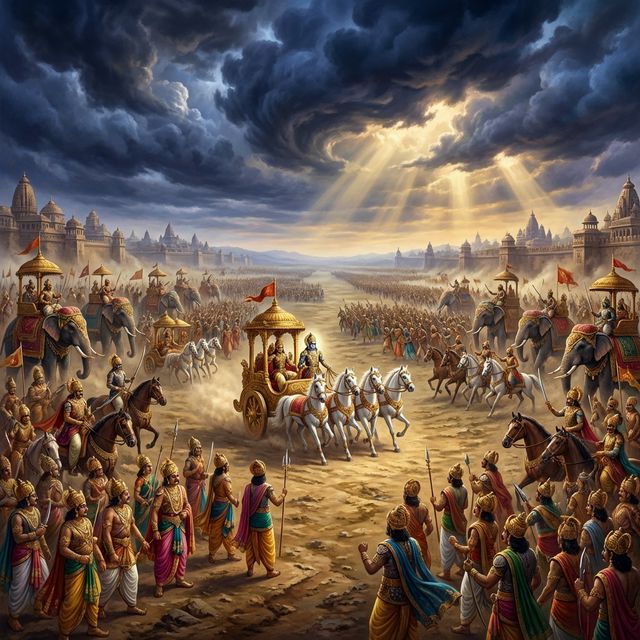
Bhima Carried From the Field
Ashwatthama's afternoon after the Narayana weapon, and the shaft that took Bhima's charioteer
The Fire That Went Into Him
Sanjaya had been given eyes that could see the whole of Kurukshetra, and the man he had to describe it to was blind, and on the fifteenth day of the war there was very little in it that a father would have wanted to hear.
Drona had fallen at noon. His son Ashwatthama, coming late to the place where his father's body lay, had answered by calling down the Narayana weapon, which belongs to the god himself and cannot be met by courage. Krishna had told the Pandava host the only defence there is against it. Throw down your weapons. Come off your cars and your elephants and your horses. Stand on the earth with empty hands and it will pass over you, and any man who contends against it even in his imagination will be killed though he hide himself deep under the ground.
The whole army obeyed him. One man did not.
Bhima had said, in front of everybody, that there was no man on that field equal to him, that his two arms were like the trunks of a pair of elephants and could pull down the mountain of Himavat, and that he would go and quell the weapon of Drona's son with his shafts and with his gold-decked mace. He had asked Arjuna not to lay Gandiva aside. Arjuna had told him that it was his vow never to use Gandiva against the Narayana weapon, against kine, or against Brahmanas. So Bhima went alone, on a car whose rattle was like the roar of clouds, and drove it into the fire in the sight of both armies.
And the weapon came to him. Every blazing shaft in that sky turned and ran toward Bhima's car, said Sanjaya, the way the luminaries at the close of night all run toward the hill of the west. Bhima, his steeds, his driver and his chariot stood in the middle of it and could not be looked at: a fire in the midst of another fire.
Arjuna saw it and covered his brother with the Varuna weapon, which is water against flame. His hands were so light and the blaze was so bright that not one man on either side saw him do it.
And then the weapon stopped burning around Bhima and began to go into him, the way the fire that consumes the universe at the end of the Yuga enters at last into the mouth of the Creator. You cannot see a flame that has gone into the sun. Nobody could see that energy passing into Bhima's body.
All creatures cried out Oh and Alas, and the loudest of them were the Pandavas.
Two Men Walk Into the Weapon
Ashwatthama stood in his car with no antagonist left anywhere in front of him, swelling with the energy of what he had loosed. The Pandava weapons were lying in the dust. Yudhishthira and every great car-warrior of that host had turned their faces away from the enemy. There was one chariot still burning on the field and one man inside it.
Then Arjuna and Krishna got down off their own car and ran toward Bhima.
They went into that energy on foot. Sanjaya, who was old enough to know what he was saying, named them by their older names when he described it: Nara and Narayana, the two rishis who are said to be older than the oldest of the gods and who take birth in every Yuga for the work of the world. They dived into the fire born of the might of Ashwatthama's weapon and it did not consume them, partly because they had laid their own weapons aside, partly because of the force of the Varuna weapon that was already there, and partly because of what they were.
They took hold of Bhima and began to drag him, and his weapons with him, down out of the chariot.
He fought them. Kunti's son roared aloud, and the weapon, feeling itself resisted, at once began to increase.
Then Krishna spoke to him.
"How is it, son of Pandu, that though forbidden by us, you still do not abstain from battle? If the Kurus could be vanquished in battle now, then we, and all these foremost of men, would certainly have gone on fighting. Look at your own army. Every warrior in it has come down from his car. For that reason, son of Kunti, come down from yours."
And he brought Bhima down off the chariot himself. Bhima came, with his eyes red as blood, sighing like a snake, and let his weapons go.
The Narayana weapon was pacified.
When its unbearable energy stilled, the points of the compass cleared, cardinal and subsidiary. Sweet breezes began to blow. The birds and the animals became quiet, and the horses and the elephants took heart, and the men did too. Bhima stood on the ground with nothing in his hands, and Sanjaya said he shone there like the morning sun.
Behind him, the remnant of the Pandava army was picking its weapons back up off the earth and forming its lines again.
It Cannot Be Used Twice
Duryodhana saw the Panchalas standing arrayed again, wanting victory, on a field he had thought was swept clean an hour before.
"Ashwatthama," he said. "Use that weapon again, and quickly."
Drona's son sighed, and there was no cheer in him at all when he answered the king.
"That weapon cannot be brought back. It cannot be used twice. If it is called back it will, beyond any doubt, kill the man calling it. Vasudeva has caused it to be baffled, by the means you saw with your own eyes. That is why the destruction of the enemy has not been accomplished in this battle."
Then he said the thing that was really troubling him, and it had nothing to do with the mechanics of an astra.
"Defeat and death, however, are the same. Rather, defeat is worse than death. Look at them. The enemy, vanquished and compelled to lay down his arms, looks as if he had been deprived of life."
He had beaten them. That was the point. He had made an entire army get off its chariots and stand in the dirt with its hands open, which is the posture of men who have already lost, and it had cost them nothing but their dignity, and they had picked their bows back up and their dignity with them. What his father had spent five days trying to do, and had died still trying to do, had been done by the weapon in a quarter of an hour and had come undone just as fast.
Duryodhana did not follow him into any of that.
"If it is so, son of my preceptor, if this weapon cannot be used twice, then let those slayers of their preceptor be slain with other weapons, O foremost of all men acquainted with weapons. All the celestial weapons are in you, as they are in the three-eyed Shiva of immeasurable energy. If you do not wish it, not even Purandara in a rage can escape you."
Sanjaya said that the son of Drona owned a banner with the device of a lion's tail on it, and that when he moved, he moved remembering the slaughter of his sire.
He cast off all fear, and went looking for the son of Prishata.
The Son of Prishata
Dhrishtadyumna was the son of Drupada, king of the Panchalas, and Drupada's line goes back to Prishata, which is why the poem keeps calling him the son of Prishata as though the name were an accusation. He had been born out of a sacrificial fire for one purpose, which was to kill Drona, and that morning he had finished it, and he had done it with a sword on an old man who had laid down his weapons and sat in yoga on the terrace of his car.
Ashwatthama came at him with great impetuosity and put five and twenty small arrows into him before anything else happened.
Dhrishtadyumna answered like a man who had nothing further to lose. He pierced Drona's son, who resembled a blazing fire, with sixty-four shafts. He put twenty stone-whetted arrows with wings of gold into Ashwatthama's driver, and four sharp ones into his four horses. He roared until the earth trembled with it, and Sanjaya said that at that moment the prince of Panchala looked like a man employed in taking the lives of every creature in the world.
He made death itself his goal. He rushed at Drona's son alone, and poured a shower of arrows down on Ashwatthama's head.
And Drona's son covered him with winged shafts, and then pierced him with ten more, remembering the slaughter of his father with every one of them.
Then it turned. Two well-shot razor-headed arrows took off the Panchala prince's standard and cut his bow in half. Ashwatthama began to grind him with the arrows that followed. He killed the horses. He killed the driver. He broke the car. In that dreadful battle he made his father's murderer steedless and driverless and carless, standing on the ground in the wreck of his chariot, and then turned the same showers on the men around him.
The Panchala troops, mangled, went. They fled away in fear and great affliction and left their commander where he stood.
Across the field, a man of the Vrishnis saw the troops turning and saw whom they were leaving behind, and urged his chariot into the gap.
The Grandson of Sini
Satyaki was a Vrishni, of Krishna's own people, the grandson of Sini, and he had a habit of going alone into places where nobody else would go and coming out again. He came now at the man who had just dismantled Dhrishtadyumna.
He afflicted Ashwatthama with eight keen shafts, and then with twenty more of diverse kinds. He pierced the driver. He put four arrows into the four horses. Then, with great deliberation and a lightness of hand that Sanjaya thought worth describing to a king, he cut off Ashwatthama's bow and his standard, cut the gold-decked car into fragments together with the steeds that drew it, and put thirty arrows deep into Ashwatthama's chest.
Drona's son, shrouded in arrows and afflicted past bearing, did not know what to do.
When the preceptor's son had fallen into that plight, the Kauravas came for the man who had done it. Duryodhana pierced Satyaki with twenty arrows. Kripa, the son of Saradwat, with three. Kritavarman with ten. Karna with fifty. Dushasana with a hundred. Vrishasena with seven. Six great car-warriors on one man from every side at once.
Satyaki made all of them fly away from the field, deprived of their cars.
Ashwatthama recovered consciousness, sighing over and over in sorrow, and lay there thinking about what he ought to do next. Then he mounted another chariot and came back shooting hundreds of arrows, and Satyaki made him careless a second time and turned him back a second time. The Pandavas blew their conchs at the sight and roared like lions.
And Satyaki, having taken the same man's car away from him twice in one afternoon, went into the Kaurava host and did the arithmetic of that war. Three thousand car-warriors of Vrishasena's division. Fifteen thousand elephants out of Kripa's force. Fifty thousand horses of Shakuni's.
Then Drona's son came back a third time, on a third car, highly enraged, wanting to kill him.
I Shall Know No Peace
Satyaki pierced him again as he came, with shafts fiercer than the ones he had used before, and mangled him with them.
And Ashwatthama, deeply pierced, with arrows of every shape standing in him, smiled at his enemy and spoke.
"Grandson of Sini, I know your partiality for Dhrishtadyumna, that slayer of his preceptor. But you shall not be able to rescue him, or yourself, when I attack you. I swear to you, grandson of Sini, by truth and by my ascetic austerities, that I shall know no peace till I have slain all the Panchalas. Unite the forces of the Pandavas and the Vrishnis together if you like. I shall still slay the Somakas."
It is worth marking that sentence, because he kept it. Everything that happened on the last night of the war was already in it, spoken aloud on a battlefield in the afternoon with witnesses on both sides, and nobody took it for anything more than the sort of thing men say when they are bleeding.
Then he shot one arrow.
It was straight and excellent and had the effulgence of the sun on it, and he sent it the way Sakra hurled his thunder at the Asura Vritra long ago. It went through Satyaki's armour, passed through his body, and entered the earth behind him like a hissing snake going into its hole.
Satyaki, his mail pierced, became bathed in the blood that came out of that wound, like an elephant deeply struck with the hook. The bow with the arrow already fitted to it came loose out of his hands. He sat down on the terrace of his own car, strengthless, covered all over in blood, and his driver saw it and took him away from there at speed.
With another shaft, perfectly straight, well winged, Ashwatthama struck Dhrishtadyumna between the eyebrows.
The Panchala prince had already been pierced past counting. He became exceedingly weak, and to keep himself upright he took hold of his own flagstaff and hung on to it, and stood there in the ruin of his chariot like an elephant that has been brought down by a lion, waiting for whatever was coming.
What came were five men.
Three of the Five
They came with cries of Oh and Alas, armed with bows, and they encompassed the son of Drona on every side.
Arjuna was one of them, whom Sanjaya calls Kiritin here, the diademed. Bhima was another. The other three were men whose names the epic gives once, in this place, and then only in order to say how they died. Vrihatkshatra of Puru's race. Sudarsana, chief of the Malavas, well accomplished in the science of arms. And the youthful prince of the Chedis, who was of the hue of the dark lotus.
They advanced twenty paces, and with great care all five struck the angry son of the preceptor at the same moment with five and twenty arrows.
Ashwatthama cut all five and twenty out of the air, almost simultaneously, with five and twenty shafts of his own that resembled snakes of virulent poison.
Then he began to answer them one at a time. Seven sharp shafts into the Paurava prince. Three into the chief of the Malavas. One into Partha. Six into Vrikodara. The five kept shooting, together and separately, arrows whetted on stone and winged with gold, and the young Chedi put twenty into him and Arjuna three, and Ashwatthama struck Arjuna with six and Krishna with six and Bhima with five and the two lesser men with two apiece, and cut off Bhima's bow and standard with a pair of arrows, and roared.
The earth and the sky and every point of the compass in front of him and behind him were shrouded with his shafts. At that hour, Sanjaya said, Ashwatthama looked like the meridian sun on an autumn day.
Then, with three arrows, almost in one motion, he cut off both of Sudarsana's arms, which were like the poles men raise for Indra, and his head, while he sat in his car.
He pierced Vrihatkshatra with a dart, cut his chariot into small fragments, took off the two arms that were smeared with sandal-paste, and then the head from the trunk with a broad-headed shaft.
And he covered the young dark-lotus prince of the Chedis with arrows like flames of fire, and sent him to Yama's abode with his driver and his horses.
Three of the five were dead in the space of a breath, in front of the other two.
Bhima had been watching.
Arrows With His Name On Them
The mighty-armed son of Pandu was filled with rage, and covered Drona's son with hundreds of keen arrows like angry snakes of virulent poison.
Ashwatthama destroyed that shower and pierced him back. Bhima cut his bow with a broad-headed arrow and put a powerful shaft into the man himself. Ashwatthama threw the broken bow away, took another, and pierced Bhima with winged shafts, and then the two of them settled into it and began to pour their arrows down on each other like two masses of rain-charged cloud.
Bhima's arrows were gold-winged, whetted on stone, and engraved with his name. Sanjaya noticed them going in: they shrouded Drona's son the way gathering cloud shrouds the sun. And Bhima in his turn was shrouded by hundreds and thousands of arrows shot by Ashwatthama, and though he stood in the middle of all of it he felt no pain, which Sanjaya said was exceedingly wonderful.
Then Bhima sped ten gold-decked arrows of great keenness, like the darts of Yama himself. They fell on Ashwatthama's shoulders and went through his body, said the old man, like snakes penetrating an ant-hill.
Drona's son shut his eyes and caught hold of his flagstaff to keep from falling.
He was upright again within a moment, bathed in his own blood, and he mustered all of his wrath and drove straight at Bhima's chariot, and from a bow drawn to its fullest stretch he sent a hundred arrows of fierce energy into that space between them. Bhima, proud of his prowess and disregarding the energy of the man opposite him, poured back an equally dense downpour.
So it went. Ashwatthama cut Bhima's bow and struck him in the chest with many keen shafts; Bhima, unable to brook it, took up another bow and pierced Drona's son with five. Both of them had eyes red as copper. Both of them covered the other completely. They frightened each other with the terrible cracking sound of their palms on the bowstring, and each undid whatever the other had just done, and neither of them gave a step.
The Horses That Ran Away
Then Ashwatthama bent that formidable bow adorned with gold, and stood gazing steadily at Bhima while he shot.
Nobody could see him do it. He drew so fast that the eye could not catch the moment when he took a shaft out of the quiver, or fixed it, or drew the string, or let it go. His bow seemed to be a circle of fire that was never not drawn. Shafts in hundreds of thousands went out of it and coursed through the welkin like a flight of locusts, and every one of them went toward Bhima's car.
And Sanjaya, who was reporting all this to the father of the men on the other side, said plainly that what they beheld then of Bhimasena, his might and his energy and his spirit, was exceedingly wonderful. Bhima regarded that terrible shower, thick as a gathering mass of cloud, as nothing more than a spatter of rain at the close of summer. His own bow of golden back, incessantly drawn, looked like a second bow of Indra. The two downpours were so dense that the wind itself could not find room to pass between them.
Ashwatthama sent gold-decked arrows steeped in oil at him. Bhima cut each of those arrows into three pieces before they reached him, and called out, "Wait. Wait."
Then he shot a terrible shower of his own, wanting to end it, and Drona's son destroyed that shower by the illusion of his weapons and cut Bhima's bow through and filled his body with shafts. Bhima, with no bow left, whirled a dart and hurled it at the chariot; it came on with the splendour of a blazing brand, and Ashwatthama cut it out of the air. Bhima took up another very strong bow and began piercing him again, smiling while he did it.
And then Drona's son sent one straight shaft, and it went into the forehead of Bhima's charioteer.
The man fell into a swoon and let the reins go.
The horses ran. They bolted with the car and the man in it in the sight of every bowman on that field, and carried Bhima out of the battle, and Ashwatthama joyfully blew his huge conch behind them.
The Panchalas heard it and saw Bhima going, and abandoned Dhrishtadyumna where he stood and fled on every side, and Drona's son went after the broken troops shooting fiercely, and there was a great carnage among them.
Words Arjuna Had Never Used Before
Arjuna saw that force break and went after Ashwatthama to kill him. Krishna and he rallied the running men with some effort and got them to stand, and then Arjuna, supported by the Somakas and the Matsyas, went forward alone against the Kauravas and checked them.
He came up close to the banner with the lion's tail on it and said this:
"Show me now the might you have, the energy, the knowledge and the manliness that are in you, and your affection for the Dhartarashtras, and your hatred for us, and the high mettle of which you are capable. Prishata's son, the slayer of Drona, will quell your pride today. Come and encounter the Panchala prince, that hero resembling the Yuga fire, and like the Destroyer himself with Govinda. You have displayed your pride in battle. I shall quell that pride of yours."
Dhritarashtra, hearing it, stopped his charioteer's account.
"The preceptor's son is possessed of might and worthy of respect. He bears great love to Dhananjaya and the high-souled Dhananjaya loves him in return. Vibhatsu had never addressed Drona's son in this way before. Why then did the son of Kunti speak to his friend in such words?"
Sanjaya answered him honestly, which was his habit.
"The youthful prince of the Chedis had fallen, and Vrihatkshatra of Puru's race, and Sudarsana the chief of the Malavas, who knew the science of arms. Dhrishtadyumna had been defeated, and Satyaki, and Bhima. He was feeling great pain. He had been touched to the quick by what Yudhishthira had said to him. He was remembering his former woes. And out of that grief there rose in him such wrath as he had never experienced before. It was for this that he addressed the preceptor's son, who was worthy of every respect, in language that was unworthy and indecent and bitter and harsh, like a vulgar person."
The two of them had been boys together in Drona's yard. Arjuna had used the words anyway, and once used they could not be taken back any more than an astra can.
Ashwatthama became highly angry with Partha, and more angry still with Krishna.
He stood up resolutely on his car. He touched water. And he began to invoke the Agneya weapon, which cannot be resisted by the very gods.
Dharma Lesson
Bhima is the only man on that field who refuses to put his weapons down, and the refusal nearly kills him; the army that obeyed Krishna and stood in the dust with open hands is the army that survives to pick its bows back up. Ashwatthama sees this clearly and cannot accept it, and tells Duryodhana that defeat is worse than death, which is the sentence of a man who would rather be destroyed than be seen to yield. Everything he does for the rest of the afternoon follows from it, including the oath against the Panchalas that he swears while bleeding and that nobody takes seriously. And Arjuna, grieving, spends words on a friend that no victory afterwards can buy back.