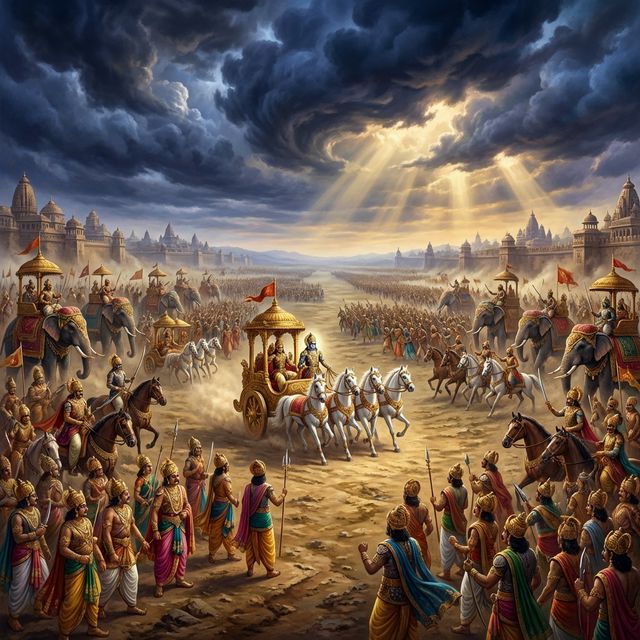
Portents Before the Fourteenth Day
The night the sky and the rivers answered Arjuna's vow, and the morning ritual of a king
Two Men Who Did Not Sleep
Sanjaya was telling the whole of it to a blind man in a hall at Hastinapur, and the part he had come to was a night.
The thirteenth day of the war was over. Abhimanyu, the son of Arjuna and Subhadra, sixteen years old, had gone alone into the wheel array that morning and had not come out of it, and Jayadratha the ruler of the Sindhus had stood in the mouth of that formation and held four Pandava brothers out of it while the boy was killed inside. In the evening Arjuna had come back to a camp that would not look at him, and had learned why, and had sworn in the hearing of Krishna and of all the kings that before the sun set on the following day he would fell the head of the ruler of the Sindhus on the earth, and that if he failed he would enter blazing fire.
The vow was made, and there was nothing left to do until morning. This is what Sanjaya said about the hours in between.
"Both Vasudeva and Dhananjaya," he said, "afflicted with sorrow and grief and frequently sighing like two snakes, got no sleep that night."
That is the whole account of the two of them. No speech, no plan, no comfort taken from each other. Two men lying awake and breathing hard in the dark, one of whom had lost his sister's son and one of whom had lost his own, and between them a promise with a sunset attached to it.
And the gods were watching, and the gods were frightened.
Understanding that Nara and Narayana were in rage, said Sanjaya, the gods with Vasava at their head became very anxious, thinking, What will come of it?
These are the two eternal rishis, born together in age after age, who had come down into this world as the man with the bow and the man who drove his horses. Heaven knew who they were. Heaven had seen them angry before. And heaven, which knows the end of most things, did not know the end of this one, and said so out loud.
The Trunk and the Mace on the Sun
The first thing that went wrong was the wind.
Fierce winds began to blow, and Sanjaya gives them two qualities, both of them bad. They were dry, and they foreboded danger. Not the wind that comes before rain and is a mercy on men who have been fighting in armour all day. The other kind, blowing across a plain that had a hundred thousand dead on it and would have more tomorrow.
Then the sun.
A headless trunk and a mace appeared on the disc of the sun. That is what the text says, and it does not explain it, and it should not be explained away. The men of both camps looked up at the light, and standing on it, dark against it, were two shapes. A body with no head on its shoulders. And a mace, which is a club for breaking bones.
There is no army in the world that could see that and not know what it was being told.
And although it was cloudless, frequent thunders were heard, of loud report, mixed with flashes of lightning.
Read the clause in front of that one. Although it was cloudless. The thunder was not weather. There was nothing overhead for it to come out of, and it came anyway, cracking across an empty sky with the lightning going with it, and the horses in the picket lines of both armies would have been screaming.
Then it went into the ground. The earth with her mountains and her waters and her forests shook: the three least movable things a person ever sees, all of them in motion together. The seas, those habitations of Makaras, swelled in agitation. The ocean is this poem's standing image for whatever is too large to be disturbed, and that sea rose, on coasts hundreds of miles from Kurukshetra, before any runner could have carried the news there.
And the rivers ran in directions opposite to their usual course.
That is the one to stop at. A river running backwards is the plainest statement the physical world is capable of making that an order has been reversed, that what was going one way is now going the other, and that nothing downstream can rely on what used to come to it. Two rivers ran across that plain, the Hiranvati and the Oghavati, and both camps drew their water from them, and men had been washing blood off their hands in them all week.
Portents here are not decoration. They are the ordinary machinery of the world reacting to a load put into it, and the load had gone in at dusk, when a man laid his hand on his weapons and swore by truth.
What the Animals Did
The last of the omens were in the bodies of the living.
The nether and upper lips of car-warriors and steeds and men and elephants began to tremble. All four ranks of a battlefield are inside that sentence, the great chariot fighters at the top and the foot soldiers under them and the animals under both, and every one of them was doing the same small involuntary thing at the same moment. Not shaking with fear, which a man can hide, and not weeping, which a man can wipe. The lips moving on their own, on the faces of kings and on the muzzles of horses, in the lamplight of the tents, where everybody could see it happening to everybody else.
Then the beasts.
As if for gladdening the cannibals, says Sanjaya, on that occasion foreboding a great accession of population to the domain of Yama, the animals began to eject urine and excreta and to utter loud cries of woe.
The cannibals are the rakshasas and the carrion eaters who follow an army and eat what it leaves behind, and they are the only parties in this whole account who are pleased. The great accession of population to the domain of Yama is the poet's phrase for what would be counted the next evening, and it is worth reading twice, because it is a census. The kingdom of the dead was about to receive an intake large enough to be described as growth.
And the animals, who had no idea what a vow was, knew.
Beholding these fierce omens that made the hair stand on end, and hearing also of the fierce vow of the mighty Arjuna, all the warriors of the Kaurava host became exceedingly agitated.
That is the sentence the whole passage has been built toward. The omens by themselves might have been argued over by the priests in the morning. The vow by itself might have been laughed at, since one man had undertaken to reach, through eleven divisions of troops, a king whom Drona himself had been assigned to protect. But the two things arrived in Duryodhana's camp on the same night, and together they were not arguable, and the men on that side lay awake as well.
Go and Comfort My Sister
In the middle of all this, Arjuna did the one thing nobody would expect of a man who has just sworn to die tomorrow if he fails.
He thought about the women.
The mighty-armed son of Pakasasana, which is to say the son of Indra, turned to Krishna and gave him an errand.
"Go, and comfort thy sister Subhadra with her daughter-in-law. And, O Madhava, let also that daughter-in-law, and her companions, be comforted by thee. O lord, comfort them with soothing words that are again fraught with truth."
Look at the condition attached to it. Soothing words that are again fraught with truth. He is not sending Krishna to tell them a kind story. Subhadra is Krishna's own sister and Arjuna's wife and the mother of the dead boy. The daughter-in-law is Uttaraa, the princess of Virata, married to Abhimanyu a little over a year ago and carrying his child, and she has been a widow for a few hours. Arjuna, who has grief enough of his own to make him useless in that tent, will not have those two consoled with anything that is not so.
Thus addressed, said Sanjaya, Vasudeva went to Arjuna's abode with a cheerless heart.
That is the other detail not to walk past. Krishna is not going in there as a comforter who is himself untouched. Abhimanyu was his nephew. He had been away on the far side of the field with Arjuna, drawn off by the samsaptakas, on the morning the boy was surrounded, which means that of all the men in that camp he and Arjuna are the two who were not there, and both of them know it.
He went with a cheerless heart, and he began to comfort his sorrowing sister, afflicted with grief on account of the death of her son.
All Creatures Have But One End
"O lady of Vrishni's race," said Krishna, "do not grieve, with thy daughter-in-law, for thy son. O timid one, all creatures have but one end ordained by Time."
He began where such an argument has to begin, with the fact that death was not something that happened specially to Abhimanyu, and then he moved at once to the thing that did happen specially to Abhimanyu, which was the manner of it.
"The end thy son hath met with, that becometh a hero of proud lineage, especially one who is a Kshatriya. Do not, therefore, grieve. By good luck it is that this mighty car-warrior of great wisdom, of prowess equal to that of his father, hath, after the Kshatriya custom, met with an end that is coveted by heroes."
By good luck. He says it to the mother, on the night of the death, and he means it, because he is speaking from inside a code in which a man of that order who dies in his armour going forward has drawn the best of the lots available to him.
Then he told her where the boy had gone, and what other men pay to get there.
"Having vanquished numberless foes and despatched them unto Yama's presence, he hath himself repaired to those eternal regions that grant the fruition of every wish, and that are for the righteous. Thy son hath attained that end which the righteous attain by penance, by Brahmacharya, by knowledge of the scriptures, and by wisdom."
Four hard roads are named there, and each of them is the labour of an entire lifetime. Penance. The celibate discipline of a student. The mastery of the scriptures. And wisdom, which is the one that cannot be worked for directly at all. Abhimanyu was sixteen and had finished none of them, and he had arrived where they arrive, in a single afternoon.
"The mother of a hero, the wife of a hero, the daughter of a hero, and a kinswoman of heroes," said Krishna, "grieve not thou for thy son who hath obtained the supreme end."
He was naming her four times over. Every one of the four was true of her, and not one of them was any use to her that night.
The Head on the Outskirts of Samantapanchaka
Then he stopped consoling her and told her what was going to happen instead.
"The wretched ruler of the Sindhus, O beautiful lady, that murderer of a child, that perpetrator of a sinful act, shall, with his friends and kinsmen, obtain the fruit of this arrogance of his on the expiry of this night. Even if he enters the abode of Indra himself he will not escape from the hands of Partha. Tomorrow thou shalt hear that the head of the ruler of the Sindhus hath, in battle, been cut off from his trunk to roll on the outskirts of Samantapanchaka."
Samantapanchaka is the old name of the ground they were all camped on, the tract that Parashurama once filled with five lakes of blood, and every man in both armies knew what had been done there and by whom. Krishna is telling a bereaved mother that by tomorrow evening the head of the man responsible for her son will be lying on that field, and he is telling her the name of the field.
Then he went back to the boy, and gave her the only thing that was actually hers to keep.
"Of broad chest, mighty arms, unreturning, a crusher of car-warriors, thy son hath gone to heaven. Drive away this fever of thy heart. Obedient to his sires and to his maternal relations, that heroic and mighty car-warrior of great prowess hath fallen a prey to death after having slain thousands of foes. Comfort thy daughter-in-law, O queen. Do not grieve too much, O Kshatriya lady. Drive away thy grief, O daughter, as thou shalt hear such agreeable news on the morrow."
Unreturning. It is the word this poem keeps for the men who do not come back out of a formation. It is a compliment, and it is also what killed him.
And at the end Krishna staked his cousin's vow the way a man stakes a wager he has no intention of losing.
"That which Partha hath vowed must be accomplished. It cannot be otherwise. That which is sought to be done by thy husband can never remain unaccomplished. Even if all human beings and snakes and Pisachas and all the wanderers of the night and birds, and all the gods and the Asuras, help the ruler of the Sindhus on the field of battle, he shall still, with them, cease to exist tomorrow."
The King Wakes to Drums
Krishna went from that tent to his own, and in the middle of the night he woke his charioteer Daruka and gave him his orders for the morning, and while the two of them were talking the night passed away.
Then Sanjaya turns the account over to the other camp entirely, and to a man who has not been mentioned for some time, and who is about to be described in more detail than any battle in this parva receives.
King Yudhishthira woke up.
He was woken the way the eldest of a royal house is always woken. The Paniswanikas and the Magadhas and the Madhuparkikas and the Sutas gratified that bull among men with songs and music. Dancers began their dance. Sweet-voiced singers sang sweet songs fraught with the praises of the Kuru race. And skilled musicians, well trained each in his own instrument, played on Mridangas and Jharjharas and Bheris and Panavas and Anakas and Gomukhas and Adamvaras, on conchs, on Dundubhis of loud sound, and on diverse other instruments besides. That noise, deep as the roar of the clouds, touched the very heavens, and it woke the king out of his sleep.
Having slept happily on his excellent and costly bed, says Sanjaya, the king awoke.
Slept happily. On the night when Arjuna and Krishna were lying awake sighing like snakes, and when nobody else in the Pandava camp closed their eyes either, the man in whose name the war was being fought slept well. The poet says it without a word of comment and leaves it lying there for whoever wants to pick it up.
Then the monarch rose from his bed and went to the bath-room to perform those acts that were absolutely necessary. And a hundred and eight servants came in to him, attired in white, themselves washed, and all of them young, carrying golden jars filled to the brim.
A hundred and eight. On the fourteenth morning of a war that had already taken his grandsire and his nephew, the household counted out the auspicious number and did not vary it by one.
The Bath and the Fire
Seated at his ease on a royal seat, attired in a thin cloth, the king bathed in several kinds of water, fragrant with sandalwood and purified with mantras.
The order of it is worth having in full, because the text gives it in full. First his body was rubbed by strong and well-trained servants with water in which diverse kinds of medicinal herbs had been soaked. Then he washed with adhivasha water, made fragrant with various odoriferous substances. Then a long piece of cloth for the head, as white as the feathers of a swan, which had been kept loose in front of him beforehand, and he tied it round his head to dry the water. Then sandal paste smeared over the body, and floral garlands, and clean robes.
Then the mighty-armed monarch sat with his face towards the east and his hands joined together, and, following the path of the righteous, the son of Kunti mentally said his prayers.
Silently. That is what mentally means here. The drums had stopped and the servants had gone out, and the king of the Pandavas sat facing the sunrise with his palms together and said nothing aloud at all.
Then, with great humility, he entered the chamber in which the blazing fire for worship was kept. He worshipped the fire with faggots of sacred wood and with libations of clarified butter sanctified with mantras, and he came out again.
Nothing in any of this is unusual, and that is the entire point of it. This is what the man did every morning of his life. He did it in Indraprastha when he was an emperor and the kings of the earth were paying him tribute. He did it in the Kamyaka forest for twelve years with nothing to pour but what the forest gave him. He did it in Virata's palace in the borrowed shape of a dice-playing brahmana who could not be seen praying like a king. And he did it on the fourteenth morning at Kurukshetra, with his brother under a vow of death and the sun already coming up over a field on which he had lost a son and a grandsire and the better part of an army, in exactly the same order, without hurrying any part of it.
Nine Thousand Brahmanas
Then that tiger among men entered a second chamber, and there he found the brahmanas waiting for him.
They were bulls among brahmanas, well acquainted with the Vedas, self-restrained, purified by the study of the Vedas and by vows, and every one of them had performed the bath that completes a sacrifice. They were worshippers of the Sun, and they numbered a thousand. Besides them there were eight thousand others of the same class.
Nine thousand men in one camp on a morning of battle, fed and housed and kept there for exactly this, which says as much about how the Pandava army was run as any muster roll could.
The son of Pandu caused them to utter agreeable benedictions in distinct voices, and to make them do it he made them presents. The list is given plainly and it should be read plainly. Honey. Clarified butter. Auspicious fruits of the best kind. To each man a nishka of gold. To each a hundred steeds decked with ornaments. Costly robes, and such other presents as were agreeable to them. And cows that yielded milk whenever they were touched, with their calves beside them, their horns cased in gold and their hoofs in silver.
Then he walked round them all, keeping them on his right, which is the salutation a man makes to whatever he holds holy.
And coming out he saw and touched the things that are set in a king's path on a morning that matters. Swastikas, fraught with increase of good fortune. Nandyavartas made of gold. Floral garlands. Water-pots. Blazing fire. Vessels full of sun-dried rice. The yellow pigment prepared from the urine of the cow. Curds and clarified butter and honey. Auspicious birds. And auspicious, well-decked maidens, standing where he would pass them.
He touched each thing in its turn. A man who has been told that this will be the best or the worst day of his life touches gold and grain and fire and the horns of cattle and walks on, and none of it is superstition exactly. It is a king performing, in front of his whole household, the act of expecting the day to go well.
The Seat of Gold and the Man at the Door
In the outer chamber the attendants brought him a seat.
It was of gold and circular in shape, decked with pearls and lapis lazuli, overlaid with a very costly carpet with another cloth of fine texture spread over that, and it was the handiwork of the divine artificer himself. The high-souled son of Kunti sat down on it, and the servants brought him all his bright and costly ornaments, and he put the begemmed things on one by one, whereupon his beauty became such, says Sanjaya, as to enhance the grief of his foes.
Then they began to fan him with white yak-tails of the bright effulgence of the moon, each of them furnished with a handle of gold, and the king looked resplendent, like a mass of clouds charged with lightning. The bards sang his praises. The panegyrists uttered his eulogies. The singers sang to that delighter of Kuru's race, and in a moment the voices swelled into a loud noise.
And then, underneath the singing, something else came up.
The clatter of car-wheels. The tread of horse-hoofs. The tinkle of elephants' bells, and the blare of conchs, and the tread of men, until the very earth seemed to tremble with it.
That was the army getting up. The fourteenth day had already started outside the walls of the tent while the last of the ornaments were being fastened on inside it.
Then one of the orderlies in charge of the doors came in. Sanjaya troubles to describe him, and he is nobody, and he gets a whole line to himself: cased in mail, youthful in years, decked with ear-rings, his sword hanging at his side. He entered the private apartment, knelt down on the ground, saluted with a bend of his head the monarch who deserved every adoration, and represented to the royal son of Dharma that Hrishikesa was waiting to be introduced.
Yudhishthira gave his servants one order.
"Let an excellent seat and an Arghya be kept ready for him."
So Krishna was brought in and seated on a costly seat, and the king addressed him with the usual enquiries of welcome, and duly worshipped him. Neither of them said anything yet about Jayadratha. The water for the guest's hands was poured first, because that is the order things are done in, and then the day that Arjuna had sworn away could begin.
Dharma Lesson
The epic never treats an oath as a private matter. When Arjuna binds himself to a sunset, the wind dries, the sea rises and the rivers turn, because a promise of that weight is a load laid on the world and not only on the man who made it. Set against the omens is Yudhishthira's morning, unchanged from the mornings of his exile: the bath, the silent prayer facing east, the fire, the gifts to the brahmanas, each thing touched in its own order. One brother meets a terrible day by swearing something enormous and the other by doing the small ordinary duties exactly right, and the poem gives them equal room.