Krishna's Gift to the Dying Grandsire
The Boon That Took Away Pain, Hunger and Thirst So Bhishma Could Speak
The Road Out of the City
Vaisampayana, telling the whole of it long afterwards to king Janamejaya, set the scene on a road.
The war was over. The eighteen days were spent, the fires had been lit for the dead, and Yudhishthira sat on a throne he did not want. Krishna had taken him up on his car that morning, and to fill the road he had told him the story of Rama of Bhrigu's race, the Brahmana with the axe who in wrath had emptied the earth of kshatriyas thrice seven times over, and of how the boys of the royal order had been hidden from him among kine and bears and apes until the earth herself begged a sage for kings again.
Yudhishthira heard it out and was filled with wonder.
"O thou of Vrishni's race," he said to Janardana, "the prowess of the high-souled Rama, who in wrath had freed the earth of kshatriyas, was like that of Sakra himself. The scions of kshatriyas, troubled with the fear of Rama, were concealed and brought up by kine, by Ocean, by leopards and bears and apes. Worthy of every praise is this world of men, and fortunate are they that reside in it, where a feat that was again so righteous was accomplished by a Brahmana."
He was a man who had just killed his own house down to the last cousin, listening to a story in which the killing of kshatriyas came out righteous at the end. He said the pious thing and did not sound comforted by it.
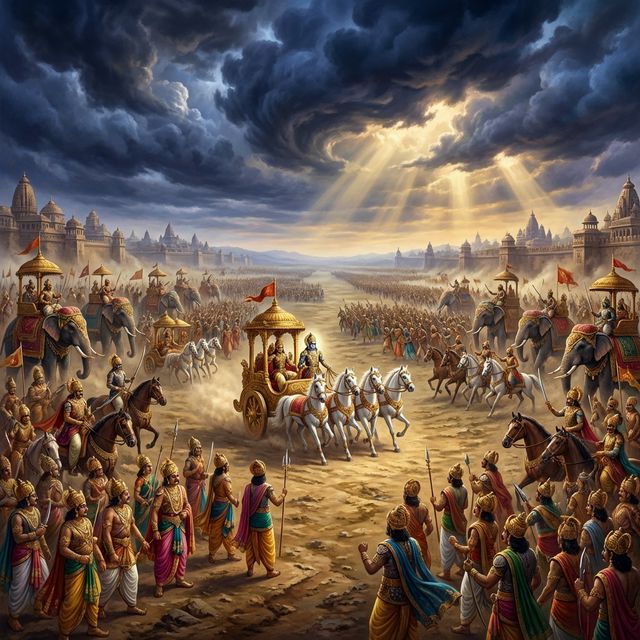
The discourse ended there, and neither of them began another. The car went on across the field where the war had been fought, and its rattle was the only sound, and the two illustrious persons on it, Krishna of unfading glory and the son of Dharma, proceeded thither where the puissant son of Ganga lay on his bed of arrows.
A Fire About to Die Out
They saw him from a long way off.
Bhishma lay stretched on his arrowy bed, and Vaisampayana says that he resembled in splendour the evening sun covered with his own rays. He had been there since the tenth day of the battle, held up off the ground on the shafts that Arjuna had driven through him, waiting by his own choice for the sun to turn north before he would consent to die. The spot was highly sacred, being situated on the banks of the river Oghavati, and the Kuru hero lying on it was surrounded by many ascetics, as he of a hundred sacrifices is surrounded by the deities of heaven.
Krishna and Dharma's royal son and the four Pandavas and the others, headed by Kripa the son of Saradwat, alighted from their vehicles while they were still at a distance. They collected their restless minds. They concentrated all their senses. Then they went forward on foot, and saluted first the foremost of the rishis, Vyasa among them, before any of them went near the bed.
Govinda and Satyaki and the rest approached the son of Ganga last, and took their seats surrounding him, the Yadu princes and the Kuru princes together on the ground, which was a thing that had not happened in that field for eighteen days without arrows in the air.
Kesava looked at him.
Whatever the ascetics had been saying about the ninth of the Vasus and his mastery over death, what was on the arrows was an old man at the end of a long life with a hundred wounds in him, and Vaisampayana chooses the plainest image in the section for what Krishna saw: he was looking like a fire about to die out.
And Kesava, with a rather cheerless heart, addressed him.
Are Thy Perceptions Clear
"Are thy perceptions now as clear as before?" Krishna said. "I hope thy understanding, O foremost of eloquent men, is not clouded. I hope thy limbs are not tortured by the pain arising from the wounds by shafts."
Then, having asked it, he answered it himself, and the answer is the strangest thing in the conversation.
"From mental grief also the body becomes weak. In consequence of the boon granted to thee by thy sire, the righteous Santanu, thy death, O puissant hero, depends on thy own will. I myself have not that merit in consequence of which thou hast obtained this boon."
Santanu had given his son that boon long ago, on the day the boy gave up a throne and a wife and every son he might have had, so that his father could marry a fisherman's daughter. The gift was that death would have to wait until Bhishma called it. It had been sitting unused for a lifetime. Now it was the only thing holding him above the ground, and Krishna, who was God walking about in the shape of a cousin, said in front of everybody that he did not possess the merit by which that boon had been won.
Then he said the other half.
"The minutest pin inserted within the body produces pain. What need then be said, O king, of hundreds of arrows that have pierced thee? Surely, pain cannot be said to afflict thee."
Both things are true at once and Krishna lets them stand side by side without reconciling them. A pin hurts. There are hundreds of arrows in this man. Therefore, he says, pain cannot be said to afflict thee, and everyone sitting on that ground could see the shafts standing out of him in the evening light and could hear what the sentence was really doing, which was asking a question in the form of a compliment.
Bhishma did not answer it yet.
The Ninth of the Vasus
Krishna went on praising him, and the praise was a list of the things nobody else had done.
"Thou art competent, O Bharata, to instruct the very gods regarding the origin and dissolution of living creatures. Possessed of great knowledge, everything belonging to the Past, the Future, and the Present is well known to thee. Thou art an ocean of virtue and duty.
"While living in the enjoyment of swelling sovereignty, I beheld thee forgo female intercourse though sound of limbs and perfectly hale and though surrounded by female companions. Except Santanu's son Bhishma, we have never heard of any other person in the three worlds that could, by his ascetic power, though lying on a bed of arrows and at the point of death, still have such a complete mastery over death as to keep it thus at bay.
"We have never heard of anybody else so devoted to truth, to penances, to gifts, to the performance of sacrifices, to the science of arms, to the Vedas, and to the protection of persons soliciting protection. Nobody so harmless to all creatures, so pure in behaviour, so self-restrained, so bent upon the good of all creatures, and also so great a car-warrior as thee. Without doubt, thou art competent to subjugate, on a single car, the gods, Gandharvas, Asuras, Yakshas and Rakshasas.
"O mighty-armed Bhishma, thou art always spoken of by the Brahmanas as the ninth of the Vasus. By thy virtues, however, thou hast surpassed them all, and art equal unto Vasava himself."
That last is not flattery but a fact about his birth. Eight Vasus once stole a sage's cow and were cursed to be born as men, and seven of them Ganga carried to the river as infants and gave back to the water at once. The eighth she was made to keep, and he grew up, and this was he, lying on the arrows with his own mother's water running past him a short way off.
"By thy ascetic power thou canst create a universe of mobile and immobile creatures."
Dispel the Grief of the Son of Pandu
Then Krishna came to what he had actually driven out there to ask.
"Dispel now the grief of the eldest son of Pandu, who is burning with sorrow on account of the slaughter of his kinsmen."
Yudhishthira was sitting there while it was said. He had been crowned days before and had spent the days since unable to look at his own hands, and the man he was being brought to was the man his brother had shot down.
Krishna set out what Bhishma had that was needed, and he set it out as an inventory, because the point was that no one else held the whole of it.
All the duties that have been declared in respect of the four orders and the four modes of life are known to thee. Everything indicated in the four branches of knowledge and in the four Hotras. Those eternal duties laid down in Yoga and in Sankhya. The duties of the four orders, and those duties that are not inconsistent with their declared practices, all of these along with their interpretations. The duties laid down for those sprung from an intermixture of the orders, and those laid down for particular countries and tribes and families. Those declared by the Vedas and those declared by men of wisdom. The subjects of the histories and the Puranas. All the scriptures treating of duty and practice dwell in thy mind.
"Save thee, O bull among men, there is no other person that can remove the doubts that may arise in respect of those subjects of knowledge that are studied in the world. With the aid of thy intelligence, do thou, O prince of men, drive away the sorrow felt by the son of Pandu."
And then a line that says why such a man is permitted to exist at all.
"Persons possessed of so great and such varied knowledge live only for comforting men whose minds have been stupefied."
Bhishma raised his head a little off the arrows, and joined his hands, and spoke.
What the Dying Man Saw
"Salutations to thee, O divine Krishna. Thou art the origin and thou art the dissolution of all the worlds. Thou art the Creator and thou art the Destroyer. Thou, O Hrishikesa, art incapable of being vanquished by any one. The universe is thy handiwork. Thou art the soul of the universe and the universe hath sprung from thee. Thou art the end of all created things. Thou art above the five elements. Salutations to thee that art the three worlds and that art again above the three worlds. O lord of Yogins, salutations to thee that art the refuge of everything."
He had been listening to a long speech in praise of himself, and the first thing he did with his voice was turn every word of it around.
Then he said what was happening to him while he lay there.
"O foremost of beings, those words which thou hast said regarding me have enabled me to behold thy divine attributes as manifest in the three worlds. O Govinda, I also behold thy eternal form."
He described it the way a man describes something he is looking at.
"Thou standest shutting up the seven paths of the Wind, possessed of immeasurable energy. The firmament is occupied by thy head, and the earth by thy feet. The points of the compass are thy two arms, and the Sun is thy eye, and Sakra constitutes thy prowess. O thou of unfading glory, thy Person, attired in yellow robes that resemble the hue of the Atasi flower, seems to us to be like a cloud charged with flashes of lightning."
Arjuna had been shown that form on the first morning of the war, between the armies, and had been terrified by it. Bhishma was shown it on the tenth day of his dying, and asked for nothing that a frightened man asks for.
"Think of that, O best of gods, which would be good, O thou of lotus eyes, for my humble self, that am devoted to thee, that seek thy protection, and that am desirous of obtaining a blissful end."
Six and Fifty Days
"Since, O bull among men, thy devotion to me is very great," said Vasudeva, "for this, O prince, I have displayed my celestial form to thee. I do not display myself unto one that is not devoted to me, or unto a devotee that is not sincere, or unto one that is not of restrained soul. Through thy own penances, O Bhishma, thou art competent to behold me."
Then he told him two things that no one else on that field could have told him.
"Those regions, O king, are ready for thee whence there is no return. Six and fifty days, O foremost one of Kuru's race, still remain for thee to live. Casting off thy body, thou shalt then obtain the blessed reward of thy acts."
Fifty-six days. Not a hope and not a blessing, a number, delivered to a man who had chosen to keep himself alive by will and had no way of knowing how much of that will he would need. And Krishna showed him what was waiting through all of it.
"Behold, those deities and the Vasus, all endued with forms of fiery splendour, riding on their cars, are waiting for thee invisibly till the moment of the sun's entering on his northerly course. Subject to universal time, when the divine Surya turns to his northerly course, thou, O foremost of men, shalt go to those regions whence no man of knowledge ever returns to this earth."
His seven brothers had come for him. They had been standing over the arrows in the air, in their chariots, since the day he fell, and they would go on standing there for eight more weeks, and nobody had been able to see them.
Then Krishna said the thing that put the whole burden on the old man's mouth.
"When thou, O Bhishma, wilt leave this world for that, all Knowledge, O hero, will expire with thee. It is for this that all these persons, assembled together, have approached thee. Speak words of truth, fraught with morality and Yoga, unto Yudhishthira, whose learning has been clouded by grief, and quickly dispel that grief of his."
I Cannot Distinguish the Sky from the Earth
Bhishma had two answers and he gave both.
The first was courtesy. "O master of all the worlds, O mighty-armed one, O Siva, O Narayana, O thou of unfading glory, hearing the words spoken by thee I have been filled with joy. But what words of instruction can I say in thy presence, when all the subjects of speech have been dealt with in thy speech? Whatever in either world should be done or is done proceeds from thy intelligent self. That person who is competent to discourse on the subject of heaven in the presence of the chief of the gods himself is competent to discourse on morality and pleasure and profit and salvation in thy presence."
Even brihaspati, he said, the very master of speech, speaking in thy presence, will be overcome by hesitation.
The second answer was not courtesy. It was the plain report of a body on a bed of arrows, and it is the only place in the whole of the Shanti Parva where Bhishma says what the last days actually feel like from the inside.
"My mind, O slayer of Madhu, is exceedingly agitated by the pain of arrow-wounds. My limbs are weak. My understanding is not clear. I am so afflicted by these shafts, resembling poison or fire, that I have not the power to utter anything. My strength is abandoning me. My life-breaths are hastening to leave me. The very vitals of my body are burning. My understanding is clouded. From weakness my utterance is becoming indistinct. How then can I venture to speak?
"I cannot any longer distinguish the points of the compass, nor the sky from the earth. Through thy energy, O slayer of Madhu, I am only barely alive."
So he refused. He asked to be excused, and asked Krishna to teach the king himself.
"Do thou, therefore, thyself speak for the good of king Yudhishthira the just, for thou art the ordainer of all the ordinances. How, O Krishna, when thou, the eternal creator of the universe, art present, can one like me speak like a disciple in the presence of the preceptor?"
Krishna did not accept the refusal. He removed the reason for it.
The Boon
"The words spoken by thee are worthy of thee," said Vasudeva, "that art the foremost one of Kuru's race, that art endued with great energy, that art of great soul, and that art possessed of great patience and conversant with every subject."
Then he gave him the gift, and it was made of exactly the complaints Bhishma had just listed, taken away one by one in the order he had named them.
"Regarding what thou hast said unto me about the pain of thy arrow-wounds, receive, O Bhishma, this boon that I grant thee from my grace.
"Discomfort and stupefaction and burning and pain and hunger and thirst shall not, O son of Ganga, overcome thee.
"Thy perceptions and memory, O sinless one, shall be unclouded. The understanding shall not fail thee. The mind, O Bhishma, freed from the qualities of passion and darkness, will always be subject to the quality of goodness, like the moon emerged from the clouds.
"Thy understanding will penetrate whatever subject connected with duty, morality or profit thou wilt think upon."
And then, past the removing of pain, an addition.
"O tiger among kings, obtaining celestial vision, thou wilt succeed in beholding the four orders of created things. Endued with the eye of knowledge, thou wilt behold, like fishes in a limpid stream, all created things that thou mayest endeavour to recollect."
That is what he was given for his fifty-six days. Not health, and not one hour of extra life. He would lie on the same arrows in the same body, and the shafts would stay where they were. What was lifted off him was everything that stood between his mind and his speech: the hunger, the thirst, the burning, the wandering, the indistinct utterance of a weak man. In their place, a memory that could look down into the whole of what had ever been made the way a man looks down into clear water and sees the fish.
Everything that comes after this in the Shanti Parva and the Anushasana Parva, every duty of kings and every old story and every catalogue of gifts and sins, comes out of a mouth that could only work because of what was said on that riverbank.
Flowers Out of Season, and the Ride Home
The rishis were still sitting there, and they had heard the whole of it.
Then those great rishis, with Vyasa amongst them, adored Krishna with hymns from the Richs, the Yajuses and the Samans. A celestial shower of flowers belonging to every season fell on that spot where he of Vrishni's race sat with Ganga's son and the son of Pandu, blossoms of spring and of the rains and of the cold weather coming down together on the same patch of ground. Celestial instruments of every kind played in the welkin and the tribes of Apsaras began to sing.
Vaisampayana is careful about what did not happen. Nothing of evil and no portent of any evil kind were seen there. An auspicious, pleasant and pure breeze, bearing every kind of fragrance, began to blow. All the points of the compass became clear and quiet, and all the animals and birds began to rove in peace. On a field where for eighteen days the omens had been jackals and headless trunks and rain of blood, there was nothing wrong with the sky for one evening.
Soon after, like a fire at the extremity of a great forest, the divine Surya of a thousand rays was seen to descend to the west. The rishis rose and saluted Janardana and Bhishma and king Yudhishthira, and Kesava and the sons of Pandu and Satyaki and Sanjaya and Kripa bowed in reverence to them, and they went away to their own abodes saying, "We will return tomorrow."
Then Kesava and the Pandavas saluted Bhishma, walked round him keeping him on their right, and ascended their handsome cars. The army went with them, cars decked with golden Kuvaras and infuriated elephants looking like mountains and horses fleet as Garudas, moving in two divisions, one before the princes and one behind, so that the whole host in the dusk resembled the two currents of the great river Narmada where the Rikshavat mountains stand across it and divide the water.
The moon rose in front of them as they went, giving back moisture to the herbs and plants whose juice the sun had sucked up all day.
And that bull of Yadu's race and the sons of Pandu entered the Kuru city and went to their mansions like tired lions seeking their caves, leaving behind them on the riverbank an old man in no pain at all, wide awake, with fifty-six days to spend and the eye of knowledge open in his head.
Dharma Lesson
Bhishma does not ask to be spared his death, and Krishna does not offer to spare it. What is lifted from him is only what stood between his mind and his speech, so that the last fifty-six days of a dying man could be spent giving something away. The boon is shaped precisely to the complaint that preceded it, which is its own kind of answer to prayer: not the removal of the arrows, but the removal of everything that made the arrows an excuse. Grace here is not comfort but capacity, and it is granted to a man who had already refused to use his weakness as a reason to be silent for anything smaller than reverence.