The Sword on Drona's Yoke
Dhrishtadyumna leaps onto his enemy's chariot to kill him, and Satyaki cuts the arrow that would have killed him first
Three Bodies, and a Man Who Went at Drona
It was the fourteenth day, and Sanjaya was telling a blind man what his sons were doing on a field he would never see.
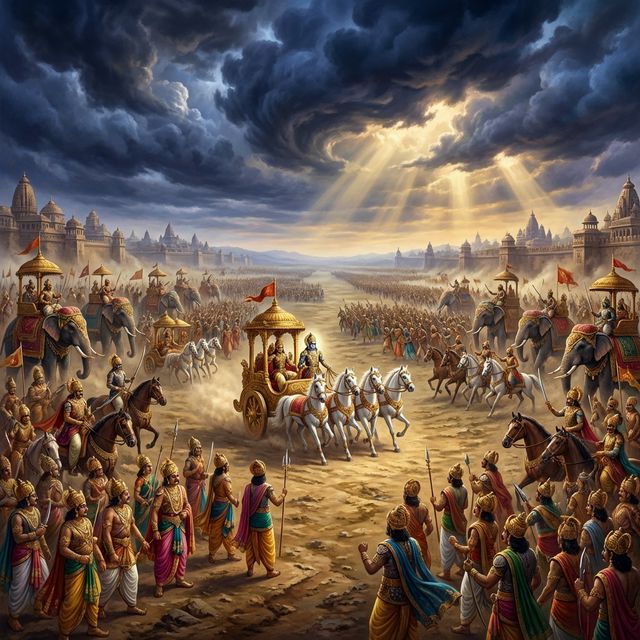
The Kaurava host stood divided into three bodies, and Drona himself was at the gate of the array he had built, because that was where the Pandavas were pressing. They wanted through. Everything that happened that afternoon happened because a line of men had been set across a road and another line of men had decided to open it.
"When that fierce battle commenced," Sanjaya said, "causing the hair to stand on end, the Pandavas rushed against the Kauravas who had been divided into three bodies."
He named the pairings the way a man names them who had watched them form. Bhimasena went against the mighty-armed Jalasandha. Yudhishthira, at the head of his troops, went against Kritavarman.
And Dhrishtadyumna, scattering his shafts like the sun shooting out his rays, went against Drona.
Nothing in that sentence is an accident. Dhrishtadyumna was the son of Drupada, of Prishata's line, the prince of the Panchalas, and he had come out of a sacrificial fire for one purpose, which any man on that field could have recited without being asked: the death of Drona. The old quarrel between the teacher and the king of Panchala had been handed down into a son who was born already carrying it. Fourteen days of war had not yet put the two of them in front of each other. They were in front of each other now.
Sanjaya, who is giving the account, does not say that the commander of the Pandava army selected his opponent, or manoeuvred toward him, or waited for his moment. He says he rushed. There is no deliberation anywhere in the line.
Then commenced that battle between all the bowmen of the Kurus and the Pandavas, eager for the encounter, excited with wrath. And during the progress of that terrible carnage, when every warrior on the field was battling with somebody else and taking no thought for anyone, the mighty Drona fought with the mighty prince of the Panchalas.
A Forest of Lotuses
The clouds of arrows those two shot filled all the spectators with wonder, and the spectators were men who had been standing inside arrow-storms for a fortnight and were not easy to impress.
Drona and the prince of the Panchalas cut off the heads of men by thousands and scattered them over the field, and Sanjaya, describing that ground to the king, reached for the only image that fitted it. The field, he said, was made to resemble a forest of lotuses.
It is worth stopping on, because it is not a kind image and it was not meant to be. A head lying on the earth with nothing under it is a flower on a broken stalk, and a stretch of ground with thousands of them lying at every angle is a pond in bloom, and a man who has once seen both will never afterwards see one without the other. The old poets did not soften what they had looked at. They found the beautiful thing it resembled, set it down, and left the reader to do the rest.
In every division there were soon strewn on the ground robes and ornaments and weapons, and standards and coats of mail. And the golden coats of mail, dyed with blood, looked like clouds charged with lightning.
Other mighty car-warriors, drawing their large bows measuring full six cubits long, felled with their shafts elephants and steeds and men. In that dreadful encounter of arms between brave and high-souled warriors, swords and shields, bows and heads and coats of mail were seen lying scattered about. And innumerable headless trunks were seen to rise up in the midst of that fierce battle, which is a thing this book reports so often and so evenly that a reader stops noticing it, and should not.
This was the ground across which the son of Drupada was working his way toward the man he had been born to kill. He was not fighting a duel in a cleared space with the armies drawn up to watch. He was fighting the greatest bowman alive in the middle of the worst hour of a bad day, with everything on the field burning at once.
And he was gaining.
The Eaters
Vultures and Kankas and jackals came down onto that field while the fighting was still going on, and swarms of other carnivorous animals came with them, and Sanjaya sets out what they did in the flat voice of a man who has decided that his king is going to hear all of it.
They ate the flesh of fallen men and steeds and elephants. They drank their blood. They dragged them by the hair. They licked and pecked at their marrow. They dragged their bodies and their severed limbs about, and rolled their heads along the ground.
That is the whole of the passage. There is no line of pity attached to it and no line of horror, because the horror is the list.
And in among the animals the men went on with their work. Warriors skilled in battle, accomplished in weapons, and firmly resolved in fight, struggled vigorously in the combat, solicitous only of fame, which was the thing they had come for and the only wage that field was paying. Many were the combatants who careered over the ground performing the diverse evolutions of swordsmen, a display worth watching under almost any other circumstances.
They killed one another with sabres and darts and lances and spears and axes, with maces and spiked clubs and other kinds of weapons, and, when those were gone or broken, with bare arms.
Car-warriors fought with car-warriors. Horsemen fought with horsemen. Elephants fought with the foremost of elephants, and foot-soldiers with foot-soldiers, each order of the army finding its own kind in the dust, so that the battle went on sorting itself even while it came apart.
And many infuriated elephants, as if perfectly mad, uttered loud shrieks and slew one another, after the manner they do in sporting arenas. Which is to say, after the manner they had been taught to do for the entertainment of kings, in peacetime, by the same men who were now underfoot.
Somewhere inside all of that, two chariots were coming together.
White as Pigeons, Red as Blood
During the progress of that battle, in which the combatants fought without any regard for one another, Dhrishtadyumna caused his own steeds to be mixed up with those of Drona.
That is a deliberate act, and it is the beginning of everything that follows. To mingle the teams is to give up manoeuvre. Two chariots whose horses are in among each other cannot circle, cannot draw off, cannot open the range that a bowman of Drona's quality lives on. The Panchala prince drove his horses into his enemy's horses on purpose, to turn a contest of archery into some other kind of contest.
And the sight of it, Sanjaya says, was exceedingly beautiful. Those steeds endued with the speed of the wind, that were white as pigeons and red as blood, thus mixed with one another in battle, looked resplendent like clouds charged with lightning.
Then that slayer of hostile heroes, the heroic Dhrishtadyumna, son of Prishata, beholding Drona arrived so near, cast off his bow.
Everything after this follows from those four words. A car-warrior of his rank does not put down the bow. He took up his sword and shield instead, for achieving a difficult feat, and the text does not pretend anything else about the odds on it.
Seizing the shaft of Drona's car, he entered into it.
And then he did not stand still and strike, because to stand still in front of Drona is to be a target. He stayed sometimes on the middle of the yoke, and sometimes on its joints, and sometimes behind the steeds. Armed with swords, he moved quickly upon the backs of those red horses, and while he was moving, the foremost of all preceptors of arms, standing on his own chariot at the length of an arm, could not detect an opportunity for striking him.
All this, said Sanjaya, seemed wonderful to us.
Indeed, like the sweep of a hawk in the woods from desire of food, seemed that sally of Dhrishtadyumna from his own car for the destruction of Drona.
The Shield With a Hundred Moons
Drona did not reach for the man on his yoke. He shot at what the man was carrying.
With a hundred arrows he cut off the shield of Drupada's son. It was decked with a hundred moons, and it was the one thing standing between a swordsman on somebody else's chariot and every weapon on that field that could be thrown at him. A hundred arrows for a single shield. The count is not decoration. It says what the thing cost to take away.
Then, with ten others, he cut the sword.
The prince of the Panchalas was now on Drona's car with nothing at all in his hands. And Drona, who might have ended it in that breath, turned instead and took the man's whole world to pieces around him, methodically, in order, the way a teacher works through a demonstration.
With four and sixty arrows he slew the steeds of his antagonist, the wind-swift horses white as pigeons that had been mingled with his own a moment before. With a couple of broad-headed shafts he cut off the standard, so that no man anywhere on that field could any longer see where the commander of the Pandava army was. With the same shafts he cut down the umbrella, which is the mark of a prince. And then he slew both the Parshni charioteers, the two drivers who flanked the car and whose entire business it was to bring Dhrishtadyumna out of a place like that alive.
Inside a few breaths the son of Drupada had no shield, no sword, no bow, no horses, no standard, no umbrella and no drivers. He had a wrecked chariot behind him, an enemy in front of him, and nothing else in the world.
Then Drona, with great speed drawing his bow-string to his ear, shot at him a fatal shaft, like the wielder of the thunder hurling the thunder at a foe.
The man born out of fire to kill Drona was, at that instant, a dead man, and every warrior on both sides who was watching knew it.
Fourteen Shafts
But soon Satyaki, with four and ten sharp shafts, cut off that fatal arrow of Drona.
Satyaki was of the Vrishni race, the grandson of Sini, Krishna's kinsman and Arjuna's pupil, and of all the men on the Pandava side he was the one most reliably to be found where nobody had sent him. He was not Dhrishtadyumna's guard. He had no orders concerning him. He was near enough to see what was about to happen and quick enough to do something about it, and what he did was put fourteen arrows into one arrow that was already in the air.
Thus the Vrishni hero rescued Dhrishtadyumna, who had been seized by that lion among men, the foremost of preceptors, like a deer seized by the king of the forests.
Sanjaya hands the simile to Drona and not to the Panchala prince, and it is worth noticing which way round it runs. The man who had leapt onto a chariot with a sword to commit a killing is the deer. The old Brahmana standing on his own car with his bowstring at his ear is the lion. That is how it looked from the Kaurava side of the field, and Sanjaya was on the Kaurava side of the field.
Drona saw who had done it. Beholding Satyaki rescue the prince of the Panchalas in that dreadful battle, he quickly shot at him six and twenty arrows.
The grandson of Sini then, in return, pierced Drona in the centre of the chest with six and twenty arrows, while the latter was engaged in devouring the Srinjayas.
Twenty-six for twenty-six, into the chest, from a man who a minute earlier had no quarrel of his own to settle there. Drona had spent that day eating the Srinjaya troops the way fire eats dry grass, and somebody had finally struck him in the middle of the meal.
Withdrawn From the Battle
Then all the Panchala car-warriors came.
They came desirous of victory upon the Satwata hero, which is Sanjaya's careful way of saying that Drupada's whole chariot force moved at once toward the place where Satyaki was now standing between Drona and their prince. They proceeded against Drona. And while they were doing it, quickly, with men dying to make the room for it, they withdrew Dhrishtadyumna from the battle.
He did not choose to go. Nothing in the account suggests that anybody asked him. He was taken off the field by his own men in the middle of the one encounter he had been born for, on foot, weaponless, his chariot in pieces and his horses dead in their traces, and the last he saw of Drona was Drona shooting at somebody else.
That is where the section ends. It ends without a verdict, which is the habit of this book.
Count what the attempt cost him. A shield, a sword, a bow, four horses, a standard, an umbrella, two charioteers, and the one clean chance the commander of the Pandava army would ever have to stand on his enemy's chariot with a blade in his hand and nothing between them. Count what it bought. Nothing whatever. Drona was untouched when Dhrishtadyumna came at him and untouched when Dhrishtadyumna was carried away, and the only wound he took in that hour he took from a man who had not been aiming at him until a moment before.
So it left the two of them exactly where it had found them, with the debt unpaid and the fire-born prince alive to collect it later. On another day, with a sword in his hands again, standing over an old man who had put his weapons down on the floor of his chariot and shut his eyes and was not going to lift them.
Dharma Lesson
Dhrishtadyumna was made for one killing and spent fourteen years being told so, and when the chance finally came he threw away the weapon he was good with to take it. Purpose that has hardened into appetite stops calculating; it only lunges. What saved him was not his own skill but a man who owed him nothing and happened to be looking, which is how most people survive their worst decisions. The debt was still paid in the end, on a day he did not choose, and by then it was no longer a feat of arms but something quieter and much harder to be proud of.