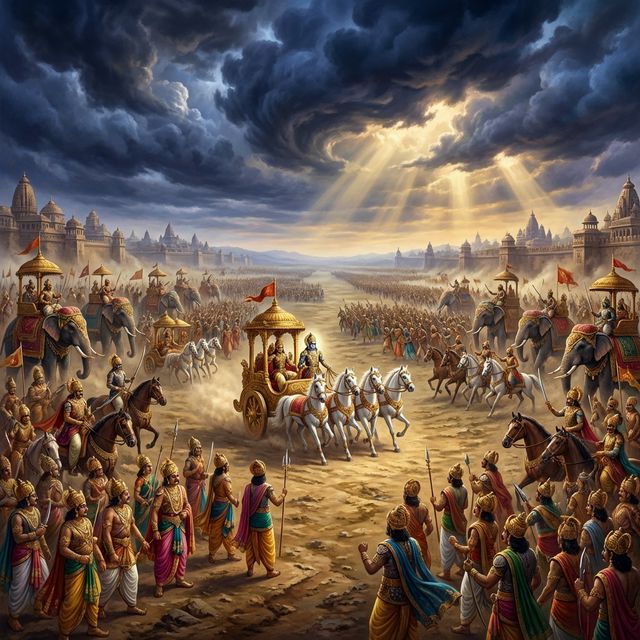
The Elephant Corps and the King of Anga
Bhima breaks Duryodhana's elephant division and beheads the Anga king in mid-fall
The Question About Arjuna
The old king wanted to hear about his best enemy.
"When the troops were thus engaged and proceeded against one another in separate divisions," Dhritarashtra said, "how did Partha and the warriors of my army endued with great activity fight? What did Arjuna do towards the car-warriors of the Samsaptakas? And what, O Sanjaya, did the Samsaptakas in their turn do to Arjuna?"
It was the twelfth day of the war. Drona had taken command of the Kaurava host on the eleventh morning with a vow to bring Yudhishthira back alive, and the whole shape of that day was built out of the vow. The Samsaptakas, the sworn men who had bound themselves either to kill Arjuna or to die, had called him away to the southern end of the field so that Drona would have the king to himself. What Dhritarashtra was asking about was happening a long way from where the day was actually being decided.
Sanjaya, who had the divine sight Vyasa had given him and who had to keep a blind man's picture of the whole field in order, answered a different question first.
"When the troops were thus engaged and proceeded against one another, thy son Duryodhana himself rushed against Bhimasena, leading his elephant division."
That is the whole of the beginning. The king of the Kauravas did not send the elephants forward. He came with them, at their head, and he chose his man.
Bhima was on the other side of that dust with the Prabhadrakas behind him and a silver lion on his standard with eyes of lapis lazuli, holding the celestial bow called Vayavya, trying like everybody else that morning to get at Drona.
He saw the elephants coming. He saw who was riding at the front of them. He turned his car out of the line and went to meet them.
Elephant Against Elephant
Sanjaya gave the meeting two images, and both of them are animal ones.
"Like an elephant encountering an elephant, like a bull encountering a bull, Bhimasena, summoned by the king himself, rushed against that elephant division of the Kaurava army."
The word to hold onto there is summoned. Bhima did not have to go. A car-warrior of his rank could have let an elephant division roll past him into the Pandava foot and left the weight of it to somebody else, and there was no shortage of men on that field who would have done exactly that. But the challenge had been issued by Duryodhana in person, the accounts between those two had been open since the game of dice, and Bhima had a lifelong habit of accepting anything Duryodhana offered him.
An elephant division was the worst thing on a battlefield to be offered. The beasts went in with archers on their backs and a driver with a hook at the neck, and they did not need weapons to do their work. They walked through infantry. They overturned cars. Horses would not stand in front of them. The recognised counter to an elephant division was another elephant division, and Bhima did not bring one. He brought a chariot, a bow, and the arithmetic that had never yet failed him, which was that anything alive can be shot.
"Skilled in battle and endued with great might of arms, Pritha's son, O sire, quickly broke that elephant division."
Quickly. Sanjaya is telling this to the father of the man who had gathered those elephants and placed them and led them out himself, and he does not soften the speed of it by a single word. What Duryodhana had spent the morning assembling came apart in about as long as it takes to say so.
Then Sanjaya slowed down and described what the breaking looked like, because his listener could not see it, and because it was worth seeing.
The Wind Rising on the Clouds
"These elephants, huge as hills, and with ichor trickling down from every part of their bodies, were mangled and forced to turn back by Bhimasena with his arrows."
Ichor is the dark oil that runs from the temples of a bull elephant in rut. Armies chose their war-elephants for that condition, because a beast in that state is past fear and past management and will go forward into anything at all. The animals in front of Bhima were the least turnable creatures in the world. Sanjaya says they turned.
"Indeed, as the wind, when it riseth, driveth away gathering masses of clouds, so did that son of Pavana rout that elephant force of the Kauravas."
He knew whose son he was describing. Bhima was the child of Pavana, the wind-god, and the image is not decoration but a piece of family argument. The clouds were massing, the wind got up, and the sky was cleared by the one power in nature that clouds cannot resist. What had been an advancing wall of hills became weather being blown off a mountain.
Then a second image, which changes the light on the whole thing.
"And Bhima, shooting his arrows at those elephants, looked resplendent like the risen sun, striking everything in the world with his rays. Those elephants, afflicted with the shafts of Bhima, became covered with blood and looked beautiful like masses of clouds in the welkin penetrated with the rays of the sun."
The poet will not let the reader off. He calls it beautiful. Red running down grey flanks in the early light, the man loosing arrows in the middle of it lit like a sunrise, and the whole scene handed over in the vocabulary of a fine morning. This is how the Mahabharata deals with slaughter when it means to be honest about it. It does not pretend the sight is ugly. It only makes sure you know what you are admiring.
The clouds broke and blew back. And the king who had brought them stood in the gap they left behind.
The King Draws on Him
"Then Duryodhana, excited with wrath, pierced with the sharp shafts that son of the Wind-god who was causing such a slaughter among his elephants."
It is easy to forget, in a story that mostly shows him in tents giving orders and complaining about his commanders, that Duryodhana was a first-class bowman who had trained under Drona in the same yard as the men he was fighting. When his elephants went to pieces around him he did not pull back behind them. He drew, and shot at the man who was doing it.
"Then Bhima, with eyes red in wrath, desirous of despatching the king to Yama's abode, pierced him speedily with many sharp shafts."
Red eyes are Bhima's weather signal in this epic. They come before the worst things he does. And the phrase Sanjaya chooses, desirous of despatching the king to Yama's abode, is exact about what was in Bhima's mind: not a check, not a wounding, not a rout. He had thirteen years and a standing oath riding on this one man's life, and here was Duryodhana within bowshot on open ground with his cover coming apart behind him.
"Then Duryodhana, mangled all over with arrows and excited with rage, pierced Bhima, the son of Pandu, with many shafts endued with the effulgence of solar rays, smiling the while."
Smiling the while. Mangled all over with arrows, and smiling. Whatever else is true of Duryodhana, and a great deal is true and none of it good, the epic never once shows him afraid in a fight. His faults were all committed indoors.
So the two of them stood in the wreckage of the elephant division and shot at each other, and each was hit, and neither gave ground, and for a few moments the whole war narrowed down to its two oldest antagonists and nobody else at all.
Then Bhima took two arrows out of the quiver together.
The Jewelled Elephant Comes Down
"Then the son of Pandu, with a couple of broad-headed arrows, quickly cut off Duryodhana's bow as also his standard, bearing the device of a jewelled elephant, decked with diverse gems."
Two arrows. The first took the bow out of the king's hands. The second took down his flag.
The device on that flag matters, and Sanjaya names it carefully for a blind man who had seen it in better years. Duryodhana's standard bore an elephant worked in jewels. It was the emblem of a house whose capital was called Hastinapura, the city of the elephant, and it had gone at the head of every Kuru procession for as long as anyone could remember. That morning the man beneath it had brought the living version of his own crest onto the field in the hundreds, and Bhima had spent the last hour turning them back with arrows.
Now the jewelled one came down into the same dust as the real ones.
A fallen standard is not merely a discourtesy in this kind of war. It is the only signalling system an army inside a dust cloud has. Men fought by looking for the flag of the man they were following. When the elephant came off Duryodhana's pole, whatever was still standing of that division lost the one thing that told it where its king was, and its king was standing on a chariot with a cut bow in his hands and Bhima in front of him already fitting the next arrow.
Sanjaya does not say that Duryodhana ran. He says only what happened next, in the flat manner he keeps for the moments that cost him most to report.
"Beholding Duryodhana thus afflicted, O sire, by Bhima, the ruler of the Angas on his elephant came there for afflicting the son of Pandu."
Somebody had to come. Somebody did.
The Ruler of the Angas
He is one of the hundreds in this war whose name the text does not trouble to give, and yet everything about him is placed exactly.
Anga was the kingdom on the lower Ganga that Duryodhana had thrown to Karna in the arena at Hastinapura, years before the war, to make a king out of a charioteer's son in the middle of an argument about birth. It was a crown given as a challenge. Whoever this ruler of the Angas was, he held that country under Karna and had brought its levy to Kurukshetra, and Sanjaya calls him a Mleccha king, one of the foreign-speaking rulers from beyond the edge of the Kuru world whose elephant troops had come in on Duryodhana's side and made up a good part of the division Bhima had just destroyed.
He came for one reason. His overlord's king was disarmed and standing in the open. So he turned his elephant out of the confusion and drove it straight at Bhima's car, roaring as it came.
"Thereupon, Bhimasena deeply pierced with a long arrow that prince of elephants advancing with loud roars, between its two frontal globes."
The two frontal globes are the paired swellings on a bull elephant's forehead, and the hollow between them is the one place in all that armoured bulk where a shaft can reach the brain. Bhima had been shooting elephants since sunrise. He put the arrow where it goes.
"That arrow, penetrating through its body, sank deep in the earth. And at this the elephant fell down like a hill riven by the thunder."
And then the sentence that is the whole of the man's death.
"While the elephant was falling down, the Mleccha king also was falling down. But Vrikodara, endued with great activity, cut off his head with a broad-headed arrow before his antagonist actually fell down."
Between the animal beginning to go over and its rider reaching the ground, Bhima nocked, drew, and took his head off in the air.
What a Dead King Does to an Army
"When the heroic ruler of the Angas fell, his divisions fled away."
That is the whole of his epitaph. The head came off in mid-air, and the men who had followed him from the lower Ganga turned round and ran, and the ground behind them was full of their own army.
"Steeds and elephants and car-warriors struck with panic, crushed the foot-soldiers as they fled."
This is the detail worth stopping on, because it is the part of ancient war that heroic poetry usually leaves out and this poem does not. The men who died in the next few minutes were not killed by Bhima. They were killed by their own cavalry and their own elephants and their own chariots coming back through them at speed. Foot-soldiers had nowhere to go. A rout in a mixed army was deadlier to the routed side than the fighting had been, and most of the killing on such a day was done in the direction of home.
So the account of that morning stands like this. Duryodhana led out his elephant division in person and used it to challenge the strongest man alive. The division was broken and turned. His bow was cut and the flag with the jewelled elephant went into the dust. A vassal king rode in to save him and lost his elephant, his head and his troops in the space of a breath. And the survivors, running, killed more of their own infantry than the enemy had managed to.
Bhima stood in the middle of it with his bow, having done exactly what a man is put on a wing to do, and having very nearly got the thing he actually wanted, which was Duryodhana.
He did not get long to stand there. The dust in front of him did not clear. It thickened, and out of it, moving without any hurry at all, came one elephant larger than anything that had run.
Under the Body of Supratika
"When those troops, thus broken, fled away in all directions, the ruler of the Pragjyotishas then advanced against Bhima, upon his elephant."
Bhagadatta, king of Pragjyotisha in the far east, was an old man and an old friend of the house, a warrior who had known Pandu and who was reckoned the finest elephant-fighter alive. His mount was Supratika. The two of them together were the one weapon on that field that nobody on the Pandava side had an answer for.
"With its two fore legs and trunk contracted, filled with rage, and with eyes rolling, that elephant seemed to consume the son of Pandu like a blazing fire. And it pounded Vrikodara's car with the steeds yoked thereto into dust."
The chariot, the horses, the driver, the silver lion on the standard: gone in a single pass. And Bhima, on his feet on open ground with an elephant on top of him, did the thing nobody watching expected.
He went forward, not back, and got in underneath the animal's body, because he knew the science called Anjalikabedha, which is the trained man's method of fighting a war-elephant from beneath, where the tusks and the trunk and the archers on its back cannot reach him. Sanjaya, who had no particular reason to praise him, sets it down plainly: the son of Pandu fled not.
Under there he began striking the beast with his bare arms, blow after blow, and Supratika started turning on the spot like a potter's wheel to get at him. Bhima, who had the might of ten thousand elephants in him, came out from under it and stood facing it.
Supratika caught him with its trunk, threw him down with its knees, took him by the neck, and meant to kill him. He twisted the trunk, worked himself out of the coil, and went back underneath, and waited there for one of his own army's elephants to come and take the weight off him.
None came.
The Cry That Went Up
So he came out and ran.
"Then a loud noise was heard, made by all the troops, to the effect, Alas, Bhima hath been slain by the elephant!"
He was not slain. He was running, on foot, out from under an elephant, and the army that saw him go could not tell the difference through the dust. The Pandava host broke and fled toward the very place where he had stopped, and the cry carried across the field to Yudhishthira, who believed it.
Believing his brother dead, the king brought the Panchalas round Bhagadatta on every side and covered him with keen shafts by hundreds and by thousands. The old man of the eastern mountains turned that whole shower aside with his iron hook and set about consuming the Pandavas and the Panchalas with the one animal. The ruler of the Dasarnas came in at his flank on a fresh elephant, and the two beasts met like two winged mountains overgrown with forests, and Supratika wheeled, ripped the other open and killed it outright, and Bhagadatta put seven lances bright as the rays of the sun through its rider as he was falling from his seat.
Supratika threw Satyaki's car bodily away, and Satyaki escaped by running. It walked out through the ring of chariots knocking kings off the field as it went. Ruchiparvan, the son of Kriti, drove at it and was sent to Yama's house with one straight shaft. Abhimanyu and the sons of Draupadi and Chekitana and Dhrishtaketu and Yuyutsu poured arrows into the animal until it looked like a mass of cloud shot through with sunlight, and it trod down Yuyutsu's horses and killed his driver, and Yuyutsu left his chariot and ran.
Bhima came back for it. The elephant raised its trunk and drenched his horses with water, and the terrified animals carried him off the field with the reins useless in his driver's hands.
A wind got up. Dust closed over the sky and the troops, and to the men still standing in it that single elephant seemed to have been multiplied into many, coursing everywhere at once.
Dharma Lesson
Duryodhana chose the weapon, the ground and the opponent, and inside a single engagement he lost his elephants, his bow, his standard and a vassal king, and not one of those losses fell on him. The men who paid were the Anga levy who had followed another man's quarrel across the country, and the foot-soldiers trampled by their own cavalry running for the rear. The epic counts them, and that is the point of the counting. A king's challenge is always answered with other men's bodies.